
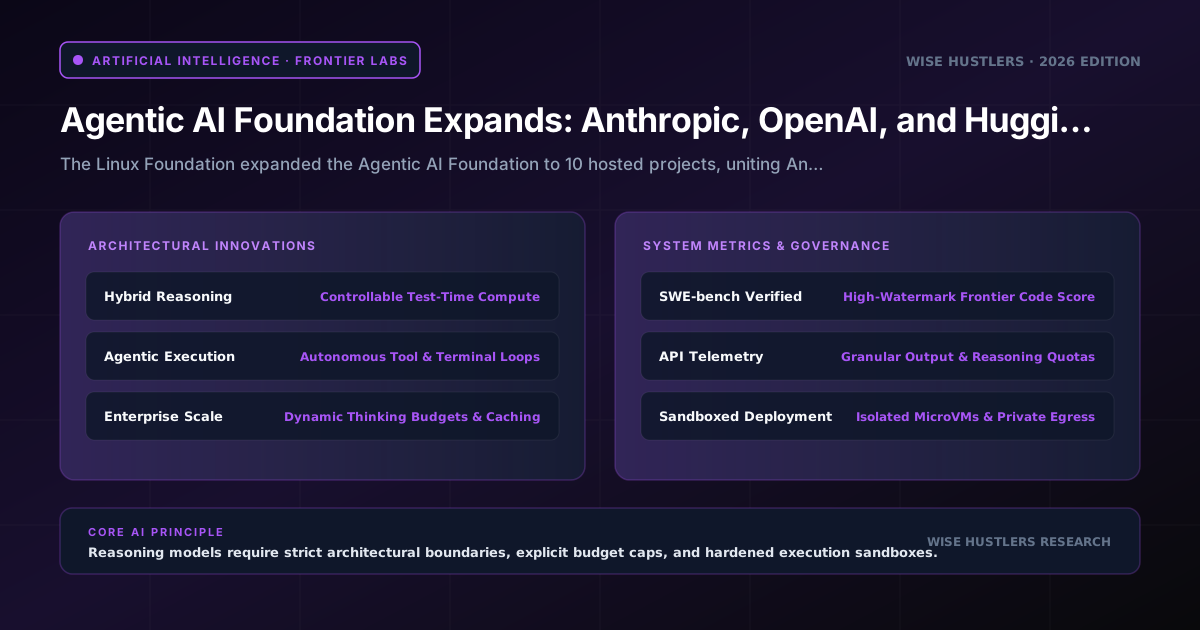
# Agentic AI Foundation Expands: Anthropic, OpenAI, and Hugging Face Unify Open Agent Stack
Summary: At AGNTCon + MCPCon North America, the Linux Foundation announced that the Agentic AI Foundation (AAIF) has expanded to 10 hosted projects. Industry rivals Anthropic, OpenAI, Hugging Face, and Alibaba contributed core technologies—Agent Skills, Open Responses, OpenEnv, and OpenSandbox—to establish an open, vendor-neutral enterprise agent stack. This milestone dismantles proprietary agent silos, mitigates multi-model vendor lock-in, and provides production-grade infrastructure for autonomous software engineering.
What Happened & Key Timeline
The autonomous agent ecosystem reached a defining milestone this week at AGNTCon + MCPCon North America. The Linux Foundation announced that the Agentic AI Foundation (AAIF)—the open-source consortium founded in late 2025—has expanded its portfolio to 10 hosted projects. Crucially, frontier AI competitors Anthropic, OpenAI, Hugging Face, and Alibaba have formally donated their core agent orchestration primitives to vendor-neutral governance under the Linux Foundation umbrella.
The rapid road to this consolidated architecture reflects the enterprise need to overcome fragmentation across agent frameworks:
- December 2025: Anthropic, OpenAI, and Block joined the Linux Foundation to launch the AAIF, anchored by Anthropic's Model Context Protocol (MCP), OpenAI's
AGENTS.md, and Block's open-sourcegooseproject. - Q1–Q2 2026: Autonomous software agents and terminal-based developer tools surged in adoption across enterprise engineering teams. However, integration teams faced acute friction due to incompatible tool signatures, divergent streaming APIs, and bespoke execution environments.
- August 2026: The AAIF Technical Steering Committee chartered the "Open Agentic Stack" initiative to standardize capability packaging, evaluation testbeds, response schemas, and execution security.
- October 2026: At AGNTCon + MCPCon, the Linux Foundation finalized the donation of four foundational technologies: Anthropic's Agent Skills, OpenAI's Open Responses, Hugging Face's OpenEnv, and Alibaba's OpenSandbox.
Together, these projects establish an open reference architecture for building, testing, and securing autonomous agents at scale.
Technical & Architectural Impact
Until now, enterprise systems architects faced a fractured landscape when operationalizing autonomous agents. Moving between proprietary model providers required rewriting tool schemas, re-implementing system prompts, and maintaining custom execution sandboxes. The expanded AAIF portfolio resolves these architectural roadblocks across four primary layers:
1. Capability Packaging: Anthropic's Agent Skills
Packaging complex operational procedures previously required bloated system prompts or brittle custom functions. Anthropic's donation of Agent Skills (the specification underlying the SKILL.md paradigm) standardizes how agents discover, acquire, and execute domain expertise.
Under the specification, a skill is a modular directory containing structured YAML metadata, deterministic execution constraints, and reference scripts that an agent loads dynamically on demand. Because the format is harness-agnostic, skills authored for one runtime execute predictably across Claude Code, OpenAI agents, Google Antigravity, and local open-source LLMs.
Here is a standard, declarative SKILL.md specification snippet illustrating capability definition under the open standard:
---
name: database-migration-validator
description: Validates PostgreSQL schema migrations against zero-downtime safety rules.
version: 1.2.0
compatibility:
  runtimes: ["claude-code", "openai-agents", "antigravity"]
parameters:
  schema_path:
    type: string
    description: Absolute path to the SQL migration file.
    required: true
  target_engine:
    type: string
    enum: ["postgres", "mysql"]
    default: "postgres"
constraints:
  deny_concurrent_ddl: true
  max_execution_timeout_ms: 15000
---
2. Interface Standard: OpenAI's Open Responses
Cross-model routing has long been hindered by divergent wire protocols and structured output schemas. OpenAI's contribution of Open Responses defines a common serialization standard for model outputs, reasoning steps, tool invocations, and error payloads.
Combined with the Model Context Protocol (MCP) for input context and data retrieval, Open Responses standardizes model output handling. Enterprise API gateways can now dynamically route agent tasks across different frontier model providers without rewriting parsing layers or maintaining bespoke translation adapters.
Below is an example of an Open Responses wire JSON payload demonstrating unified tool call serialization:
{
  "specversion": "1.0",
  "id": "resp_01HZX89ABK34MNP",
  "model": "frontier-agent-v1",
  "timestamp": "2026-10-23T02:45:00Z",
  "trace": {
    "thought_summary": "Inspecting SQL migration file for unsafe table locks."
  },
  "action": {
    "type": "tool_invocation",
    "tool_name": "database-migration-validator",
    "call_id": "call_mig_8819",
    "arguments": {
      "schema_path": "/workspace/migrations/20261023_user_indices.sql",
      "target_engine": "postgres"
    }
  },
  "execution_policy": {
    "isolation_level": "sandboxed_container",
    "egress_restricted": true
  }
}
3. Verification & Evaluation: Hugging Face's OpenEnv
Static benchmarks such as MMLU measure rote reasoning rather than multi-step agentic problem-solving. Hugging Face's OpenEnv provides an open standard for creating stateful, interactive gym environments for autonomous agent evaluation.
With OpenEnv, engineering teams can configure reproducible CI/CD testbeds—such as sandboxed codebases, mock billing systems, or staging cloud environments—to evaluate agent task completion, self-correction, and safety compliance before releasing agent workflows to production.
4. Zero-Trust Isolation: Alibaba's OpenSandbox
Autonomous agents executing terminal commands and browser interactions introduce serious security concerns regarding arbitrary code execution and indirect prompt injection. Alibaba's OpenSandbox provides a hardened, ephemeral microVM and container execution environment optimized for agent workloads.
OpenSandbox delivers rapid, low-latency container and microVM provisioning, strict egress network filtering, process-tree surveillance, and automated teardown upon task completion, ensuring that unvetted code execution remains completely isolated from corporate networks.
Architectural Comparison of the Open Agent Stack
The following matrix compares the core projects under the unified Agentic AI Foundation umbrella:
| Layer | AAIF Standard / Technology | Contributing Member | Core Engineering Function | Key Enterprise Benefit |
|---|---|---|---|---|
| Context Bus | Model Context Protocol (MCP) | Anthropic | Standardized context querying and tool discovery | Decouples data sources from proprietary model prompts |
| Agent Packaging | Agent Skills (SKILL.md) | Anthropic | Modular procedural knowledge and execution constraints | Write-once, run-anywhere operational domain procedures |
| Wire Protocol | Open Responses | OpenAI | Common serialization schema for outputs and reasoning traces | Enables unified multi-model routing across API gateways |
| Agent Evaluation | OpenEnv | Hugging Face | Stateful gym testbeds for multi-step agent benchmarking | Prevents production regressions through automated CI/CD runs |
| Execution Security | OpenSandbox | Alibaba Cloud | Hardened, ephemeral microVM and container sandboxing | Enforces zero-trust isolation against arbitrary code execution |
| Autonomous CLI | Goose | Block | Extensible local agent orchestration engine | Vendor-neutral local development interface |
Architectural Falsifiability & Production Verification
To ensure verifiable deployment, enterprise platform architects must monitor three primary failure criteria:
- Gateway Protocol Overhead: Open Responses translation overhead must remain negligible compared to model time-to-first-token (TTFT). Sustained serialization delays or disproportionate gateway latency relative to raw model responses indicate inefficient JSON/protocol buffer deserialization or unoptimized intermediate transformation middleware.
- Skill Resolution Determinism: Automated skill discovery across heterogeneous LLM orchestrators must demonstrate consistent tool selection across regression evaluation suites. Frequent schema validation failures or parameter mismatches indicate ambiguous YAML metadata or overlapping capability definitions rather than model routing anomalies.
- Sandbox Warmup & Lifecycle Management: OpenSandbox container allocation must maintain consistent provisioning times aligned with warm-pool configuration baselines. Uncharacteristic latency spikes during environment instantiation indicate orchestrator worker saturation or thread pool exhaustion rather than microVM guest initialization delays.
What This Means for Engineering Teams & Enterprises
The unification of the open agent stack marks a major shift from proprietary experimentation to mature enterprise infrastructure:
1. Elimination of Vendor Lock-In: Organizations can decouple business logic from proprietary model APIs. System workflows standardized on Agent Skills and Open Responses allow teams to switch model backends based on cost, latency, or compliance requirements via simple configuration updates.
2. Enhanced Enterprise Governance: Security engineering teams can replace ad-hoc shell execution scripts with audited, reproducible OpenSandbox environments, aligning autonomous agent execution with enterprise governance frameworks and controls, such as SOC 2 and ISO 27001 access and isolation principles.
3. Streamlined Engineering Operations: Cross-functional teams can create and version domain-specific skills independently of backend infrastructure, accelerating automation across site reliability engineering, legacy code refactoring, and cloud operations.
However, translating standardized specifications into production pipelines demands disciplined systems engineering. Enterprises must refactor legacy REST endpoints into MCP servers, architect zero-trust execution clusters, and design automated OpenEnv regression suites. To navigate this transformation, engineering organizations partner with Wise Hustlers custom engineering services to design, benchmark, and deploy enterprise-grade agent architectures aligned with open Linux Foundation standards.
FAQ Section
How does Anthropic's Agent Skills specification differ from the Model Context Protocol (MCP)?
Model Context Protocol (MCP) standardizes context and connectivity—enabling AI agents to authenticate, query data sources, and invoke external tools. Anthropic's Agent Skills specification standardizes procedural capability—packaging multi-step instructions, operational rules, and reference scripts into modular, version-controlled directories (SKILL.md). In practice, MCP acts as the peripheral bus connecting tools and data, while Agent Skills provide the procedural playbook instructing the agent how to execute complex tasks.
Will adopting OpenAI's Open Responses require rewriting existing agent wrappers?
No. Open Responses is engineered as a vendor-neutral wire specification that can be integrated incrementally. Enterprise API gateways, reverse proxies, and popular routing layers can deploy lightweight conversion middleware at their boundary. This allows internal applications to consume unified response formats without modifying existing frontend clients or business logic.
How does OpenSandbox mitigate indirect prompt injection risks?
Indirect prompt injection occurs when untrusted data retrieved by an agent manipulates its execution flow. OpenSandbox isolates all agent code execution, browser automation, and terminal actions inside ephemeral, unprivileged microVM containers. By enforcing strict egress network allowlists and continuous process-tree inspection, OpenSandbox prevents malicious payloads from accessing host filesystems or exfiltrating data to external servers.
What role does Hugging Face's OpenEnv play in enterprise CI/CD deployment?
OpenEnv serves as the automated verification gate for enterprise agent pipelines. Before an agent workflow is released to production, OpenEnv boots isolated, stateful simulation environments that replay complex user interactions, database migrations, or infrastructure tasks. By measuring task completion rates and deterministic behavior within reproducible testbeds, engineering teams can detect edge-case regressions and model drift prior to deployment.
Sources
- Linux Foundation Announces Expansion of Agentic AI Foundation
- Agentic AI Foundation (AAIF) Technical Charter and Project Index
- Anthropic Engineering: Donating Agent Skills to Open-Source Governance
- Model Context Protocol (MCP) Open Specification
- OpenAI Open Responses Specification and Standards Initiative
- Hugging Face OpenEnv Framework for Agent Evaluation
- The New Stack: Open Standards Reshape Enterprise Agent Architectures
- PR Newswire: AGNTCon + MCPCon Showcases Open Agent Innovations