
# Agritech Platforms in Nigeria: Digitizing the Agricultural Supply Chain
TL;DR: Nigerian agriculture is huge (26.8% of GDP in Q3 2025) but still loses 20–40% of harvests to broken logistics, storage, and market access — and agritech software platforms are the main lever being used to close that gap, from input marketplaces to satellite crop monitoring to blockchain traceability for exports.
Why Nigeria's Agricultural Supply Chain Needs Software, Not Just More Farms
Agriculture isn't a side sector of the Nigerian economy — it's the backbone. Crop production alone accounted for 23.2% of GDP in Q3 2025, up from 17.8% the previous quarter, and the sector as a whole employs close to half of Nigeria's working population, with another 14% employed in the broader agri-food system (Trading Economics, FAO). Roughly 80% of Nigerian farmers are smallholders, and that group produces about 90% of the country's agricultural output (PwC).
The problem isn't production capacity — it's everything that happens after the harvest. Post-harvest losses in Nigeria run between 20% and 40% of total food production depending on the crop, and for perishables like tomatoes it is worse: published estimates put Nigerian tomato post-harvest losses in the 33-50% range, with Ugonna et al. (2015) the most-cited single figure at 45% (Adoption of postharvest innovations to minimize tomato losses in Nigeria, *Scientific Reports*). Where those losses actually occur matters more than the headline number, and recent field evidence is counterintuitive: a Michigan State University study of Nigerian tomato farms found on-farm loss is close to negligible — only 13% of farmers reported any loss at all, averaging 19 kg out of a 6,000 kg harvest (MSU, *Little Is Lost*). The waste is concentrated downstream, in aggregation, transport, storage and market access — which is precisely the part software can address. Losses aren't evenly distributed either — the north-east region sees the highest average post-harvest loss rate at nearly 20%, driven heavily by pepper spoilage (FCDO food-loss report).
None of that is a farming problem in the agronomic sense. It's a coordination, information, logistics, and financing problem — which is exactly the kind of problem software is good at solving.
What Agritech Platforms in Nigeria Actually Do
"Agritech" gets used loosely, so it's worth breaking down the specific layers of the supply chain that Nigerian platforms are digitizing today.
1. Input access and e-commerce marketplaces
Getting the right seeds, fertilizer, and crop protection to a farmer at the right time is still a logistics nightmare across much of rural Nigeria. Platforms like Afrimash built an e-commerce model specifically for this gap, connecting farmers to a catalog of thousands of farm inputs and cutting out several layers of informal middlemen that previously drove up cost and unpredictability (World Bank).
2. Farmer financing and credit scoring
Smallholder farmers are typically unbanked or thin-file, which locks them out of conventional credit. Digital credit apps and mobile wallets now let farmers buy inputs on credit against future harvest value, and this layer increasingly sits on top of formal government financing rails. The Central Bank of Nigeria's Anchor Borrowers' Programme, launched in 2015, has disbursed over ₦1.09 trillion to smallholder farmers by connecting them to large "anchor" buyers, while NIRSAL (Nigeria Incentive-Based Risk-Sharing System for Agricultural Lending) has separately disbursed roughly ₦215 billion — a figure that has since drawn a National Assembly probe alongside the Anchor Borrowers' Programme — and captured more than 400,000 farmers in a nationwide database used for credit risk assessment (CBN, BusinessDay). Private agritech platforms increasingly plug into or replicate this model — using farm-level data (plot size, crop history, yield estimates) as the underwriting layer that traditional banks lack.
3. Aggregation, logistics, and route optimization
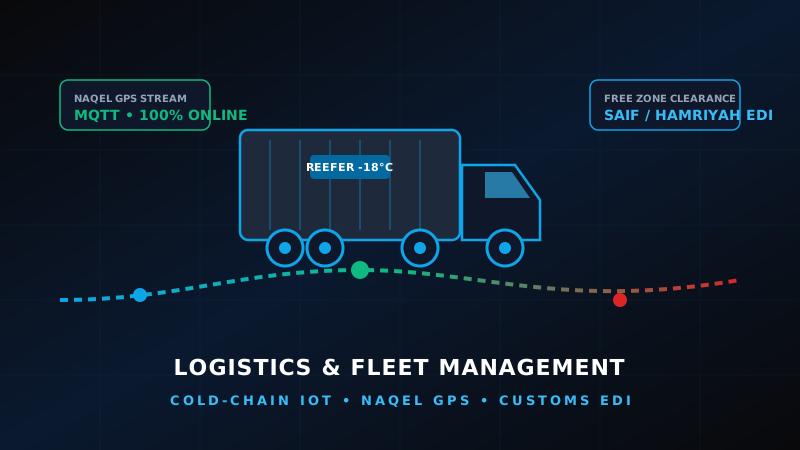
Getting produce from a farm gate in Benue or Kaduna to a market or processor in Lagos reliably and without spoilage requires real logistics software — route planning, bulk transport coordination, and cold-chain tracking where applicable. Digital freight platforms like Zido Global have emerged specifically to solve trucking and haulage matching for agricultural cargo, a segment that was almost entirely informal a decade ago (Farmonaut).
4. Storage and post-harvest loss reduction
ICT-enabled storage — from sensor-monitored silos to solar-powered cold rooms — is one of the highest-leverage interventions available, given how concentrated losses are in the storage and transport window. Vendor-published figures put the spoilage reduction from portable, ICT-enabled storage for staples like maize, yam, and cassava at up to 25% (Farmonaut) — worth treating as a supplier's best case rather than a benchmark, since we could not find an independent study reproducing it.
5. Crop monitoring and precision agriculture
Satellite imagery combined with AI is the basis on which platforms such as CropSense AI market remote visibility into crop health, moisture stress, and yield forecasts without a field visit — a capability that was previously the preserve of large commercial farms (CropSense AI, the vendor's own account). How far it has genuinely reached cooperatives and mid-size Nigerian producers is not something we found independent measurement for.
6. Traceability for export markets
As Nigerian exporters chase premium markets under frameworks like AfCFTA, blockchain-based and digital tagging traceability systems are being used to track commodities from farm gate to export port, giving international buyers the documentation they need to trust origin and handling claims (Farmonaut).
A Practical Supply Chain Map
| Supply chain stage | Core problem today | Software layer digitizing it |
|---|---|---|
| Input procurement | Fragmented, informal supply, price volatility | E-commerce marketplaces (e.g., Afrimash) |
| Financing | Smallholders are unbanked, no credit history | Digital credit scoring, mobile wallets, ABP/NIRSAL data integration |
| Production monitoring | No visibility until harvest | Satellite + AI crop monitoring |
| Aggregation & logistics | Informal trucking, no route optimization | Digital freight matching (e.g., Zido Global) |
| Storage | 20–40% spoilage before sale | ICT-enabled silos, sensor-based storage |
| Market access | Farmers sell to whoever shows up, no price transparency | Direct farmer-to-buyer marketplaces |
| Export | No verifiable chain of custody | Blockchain/digital traceability |
Why This Is a Software Engineering Problem, Not Just a Development Problem
It's tempting to treat "digitizing agriculture" as a policy or NGO initiative, but in practice every layer above is a real software system with real engineering constraints: offline-first mobile apps for farmers with intermittent connectivity, USSD fallbacks for feature phones, integration with payment rails (bank transfer, card, and increasingly mobile money) for input purchases and loan disbursement, geospatial data pipelines for satellite imagery, and audit-grade data models for traceability claims that export buyers will actually trust.
That's the kind of system that doesn't come off the shelf — it has to be built around the specific realities of Nigerian rural connectivity, the specific commodities and seasons involved, and the specific financing programs (ABP, NIRSAL, private lenders) a platform is trying to plug into. This is where a firm doing custom software development work matters: agritech products succeed or fail on whether the engineering team actually modeled the farmer's real workflow — harvest timing, cash flow gaps, device constraints — rather than shipping a generic e-commerce template and calling it agritech.
The Road Ahead
The direction is clear even if the pace varies by region: more farmer data flowing into formal credit systems, more aggregation happening through digital marketplaces instead of informal middlemen, and more traceability infrastructure being built to unlock export premiums. The platforms that win the next five years will be the ones that treat the entire chain — input to financing to storage to market to export — as one connected data problem, rather than solving one link in isolation.
FAQ
What is agritech software, and how is it different from a regular farming app?
Agritech software refers to purpose-built digital systems that address specific points in the agricultural value chain — input procurement, farmer financing/credit scoring, crop monitoring, logistics, storage, and traceability — rather than generic productivity or e-commerce tools repurposed for farmers. The distinction matters because agricultural workflows have unique constraints: seasonality, perishability, rural connectivity, and financing tied to harvest cycles.
Why are post-harvest losses such a big focus for Nigerian agritech platforms?
Because Nigeria already produces enough food to matter at scale — the losses happen after the harvest, in storage, transport, and market access, where 20–40% of production is lost depending on the crop (published estimates for tomatoes run 33-50%). That's the highest-leverage place to intervene with software: better storage monitoring, logistics coordination, and faster farmer-to-buyer matching directly reduce waste without needing more farmland or labor.
How do agritech platforms in Nigeria help farmers access financing?
Most rely on a mix of private credit-scoring models (using farm data as collateral proxy) and integration with government-backed schemes like the CBN's Anchor Borrowers' Programme and NIRSAL, which together have disbursed well over ₦1.3 trillion combined and built farmer databases covering hundreds of thousands of smallholders used for underwriting.
Is building an agritech platform for the Nigerian market different from building one elsewhere?
Yes, meaningfully. Connectivity is inconsistent in many farming regions, so offline-first design and USSD/SMS fallbacks matter more than they would in a typical SaaS product. Payment flows need to account for mobile money and bank transfer patterns specific to Nigeria, and any financing feature needs to be built with an understanding of how programs like ABP and NIRSAL actually structure disbursement and repayment, rather than assuming a generic consumer-lending model.
Sources
- World Bank — Nigeria's E-commerce Platforms: Using Data and Digital Tools to Deliver Farm Inputs and Trading Food Commodities
- Farmonaut — Agritech Startups In Nigeria: Pioneering Sustainable Farming
- CropSense AI — Top 10 Agritech Trends Transforming Nigerian Agriculture
- Trading Economics — Nigeria Agriculture, Value Added (% of GDP)
- FAO — Nigeria at a Glance
- PwC — Current State of Nigeria Agriculture and Agribusiness Sector (AfCFTA Workshop)
- Agriculture Nigeria — Post-Harvest Food Losses
- FCDO — Postharvest Loss Reduction Interventions in Sub-Saharan Africa
- Central Bank of Nigeria — Anchor Borrowers' Programme
- The Sun Nigeria — NIRSAL, CBN and Anchor Borrowers Programme