
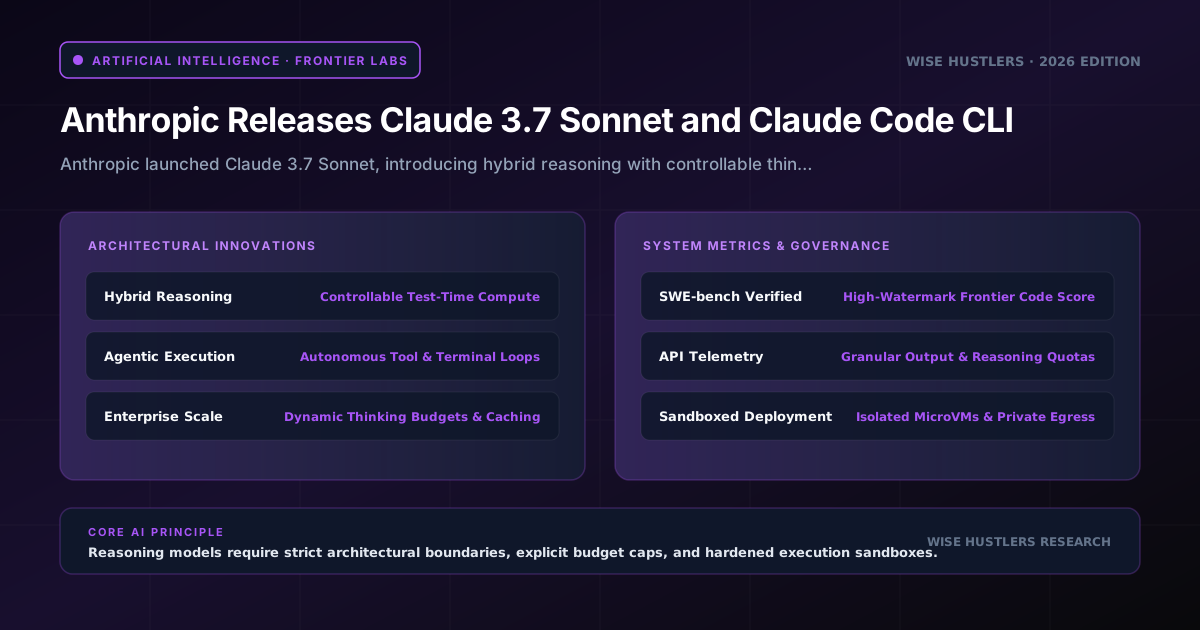
# Anthropic Launches Claude 3.7 Sonnet: Hybrid Reasoning Architecture and Claude Code CLI
Summary: Anthropic has officially released Claude 3.7 Sonnet, the industry's first hybrid reasoning frontier model combining rapid token generation with dynamic, user-controlled extended thinking. Alongside the model, Anthropic debuted Claude Code, a terminal-native agentic CLI capable of navigating codebases, executing tests, and committing code directly. The release establishes a 70.3% benchmark on SWE-bench Verified while providing engineering leaders with direct API control over reasoning budgets, response latency, and inference economics.
What Happened & Key Timeline
On February 24, 2025, Anthropic introduced Claude 3.7 Sonnet, departing from the market bifurcation between fast general LLMs and dedicated, high-latency reasoning models. Previously, engineering teams had to route between separate models like Claude 3.5 Sonnet and OpenAI o1. Claude 3.7 Sonnet unifies both operational paradigms within a single foundational architecture.
Anthropic deployed the model simultaneously across its commercial channels:
- Direct Web & Mobile: Available to Pro, Team, and Enterprise users on Claude.ai with extended thinking controls, and in standard response mode across free tiers.
- Enterprise Hyperscalers: Available day one on Amazon Bedrock and Google Cloud Vertex AI, eliminating enterprise procurement friction.
- Anthropic API: Developers configure hybrid behavior using an explicit
thinkingparameter to bound reasoning token consumption. - Claude Code CLI: Introduced in a research preview, providing an agentic terminal tool designed to automate programming workflows.
Pricing remains identical to Claude 3.5 Sonnet: $3.00 per million input tokens and $15.00 per million output tokens, with internal reasoning tokens billed at the standard output rate. Prompt caching remains supported, providing a 90% discount ($0.30 per million tokens) on cached input reads after the initial write surcharge ($3.75 per million tokens).
Technical & Architectural Impact
Claude 3.7 Sonnet redefines production AI architecture by embedding step-by-step reflection directly into core model weights rather than delegating reasoning to an external multi-agent wrapper.
1. Dual-Mode Inference Engine
Traditional dedicated reasoning models enforce fixed, opaque reasoning phases that introduce substantial response latency, even when a subtask requires straightforward execution. Claude 3.7 Sonnet operates dynamically. In standard mode, it outputs tokens with sub-second time-to-first-token (TTFT) metrics comparable to Claude 3.5 Sonnet. When extended thinking is triggered, the model pauses generation to emit structured internal reasoning tokens before formulating its final answer.
Developers control this behavior through the thinking API object:
{
  "model": "claude-3-7-sonnet-20250219",
  "max_tokens": 16000,
  "thinking": {
    "type": "enabled",
    "budget_tokens": 8000
  },
  "temperature": 1.0
}
The budget_tokens key establishes an upper bound on test-time compute. If an algorithm requires only 2,400 tokens of reasoning, the model terminates thinking early and transitions to output generation, preserving both budget and latency.
2. Verified Benchmark Breakthroughs
Software engineering evaluations were central to the announcement. On SWE-bench Verified—evaluating an AI model's capacity to resolve real-world GitHub issues across large codebases—Claude 3.7 Sonnet demonstrated state-of-the-art results:
- Standard SWE-bench Verified: Scored 62.3% without scaffolding, up from 49.0% for Claude 3.5 Sonnet.
- Scaffolded SWE-bench Verified: Reached 70.3% when combined with custom scaffolding and extended thinking budgets.
- Agentic Reliability: On TAU-bench, measuring multi-turn agentic tool usage and policy adherence, Claude 3.7 Sonnet scored 81.2% in retail and 58.4% in airline domains.
- Advanced Reasoning: Scored 80.0% on AIME 2024 and 84.8% on GPQA Diamond with extended thinking enabled (68.0% in standard mode).
3. Agentic Terminal Workflows with Claude Code
Alongside the model, Anthropic launched Claude Code, an agentic CLI distributed via npm (@anthropic-ai/claude-code). Operating directly in terminal environments, Claude Code indexes repositories, searches symbol definitions, edits files in place, executes bash commands, and evaluates test failures. Rather than relying on copy-paste IDE interactions, Claude Code establishes an autonomous loop: reading compiler errors, correcting failed assertions, and preparing formatted git commits.
What This Means for Engineering Teams & Enterprises
For enterprise software leaders, Claude 3.7 Sonnet marks the transition from passive code completion tools to active, semi-autonomous engineering systems.
Deprecating Fragile Model Routers
Enterprise platform teams previously built custom routing layers to parse incoming prompts and dispatch requests to either fast models or slow reasoning models. These routing heuristics frequently suffered from classification drift and latency overhead. Claude 3.7 Sonnet eliminates dual-model pipelines: a single model handles fast customer queries, complex algorithmic refactoring, and code generation simply by adjusting the budget_tokens header dynamically across microservices.
Managing Token Economics in Agentic Loops
Because reasoning tokens are billed as standard output tokens at $15.00 per million, unconstrained loops can quickly accumulate costs. A background process running with a 32,000-token thinking budget can incur $0.48 in compute on a single execution pass.
To manage unit economics, enterprises must establish clear governance:
1. Dynamic Budget Throttling: Restrict routine batch jobs to modest thinking budgets (2,000 to 4,000 tokens) while reserving high budgets (16,000+ tokens) for complex debugging.
2. Aggressive Prompt Caching: Pin base schemas, repository indexes, and system instructions to benefit from 90% read cost reductions.
3. Containerized Sandboxing: Because CLI tools like Claude Code execute shell commands, deployment environments must enforce ephemeral Docker containers with read-only volume mounts and restricted egress.
For organizations deploying production-grade agentic pipelines or multi-agent orchestration, collaborating with Wise Hustlers custom engineering services provides specialized technical consultation and hands-on systems architecture.
FAQ Section
How does Claude 3.7 Sonnet differ from previous reasoning models like OpenAI o1?
Previous reasoning models enforced fixed multi-phase execution where internal thinking could not be throttled via API parameters. Claude 3.7 Sonnet provides a unified hybrid architecture supporting both fast responses and extended thinking. Teams can configure an exact budget_tokens ceiling, balancing reasoning depth, latency, and cost per request.
How does the thinking budget parameter work in the Anthropic API?
When extended thinking is enabled, developers pass a budget_tokens integer setting the maximum reasoning compute. The total max_tokens parameter must always exceed budget_tokens to ensure room for the visible output. If the model resolves the problem early, it concludes thinking and emits the final answer immediately.
How are reasoning tokens billed in enterprise production?
Thinking tokens emitted during extended thinking are billed as standard output tokens at $15.00 per million tokens. These tokens appear in structured response telemetry, enabling teams to monitor consumption and enforce programmatic quotas.
Sources
- Anthropic: Claude 3.7 Sonnet and Claude Code Announcement
- Anthropic Documentation: Building with Extended Thinking
- Anthropic Documentation: Claude Code CLI Overview
- Amazon Web Services: Claude 3.7 Sonnet Available in Amazon Bedrock
- Google Cloud: Anthropic Claude 3.7 Sonnet on Vertex AI
- SWE-bench Leaderboard: Verified Software Engineering Benchmarks