# How Much Does a Mobile App Cost in DRC: Budget Guide
Summary: In the DRC, a simple mobile app (Android MVP, no payment integration) starts around 3,000–6,000 USD, an app with mobile money integration (Airtel Money, M-Pesa, Orange Money) runs 8,000–20,000 USD, and a complex, multi-feature app often exceeds 25,000 USD — the biggest swing factor isn't screen count, it's how many payment gateways you connect and which currency the quote is written in.
If you run a business in Kinshasa, Lubumbashi, or elsewhere in the DRC and you're looking for a number to budget your mobile app project against, you've probably already noticed that quotes can vary by a factor of ten depending on who gives them. That's not random: the Congolese market has specific constraints — an unstable currency, dominant mobile payment habits, an almost exclusively Android device base — that push directly on the final price, far more than any generic pricing table you'll find online.
Why a mobile app budget in the DRC doesn't look like anywhere else
Three local realities explain why generic price ranges (often copied from North American benchmarks, or even from Ivorian CFA-franc pricing) don't translate cleanly to the DRC.
The currency depreciates while the project is still running. In early August 2026, the Central Bank of Congo's official reference rate hovered around 2,271 CDF per USD, against a parallel-market rate generally higher, around 2,300–2,350 CDF depending on the source and date — a gap that reflects ongoing depreciation of the Congolese franc. In practice, a quote fixed in Congolese francs at the start of a three-month project can lose real value before delivery. That's why nearly every serious agency operating in the DRC, ours included, prices app projects in US dollars rather than CDF.
The market is over 80% Android. According to StatCounter (via Statista), Android held roughly 82.65% of mobile OS share in Africa as of April 2026, against 17.24% for iOS — and the DRC, where the iPhone remains a niche urban product because of price, sits noticeably above that continental average. Designing for iOS first, or paying for native Swift development alongside Android, is often a budgeting choice that doesn't match the reality of the Congolese market.
Mobile payment isn't an optional feature — it's the infrastructure. Any Congolese consumer-facing app — delivery, e-commerce, financial services, marketplace — needs to handle mobile money payment from day one, not as a future iteration.
Real price ranges by app type
These ranges reflect the indicative rates we quote at Wise Hustlers for mobile app projects delivered to clients in the DRC, on a roughly 6–12 week timeline for an MVP, longer for a complex app — they're a realistic order of magnitude, not a substitute for a project-specific quote, and other local agencies' rates can vary.
| App type | Price range (USD) | What's included |
|---|---|---|
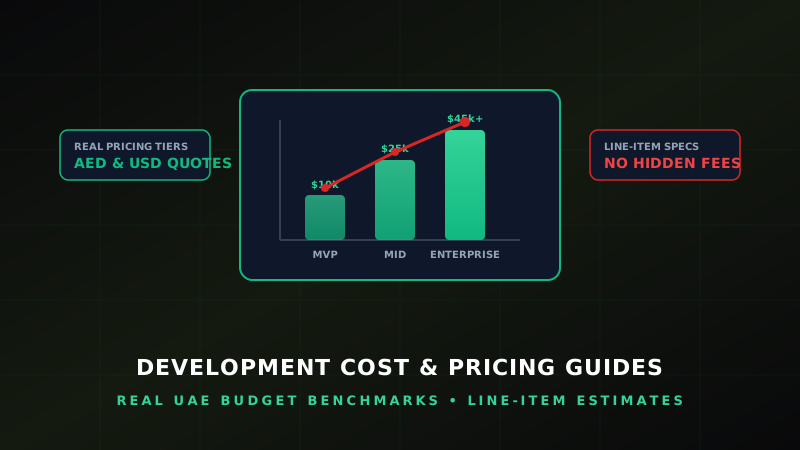
| Simple MVP (Android only, no payment) | $3,000 – $6,000 | Basic screens, Firebase/Supabase database, authentication, no third-party integration |
| App with 1 mobile money integration | $6,000 – $12,000 | MVP + payment (Airtel Money or M-Pesa or Orange Money), push notifications |
| App with multi-operator payment | $8,000 – $20,000 | MVP + 2–3 mobile money gateways, refund handling, admin dashboard |
| Complex app (marketplace, fintech, logistics) | $25,000+ | Robust backend, multiple roles, geolocation, compliance, App Store + Play Store |
For regional comparison, mobile developer hourly rates in Nigeria run $25–$50/hour, and in Kenya $20–$45/hour — a useful benchmark if a Congolese provider or an international agency hands you a quote, to judge whether the implied hourly rate is consistent with the East African market.
The mobile money factor: why it reshapes the whole budget
This is where most project owners underestimate their budget. In the DRC, the mobile payment market is split across several operators, and none holds a monopoly large enough to be safely ignored.
According to mid-2026 market data reported in the Congolese business press, M-Pesa (Vodacom) held roughly 43.77% of mobile money transactions, Airtel Money about 41.30%, Orange Money 14.44%, and Afrimoney 0.49%. On the revenue side for 2025, Airtel Money generated $194.8 million (+42% year over year) while M-Pesa reached $207.1 million (+23%), and Orange Money's active subscriber base grew 50.4% to reach 7.7 million users.
In practice: if your app only integrates M-Pesa, you immediately shut out a meaningful share of potential users who rely on Airtel Money or Orange Money instead. That's why integrating a single operator is relatively cheap (a standard API integration), but integrating two or three operators multiplies the work involved in transaction testing, error handling, and accounting reconciliation — which is exactly the jump in budget between the "1 integration" and "multi-operator" rows in the table above.
Local development vs agency: what talent actually costs in DRC
The cost of the developer writing the code directly shapes the final quote. According to recent salary data for Kinshasa, a junior developer generally earns between $400 and $700 per month, while a senior developer or tech lead can reach $1,500 to $2,000 per month — a range well below North American or even Western European hourly rates, which partly explains why local and regional agencies can offer more competitive quotes than firms based in Europe or the US for an equivalent project.
That said, a low rate doesn't always mean real savings: an individual freelancer without a QA team or test process can ship an app that crashes on the entry-level Android phones that make up most of the Congolese device base, generating post-launch fix costs that exceed the initial saving. At Wise Hustlers, we structure our mobile app development quotes around exactly that trade-off: native or cross-platform builds tested on the hardware actually used in the DRC, with local payment integrations budgeted into the scope from the start rather than bolted on afterward under pressure.
Connectivity: a cost factor that's easy to forget
According to DataReportal's Digital 2026 report on the DRC, the country had 34.7 million internet users at the end of 2025, a penetration rate of 30.5% of the population, against 64.7 million active cellular mobile connections (56.9% of the population) — of which 79.6% are classified as "broadband" connections (3G/4G/5G) by GSMA Intelligence.
These figures matter for your budget in two ways. First, a meaningful share of your potential users has an unstable or expensive data connection — which justifies "offline-first" design work (local caching, deferred sync) that adds development time but reduces post-install drop-off. Second, with only 30.5% internet penetration, an app only makes economic sense if your target customer base is actually part of that connected segment — a quick market check before development starts can save a budget from being spent on an audience that isn't online yet.
How to lower the budget without cutting quality
- Choose cross-platform over building natively twice. Building natively for Android and iOS separately typically costs 30–50% more than targeting a single platform natively; cross-platform frameworks like Flutter or React Native cut a large share of that overhead by sharing most of the codebase between platforms (TechQware).
- Prioritize Android-only for version 1. Given Android's share of the African market (roughly 82.65% as of April 2026), launching on Android first and adding iOS after the market validates the product is often the more rational budget call.
- Start with a single mobile money integration — the one your core customer base actually uses — and add the others based on user feedback rather than integrating everything on day one.
- Ask for a quote in USD, not CDF, so the Congolese franc's depreciation doesn't distort budget planning mid-project.
- Budget developer account fees separately ($25 one-time for Google Play; $99/year for the Apple App Store) — these are often left out of initial development quotes.
FAQ
How much does a simple mobile app cost in DRC?
A basic Android MVP with no payment integration generally runs $3,000–$6,000 for a 6–8-week build, depending on screen complexity and feature count.
Why are quotes priced in Congolese francs risky?
Because the CDF depreciated against the dollar throughout 2025–2026 (around 2,271 CDF per USD at the official reference rate in early August 2026, with a higher parallel-market rate); a quote fixed in CDF at the start of a multi-month project can end up out of step with the real value of the work by delivery time.
Should you build for Android, iOS, or both?
Since Android accounts for over 80% of mobile market share in Africa, most Congolese businesses should prioritize Android for their first launch, unless their specific target customers are predominantly iPhone users (a premium urban segment).
How much does mobile money integration add to an app's cost?
Integrating a single operator (Airtel Money, M-Pesa, or Orange Money) typically adds $3,000–$6,000 to an MVP budget; integrating multiple operators at once — recommended given how split the market is between M-Pesa, Airtel Money, and Orange Money — can add $8,000 or more because of the extra transaction testing and reconciliation involved.
Sources
- Digital 2026: The Democratic Republic Of The Congo — DataReportal
- With $194.8 million in 2025 revenue, Airtel Money closes in on M-Pesa in DRC — Bankable
- M-Pesa vs Airtel Money : ces millions de dollars que l'ARPTC peine à éclaircir — Strong2kin Moov
- Monthly mobile OS market share Africa — Statista
- Salaires à Kinshasa en 2026 : grille complète par secteur — Openshores
- Taux de change dollar (USD) franc congolais (CDF) — Mataf
- RDC : dépréciation du franc congolais sur les deux segments du marché des changes — ACP
- Modes de paiement et reçus pour l'enregistrement d'un compte de développeur — Aide Console Play
- MVP Development Cost in Africa 2026 — Algosoft