
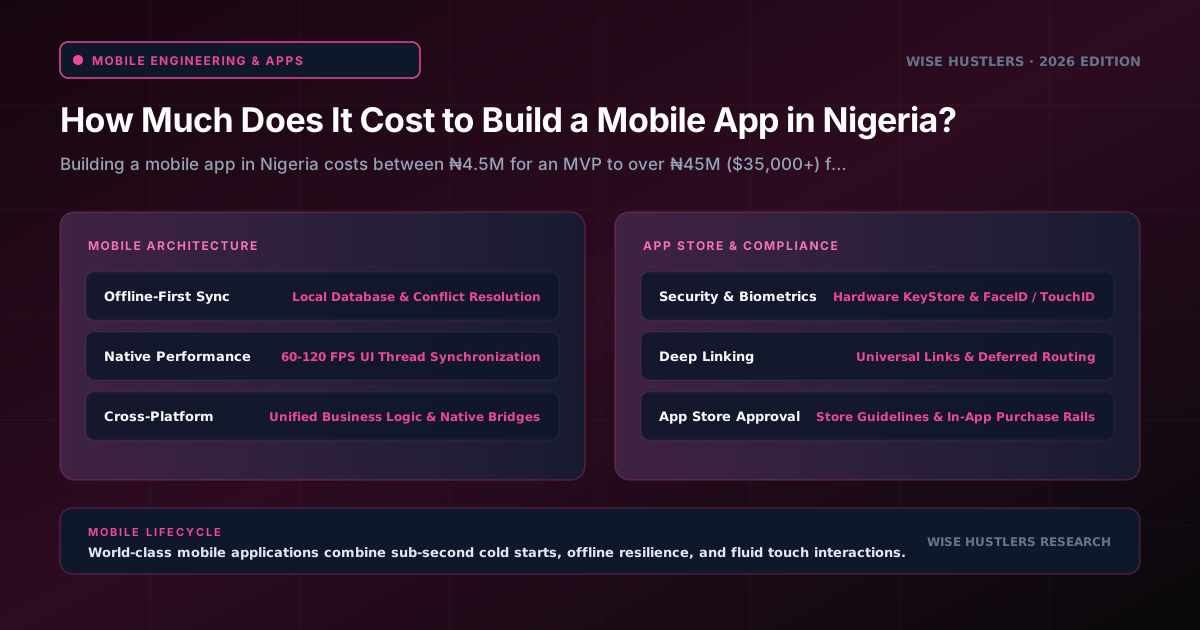
# How Much Does It Cost to Build a Mobile App in Nigeria? (Mobile App Development Cost Nigeria)
Summary: Based on software engineering sprint benchmarks and agency billing rates across Lagos and Abuja, the mobile app development cost Nigeria in 2026 typically spans ₦4,500,000 to ₦10,000,000 ($3,000–$6,500) for a Minimum Viable Product (MVP), ₦12,000,000 to ₦30,000,000 ($8,000–$20,000) for mid-tier commercial software, and ₦35,000,000 to over ₦90,000,000 ($25,000–$60,000+) for enterprise platforms. Total investment varies by architectural complexity, third-party KYC and payment APIs, infrastructure, and compliance standards.
Executive Breakdown: Mobile App Development Cost Bands in Nigeria
Budgeting for software in Nigeria requires balancing engineering precision against local market realities. Foreign exchange volatility, localized payment rails, and cellular constraints make capital planning in Lagos or Abuja distinct from Western benchmarks.
Rather than relying on generic global estimates, local development budgets reflect sprint velocity, cross-functional squad composition, and the integration overhead required to connect with domestic banking rails. Capital allocation across Nigerian mobile initiatives generally aligns with three primary project tiers:
| Project Tier | Scope & Core Capabilities | Timeline | Cost (NGN) | Cost (USD Equiv.) |
|---|---|---|---|---|
| Minimum Viable Product (MVP) | Single user flow, basic auth, Paystack/Flutterwave checkout, core admin panel | 6 – 10 weeks | ₦4,500,000 – ₦10,000,000 | $3,000 – $6,500 |
| Mid-Tier Commercial App | Multi-role access, automated KYC (BVN/NIN), offline caching, push notifications, scalable backend | 12 – 20 weeks | ₦12,000,000 – ₦30,000,000 | $8,000 – $20,000 |
| Enterprise / High-Availability | Distributed microservices, double-entry ledgers, automated reconciliation, multi-region redundancy | 24 – 48 weeks | ₦35,000,000 – ₦90,000,000+ | $25,000 – $60,000+ |
Minimum Viable Product (MVP): ₦4,500,000 to ₦10,000,000
An MVP validates core product-market fit with controlled capital exposure. In the Nigerian market, engineering teams typically build cross-platform codebases using Flutter or React Native to support Android and iOS simultaneously from a single codebase, preventing the overhead of maintaining dual native code repositories.
The backend infrastructure usually deploys as a lightweight monolithic application on managed cloud hosting such as DigitalOcean App Platform, Render, or AWS Lightsail. Payment processing relies on official client SDKs and hosted checkouts from Paystack or Flutterwave. Authentication uses email or SMS verification. This budget band fits early-stage founders seeking validation before an angel investment round or local merchants launching their first digital commerce channel.
Mid-Tier Commercial Application: ₦12,000,000 to ₦30,000,000
Mid-tier software serves expanding enterprises that require bespoke business logic, automated customer onboarding, role-based access controls, and resilience against high concurrency spikes.
At this level, systems incorporate offline-first local databases (such as SQLite or WatermelonDB) to handle spotty cellular network coverage across domestic telecommunications carriers like MTN, Airtel, Globacom, and 9mobile. Identity verification integrates with verification gateways like Prembly (formerly Identitypass) or Dojah for automated Bank Verification Number (BVN) and National Identification Number (NIN) resolution. Notification pipelines connect with providers such as Termii for transactional SMS and WhatsApp OTP delivery.
Enterprise and High-Availability Platforms: ₦35,000,000 to ₦90,000,000+ ($25,000 to $60,000+ USD)
Enterprise applications power digital banks, payment service providers (PSPs), healthtech networks, and nationwide logistics operations. These platforms demand event-driven architectures, strict data isolation, zero-downtime deployment pipelines, and alignment with Central Bank of Nigeria (CBN) regulatory frameworks.
Enterprise projects in Nigeria are frequently quoted in US Dollars or pegged to currency exchange collars due to senior engineering compensation standards and dollar-denominated cloud hosting infrastructure. Infrastructure incorporates container orchestration via Kubernetes, distributed event streaming with Apache Kafka or RabbitMQ, and rigorous compliance operations under the Nigeria Data Protection Act (NDPA).
Architectural Blueprint: Estimating the Cost to Build a Fintech Savings Platform in Lagos
To ground development budgets in technical reality, examine the engineering architecture of a production-grade automated savings and micro-investment platform (modeled after leading Nigerian consumer services like PiggyVest).
Building an automated savings application in Lagos requires specialized financial engineering, automated bank debit scheduling, and regulatory KYC workflows. The following architectural teardown and budget model represent an independent engineering blueprint based on standard agency sprint allocations, rather than proprietary internal disclosures from any single commercial entity.
Architectural Teardown and Core Subsystems
A production-ready consumer savings application relies on three interdependent engineering subsystems:
1. Cross-Platform Client: Built with Flutter or React Native, optimized for low-memory Android devices (2GB RAM) without sacrificing iOS UI responsiveness.
2. Double-Entry Financial Ledger: A backend transactional accounting engine enforcing strict ACID compliance. The ledger maintains absolute balance integrity across individual user savings wallets, locked maturity deposits, interest accrual ledgers, and withdrawal clearing accounts before dispatching settlement instructions to external banking rails.
3. Automated Cron & Worker Engine: Fault-tolerant background job schedulers (built with BullMQ and Redis or Go workers) executing recurring automated debits, interest calculations, savings maturity transitions, and webhook event retries.
Third-Party API Integration and KYC Rails
Fintech applications operating in Nigeria depend on specialized domestic API platforms:
- Identity & KYC Verification: Platforms such as Prembly and Dojah provide programmatic endpoints to resolve customer BVNs, NINs, and residential addresses. These services operate on tiered, wallet-prefunded API models where per-request fees vary depending on the verification tier (e.g., basic textual lookup versus biometric photo matching or virtual NIN verification).
- Payment Collection & Tokenization: Paystack and Flutterwave provide card tokenization and automated direct debits. Monnify provides dedicated dynamic and static virtual bank accounts, enabling instant bank-transfer deposits matched via the Nigeria Inter-Bank Settlement System (NIBSS).
- Telecom Messaging & Transaction Alerts: Providers like Termii manage critical transactional OTPs and security alerts across Nigerian mobile operators, utilizing route-based fallback logic to bypass Do-Not-Disturb (DND) restrictions.
Code Implementation: Calculating Local Gateway Processing Overhead
Because payment processing fees directly affect unit economics, engineering teams must model gateway transaction costs accurately. According to Paystack's official merchant pricing, domestic Nigerian transactions incur a fee of 1.5% + ₦100 (with the ₦100 flat fee waived for transactions below ₦2,500), capped at ₦2,000 per transaction. Conversely, according to Flutterwave's official merchant pricing, local transactions carry a standard processing fee of 2.0%.
The following runnable TypeScript module calculates the exact net settlement and processor fees for local transactions:
/**
 * Nigerian Payment Gateway Fee Calculator
 * Implements published fee schedules for local NGN collections:
 * - Paystack: 1.5% + NGN 100 (flat fee waived below NGN 2,500), capped at NGN 2,000
 * - Flutterwave: 2.0% standard local collection fee
 */

export interface GatewayFeeResult {
  gateway: 'Paystack' | 'Flutterwave';
  grossAmountNgn: number;
  processingFeeNgn: number;
  netPayoutNgn: number;
  effectiveRatePercent: number;
}

export function calculatePaystackLocalFee(amountNgn: number): GatewayFeeResult {
  if (amountNgn <= 0) {
    throw new Error('Transaction amount must be greater than zero');
  }

  const percentageFee = amountNgn * 0.015;
  const flatFee = amountNgn < 2500 ? 0 : 100;
  const totalCalculated = percentageFee + flatFee;

  // Maximum fee is strictly capped at NGN 2,000
  const processingFeeNgn = Math.min(totalCalculated, 2000);
  const netPayoutNgn = amountNgn - processingFeeNgn;
  const effectiveRatePercent = (processingFeeNgn / amountNgn) * 100;

  return {
    gateway: 'Paystack',
    grossAmountNgn: amountNgn,
    processingFeeNgn: Math.round(processingFeeNgn * 100) / 100,
    netPayoutNgn: Math.round(netPayoutNgn * 100) / 100,
    effectiveRatePercent: Math.round(effectiveRatePercent * 100) / 100,
  };
}

export function calculateFlutterwaveLocalFee(
  amountNgn: number,
  feeCapNgn?: number
): GatewayFeeResult {
  if (amountNgn <= 0) {
    throw new Error('Transaction amount must be greater than zero');
  }

  // Standard local collection rate is 2.0%
  const percentageFee = amountNgn * 0.02;
  const processingFeeNgn = feeCapNgn ? Math.min(percentageFee, feeCapNgn) : percentageFee;
  const netPayoutNgn = amountNgn - processingFeeNgn;
  const effectiveRatePercent = (processingFeeNgn / amountNgn) * 100;

  return {
    gateway: 'Flutterwave',
    grossAmountNgn: amountNgn,
    processingFeeNgn: Math.round(processingFeeNgn * 100) / 100,
    netPayoutNgn: Math.round(netPayoutNgn * 100) / 100,
    effectiveRatePercent: Math.round(effectiveRatePercent * 100) / 100,
  };
}
Estimated Agency Sprint Budget Model for a Consumer Fintech Platform
The table below outlines a representative engineering budget model for developing a production-ready savings application in Lagos over a 16-to-20-week sprint cycle. This breakdown reflects commercial agency billing rates and technical requirements:
| Engineering Phase / Component | Scope & Tech Stack | Estimated Cost Range (NGN) |
|---|---|---|
| Product Discovery & UI/UX Design | User journey mapping, interactive prototypes, design system, local usability tests | ₦2,500,000 – ₦3,500,000 |
| Mobile Client Development | Flutter or React Native, state management, biometric authentication, secure storage | ₦6,000,000 – ₦8,000,000 |
| Ledger Engine & Core Backend | Node.js/Go, PostgreSQL double-entry schema, Redis caching, job queues | ₦7,500,000 – ₦9,500,000 |
| Local API Integrations | Paystack tokenization, Monnify virtual accounts, Prembly KYC, Termii OTPs | ₦3,000,000 – ₦4,000,000 |
| Security, Testing & Compliance Readiness | Static analysis, penetration testing, vulnerability patching, DPCO audit preparation | ₦2,000,000 – ₦3,000,000 |
| Cloud Infrastructure & DevOps Setup | AWS or DigitalOcean provisioning, Docker containerization, CI/CD automated test suites | ₦1,800,000 – ₦2,500,000 |
| Total Estimated Build Cost | Production-Ready Fintech Platform (16–20 Weeks) | ₦22,800,000 – ₦30,500,000 (~$15,000–$20,000 USD) |
(Note: This represents an independent architectural teardown and agency estimation model for building a consumer savings application in Lagos with equivalent features; it does not represent proprietary financial data or internal disclosures from PiggyTech Global Advisory Limited).
Core Cost Drivers for Mobile App Development in the Nigerian Market
Understanding what influences engineering proposals enables founders and product leaders to budget effectively.
Device Fragmentation and Cellular Network Realities
According to mobile market share data from Statcounter Global Stats, Android devices account for approximately 80% to 85% of mobile operating system market share in Nigeria (with Apple iOS capturing 12% to 15%). The Android landscape is heavily dominated by Transsion Holdings brands (Tecno, Infinix, itel), alongside budget Samsung and Xiaomi models. Many of these handsets feature limited processor memory (1GB to 3GB RAM) and constrained internal flash storage.
Consequently, development teams must incorporate specialized engineering optimizations:
- Binary Size Reduction: Utilizing ProGuard and R8 bytecode shrinking alongside Android App Bundles (AAB) to keep initial download sizes under 25MB, mitigating user drop-off driven by cellular data costs.
- Offline-First Data Architecture: Implementing local client caching with SQLite or WatermelonDB so users can view transaction history and generate offline receipts during network blackouts.
- Payload Compression: Applying Gzip/Brotli compression and WebP image assets to conserve mobile data balances across domestic cellular networks.
Third-Party API Unit Economics and Foreign Exchange Volatility
Operational expenditures in Nigeria diverge from Western software applications due to domestic API unit economics and currency valuation changes.
Identity verification platforms (such as Prembly and Dojah) and telecom gateways (such as Termii) operate on prepaid credit models. Development teams must maintain funded wallet balances in escrow to prevent API calls from failing in production.
Simultaneously, global cloud infrastructure providers (Amazon Web Services, Google Cloud Platform, Microsoft Azure) invoice customer accounts in US Dollars. Because Nigerian digital products generate revenue primarily in Nigerian Naira (NGN), currency fluctuations can amplify hosting expenses in local terms. Engineering teams mitigate this exposure by implementing Redis caching layers, minimizing database egress, and selecting resource-conscious compute architectures.
Regulatory Governance: NDPA and Central Bank Guidelines
Regulatory compliance directly influences backend software architecture and security protocols.
Under the Nigeria Data Protection Act 2023 (NDPA), overseen by the Nigeria Data Protection Commission (NDPC), organizations processing personal data must implement privacy-by-design principles:
- Data Protection Standards: Strong cryptographic protection, including TLS 1.3 for data in transit and AES-256 for sensitive personal data at rest.
- Consent and Audit Trails: Granular user consent mechanisms and immutable audit logging for personal data modifications.
- Statutory Audit Filings: Organizations classified as Major Data Processing Entities (MDPEs) must conduct statutory compliance audits and file returns through licensed Data Protection Compliance Organizations (DPCOs), with professional audit retainers varying based on organizational data volume and processing scale.
For applications handling payments or stored value, Central Bank of Nigeria (CBN) regulatory guidelines—including the Regulatory Framework for Mobile Payment Services and Risk-Based Cybersecurity Framework—stipulate multi-factor authentication (MFA), cryptographic credential hashing, transaction velocity limits, and automated session termination parameters.
Talent Delivery Models in Nigeria: Freelancers vs. Local Agencies vs. Enterprise Partners
The delivery model chosen dictates both upfront capital requirements and overall project execution risk:
| Delivery Model | Typical Rate Structure | Primary Advantages | Delivery & Operational Risks | Best Suited For |
|---|---|---|---|---|
| Local Freelancers | ₦400,000 – ₦900,000 / month | Lowest upfront capital; direct 1-on-1 communication | Single point of failure; lacks dedicated QA; risk of code debt | Proof-of-concept prototypes; basic feature maintenance |
| Boutique Local Agencies | ₦12,000,000 – ₦30,000,000 / project | Complete cross-functional squad; local API domain expertise | Higher cost than individual contractors; variable sprint capacity | Commercial MVPs; funded startups; business process apps |
| Specialized Enterprise Partners | ₦35,000,000 – ₦90,000,000+ ($25,000+) | Strict SLAs; enterprise DevSecOps; dedicated security & compliance | Substantial capital commitment; formal governance cycles | Financial institutions; national logistics; mission-critical systems |
Local Contract Developers in Tech Hubs
According to regional tech talent compensation reports across developer hubs such as Yaba and Lekki in Lagos, mid-to-senior software developers typically charge between ₦400,000 and ₦900,000 per month on dedicated contracts. While independent developers offer accessible initial pricing, single developers rarely possess equal depth across UI/UX design, mobile client development, backend architecture, and cybersecurity. Without dedicated QA and automated testing pipelines, projects often incur technical debt that requires costly refactoring.
Boutique Local Engineering Agencies
Boutique software engineering studios in Nigeria typically scope end-to-end commercial applications between ₦12,000,000 and ₦30,000,000. These teams provide a balanced squad—Product Manager, UI/UX Designer, Frontend/Mobile Developer, Backend Architect, and QA Engineer. They bring pre-existing experience navigating domestic payment integrations, telecom quirks, and local device constraints.
Specialized Enterprise Development Partners
Enterprise engineering firms handle high-concurrency, mission-critical systems starting from ₦35,000,000 ($25,000+ USD). They deliver formal service level agreements (SLAs), dedicated DevSecOps pipelines, automated stress testing, and contractual guarantees demanded by institutional stakeholders and financial regulators.
Hidden Post-Launch Operating Expenses in Nigeria
Deploying an application to production initiates ongoing operational commitments:
1. App Store Developer Programs: Apple charges $99 annually for the Apple Developer Program; Google Play requires a one-time $25 registration fee.
2. Infrastructure Maintenance & Updates: Standard software engineering industry guidelines (such as those published by the IEEE Computer Society) estimate annual routine maintenance—encompassing operating system patches, dependency upgrades, database tuning, and bug remediation—at approximately 15% to 20% of the initial development cost.
3. Cybersecurity & Penetration Testing: Periodic third-party penetration testing and vulnerability assessments ensure security integrity, with retainers scaling based on application surface area and compliance scope.
4. API Pre-Funding Escrow: Maintaining liquid capital reserves in verification and messaging provider wallets (Prembly, Dojah, Termii) ensures transactional services do not halt unexpectedly.
When planning your architectural roadmap, working with vetted experts who specialize in app development in Nigeria ensures that your product avoids costly refactoring, optimizes infrastructure spend, and scales reliably within local market dynamics.
Frequently Asked Questions
What is the average app development price Nigeria for an early-stage startup MVP?
For an early-stage startup building a Minimum Viable Product (MVP), typical development costs in Nigeria range from ₦4,500,000 to ₦10,000,000 ($3,000 to $6,500). This budget covers product discovery, UI/UX prototyping, cross-platform mobile development (using Flutter or React Native), Paystack or Flutterwave payment integration, and managed cloud deployment on platforms like DigitalOcean or AWS Lightsail.
How does the cost to build app Lagos compare to hiring offshore engineering teams?
According to international IT outsourcing benchmarks from platforms such as Clutch and Accelerance, contracting development teams in North America or Western Europe typically commands hourly rates between $75 and $150+, whereas specialized Nigerian engineering studios bill at blended rates between $20 and $45 per hour. Consequently, a commercial application costing ₦15,000,000 to ₦25,000,000 ($10,000 to $17,000) in Lagos frequently requires $40,000 to $75,000+ when contracted with Western agencies, while providing the advantage of direct West African timezone alignment (WAT/GMT+1) with European partners.
Why do cloud hosting costs fluctuate significantly for Nigerian mobile apps?
Major cloud providers (AWS, Google Cloud, Microsoft Azure) bill resources in US Dollars. Because Nigerian digital products collect revenue in Nigerian Naira (NGN), foreign exchange volatility can increase local currency hosting expenses even when compute usage remains constant. Engineering teams counter this by containerizing workloads, optimizing database queries, and utilizing aggressive caching layers to minimize cloud resource consumption.
How does the Nigeria Data Protection Act (NDPA) affect mobile application architecture?
The NDPA establishes privacy-by-design obligations for software applications, requiring data minimization, granular user consent management, TLS 1.3 transport security, and field-level encryption (AES-256) for sensitive personal data. Incorporating these standards requires additional engineering sprint time during database schema design and API development, alongside ongoing compliance audit filings for organizations designated as Major Data Processing Entities.
What ongoing third-party API costs should fintech founders budget for in Nigeria?
Fintech applications incur per-transaction and per-request operating costs. Card and account collections incur gateway processing fees (such as Paystack's 1.5% + ₦100 fee capped at ₦2,000 or Flutterwave's 2.0% standard rate). In addition, identity verification APIs (Prembly, Dojah) and SMS/WhatsApp messaging gateways (Termii) operate on prepaid credit schedules that require ongoing balance management to prevent service disruptions.
Sources
- Nigeria Data Protection Commission (NDPC) - Nigeria Data Protection Act 2023
- Central Bank of Nigeria (CBN) - Guidelines and Regulatory Framework for Mobile Payment Services
- Paystack Merchant Pricing Documentation
- Flutterwave Merchant Processing Fee Schedule
- Termii Messaging and SMS Pricing
- Statcounter Global Stats - Mobile Operating System Market Share Nigeria
- Clutch - Global Software Development Agency Rate Benchmarks
- Accelerance - Global Software Outsourcing Rates Guide