
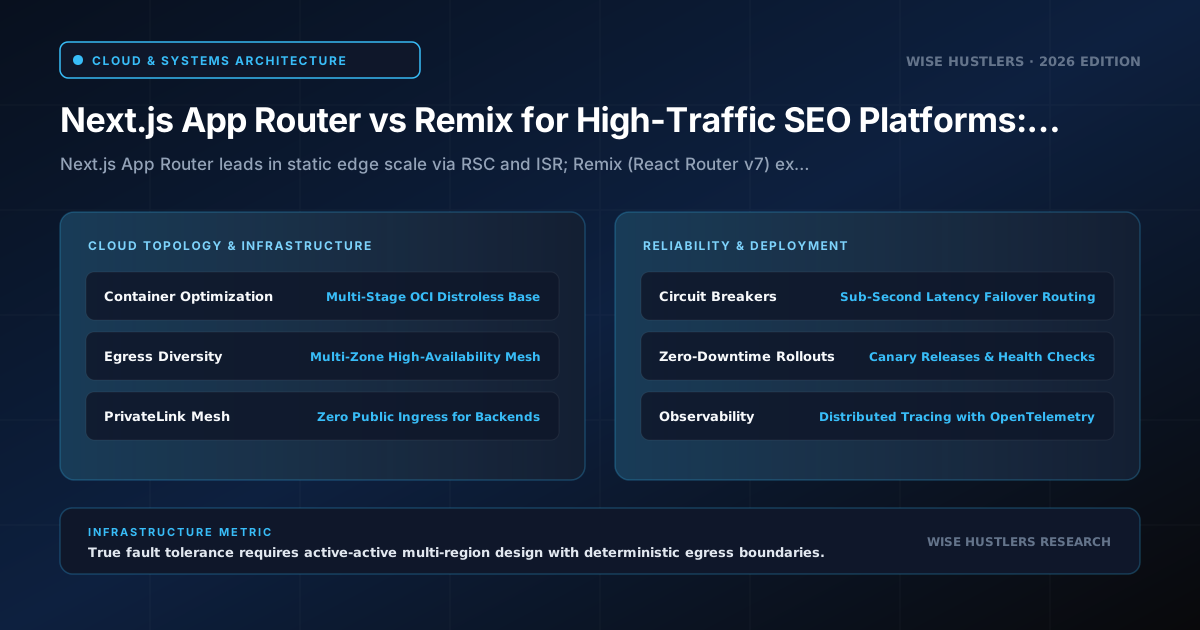
# Next.js vs Remix SEO: App Router Production Trade-Offs for High-Traffic Platforms
Summary: For high-traffic platforms exceeding 1,000,000 monthly pageviews, choose Next.js App Router when your platform relies on Incremental Static Regeneration (ISR) and static edge caching for massive programmatic catalogs. Choose Remix (React Router v7) when you demand predictable, low-latency Server-Side Rendering (SSR), clean HTML streaming without React Server Component serialization overhead, lower cloud compute expenditures, and complete multi-cloud portability without platform lock-in.
---
Selecting an enterprise frontend framework for platforms serving over one million monthly organic visitors directly impacts crawl efficiency, infrastructure costs, and Core Web Vitals field performance.
Evaluating nextjs vs remix seo requires looking past framework marketing. Architectural choices dictate how search crawlers parse content, how edge nodes invalidate cache, and how devices process payloads. This guide compares Server-Side Rendering (SSR), Streaming HTML, cache-invalidation mechanisms, and Core Web Vitals (INP, LCP, CLS) at scale, evaluating remix vs nextjs performance.
---
Architectural Foundations: React Server Components vs. Web Standards
Understanding runtime execution models is essential before analyzing crawl behavior.
NEXT.JS: Request -> Edge CDN -> Node Engine -> RSC Flight Stream -> Streams HTML + Inline Flight Data -> Hydrate
REMIX:   Request -> Edge CDN (RFC 9111) -> Node/Edge (Parallel Loaders) -> Streams HTML + Deferred JSON -> Hydrate
Next.js App Router: Component-Level Server Execution
The Next.js App Router centers on React Server Components (RSC), which execute exclusively on the server and emit an RSC Flight Data stream. Only components tagged with "use client" hydrate in the browser.
When evaluating next.js app router server components vs remix, Next.js colocates data fetching inside components, introducing distinct operational considerations for react server components seo:
// app/catalog/[category]/[slug]/page.tsx (Next.js App Router)
export default async function ProductPage({ params }: { params: Promise<{ slug: string }> }) {
  const res = await fetch(`https://api.internal/v1/products/${(await params).slug}`, {
    next: { tags: ['products'], revalidate: 86400 }
  });
  if (!res.ok) return notFound();
  return <article><h1>{((await res.json())).title}</h1></article>;
}
Remix (React Router v7): Route-Level Parallel Loaders
Remix adheres strictly to native Web Fetch API standards (Request, Response, Headers). Instead of scattering fetches inside visual components, Remix extracts data acquisition into route-level loader functions. All nested loaders execute in parallel on the server before rendering, eliminating fetch waterfalls:
// app/routes/catalog.$category.$slug.tsx (Remix / React Router v7)
export const headers: HeadersFunction = () => ({
  'Cache-Control': 'public, s-maxage=3600, stale-while-revalidate=86400',
});
export async function loader({ params }: LoaderFunctionArgs) {
  const res = await fetch(`https://api.internal/v1/products/${params.slug}`);
  if (!res.ok) throw new Response('Not Found', { status: 404 });
  return json({ product: await res.json() });
}
export default function ProductRoute() {
  const { product } = useLoaderData<typeof loader>();
  return <article><h1>{product.title}</h1></article>;
}
---
6-Criteria Comparison Matrix for High-Traffic Platforms
The matrix below contrasts operational metrics when supporting an enterprise platform generating 1,000,000 to 10,000,000 monthly pageviews.
| Evaluation Vector | Next.js App Router (v14 / v15) | Remix (React Router v7) | Production Reality at 1M+ Monthly Views |
|---|---|---|---|
| Performance | Near-instant TTFB on static/ISR; dynamic SSR latency varies with RSC Flight serialization depth. | Predictable SSR TTFB bounded by slowest parallel loader; clean HTML streaming. | Next.js leads on static catalogs; Remix on dynamic feeds. |
| Developer Velocity | Steep learning curve; complex boundary rules and 4-tier caching. | Low overhead; standard React code and Web Standards. | Teams ship CRUD and search filters faster in Remix. |
| Total Cost of Ownership | Low friction on Vercel; complex Kubernetes self-hosting. | Low compute footprint across Docker, Lambda, or Cloudflare. | Next.js self-hosting incurs higher pod memory baselines for Data Cache and RSC worker pools. |
| Vendor Lock-in | Weak portability; features rely heavily on Vercel primitives. | Full portability; adheres strictly to Web Fetch standards. | Remix enables switching cloud providers in hours. |
| Scalability & Concurrency | Scales via ISR; dynamic SSR risks Node memory saturation. | High SSR throughput; parallel loaders minimize database locks. | Remix handles dynamic traffic surges with lower memory saturation. |
| Maintenance Burden | Elevated; frequent breaking API shifts across major releases. | Low; stable architectural contracts across versions. | Significantly lower maintenance overhead tracking Remix API updates. |
| Programmatic SEO | Native ISR pre-renders top pages, generating long-tail on demand. | Uses Edge CDN caching (s-maxage, SWR) and surrogate key purges. | Both scale to 1M+ URLs; Next.js manages internally, Remix at edge. |
---
Core Web Vitals Impact: Architectural Analysis at Scale
When evaluating core web vitals nextjs vs remix at 1M+ monthly pageviews, Core Web Vitals (LCP, INP, CLS) distributions reflect underlying runtime and streaming mechanics.
Largest Contentful Paint (LCP)
- Next.js App Router: Delivers optimal LCP on static or ISR routes via edge CDN cache resolution. On dynamic SSR routes, serializing RSC Flight data before emitting hero markup can introduce tail-latency bottlenecks if data fetches experience latency spikes.
- Remix: Streams standard HTML immediately via
renderToPipeableStream. Placing document<head>, meta tags, and hero image preloads in root layouts enables early asset discovery and consistent LCP on dynamic SSR while deferred loaders resolve in parallel.
Interaction to Next Paint (INP)
- Next.js App Router: Advantageous for content directories. Because React Server Components execute strictly on the server, non-interactive dependencies remain off client bundles, reducing hydration overhead and keeping the main thread responsive during user interactions (INP).
- Remix: Ships client JavaScript to hydrate route components. Interactive components execute client hydration, but standard React transitions and
useFetcherkeep inputs responsive.
Cumulative Layout Shift (CLS)
Both frameworks stream HTML via React <Suspense>, introducing layout shift risks:
- In Next.js,
<Suspense fallback={<ProductSkeleton />}>chunks stream as promises resolve. Layout shifts occur if skeleton dimensions do not match final rendered elements. - In Remix, deferred loaders using
<Await>present identical risks. Stable CLS requires reserving container dimensions via CSSmin-heightoraspect-ratiorules.
---
Production Trade-Offs: SSR, Streaming HTML, and Invalidation Mechanics
Architecting react frameworks for programmatic seo requires balancing server caching, crawler render budgets, and data freshness.
Streaming HTML and Crawler Rendering Budgets
Search crawlers (Googlebot, Bingbot) process HTML through initial crawl passes and deferred rendering pipelines:
- Next.js Inline Flight Payloads: Next.js injects HTML alongside inline
<script>tags containing serialized RSC Flight data (self.__next_f.push(...)). For large catalog pages, this serialization duplicates text and component data in the payload, increasing document weight and consuming crawler bandwidth. - Remix Deferred Data Payloads: Remix streams HTML markup and injects deferred data at the document footer as plain JSON. Semantic markup remains clean, ensuring crawlers index complete text content immediately.
Cache Invalidation: Tag-Based vs. HTTP Headers
Cache invalidation at 1M+ monthly pageviews separates stable platforms from operational failures:
- Next.js Tag-Based Invalidation (`revalidateTag`): Purges cached fetch entries across route segments. When self-hosting on Kubernetes,
revalidateTagonly clears local pod memory unless integrated with an external Redis cache handler (@neshca/cache-handler). - Remix HTTP-Standard Edge Invalidation (RFC 5861 / RFC 9111): Relies on standard HTTP
Cache-Controlheaders (public, s-maxage=86400, stale-while-revalidate=604800) withSurrogate-Keyheaders. Purging runs via CDN API calls, eliminating Redis dependencies.
---
Architectural Blueprints for High-Traffic Scale
The blueprints below demonstrate how each framework scales to millions of monthly requests in a production programmatic seo architecture.
Blueprint 1: Next.js App Router Hybrid Architecture
[ Crawlers ] -> [ Edge CDN Cache ] -> [ Ingress ] -> [ Next.js Pods ] -> [ Redis Cache (@neshca) ] -> [ DB ]1. Enable output: 'standalone' in next.config.js to minimize container image footprint.
2. Implement a distributed Redis cache handler to synchronize revalidateTag events across pods.
3. Offload Sharp image optimization to worker services to prevent event-loop blocking.
Blueprint 2: Remix Web-Standards Edge Architecture
[ Crawlers ] -> [ Edge CDN (Cloudflare/Fastly) SWR ] -> [ Remix Cluster ] -> [ PgBouncer ] -> [ DB Replica ]1. Declare explicit Cache-Control headers with s-maxage and stale-while-revalidate on public loaders.
2. Place PgBouncer or AWS RDS Proxy before databases to prevent parallel loaders from exhausting connections.
3. Configure CMS webhooks to purge CDN surrogate keys when content updates.
---
Edge-Case Failure Modes and Blast Radius Analysis
Recognizing failure modes prevents service disruptions under heavy traffic.
Next.js App Router Failure Modes
1. RSC Serialization Memory Spikes: Passing unfiltered database records into Client Components forces Node.js to serialize redundant properties into inline Flight strings, risking out-of-memory crashes under crawler sweeps. Use strict Data Transfer Objects (DTOs) to strip unneeded properties.
2. Split-Brain Cache Desynchronization: In multi-pod clusters lacking a centralized Redis cache handler, Pod A invalidates a route while Pod B serves stale assets, causing fluctuating content hashes for Googlebot. Centralize the Data Cache in a high-availability Redis cluster.
3. Dynamic Function Cascade: Calling cookies() or headers() inside a shared root layout.tsx inadvertently forces all downstream nested routes into dynamic SSR, disabling static pre-rendering sitewide. Implement CI build manifest checks.
Remix Failure Modes
1. Crawler Thundering Herd on Uncached Routes: Omitting CDN caching headers on programmatic routes exposes application servers to crawler bursts during discovery sweeps, saturating database IOPS. Set fallback CDN caching headers at reverse proxy or root loader levels.
2. Internal Loader Waterfalls: Sequentially awaiting independent database queries inside individual loaders creates performance bottlenecks. Enforce Promise.all() for independent asynchronous fetches.
3. Asset Hash Rollout Mismatches: Active users requesting split JavaScript chunks during rolling container updates can hit older pods, triggering chunk load failures. Deploy assets to an external object store behind a CDN prior to container updates.
---
Migration Trade-Offs: Transitioning Between Frameworks
Migrating an enterprise platform between Next.js and Remix requires targeted architectural changes:
Migrating from Next.js to Remix
- Consolidate Fetching: Move decentralized data fetching from Server Components into route
loaderfunctions. - Normalize Cache Headers: Replace Next.js-specific
revalidatetags with standardCache-Controlheaders. - Simplify Components: Remove
"use client"directives; manage hydration at route boundaries. - Flatten Routes: Transition from nested folder routes (
/app/catalog/[category]/[slug]/page.tsx) to flat routes (/app/routes/catalog.$category.$slug.tsx).
Migrating from Remix to Next.js App Router
- Split Component Boundaries: Separate interactive state from markup, applying
"use client"surgically. - Build Cache Infrastructure: When self-hosting, deploy a custom Redis cache handler for stale-while-revalidate.
- Audit Serialization: Prevent passing raw database objects into Client Components to avoid Flight payload bloat.
---
Enterprise Decision Framework and Falsifiability Benchmarks
Use this decision logic to guide your engineering roadmap:
- Choose Next.js App Router when building large catalog platforms where most content is static, mobile INP optimization is critical, or your team relies on managed Vercel infrastructure.
- Choose Remix (React Router v7) when building high-concurrency dynamic platforms with real-time data, requiring multi-cloud portability on Kubernetes, and prioritizing Web Fetch standards.
Production Falsifiability Test
Every architectural decision requires measurable falsifiability criteria. Execute this benchmark during staging load tests or within 30 days of production launch:
Falsifiability Check: During pre-production load testing or within 30 days of launch, under sustained synthetic crawler load (such as 500 requests per second across programmatic catalog endpoints), if P95 origin Server TTFB exceeds 250ms, or if Real User Monitoring (RUM) indicates that over 15% of indexed URLs fail Core Web Vitals thresholds (INP > 200ms or LCP > 2.5s), the architecture has failed its service level objectives (SLOs). Immediate profiling of RSC Flight payload sizes (Next.js) or database connection pool queuing (Remix) is required.
When architecting high-scale web systems, engineering leadership teams seeking independent validation consult our enterprise web development services to audit rendering pipelines, eliminate cache stampedes, and guarantee sub-second Time to First Byte across millions of indexed URLs.
---
Frequently Asked Questions
Between Next.js App Router and Remix, which framework delivers superior Core Web Vitals for programmatic SEO platforms?
Next.js App Router leads in LCP and INP on static directories via edge pre-rendering and smaller client JS bundles. Remix delivers more consistent TTFB on dynamic routes and avoids layout shifts from delayed RSC streaming.
How does Next.js React Server Component (RSC) flight payload serialization affect search engine crawler rendering budgets?
Next.js streams serialized RSC Flight data inside inline HTML script tags, expanding total document transfer size. For search crawlers with strict bandwidth budgets, this consumes crawl capacity faster than clean HTML streams from Remix.
Can Remix replicate Next.js Incremental Static Regeneration (ISR) without custom application-level caching?
Yes. Remix replicates ISR using standard HTTP Cache-Control headers with s-maxage and stale-while-revalidate directives (RFC 5861) cached at the CDN edge, serving stale content while asynchronously revalidating in the background.
What are the primary hidden infrastructure cost drivers when self-hosting Next.js App Router compared to Remix?
Self-hosting Next.js on Kubernetes requires an external Redis cluster to synchronize revalidateTag across pods, plus increased memory limits for Data Cache and RSC workers. Remix operates as a lightweight Node process delegating caching to CDNs, substantially lowering pod overhead.
---
Sources & Technical Specifications
- RFC 5861: Stale Content HTTP Caching - Stale-while-revalidate specification.
- RFC 9111: HTTP Caching - IETF caching and surrogate control standards.
- Google Web Vitals - Core metrics for INP, LCP, and CLS.
- React Server Components - Server Component flight serialization.
- Remix Documentation - Parallel loaders and Web Fetch primitives.