
# OpenAI Launches Dots: Persistent Cloud Agents on GPT-6 Astra
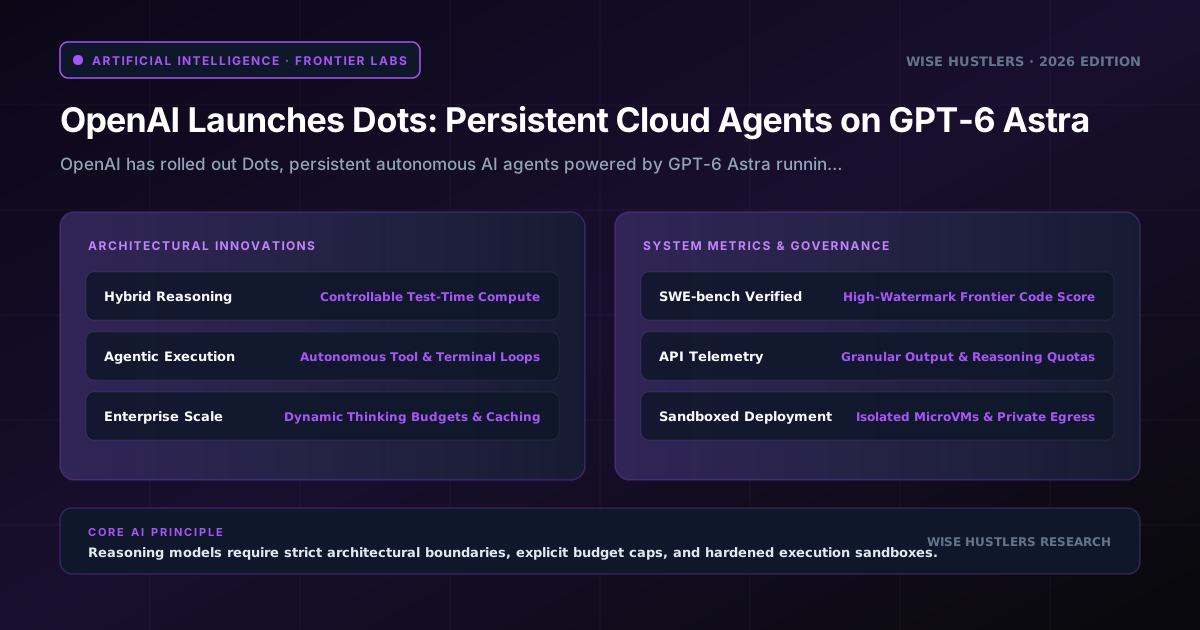
Summary: OpenAI has expanded enterprise access to Dots, a class of persistent, always-on artificial intelligence agents powered by GPT-6 Astra and GPT-6.1 Sol. Running inside dedicated cloud virtual machines with integrated headless browser runtimes and connections to over 4,000 applications, Dots transition artificial intelligence from ephemeral chat prompts to asynchronous execution. This architectural shift redefines background automation, state management, and permission boundaries across modern software engineering stacks.
What Happened & Key Timeline
The transition of artificial intelligence from conversational interfaces to autonomous execution reached an operational milestone this week. Following their introduction at OpenAI DevDay 2026 on September 29 in San Francisco, OpenAI initiated the broad production rollout of Dots across ChatGPT Pro and Business Premium tiers, with phased access expanding across enterprise and business workspaces throughout October 2026.
Unlike standard conversational interfaces or stateless API endpoints, each Dot functions as an independent worker provisioned with a persistent runtime environment. Key milestones across this release cycle include:
- September 29, 2026: OpenAI unveiled the GPT-6 model family at DevDay 2026, presenting its flagship reasoning model, GPT-6 Astra, alongside GPT-6.1 Sol, a specialized model designed for high-throughput coding and routine tool execution at substantially reduced token pricing compared to Astra. OpenAI demonstrated Dots operating inside dedicated cloud computers rather than isolated prompt sessions.
- October 6, 2026: OpenAI published joint benchmark research with legal automation platform Ironclad. The technical report evaluated autonomous agent performance across multi-step corporate workflows, documenting that GPT-6 Astra achieved a 55.0% score across 11 complex research tasks (compared to 41.6% for GPT-5.6 Sol) while demonstrating an 89% reduction in unintended outcomes across enterprise safety benchmarks.
- October 7–9, 2026: Phased rollout expanded across commercial teams and early enterprise adopters. Enterprise administration consoles received tenant-level controls to govern Dot provisioning, set isolated workspace sandboxes, and audit external tool invocations.
As with previous autonomous agent capabilities, regional rollout schedules remain subject to local regulatory compliance, including governance alignment with the European Union AI Act and regional data sovereignty standards. Enterprise teams deploying across jurisdictions typically evaluate cross-border data transfer limits and autonomous action boundaries before enabling background execution.
Technical & Architectural Impact
Dots represent an architectural departure from conversational AI. For years, language model applications adhered strictly to the client-server request-response pattern: a client dispatches an HTTP POST payload with prompt tokens, the model streams an inference response, and the underlying server context terminates.
Dots eliminate this stateless constraint through three primary design decisions:
1. Dedicated Virtual Machine Runtimes and Browser Sandboxes
Every Dot runs within an isolated cloud-hosted virtual machine equipped with persistent disk storage, an execution shell, and a dedicated headless Chromium browser. When an engineer assigns an asynchronous task—such as monitoring a distributed build pipeline, auditing package dependencies, or triaging error logs—the Dot operates independently of an active user session.
The agent maintains operational state over days. If an external service rate-limits an API call or an asynchronous build takes hours, the Dot suspends its process, configures an internal timer hook, and resumes execution without losing accumulated context.
2. Dual-Engine Model Routing: Astra and Sol
Running persistent background loops on frontier models presents severe cost challenges. Iterative reasoning, context re-hydration, and environment feedback parsing consume millions of tokens.
OpenAI addresses this through a dual-engine routing topology:
- GPT-6 Astra serves as the cognitive planner. It handles high-level task decomposition, edge-case evaluation, code synthesis, and non-deterministic error recovery.
- GPT-6.1 Sol operates as the execution worker. It executes repetitive syntax validations, schema formatting, standard SQL queries, and deterministic API transformations at substantially lower compute overhead than the flagship reasoning tier.
- Prompt Caching Breakpoints: To minimize billing during long-running tasks, OpenAI implemented explicit prompt caching breakpoints at the infrastructure layer. By establishing caching breakpoints for recurring system prompts, static tool definitions, and repository schemas, the runtime avoids re-evaluating static context across successive tool executions, significantly lowering latency and token consumption during iterative workflows.
3. Application Integration and Action Gates
Dots connect to more than 4,000 external applications through OpenAI's updated plugin architecture. The agent interacts across Slack channels, Microsoft Teams, Jira boards, and cloud infrastructure dashboards.
To prevent unintended mutations, the runtime enforces deterministic Action Gates. Read-only queries proceed autonomously, but write operations affecting sensitive resources—such as altering production database schemas, initiating payments, or exposing API keys—pause for human approval or trigger automated compliance checks.
| Architectural Layer | Stateless Request-Response APIs | Persistent Cloud Agents (Dots) |
|---|---|---|
| Runtime Persistence | Ephemeral (terminates once HTTP response stream closes) | Long-running (persists across hours or days via background cloud VMs) |
| Execution Environment | Sandboxed serverless container reset after each call | Dedicated virtual machine with persistent local disk storage and shell |
| Browser & Tool Access | Static function calling requiring manual client glue code | Headless Chromium automation and connections to 4,000+ applications |
| Model Routing | Single model endpoint per transaction | Dual-engine routing: GPT-6 Astra (reasoning) + GPT-6.1 Sol (execution) |
| Context & State Management | Client must store and resend conversation histories | Retained filesystem state and infrastructure prompt caching breakpoints |
| Mutation Safety | Application-level prompt filtering and heuristic checks | Deterministic Action Gates requiring human confirmation for critical writes |
The following runnable TypeScript policy shows how engineering teams can implement deterministic Action Gate evaluation to guard persistent agent runtimes:
/**
 * Deterministic Action Gate evaluation for persistent agent runtimes.
 * Prevents unauthorized system mutations during asynchronous execution.
 */
import { z } from "zod";

const ActionRequestSchema = z.object({
  actionId: z.string(),
  type: z.enum(["READ_ONLY", "MUTATION_SAFE", "MUTATION_CRITICAL"]),
  targetResource: z.string(),
  payload: z.record(z.unknown()),
});

type ActionRequest = z.infer<typeof ActionRequestSchema>;

interface GateEvaluation {
  status: "PERMITTED" | "REQUIRES_APPROVAL" | "BLOCKED";
  actionId: string;
  reason: string;
}

export class AgentActionGate {
  private allowedReadOnlyResources = new Set(["logs", "telemetry", "git-status"]);
  private sensitiveResources = new Set(["production-db", "payment-gateway", "iam-roles"]);

  public evaluate(request: ActionRequest): GateEvaluation {
    const validated = ActionRequestSchema.parse(request);

    // Permit read-only queries autonomously
    if (validated.type === "READ_ONLY") {
      return {
        status: "PERMITTED",
        actionId: validated.actionId,
        reason: `Autonomous read permitted for ${validated.targetResource}.`,
      };
    }

    // High-consequence mutations require explicit human confirmation
    if (
      validated.type === "MUTATION_CRITICAL" ||
      this.sensitiveResources.has(validated.targetResource)
    ) {
      return {
        status: "REQUIRES_APPROVAL",
        actionId: validated.actionId,
        reason: `Operation targeting ${validated.targetResource} requires explicit staff authorization.`,
      };
    }

    return {
      status: "PERMITTED",
      actionId: validated.actionId,
      reason: "Standard operational mutation permitted under sandbox policy.",
    };
  }
}

// Example usage:
const gate = new AgentActionGate();

// 1. Safe read-only inspection
const readCheck = gate.evaluate({
  actionId: "act-101",
  type: "READ_ONLY",
  targetResource: "logs",
  payload: { path: "/var/log/nginx/error.log" },
});
console.log(readCheck.status); // "PERMITTED"

// 2. Production mutation intercepted by Action Gate
const writeCheck = gate.evaluate({
  actionId: "act-102",
  type: "MUTATION_CRITICAL",
  targetResource: "production-db",
  payload: { statement: "DROP TABLE legacy_sessions;" },
});
console.log(writeCheck.status); // "REQUIRES_APPROVAL"
What This Means for Engineering Teams & Enterprises
For engineering leaders, staff architects, and infrastructure teams, persistent cloud agents change deployment planning, security posture, and automation strategies:
1. Moving From Fragile Cron Scripts to Adaptive Execution
Traditional DevOps automation relies on rigid cron scripts and bespoke glue code that break when external schemas shift. Persistent agents introduce adaptive execution: a Dot can inspect an altered webhook payload, consult updated documentation via its browser, modify the request structure, and alert engineers with a contextual diff rather than crashing silently.
2. Guarding Against Silent Semantic Drift
The most critical operational risk with autonomous agents is not explicit system failure, but silent semantic drift.
Falsifiability Check: How does an engineering team determine whether an autonomous agent deployment has failed? Unlike microservices where failures trigger HTTP 500 status codes or unhandled exceptions, agent failures occur when a task completes successfully according to syntactic rules while violating business logic. For instance, an agent directed to archive inactive user accounts might identify stale profiles correctly by date, but inadvertently delete records subject to active legal holds. Engineering teams must establish deterministic regression suites and strict output verification before granting agents write access to production systems.
3. Establishing Production-Grade Governance
Deploying autonomous agents requires strict boundaries around credential delegation, workspace isolation, and auditability. Teams should avoid granting broad API keys to autonomous runtimes; environments must enforce fine-grained, short-lived tokens paired with immutable activity logs.
Organizations planning to architect and implement specialized autonomous infrastructure can partner with Wise Hustlers custom AI solutions to design reliable agent architectures, implement deterministic verification guardrails, and build secure runtimes tailored to enterprise security standards.
FAQ Section
How do OpenAI Dots differ from existing Custom GPTs and the Assistants API?
Custom GPTs and the standard Assistants API operate as stateless, request-driven interfaces where execution halts once the model finishes streaming its reply. OpenAI Dots run inside persistent cloud virtual machines with dedicated storage and integrated headless browsers, allowing them to execute multi-step workflows in the background after users log off.
What models power OpenAI Dots, and how are execution costs managed?
Dots use a hybrid routing architecture powered by GPT-6 Astra for complex reasoning and planning, combined with GPT-6.1 Sol for routine tool orchestration and schema formatting at a fraction of the compute cost. Explicit infrastructure prompt caching breakpoints also reduce repetitive token recomputation during long background sessions.
What security controls prevent Dots from executing unauthorized actions?
Dots enforce a multi-tier governance model comprising container sandboxes, operational policies, and deterministic Action Gates. While read-only research and analytical queries proceed autonomously, high-consequence actions—including financial transactions, credential access, and database modifications—require mandatory human confirmation before execution.
How can engineering teams verify that background agent workflows remain reliable?
Teams should establish deterministic testing harnesses that evaluate agents against synthetic environments and recorded API replay fixtures. In addition, organizations should enforce strict telemetry around tool invocations, verify schema contracts using runtime validators, and implement dry-run approval pipelines before promoting agents to live production access.