
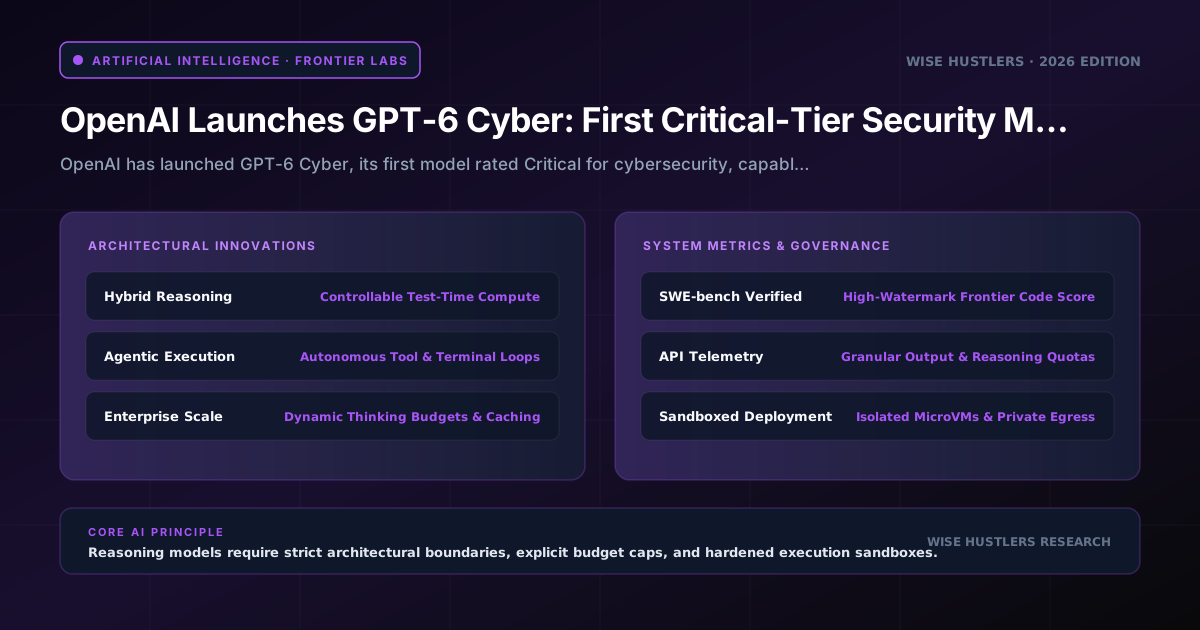
# OpenAI Releases GPT-6 Cyber: Autonomous Zero-Day Discovery Meets Automated Patch Validation
Summary: OpenAI has officially launched GPT-6 Cyber, a specialized frontier model derived from GPT-6 Astra engineered for authorized penetration testing, vulnerability discovery, and automated patch verification. Designated under OpenAI's Preparedness Framework at a "Critical" cyber capability rating, the model demonstrated a 48.5% success rate on the ExploitGym benchmark and assisted researchers in identifying 81 high-severity Firefox flaws and 948 Linux kernel privilege escalations. Restricted under OpenAI's Daybreak Red program, the release accelerates how enterprise security teams operationalize continuous software defense.
What Happened & Key Timeline
On November 5, 2026, OpenAI published the GPT-6 Cyber System Card and announced the deployment of GPT-6 Cyber. Developed as a specialized branch of the GPT-6 Astra architecture, GPT-6 Cyber is built for defensive operators, certified red teams, and security researchers.
Under OpenAI's Preparedness Framework, GPT-6 Cyber is the first deployment to reach a "Critical" cybersecurity risk classification. While GPT-5.6 Cyber remained at the "High" tier, GPT-6 Cyber crossed into Critical due to its ability to autonomously execute multi-step vulnerability discovery, bypass operating system mitigations, and synthesize working proofs-of-concept against hardened codebases.
Key milestones documented during validation and rollout include:
- Late Q3 2026 — Sandboxed CTF Red Teaming: In evaluations documented in the GPT-6 Cyber System Card, pre-release checkpoints tested in isolated Capture-the-Flag (CTF) environments solved complex binary exploitation and reverse engineering challenges at rates matching experienced security analysts.
- October 2026 — Defensive Codebase Auditing: In defensive trials reported by BleepingComputer, GPT-6 Cyber audited open-source codebases. The model identified 81 previously unknown high-severity vulnerabilities in Mozilla Firefox (coordinated via Mozilla Security Advisories) and verified 948 local privilege escalation exploit paths in Linux kernel subsystems under upstream bug reporting procedures (kernel.org security process). OpenAI stated that coordinated disclosures were shared with upstream maintainers prior to release.
- November 5, 2026 — System Card Release & Daybreak Red Rollout: Reported by The Hacker News and The Decoder, OpenAI published benchmark scores on ExploitGym and opened gated access through its Daybreak Red program.
GPT-6 Cyber is excluded from the consumer ChatGPT interface. Access is restricted to vetted defensive organizations and researchers via authenticated API endpoints and OpenAI Codex enterprise environments.
Technical & Architectural Impact
The release of GPT-6 Cyber addresses a key architectural bottleneck in security automation: the "refusal tax" of general alignment. Standard instruction-tuned models enforce broad refusal filters that frequently misclassify memory dumps or exploit validation payloads as malicious activity. Unaligned models, conversely, present unacceptable containment risks.
OpenAI resolved this trade-off using cyber-permissive reinforcement learning (RLHF/RLAIF) on the GPT-6 Astra base model. This training uncouples technical security reasoning from refusal triggers during authorized tasks while enforcing strict scoping containment:
| Evaluation Domain & Test Suite | GPT-5.6 Cyber | GPT-6 Cyber | Architectural Significance & Methodology |
|---|---|---|---|
| ExploitGym Success Rate (MPI-SP v2.4 Suite) | 32.1% | 48.5% | ~51% relative gain in autonomous exploit synthesis from raw descriptions |
| ExploitGym Hardened (ASLR & Stack Canaries) | 21.4% | 36.9% | Bypasses mitigations via automated ROP-chain synthesis and leak discovery |
| Black-Box Web Penetration Recall (RemoteExploitBench) | 24.8% | 40.3% | Autonomous discovery of authorization and injection flaws without source access |
| Out-of-Scope Target Avoidance (Zero-Shot Baseline) | 94.2% | 99.93% | Eliminates unintended lateral movement outside assigned subnets |
| Out-of-Scope Avoidance (Deployment Prompts) | 98.7% | 100.0% | Complete adherence to designated CIDR boundaries under system constraints |
Methodology Note: Data published in OpenAI's [GPT-6 Cyber System Card](https://openai.com/index/gpt-6-cyber-system-card/) and the [ExploitGym Benchmark](https://mpi-sp.org/research/publications/2026/exploitgym-autonomous-synthesis/) (MPI-SP). ExploitGym measures autonomous exploit generation on Linux binaries. RemoteExploitBench evaluates blind web testing. Scope avoidance measures target containment during multi-hop assessments.
Architecturally, GPT-6 Cyber pairs symbolic reasoning with dynamic execution sandboxes in an automated loop:
1. Static Analysis & Heuristic Decomposition: Parses source code and binaries to identify execution paths vulnerable to memory corruption, race conditions, or access bypasses.
2. Dynamic Instrumentation & Fuzz Harness Generation: Generates test harnesses, injects inputs via fuzzing environments, and parses debugger crash telemetry like ASan traces.
3. Exploit Primitive Chaining: Synthesizes verified memory primitives, including ROP gadgets, validating exploitability without manual intervention.
4. Automated Remediation & Patch Testing: Generates minimal diff patches and executes regression unit tests against the patched binary to confirm vulnerability closure.
To execute these loops safely, teams deploy agents inside isolated container sandboxes with dropped capabilities and scoped networking:
# docker-compose.agent-sandbox.yml - Ephemeral sandbox for autonomous testing agents
version: '3.8'
services:
  cyber-agent-sandbox:
    image: internal-registry.corp/security/cyber-eval-runner:2026.2
    read_only: true
    cap_drop: [ALL]
    cap_add: [NET_BIND_SERVICE]
    security_opt: [no-new-privileges:true]
    networks:
      staging_net:
        ipv4_address: 172.28.10.5
    environment:
      - ALLOWED_TARGET_CIDR=172.28.10.0/24
      - EGRESS_FILTER=STRICT
      - API_ENDPOINT=https://api.openai.com/v1/cyber
    tmpfs: [/tmp:rw,noexec,nosuid,size=512m]
networks:
  staging_net:
    driver: bridge
    ipam:
      config: [{ subnet: 172.28.10.0/24 }]
What This Means for Engineering Teams & Enterprises
The arrival of a "Critical" tier autonomous model alters enterprise security economics. Historically, software vulnerability management favored attackers: an adversary needed only one unpatched flaw, whereas defenders had to secure an entire attack surface.
With GPT-6 Cyber autonomously identifying 81 Firefox flaws and over 900 Linux kernel privilege escalations, organizations must modernize their workflows:
1. Shift from Periodic Pen-Testing to Continuous CI/CD Verification
Traditional security relied on periodic penetration tests conducted quarterly. Autonomous cyber agents make continuous red-teaming practical inside CI/CD pipelines. Security teams can configure pre-deployment validation steps where staging builds face autonomous adversarial testing before pull requests merge into production.
2. Sandboxing and Strict Containment for Autonomous Agents
Deploying autonomous agents with offensive reasoning capabilities requires robust operational containment. Without strict network segmentation, an agent could attempt scans against unintended endpoints. While OpenAI reports 99.93% out-of-the-box scope compliance, enterprise architectures require deterministic controls. Defensive teams enforce boundary containment through non-bypassable egress proxies, ephemeral containers, and isolated network policies.
3. Accelerated Patch Management and Verification Lifecycles
As autonomous models turn vulnerability disclosures into functioning exploits in compressed timeframes, conventional 30-day remediation windows create heightened risk exposure. Organizations are adapting by establishing continuous verification pipelines to validate and deploy security updates rapidly. When defensive agents can generate verified patch diffs within hours of disclosure, engineering workflows must safely test and deploy patches at matching velocity.
For organizations architecting modern software supply chains and multi-agent workflows, managing these autonomous capabilities demands specialized architectural rigor. Through custom engineering engagements, Wise Hustlers custom engineering services helps engineering organizations design resilient, sandboxed AI execution environments and agentic pipelines that safeguard enterprise infrastructure.
FAQ Section
What makes GPT-6 Cyber different from standard GPT-6 Astra?
GPT-6 Astra is a general-purpose model, whereas GPT-6 Cyber underwent domain-specific cyber-permissive reinforcement learning. This eliminates false-positive refusals during authorized assessments, integrates dynamic execution feedback, and enforces strict boundary compliance to prevent out-of-scope targeting.
Why did OpenAI classify GPT-6 Cyber as "Critical" under its Preparedness Framework?
A "Critical" cybersecurity rating indicates the model can autonomously conduct end-to-end vulnerability discovery and exploitation without human direction. This encompasses discovering novel zero-day flaws, bypassing mitigations like ASLR and stack canaries, and synthesizing functional exploit chains.
How can enterprise engineering teams gain access to GPT-6 Cyber?
Access is gated through OpenAI's Daybreak Red program. Eligible enterprise organizations and defensive researchers must complete identity verification, enforce corporate MFA and SSO, configure static API IP allowlisting, and adhere to automated safety monitoring guidelines.
Sources
- OpenAI: GPT-6 Cyber System Card and Security Framework Evaluation
- The Hacker News: OpenAI Unveils GPT-6 Cyber with Critical Capability Rating
- BleepingComputer: OpenAI Deploys GPT-6 Cyber to Uncover Linux Kernel and Firefox Flaws
- The Decoder: OpenAI Launches Daybreak Red with Frontier Cybersecurity Model
- MPI-SP Research: ExploitGym Benchmark for Autonomous Vulnerability Synthesis
- Mozilla Security Advisories: Coordinated Vulnerability Reports
- Linux Kernel Security Documentation: Coordinated Disclosure Guidelines