
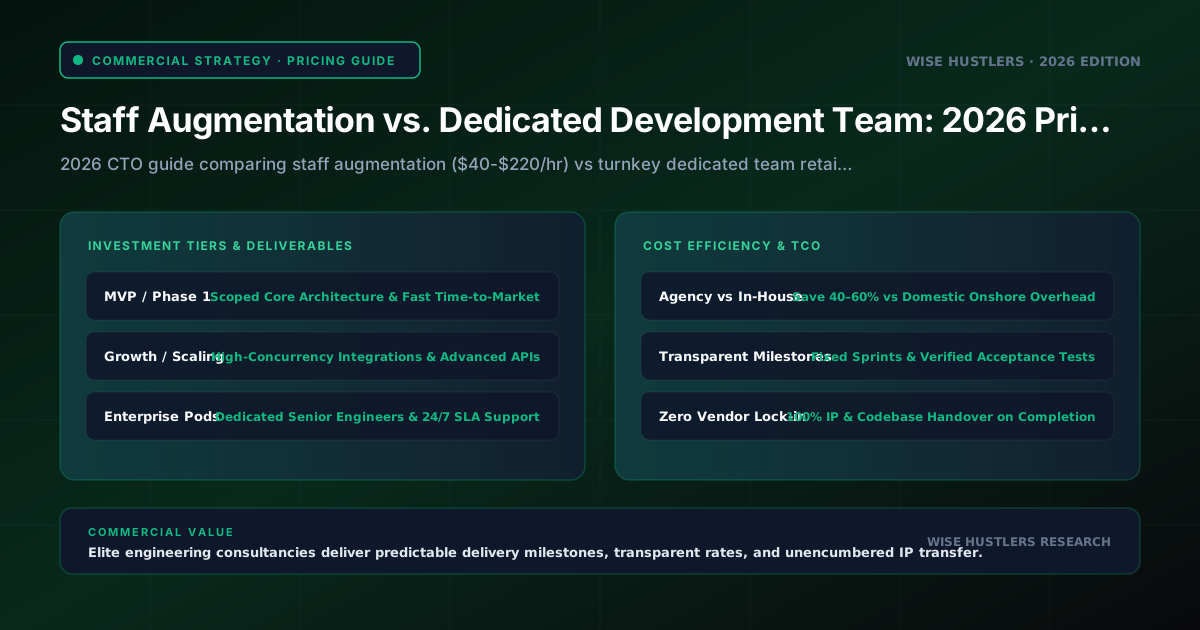
# Staff Augmentation vs Dedicated Team Pricing: 2026 Management TCO & Decision Matrix
For US technology leaders evaluating engineering scale in 2026, comparing talent models on base contractor rates alone creates a distorted financial picture.
Summary: According to published IT procurement reports and industry rate guides (including Accelerance and Clutch), individual staff augmentation spans $25–$70/hr offshore, $55–$95/hr nearshore, and $120–$220/hr onshore, while turnkey dedicated teams cost $25,000–$80,000 monthly for a 4–6 engineer pod. Factoring in domestic engineering management overhead (8–15 hours weekly per contractor) and onboarding drag, total cost of ownership (TCO) models demonstrate that hourly staff augmentation can incur 25% to 44% higher effective costs over 6+ months.
---
1. The Core Economic Divergence: Capacity Injection vs. Turnkey Pod Delivery
Selecting between IT staff augmentation and a dedicated software engineering team is not merely a staffing choice; it is an architectural decision regarding where delivery risk, management overhead, and operational liability reside.
+--------------------------------------------------------------------------------------------------+
| MODEL COMPARISON: OPERATIONAL & GOVERNANCE BOUNDARIES                                            |
+------------------------------------+----------------------------------+--------------------------+
| DIMENSION                          | STAFF AUGMENTATION               | DEDICATED DEVELOPMENT    |
|                                    | (INDIVIDUAL CONTRACTORS)         | TEAM (TURNKEY POD)       |
+------------------------------------+----------------------------------+--------------------------+
| Billing Construct                  | Time & Materials (Hourly Rate)   | Fixed Monthly Retainer   |
| Management Accountability          | Internal (US Engineering Team)   | Shared / Vendor Delivery |
| Delivery Output Liability          | Client Bears All Delivery Risk   | Vendor Committed to SLAs |
| Team Composition & Cohesion        | Ad-hoc Individual Seats          | Pre-integrated Unit Pod  |
| Onboarding & Ramp Responsibility   | Domestic Lead Engineers          | Vendor Tech Lead & Pod   |
| Attrition & Replacement Cost       | Client Absorbs Re-hiring Drag    | Vendor Replaces & Shadows|
| Quality Assurance & DevOps         | Client Must Provide or Purchase  | Integrated into Pod Core |
+------------------------------------+----------------------------------+--------------------------+
Staff Augmentation (Capacity Injection)
Staff augmentation inserts individual contract developers directly into your existing reporting hierarchy. Your internal Engineering Managers (EMs), Tech Leads, and Product Managers (PMs) assign Jira tickets, review GitHub pull requests, conduct daily standups, and resolve architectural roadblocks. You pay for billable hours ($/hr), assuming 100% of the operational risk, sprint velocity accountability, and code quality governance.
Dedicated Development Team (Turnkey Pod Delivery)
A dedicated team is a self-contained, cross-functional engineering unit—typically consisting of a Technical Lead/Architect, 2–4 Senior Software Engineers, a QA Automation Engineer, and a Delivery Manager/Scrum Master. The pod operates as an autonomous extension of your engineering organization, governed by sprint-level service level agreements (SLAs), burndown commitments, and milestone targets. The client owns product strategy and high-level architectural approval, while the vendor manages sprint execution, peer review cycles, performance monitoring, and team continuity.
---
2. 2026 Comprehensive USD Pricing Matrix: Hourly Rates vs. Monthly Retainers
Understanding staff augmentation vs dedicated team pricing requires contrasting spot contractor hourly rates across global geographies against turnkey team retainers.
Nearshore vs Onshore Developer Rates 2026: Global Staff Augmentation Benchmarks
According to global IT procurement studies, including the Accelerance Global Software Outsourcing Rates Guide and Clutch contract rate surveys, engineering bill rates vary significantly based on regional cost of living, timezone alignment, and senior technical specializations:
| Region | Junior Developer (1–3 Yrs) | Mid-Level Developer (3–5 Yrs) | Senior Developer (5–8 Yrs) | Lead Architect (8+ Yrs) | Average Monthly Cost per Dev (160 Hrs) |
|---|---|---|---|---|---|
| Onshore US | $85 – $120/hr | $120 – $165/hr | $165 – $220/hr | $220 – $290/hr | $19,200 – $35,200 |
| Nearshore (LATAM / Eastern Europe) | $35 – $55/hr | $55 – $75/hr | $75 – $95/hr | $95 – $130/hr | $8,800 – $15,200 |
| Offshore (South Asia / APAC) | $25 – $38/hr | $38 – $55/hr | $55 – $70/hr | $70 – $95/hr | $6,400 – $11,200 |
Note: Rates synthesize industry procurement data from the Accelerance Global Software Outsourcing Rates Guide, Clutch B2B research indices, and enterprise technical staffing benchmarks for 2025–2026.
Dedicated Software Development Team Cost USA: Turnkey Monthly Retainer Tiers (4–6 Engineer Pods)
Rather than paying disconnected hourly rates for individual seats, turnkey pods operate on predictable monthly retainers that bundle technical management, automated QA, and DevOps infrastructure:
| Tier | Pod Composition (Headcount & Roles) | Best Suited For | Nearshore Monthly Retainer | US / Hybrid Monthly Retainer |
|---|---|---|---|---|
| Tier 1: Growth Pod | • 1 Lead Full-Stack Engineer (1.0 FTE)<br>• 2 Mid-Senior Developers (2.0 FTE)<br>• 0.5 QA Automation Engineer<br>• 0.5 Agile Delivery Lead | MVPs, high-velocity feature sprints, SaaS greenfield builds | $25,000 – $38,000/mo | $45,000 – $60,000/mo |
| Tier 2: Core Product Pod | • 1 Principal Solution Architect (0.5 FTE)<br>• 2 Senior Backend Engineers (2.0 FTE)<br>• 1 Senior Frontend Engineer (1.0 FTE)<br>• 1 Dedicated QA SDET (1.0 FTE)<br>• 0.5 Technical Project Manager | Enterprise SaaS scale, cloud microservices, API platforms | $40,000 – $58,000/mo | $60,000 – $80,000/mo |
| Tier 3: Enterprise Modernization Pod | • 1 Principal Cloud Architect (1.0 FTE)<br>• 3 Senior Full-Stack Engineers (3.0 FTE)<br>• 1 Senior DevOps/SRE Engineer (1.0 FTE)<br>• 1 Senior Lead QA Engineer (1.0 FTE)<br>• 1 Dedicated Scrum Master (0.5 FTE) | Legacy replatforming, distributed architectures, high-load fintech/healthtech | $60,000 – $80,000/mo | $90,000 – $125,000/mo |
Software Engineering Team Hourly Rate vs Monthly Retainer Analysis
When evaluating a software engineering team hourly rate vs monthly retainer, the monthly retainer model eliminates billing volatility and invoice surprise. Under an hourly staff augmentation contract:
- A pod of 4 senior nearshore contractors billing an average of $75/hr costs $48,000 in a standard 160-hour month.
- In a 176-hour month (22 working days), that invoice surges to $52,800.
- Overtime, scope creep, complex environment debugging spikes, and unbudgeted spike tickets introduce capital variance.
Conversely, a monthly retainer guarantees fixed burn-rate predictability for financial planners, with the vendor assuming responsibility for delivering committed sprint story points and feature roadmaps within the agreed capacity.
---
3. Engineering Management TCO Software Development: Quantifying Staff Augmentation Drag
The most frequent oversight engineering executives make is modeling cost strictly as Billable Hours × Hourly Rate. In enterprise environments, staff augmentation imposes substantial operational friction on domestic engineering leadership.
The True Cost Formula
$$\text{True TCO} = \text{Direct Invoice Fees} + \text{Domestic Management Drag} + \text{Ramp Friction} + \text{Attrition Vacuum} + \text{Tooling Burden} + \text{Quality Rework}$$
+--------------------------------------------------------------------------------------------------+
| THE 5 HIDDEN TCO COST DRIVERS OF INDIVIDUAL CONTRACTOR AUGMENTATION                             |
+--------------------------------------------------------------------------------------------------+
| [1] Domestic Sprint Management Drain (8-15 hrs/wk/contractor)                                    |
|     --> Consumes $4,800 - $8,400/month of US Engineering Manager / Architect bandwidth           |
+--------------------------------------------------------------------------------------------------+
| [2] Onboarding Ramp Friction & Velocity Deficit                                                  |
|     --> 6 to 12 weeks to full productivity; internal leads fund paired-programming time        |
+--------------------------------------------------------------------------------------------------+
| [3] Attrition, Churn Volatility & Re-Hiring Transaction Costs                                    |
|     --> 20-35% contractor turnover (SIA/SHRM); $15,000-$28,000 realized cost per incident        |
+--------------------------------------------------------------------------------------------------+
| [4] Tooling, Infrastructure & Security Compliance Licensing                                      |
|     --> MDM, IDE, SSO, CI/CD, cloud sandboxes, telemetry licensing ($400-$850/seat/mo)           |
+--------------------------------------------------------------------------------------------------+
| [5] Code Quality Rework & Technical Debt Accumulation                                            |
|     --> 15-25% PR rework rate (GitClear/LinearB data) when contractors lack embedded pod QA      |
+--------------------------------------------------------------------------------------------------+
Detailed Breakdown of the 5 Hidden Cost Drivers
Factor 1: Domestic Engineering Manager & Lead Architect Sprint Overhead
Individual contractors require hands-on technical supervision. Engineering leadership workflow studies and time-allocation analyses (such as reports from the LeadDev community) document that managing an external contributor absorbs 8 to 15 hours per week in backlog grooming, synchronous standups, asynchronous pull request reviews, environment debugging, and architectural clarification.
- US Engineering Leadership Compensation: According to data from the U.S. Bureau of Labor Statistics (BLS Occupational Employment and Wage Statistics for Computer and Information Systems Managers, SOC 11-3021) and industry compensation reports from Levels.fyi and Glassdoor, the median base salary for an experienced US Engineering Manager or Lead Architect spans $180,000 to $220,000. Applying a standard 30% to 35% employer burden factor (payroll taxes, health coverage, retirement benefits, and equity administration) yields an effective loaded cost of ~$135 to $145 per hour (modeled here at $140/hour based on 2,080 annual working hours).
- Direct Management Friction: At $140/hour, 10 hours weekly spent supervising a single contractor represents $1,400/week ($6,067/month) in domestic management bandwidth.
- With 3 augmented engineers, internal leaders spend 25 to 45 hours weekly—diverting an entire domestic engineering manager away from core strategic initiatives.
Factor 2: Onboarding Ramp Friction & Context Acquisition Latency
Empirical research on developer productivity, including studies published by IEEE Software and findings from Google's DevOps Research and Assessment (DORA), shows that engineers joining an unfamiliar enterprise codebase typically require 6 to 12 weeks to attain full sprint velocity. In complex distributed architectures, individual onboarding contractors frequently operate at fractional capacity (often estimated at 30% to 40% velocity during weeks 1 through 4) while drawing 10 to 20 hours weekly of senior domestic engineer pairing time. With a turnkey dedicated team, the vendor’s Lead Architect internalizes domain ingestion and establishes standardized pod runbooks, shielding the client's internal staff from repetitive onboarding overhead.
Factor 3: Attrition, Churn Volatility & Re-Hiring Transaction Costs
Contingent workforce research from Staffing Industry Analysts (SIA) and the Society for Human Resource Management (SHRM) indicates that contractor turnover in technical fields routinely averages 20% to 35% annually. When an augmented contractor departs mid-flight:
- The organization loses unwritten institutional knowledge.
- Domestic leads invest 15 to 30 hours screening candidate resumes and conducting technical interviews.
- The multi-week onboarding cycle restarts from zero.
Based on replacement cost frameworks from SHRM and the Center for American Progress (CAP), the realized friction of turnover translates to an estimated $15,000 to $28,000 per occurrence in lost sprint velocity, recruiter placement fees, and domestic engineering distraction. In contrast, mature dedicated team providers maintain redundant cross-trained bench capacity, replacing team members under contractual SLAs with mandatory vendor-funded shadowing.
Factor 4: Tooling, Workstations & Security Compliance Overhead
Every external contributor provisioned on enterprise systems incurs direct software licensing and compute costs:
- Enterprise collaboration & version control (GitHub Enterprise at $21/seat, Jira Software Cloud Enterprise at ~$15–$30/seat, Slack Enterprise, Okta SSO, password managers): ~$100–$160/user/month.
- Cloud staging & development sandboxes (isolated AWS/GCP dev instances, container registries, staging databases): ~$200–$450/user/month based on standard cloud compute pricing.
- Endpoint compliance & security tooling (Mobile Device Management like Jamf/Intune, endpoint protection like CrowdStrike, virtual private network licensing): ~$100–$240/user/month.
Synthesizing published enterprise software price cards and IT spending surveys, this represents an estimated infrastructure burden of $400 to $850+ per seat per month.
Factor 5: Code Quality Rework & Architectural Debt Burden
Repository intelligence studies, such as GitClear's longitudinal research on code quality and LinearB's Engineering Benchmarks, indicate that code churn and pull request rework rates frequently reach 15% to 25% when individual contributors work without unified architectural standards or embedded QA automation. In staff augmentation models where developers are evaluated on ticket output rather than systemic maintainability, domestic engineers frequently spend significant cycles refactoring merged code. A dedicated pod incorporates a dedicated QA automation engineer and Lead Architect who enforce testing gates and architectural compliance prior to pull request submission.
---
Staff Augmentation vs Software Agency ROI: 12-Month Total Cost of Ownership Simulation
To compare staff augmentation vs software agency roi, consider a modeled scenario of a mid-market US technology enterprise deploying 4 software engineers over a 12-month engagement:
| Cost Component | Option A: 4 Nearshore Augmented Contractors ($75/hr) | Option B: 4-Engineer Turnkey Dedicated Pod (Fixed Retainer) |
|---|---|---|
| Direct Invoiced Cost (12 Months) | $576,000 (4 devs × 160 hrs × $75 × 12) | $432,000 ($36,000/mo retainer) |
| Domestic Management Drag (EM / Lead) | $182,000 (Modeled 25 hrs/wk total @ $140/hr) | $36,400 (Modeled 5 hrs/wk oversight @ $140/hr) |
| Onboarding Ramp & Pairing Drag | $36,000 (6 weeks at fractional velocity) | $12,000 (Vendor-managed pod onboarding) |
| Attrition & Replacement Costs (1 Departure) | $24,000 (Recruiting, screening & ramp restart) | $0 (Vendor SLA coverage & funded shadowing) |
| Tooling, Sandbox & Security Infrastructure | $28,800 (4 seats @ $600/mo) | $9,600 (Vendor-provided development infrastructure) |
| Code Rework & Technical Debt Remediation | $48,000 (Internal refactoring overhead) | $8,000 (Embedded pod QA & architect review) |
| TOTAL 12-MONTH MODELED TCO | $894,800 | $498,000 |
| Effective Cost per Productive Developer Hour | $116.51 / hr | $64.84 / hr |
TCO Comparison: 12-Month Financial Exposure (Modeled Simulation)
========================================================================================
Option A (Augmentation): [==================================================] $894,800
Option B (Dedicated Pod): [============================] $498,000
----------------------------------------------------------------------------------------
Projected Model Cost Variance: $396,800 (~44.3% TCO Difference under Model Assumptions)
Domestic Engineering Management Bandwidth Reclaimed: ~1,000+ Hours / Year
========================================================================================
Methodology Note: This simulation illustrates a scenario of 4 developers working 160 hours monthly over 12 months. Figures reflect assumptions cited above: US EM loaded compensation of $140/hr (BLS/Levels.fyi data), 1 contractor attrition event (SHRM/SIA replacement cost models), and published tooling pricing tiers. Realized savings vary according to specific internal salary bands, codebase complexity, and actual contractor retention.
---
Computational TCO Model: Runnable TypeScript Calculator
Engineering leaders can evaluate their specific organizational numbers using the following standalone TypeScript calculator. The script models both staffing constructs across custom hourly rates, management allocations, onboarding latency, and infrastructure expenses:
/**
 * Engineering Delivery Model TCO Calculator
 * Evaluates Total Cost of Ownership: Staff Augmentation vs. Turnkey Dedicated Pod
 * Run with: npx ts-node tco-calculator.ts
 */

interface TeamParameters {
  teamSize: number;
  durationMonths: number;
  monthlyHoursPerDev: number;
  // Option A: Staff Augmentation
  hourlyRate: number;
  weeklyMgmtHoursPerContractor: number;
  emLoadedHourlyRate: number;
  rampWeeks: number;
  rampProductivityLossPct: number; // e.g. 0.50 for 50% velocity during ramp
  annualTurnoverRate: number;      // e.g. 0.25 for 25% annual turnover
  turnoverReplacementCost: number;
  monthlyToolingPerDev: number;
  annualReworkAllowance: number;
  // Option B: Turnkey Dedicated Pod
  podMonthlyRetainer: number;
  weeklyPodOversightHours: number;
  podRampOverhead: number;
  podMonthlyToolingClientSide: number;
  podAnnualReworkAllowance: number;
}

interface TCOResult {
  directInvoice: number;
  managementCost: number;
  rampCost: number;
  turnoverCost: number;
  toolingCost: number;
  reworkCost: number;
  totalTCO: number;
  effectiveHourlyRate: number;
}

function calculateTCO(params: TeamParameters): { aug: TCOResult; pod: TCOResult; delta: number; deltaPct: number } {
  const totalBilledHoursPerDev = params.monthlyHoursPerDev * params.durationMonths;
  const totalDevHours = totalBilledHoursPerDev * params.teamSize;
  const weeks = (params.durationMonths / 12) * 52;

  // Option A: Staff Augmentation Calculations
  const augDirectInvoice = totalDevHours * params.hourlyRate;
  const totalMgmtHoursAug = params.weeklyMgmtHoursPerContractor * params.teamSize * weeks;
  const augManagementCost = totalMgmtHoursAug * params.emLoadedHourlyRate;
  const augRampCost = params.teamSize * (params.rampWeeks * 40 * params.hourlyRate * params.rampProductivityLossPct);
  const turnoverEvents = params.teamSize * (params.annualTurnoverRate * (params.durationMonths / 12));
  const augTurnoverCost = turnoverEvents * params.turnoverReplacementCost;
  const augToolingCost = params.teamSize * params.monthlyToolingPerDev * params.durationMonths;
  const augReworkCost = params.annualReworkAllowance * (params.durationMonths / 12);

  const augTotal = augDirectInvoice + augManagementCost + augRampCost + augTurnoverCost + augToolingCost + augReworkCost;

  // Option B: Turnkey Dedicated Pod Calculations
  const podDirectInvoice = params.podMonthlyRetainer * params.durationMonths;
  const totalMgmtHoursPod = params.weeklyPodOversightHours * weeks;
  const podManagementCost = totalMgmtHoursPod * params.emLoadedHourlyRate;
  const podRampCost = params.podRampOverhead;
  const podTurnoverCost = 0; // Vendor SLA absorbs attrition and shadowing
  const podToolingCost = params.teamSize * params.podMonthlyToolingClientSide * params.durationMonths;
  const podReworkCost = params.podAnnualReworkAllowance * (params.durationMonths / 12);

  const podTotal = podDirectInvoice + podManagementCost + podRampCost + podTurnoverCost + podToolingCost + podReworkCost;

  const productiveHours = totalDevHours * (1 - 0.10); // Standard baseline productive hours

  return {
    aug: {
      directInvoice: augDirectInvoice,
      managementCost: augManagementCost,
      rampCost: augRampCost,
      turnoverCost: augTurnoverCost,
      toolingCost: augToolingCost,
      reworkCost: augReworkCost,
      totalTCO: augTotal,
      effectiveHourlyRate: augTotal / productiveHours,
    },
    pod: {
      directInvoice: podDirectInvoice,
      managementCost: podManagementCost,
      rampCost: podRampCost,
      turnoverCost: podTurnoverCost,
      toolingCost: podToolingCost,
      reworkCost: podReworkCost,
      totalTCO: podTotal,
      effectiveHourlyRate: podTotal / productiveHours,
    },
    delta: augTotal - podTotal,
    deltaPct: ((augTotal - podTotal) / augTotal) * 100,
  };
}

// Representative Enterprise Scenario (4 Developers, 12 Months)
const scenario: TeamParameters = {
  teamSize: 4,
  durationMonths: 12,
  monthlyHoursPerDev: 160,
  hourlyRate: 75,
  weeklyMgmtHoursPerContractor: 6.25, // 25 hrs/wk across 4 contractors
  emLoadedHourlyRate: 140,            // Based on BLS / Levels.fyi data
  rampWeeks: 6,
  rampProductivityLossPct: 0.50,
  annualTurnoverRate: 0.25,           // SIA contingent labor benchmark
  turnoverReplacementCost: 24000,     // SHRM turnover cost methodology
  monthlyToolingPerDev: 600,          // GitHub, Jira, AWS Sandboxes, MDM
  annualReworkAllowance: 48000,
  podMonthlyRetainer: 36000,
  weeklyPodOversightHours: 5,         // High-level roadmap alignment only
  podRampOverhead: 12000,
  podMonthlyToolingClientSide: 200,   // SSO & client repo access only
  podAnnualReworkAllowance: 8000,
};

const result = calculateTCO(scenario);
console.log("=== 12-MONTH ENGINEERING TCO SIMULATION ===");
console.log(`Staff Augmentation Total TCO: $${result.aug.totalTCO.toLocaleString()}`);
console.log(`Dedicated Pod Total TCO:       $${result.pod.totalTCO.toLocaleString()}`);
console.log(`Modeled Variance:              $${result.delta.toLocaleString()} (${result.deltaPct.toFixed(1)}%)`);
---
4. CTO Decision Flowchart & Project Lifecycle Mapping
To select the appropriate engagement model, US engineering executives must evaluate internal management bandwidth, project duration, architectural definition, and delivery liability.
flowchart TD
    Start["New Engineering Initiative"] --> ScopeCheck{"Is project scope & architecture fully defined?"}

    ScopeCheck -- "No / Evolving Architecture" --> LeadershipCheck{"Do you have surplus US Engineering Managers & Tech Leads?"}
    ScopeCheck -- "Yes / Repetitive Maintenance" --> DurationCheck{"Is project duration under 3 months?"}

    LeadershipCheck -- "Yes / Ample Domestic Bandwidth" --> CapacityCheck{"Do you only need specific, isolated skills (e.g. 1 Rust dev)?"}
    LeadershipCheck -- "No / Domestic Leads at Capacity" --> TurnkeyPod["Select TURNKEY DEDICATED TEAM POD"]

    CapacityCheck -- "Yes" --> StaffAug["Select STAFF AUGMENTATION"]
    CapacityCheck -- "No / Need Multi-Role Delivery" --> TurnkeyPod

    DurationCheck -- "Yes (1-12 Weeks)" --> StaffAug
    DurationCheck -- "No (3+ Months)" --> DeliveryRisk{"Who must bear delivery & SLA velocity liability?"}

    DeliveryRisk -- "Client internal team absorbs risk" --> StaffAug
    DeliveryRisk -- "Vendor must commit to delivery output & SLAs" --> TurnkeyPod
Strategic Fit Across the Software Development Lifecycle
+--------------------------------------------------------------------------------------------------+
| PROJECT LIFECYCLE HIRING DECISION MATRIX                                                         |
+--------------------------+--------------------+------------------+-------------------------------+
| LIFECYCLE PHASE          | OPTIMAL MODEL      | PRIMARY DRIVER   | KEY PERFORMANCE METRIC        |
+--------------------------+--------------------+------------------+-------------------------------+
| Greenfield MVP Build     | Dedicated Team     | Speed to Market  | Sprint cycle time,            |
| (Months 0–6)             |                    | & Unified Arch   | Low domestic management tax   |
+--------------------------+--------------------+------------------+-------------------------------+
| Tactical Capacity Spike  | Staff Augmentation | Elasticity &     | Immediate onboarding date,    |
| (Months 1–3)             |                    | Niche Skillset   | Hourly billing flexibility    |
+--------------------------+--------------------+------------------+-------------------------------+
| Core Platform Scale      | Dedicated Team     | Predictable Burn | Burndown predictability,      |
| (Months 6–24)            |                    | & Quality SLAs   | PR merge cycle < 36 hrs       |
+--------------------------+--------------------+------------------+-------------------------------+
| Legacy Maintenance       | Staff Augmentation | Ticket Flow,     | Ticket closure rate,          |
| (Ongoing)                |                    | Modular Scope    | Cost per resolved issue       |
+--------------------------+--------------------+------------------+-------------------------------+
---
5. Quantitative Risk Mitigation: IP Protection, Knowledge Transfer & SLAs
Partnering with an external engineering firm requires rigorous legal, technical, and operational safeguards to protect intellectual property and enterprise value.
1. Intellectual Property (IP) Protection & Enforceability
- Domestic Corporate Governance: Enterprise procurement best practice generally favors contracting through a US-registered corporate entity (such as a Delaware C-Corp or LLC) with established domestic legal jurisdiction, ensuring standard legal recourse and dispute resolution regardless of developer physical location.
- Express Present IP Assignment: Under US copyright law (17 U.S.C. § 101), software authored by independent contractors does not automatically qualify as a "work made for hire" unless specific statutory criteria are met. Master service agreements must incorporate explicit present-assignment language ("hereby irrevocably assigns all right, title, and interest in and to all work product") ensuring all source code, architecture schemas, and documentation vest exclusively in the client upon creation.
- Upstream Flow-Down Agreements: Commercial contracts should require vendor warranties confirming that all pod personnel, contractors, and subcontractors have executed binding IP assignment and confidentiality agreements prior to obtaining code repository access.
2. Knowledge Transfer Protocols & Documentation Sovereignty
To mitigate vendor lock-in and single-point-of-failure risks:
- Architectural Decision Records (ADRs): Require engineering teams to maintain ADRs in markdown within the primary repository, documenting structural trade-offs, database schema decisions, and third-party dependency rationale.
- Automated Living Documentation: Enforce CI/CD pipeline steps that generate OpenAPI definitions, TypeDoc/Javadoc references, and entity-relationship diagrams upon merge to main branches.
- Trunk-Based Clean Handoff: Maintain trunk-based development with peer code reviews for all merges. Prohibit siloed long-lived feature branches that obscure progress or complicate handoffs.
3. Concrete SLA Commitments & Delivery Benchmarks
Enterprise agreements benefit from verifiable contractual SLAs backed by standard billing remedies:
- Velocity Variance SLA: Dedicated pod velocity targets should remain within ±10% to ±15% of the rolling 3-sprint established baseline.
- PR Review & Cycle Time: Maximum initial PR review turnaround target of under 24 hours; PR cycle time target of under 48 hours.
- Defect Density Benchmark: Quality targets aligned with IEEE Standard 1061 and Software Engineering Institute (SEI) defect density benchmarks typically aim for fewer than 0.5 to 1.0 Sev-1/Sev-2 production defects per 1,000 lines of delivered executable code (KLOC).
- Staffing Substitution SLA: Contractual replacement commitments stipulating replacement candidate presentation within 10 business days, paired with a vendor-funded onboarding overlap period to maintain sprint continuity.
---
6. Enterprise Vendor Vetting Scorecard & Architectural Squad Blueprint
Before entering a partnership, evaluate prospective engineering vendors across technical, operational, and governance dimensions.
The 20-Point Technical & Operational Vetting Scorecard
| Category | Evaluation Criteria | Recommended Benchmark | Red Flag Indicator |
|---|---|---|---|
| Technical Depth | Architectural Code Challenge | Automated test coverage > 80%, clear modular architecture | Code without unit tests, hardcoded environment secrets |
| Code Quality | Automated Static Code Analysis | Static analysis debt ratio < 5%, zero critical security alerts | Reliance purely on manual visual code reviews |
| Communication | Synchronous US Timezone Overlap | Minimum 3 to 4 hours daily synchronous overlap with US EST/PST | Pure asynchronous handoffs with > 12-hour response lag |
| Security & Compliance | Infosec & Data Access Controls | SOC 2 Type II audit report, encrypted endpoints, MDM enforcement | Contractors using unmonitored personal devices |
| Staff Continuity | Historical Pod Retention Rate | Trailing 12-month team retention rate > 85% | Contractor turnover exceeding 30% or frequent staffing churn |
Architectural Squad Blueprint: Hybrid Pod Integration
+----------------------------------------------------------------------------------------------------+
| HYBRID SQUAD INTEGRATION BLUEPRINT                                                                 |
+----------------------------------------------------------------------------------------------------+
|                                                                                                    |
|   US EXECUTIVE LEADERSHIP (CLIENT)                                                                 |
|   +--------------------------------------------------------------------------------------------+   |
|   |   VP of Engineering / CTO          <--->          Chief Product Officer / VP Product       |   |
|   +--------------------------------------------------------------------------------------------+   |
|                                                |                                                   |
|                        Weekly Strategic Alignment & Roadmap Prioritization                        |
|                                                v                                                   |
|   DEDICATED TEAM LEADERSHIP POD (VENDOR-MANAGED)                                                   |
|   +--------------------------------------------------------------------------------------------+   |
|   |   Delivery Manager / Scrum Master   <--->   Principal Solutions Architect / Tech Lead      |   |
|   +--------------------------------------------------------------------------------------------+   |
|                                                |                                                   |
|                         Sprint Backlog, CI/CD Standards & Code Review Governance                   |
|                                                v                                                   |
|   EXECUTION & DELIVERY ENGINE                                                                      |
|   +----------------------------+-------------------------------+-------------------------------+   |
|   | Senior Backend Engineers   | Senior Frontend Engineers     | QA Automation / SDET          |   |
|   | (Node.js / Go / Python)    | (React / Next.js / TypeScript)| (Playwright / Cypress / CI)   |   |
|   +----------------------------+-------------------------------+-------------------------------+   |
|                                                                                                    |
+----------------------------------------------------------------------------------------------------+
Under this structure, domestic leadership interfaces directly with the dedicated pod's Tech Lead and Delivery Manager. Internal US engineers avoid day-to-day administrative firefighting, retaining strategic roadmap control while offloading operational sprint execution.
---
7. Strategic Scaling with Wise Hustlers
Navigating engineering expansion requires balancing capital efficiency with rigorous architectural standards. While commodity staffing agencies supply individual resumes that shift daily management burden onto your internal leads, Wise Hustlers delivers cohesive, cross-functional engineering pods designed for enterprise delivery.
Through Wise Hustlers custom application development services, US technology organizations access dedicated engineering pods guided by experienced software architects. Our squads integrate into your existing technical workflows, adhere to automated CI/CD delivery standards, and provide synchronous US timezone collaboration.
Whether your organization requires a turnkey development team to build a complex software product from inception or an engineering squad to execute enterprise cloud modernization, Wise Hustlers minimizes management friction and accelerates product delivery.
---
8. Executive Decision-Maker FAQ
How does IP protection differ between individual staff augmentation contractors and a dedicated team contract?
Under standard cross-border staff augmentation arrangements, individual contractors often sign direct independent contractor agreements governed by local foreign laws where resolving legal disputes or enforcing patent assignments can be complex and expensive. Conversely, entering a turnkey dedicated team engagement with a US-domiciled engineering partner like Wise Hustlers establishes unified domestic corporate accountability under US state law (e.g., Delaware). The master services agreement incorporates express present IP assignments, standard corporate indemnification, and binding flow-down covenants executed with every pod member before work commences.
At what team size or project duration does a dedicated team become more cost-effective than staff augmentation?
A dedicated team model generally proves more cost-effective when an initiative requires 3 or more engineers for 4 or more consecutive months. For short durations under 3 months or single-developer specialized skill gaps, the elasticity of staff augmentation is suitable. However, once an engineering initiative expands to multiple engineers over extended horizons, the domestic management overhead (8–15 hours weekly per contractor) and onboarding friction compound. As modeled in our 12-month TCO simulation, an integrated dedicated team can reduce total operational costs by 25% to 44% by absorbing delivery management, automated quality assurance, and technical leadership.
Can our internal engineering manager manage a dedicated team, or does the vendor provide all leadership?
Dedicated team engagements support flexible governance models. The vendor provides an embedded Technical Lead and Agile Delivery Manager who supervise daily sprint workflows, pull request reviews, automated testing compliance, and ticket execution. Your internal VP of Engineering or Product Manager maintains complete authority over roadmap prioritization, release approvals, and high-level architectural standards. This hybrid structure eliminates administrative task coordination for domestic managers while preserving full strategic product control.
What happens if a key developer on a dedicated team departs during an active sprint?
In an individual staff augmentation arrangement, contractor departure halts sprint delivery and forces internal engineering leads to restart candidate sourcing, technical screening, and onboarding, leading to weeks of lost velocity. In contrast, enterprise dedicated team agreements include contractual staffing continuity provisions. The vendor maintains an active bench of pre-vetted engineers. When a transition occurs, the vendor provides a replacement engineer within agreed timeframes (typically 10 business days) and finances a shadowing and knowledge-transfer overlap period, ensuring feature delivery continues without interruption.
---
Sources
- U.S. Bureau of Labor Statistics (BLS): Computer and Information Systems Managers (SOC 11-3021)
- Accelerance: Global Software Outsourcing Rates & Cost Benchmarks Guide
- Society for Human Resource Management (SHRM): Human Capital Benchmarking & Cost of Turnover
- Google Cloud / DORA: State of DevOps Report & Engineering Velocity Research
- GitClear: Code Quality, Refactoring Trends & Git Intelligence Report
- LinearB: Software Engineering Benchmarks & Cycle Time Analysis
- IEEE Standard 1061: Standard for a Software Quality Metrics Methodology
- U.S. Copyright Office: 17 U.S.C. § 101 Works Made for Hire and Ownership Provisions