
# Web Portal Development Cost in Kenya: Full Breakdown
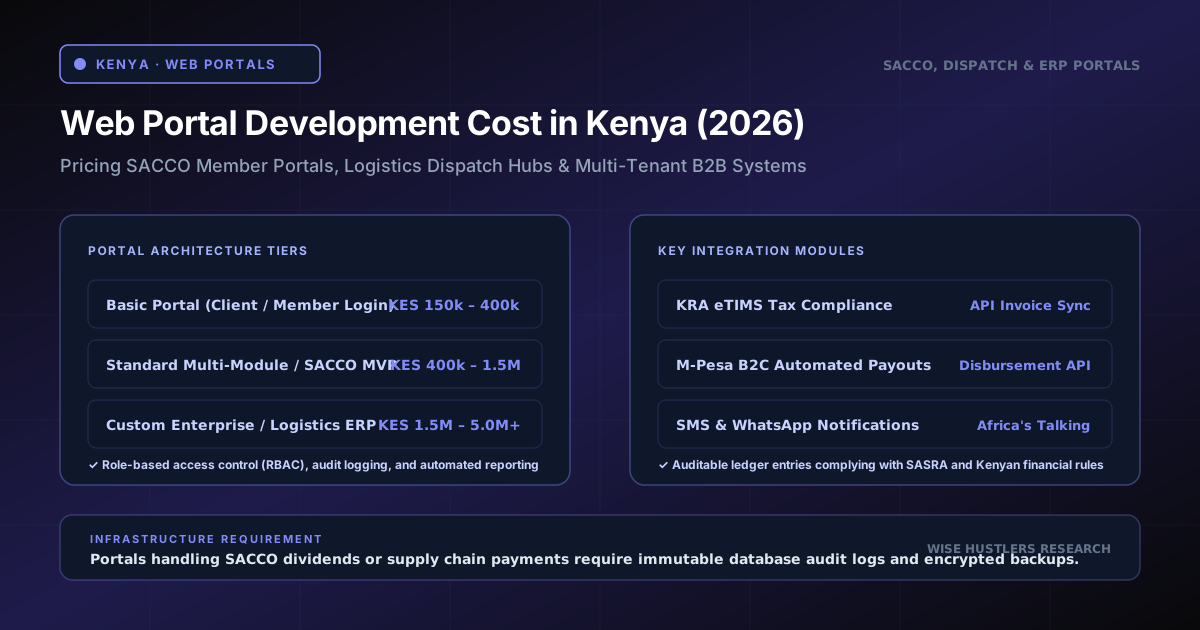
A custom web portal in Kenya costs KES 150,000–400,000 for a single-module build, KES 400,000–1,500,000 for a multi-module portal with M-Pesa integration and role-based access, and KES 1,500,000–5,000,000+ for a full enterprise platform. Prices below are as of late July 2026, at roughly 1 USD = 129.45 KES.
If you've been quoted "contact us for a custom price" and nothing else, keep reading — there's enough published data in this market to know roughly where your project should land before you take a single call.
Web Portal Pricing in Kenya by Tier (2026)
| Tier | Price (KES) | Approx. USD | What you actually get |
|---|---|---|---|
| Basic / Single-Module | 150,000 – 400,000 | 1,160 – 3,090 | One core module (e.g. a member directory, a booking system, or a simple internal tool), a single admin dashboard, basic reports, 30-day post-launch support. |
| Standard / Multi-Module (MVP) | 400,000 – 1,500,000 | 3,090 – 11,585 | Several integrated modules, M-Pesa and SMS integration, role-based access control (member vs. staff vs. admin), 90 days of support plus hosting setup. Most SACCO, logistics-dispatch, and member-portal MVPs land here. |
| Enterprise Platform | 1,500,000 – 5,000,000+ | 11,585 – 38,600+ | Unlimited modules and users, full third-party API integrations, multi-branch support, priority SLA. Genuinely custom-quoted — a single number here means someone skipped the scoping conversation. |
These bands come from a Nairobi software developer's own published pricing page — the same structure (starter, business, enterprise) shows up, with overlapping numbers, on two other local providers' sites, which we cover in the market comparison below. A lighter-weight "custom web application" — a member portal or booking platform without deep integrations — can start as low as KES 250,000 according to a separate Kenyan web agency, which is a useful sanity-check floor rather than a competing tier.
A web portal is a different animal from a marketing website — if you're not sure which one you need, our web portal development page walks through the distinction, and it's worth reading before you request quotes, because "website" and "portal" quotes are not comparable.
What Actually Drives the Price: A Module-by-Module Breakdown
Kenyan dev shops quote in tiers, not itemised invoices — none of the agencies we checked publish a line-by-line "auth costs X, dashboard costs Y" breakdown. So here's what those tiers are actually paying for, module by module, using a real local build type — a SACCO member portal — as the working example, because it's a build that genuinely needs every module below.
Why a SACCO portal. Kenya's deposit-taking SACCOs are regulated by SASRA, which requires them to run a Management Information System capable of generating the statutory reports SASRA demands, and DT-SACCOs must also register with Kenya's Financial Reporting Centre for anti-money-laundering compliance. That's not a nice-to-have feature — it's a regulatory floor a portal has to clear. Coretec Africa, a Kenyan SACCO software vendor, says it serves 70+ SACCOs including Capital Sacco, Stima Sacco, Fortitude Sacco, Waumini Sacco, Kimisitu Sacco, and Finnlemm Sacco, with modules covering core banking, dividend automation, loan approval workflow, bank reconciliation, member registration, internet banking, M-Pesa integration, USSD, and SASRA-compliant reporting — Coretec doesn't publish its own prices, but the module list matches almost exactly what a mid-tier build needs. Safaricom runs its own Sacco Suite product too, which tells you this isn't a niche market — it's active enough that a telco has built for it directly.
Here's what those modules cost to build, based on what's actually sourced plus a transparent estimate where Kenyan vendors don't publish per-module figures (flagged below):
| Module | Estimated cost (KES) | Basis |
|---|---|---|
| Authentication / user & role management | 80,000 – 250,000 | Estimated from typical build effort — not independently quoted per-module by a Kenyan vendor. |
| Admin dashboard | Included from KES 150,000 | Bundled into the entry tier by Quest Designers as "admin dashboard, basic reports." |
| Payments (M-Pesa integration) | 20,000 – 50,000+ for a custom Daraja API build; 5,000 – 15,000 for a pre-built WordPress/WooCommerce plugin | Two independent Kenyan sources give overlapping figures for M-Pesa specifically — this is the best-documented module in the whole market. |
| Reporting / statutory compliance | 100,000 – 350,000 | Estimated — reporting that has to satisfy a regulator needs more QA than a generic chart, but no Kenyan vendor publishes this as a separate line item. |
| Third-party integrations (SMS, USSD, accounting, GPS/delivery APIs) | 60,000 – 400,000 per integration | Estimated; wide range because some Kenyan APIs are well-documented and fast, others aren't. |
The one hard, sourced number in that table is the M-Pesa line — everything else is a reasoned estimate, not a quote, because Kenyan agencies simply don't publish itemised module pricing. Ask any provider for a line-item breakdown before you sign; if they can give you one instantly with no discovery call, be skeptical of how it was produced.
A logistics angle, if that's your sector instead of finance: Kenya's Communications Authority introduced a new Courier-Hailing Service Provider licence for delivery platforms, effective 29 July 2026 — a KES 5,000 application fee, a KES 100,000 initial licence fee (up from KES 30,000), and an annual operating fee of KES 100,000 or 0.4% of gross turnover, whichever is higher, plus a 0.5% Universal Service Levy. Uber, Bolt, and Glovo are named as platforms affected. If you're building a dispatch or delivery-tracking portal in Kenya, that's a real, dated cost on top of development — budget for it the same way you'd budget for the M-Pesa transaction fee below.
Beyond the module list, three general factors move price the most:
- Integration complexity — a portal that only displays data is cheaper than one that writes back to a core system (a bank, an ERP, a regulator's reporting format).
- Number of user roles — two roles (member, admin) is simple; five roles with different permission sets (member, branch staff, branch manager, head office, auditor) adds real logic.
- Data migration — moving existing member/customer records from spreadsheets or an old system into the new portal is routinely underestimated and routinely billed separately.
What brings the price down: launching with fewer modules and adding the rest in a phase two, using a proven local vendor's existing SACCO/ERP product as a base instead of building from zero, and doing your own data cleanup before migration instead of paying the developer to do it.
What's Included vs. What Gets Charged Extra
Kenyan portal quotes commonly bundle initial hosting setup and a support window (30–90 days depending on tier) into the headline price. What's almost always extra, even when it isn't flagged upfront:
- Ongoing support and maintenance after the bundled window — Quest Designers' own published retainer starts from KES 80,000/month for standard support, or from KES 25,000/month for a lighter retained package
- M-Pesa transaction fees themselves (as opposed to the integration build) — Safaricom charges up to 0.55% per transaction on Lipa na M-Pesa Business Till, capped at KES 200, with transactions of KES 200 or below fee-free; the Daraja API access itself is free
- Data migration from legacy systems or spreadsheets
- Third-party API costs the API provider charges (SMS gateway credits, USSD short-code rental)
- Domain (KES 1,500–3,500/year) and hosting (KES 6,000–30,000/year) renewal
- Any regulatory licensing specific to your sector (see the courier licence example above)
- VAT — most published Kenyan software dev pricing, including Quest Designers', is quoted exclusive of VAT
If a quote doesn't separate these out, ask for an itemised version before you pay a deposit.
Real Market Comparison: What Kenyan Providers Actually Publish
Three Kenyan providers publish real pricing for custom web applications and portals — not industry averages, their own numbers:
| Provider | Published price point | What it covers |
|---|---|---|
| Quest Designers | Starter from KES 150,000; Business from KES 400,000; Enterprise on custom quote (up to KES 5,000,000+) | Tiered software development with explicit module inclusions per tier |
| Mocky Digital | Web Applications from KES 150,000 | Custom features, user accounts, database design; the company states 500+ clients over 5+ years |
| Rawlinz Designs (rdxafrika.com) | KES 150,000 (focused web application) to KES 3,000,000+ (full enterprise systems) | Final price set after a discovery consultation |
Notice all three converge on roughly KES 150,000 as the realistic floor for anything you could reasonably call a custom web application — not a template site. Where they diverge is the ceiling: KES 3,000,000+ to KES 5,000,000+ depending on provider and scope. That spread is normal for enterprise-tier work and reflects genuinely different scope, not one provider being dishonest — worth confirming exactly what "enterprise" includes before comparing two quotes on price alone.
How to Avoid Being Overcharged
1. Ask for a module-by-module breakdown, not a single lump sum. As shown above, almost no Kenyan vendor publishes this unprompted — asking for it, and seeing how quickly and specifically they can answer, tells you a lot about how the quote was actually built.
2. Get the exact user roles and permission levels in writing. "Admin access" means different things to different vendors — confirm who can see what before development starts, not after.
3. Confirm who owns the source code and database after final payment. This matters more for portals than websites, because a portal usually holds your actual business data.
4. Separate the build cost from the M-Pesa transaction fee. These are billed by two different parties (your developer vs. Safaricom) — a vendor who quotes them as one number is doing you a disservice.
5. Ask what happens after the bundled support window ends. A KES 400,000 quote with no mention of the KES 80,000+/month retainer that follows it isn't the full cost of ownership — ask for the year-one total, not just the build price.
6. If your sector is regulated (SACCO, logistics, fintech), ask the vendor directly whether they've built for that regulator before. SASRA and the Communications Authority's requirements are specific enough that general web experience isn't the same as sector experience.
FAQ
Is KES 150,000 enough for a real web portal in Kenya?
It's enough for a single-module portal — one core feature, one admin dashboard, basic reports. It won't cover multiple integrated modules, M-Pesa integration at the "Standard" tier level, or the reporting depth a regulated sector like SACCOs needs.
Why do SACCO and logistics portals cost more than a generic member portal?
Because they carry compliance requirements a generic portal doesn't — SASRA's statutory reporting and AML registration for SACCOs, and now a Communications Authority licensing regime for logistics/courier platforms. Those aren't optional features; they're regulatory floors that add real development and reporting work.
Does the portal price include M-Pesa transaction fees?
No. The integration — the code that lets your portal talk to M-Pesa — is a one-time development cost (KES 20,000–50,000+ for a custom build). The transaction fee Safaricom charges per payment (up to 0.55%, capped at KES 200) is separate and ongoing.
How much does portal maintenance cost after launch in Kenya?
Based on one Kenyan vendor's published retainer, budget from roughly KES 25,000–80,000+/month depending on support level, on top of hosting and domain renewal. Our website maintenance cost guide covers this in more depth for general sites, though portals with active integrations typically sit at the higher end of that range because there's more that can need fixing.
Should I build a portal or a mobile app for my Kenya business?
It depends on how your users will access it — a web portal reaches anyone with a browser and no download, which matters in a market where data costs are a real constraint. If you're weighing the two, our mobile app development cost guide breaks down the app side of that comparison.
Getting a Real Quote
If you're scoping a portal build in Kenya, the fastest way to a realistic number is to list your modules before you request quotes — authentication, dashboard, payments, reporting, integrations — and ask each provider to price against that list, not against a vague description. For a build in a regulated sector, confirm sector experience before price. If you want help scoping a SACCO, logistics, or general business portal against real Kenyan pricing rather than a generic estimate, see our web portal development services or get in touch for a scoped conversation rather than a ballpark figure.
---
Technical Architecture & Consultation with Wise Hustlers
For businesses in Kenya scaling digital platforms, Wise Hustlers designs custom software and web portals, high-availability cloud architecture, and automated lead systems. [Speak with our lead engineers today to review your technical scope](https://wise-hustlers.com/contact).