
# Website Maintenance Cost in Kenya: What's Actually Included
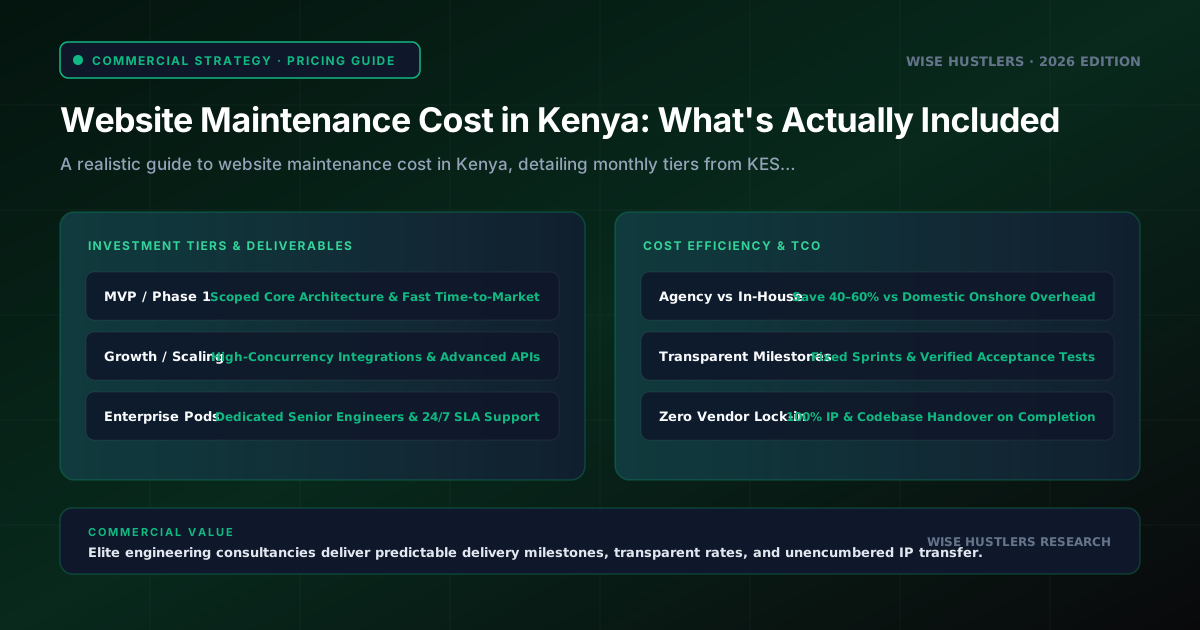
Summary: Based on agency rate cards across Nairobi, website maintenance cost in Kenya typically ranges from KES 5,000 to KES 25,000 monthly for SME sites, KES 35,000 to KES 85,000 for transactional platforms, and $1,200 to $3,500+ for enterprise systems. A robust maintenance plan covers core security updates, Safaricom M-Pesa Daraja API reliability, automated offsite cloud backups, and data protection alignment.
---
For most Kenyan enterprises, launching a website is treated as a one-off capital expense. A business hires an agency in Westlands or Kilimani, signs off on user testing, and celebrates the launch. Within months, however, unmanaged websites decay. Contact forms fail, unpatched plugins expose customer databases, mobile layouts break on budget Android phones, and Safaricom M-Pesa STK Push callbacks timeout during peak shopping hours.
In Kenya's digital economy, your website is an active sales channel, a customer service portal, and a regulated repository of personal data. Understanding the true website maintenance cost in Kenya empowers leadership teams to safeguard brand reputation, maintain statutory compliance, and prevent revenue-killing downtime.
---
The Realities of Running a Digital Platform in Kenya
Operating an online asset in Kenya requires engineering tailored to local telecommunications infrastructure and statutory frameworks:
- Mobile-First Traffic & Bandwidth Economics: According to quarterly statistical reports from the Communications Authority of Kenya (CAK)—where mobile data subscriptions account for over 98% of total internet subscriptions—and traffic telemetry from Statcounter Global Stats (which measures Kenyan mobile handset web traffic consistently between 75% and 85%), the vast majority of users browse via mobile devices on Safaricom, Airtel Kenya, and Telkom. Because users pay directly for metered data bundles, unmaintained sites weighed down by uncompressed media, render-blocking scripts, and bloated plugins suffer steep bounce rates.
- KIXP Peering & Server Latency: Telemetry benchmarks from the Telecommunications Service Providers Association of Kenya (TESPOK) indicate that hosting websites on overseas shared servers (such as un-cached facilities in North America or Europe) introduces network latency between 180ms and 300+ ms of round-trip time (RTT). By contrast, local peering through the Kenya Internet Exchange Point (KIXP) keeps intra-country transit under 20ms. Professional website support Kenya teams configure edge caching, Content Delivery Networks (CDNs), and optimized reverse proxies to ensure sub-second domestic page loads.
- M-Pesa Daraja 2.0 API Dependencies: Unlike card-dominated Western markets, Kenyan e-commerce relies heavily on mobile money gateways, specifically Safaricom’s M-Pesa Daraja 2.0 API, Airtel Money, and payment aggregators such as Pesapal. When payment providers update API tokens, SSL/TLS certificates, or callback endpoints, an unmaintained checkout drops sales without warning if callback URLs and security handshakes are not actively validated.
- Active Regional Cyber Threats: The National Computer and Cybercrimes Coordination Committee (NC4) and the CAK National Cybersecurity Centre (KE-CIRT/CC) quarterly cybersecurity advisories document millions of cyber threat events targeting Kenyan infrastructure each quarter, including web application probes, brute-force attacks, and server misconfigurations. Routine patch management, Web Application Firewalls (WAF), and security audits are necessary to prevent malware injections, database compromises, and domain defacements across local (.ke) domains.
---
Monthly Website Maintenance Cost in Kenya: 2026 Pricing Tiers
Because website maintenance pricing in Kenya is not governed by a statutory tariff, commercial rates vary based on architectural complexity, transaction volume, database dependencies, and contractual Service Level Agreements (SLAs). The table below reflects observed commercial market estimates and agency rate cards across Nairobi's technology ecosystem:
| Tier Level | Estimated Monthly Retainer (KES / USD) | Target Digital Platform | Typical Engineering Hours | Target SLA Response |
|---|---|---|---|---|
| Tier 1: Essential SME | KES 5,000 – KES 15,000 / mo | 5–15 page corporate brochure, service firm, NGO profile | 3–6 hours / month | 24–48 hours (Business days) |
| Tier 2: Growth Mid-Market | KES 20,000 – KES 45,000 / mo | High-traffic lead generation, schools, real estate, clinics | 8–15 hours / month | 8–12 hours (Business hours) |
| Tier 3: Transactional Commerce | KES 50,000 – KES 85,000 / mo | Multi-vendor ecommerce, booking portals, custom M-Pesa checkout | 20–35 hours / month | 2–4 hours (Critical 24/7) |
| Tier 4: Enterprise & Regional | $1,200 – $3,500+ USD / mo | FinTech, tier-1 financial institutions, regional logistics | 40–80+ dedicated hours | 15–30 minutes (24/7/365 SRE) |
Tier 1: Essential SME & Brochure Sites (KES 5,000 – KES 15,000 / month)
Designed for local service providers like law firms in Upper Hill and consulting practices running WordPress or Webflow. Typical scope includes monthly CMS core updates, weekly off-site backups, basic spam filtering, uptime monitoring, and up to two hours for minor content edits.
Tier 2: Mid-Market Corporate & Lead Generation (KES 20,000 – KES 45,000 / month)
Tailored for expanding regional brands dependent on organic search inquiries. This tier includes weekly staging updates, PHP 8.x compatibility checks, broken link fixes, Google Search Console audits, and Core Web Vitals speed optimization for Google Kenya rankings.
Tier 3: Transactional Ecommerce & FinTech Platforms (KES 50,000 – KES 85,000 / month)
Essential for businesses processing real-time payments through Safaricom M-Pesa C2B/B2C, cards, or bank APIs. A dedicated maintenance plan Nairobi retailers rely on includes continuous webhook validation, database cleanups, hourly cloud backups, malware scanning, and priority patch deployment within four hours of zero-day disclosures.
Tier 4: Enterprise & Cross-Border Ecosystems ($1,200 – $3,500+ USD / month)
For commercial financial institutions, microfinance platforms, and pan-African logistics operators, contracts are quoted in USD to reflect multi-cloud infrastructure oversight (AWS Cape Town/Nairobi local zones, Azure, GCP), ISO 27001 compliance standards, CI/CD pipelines, and 24/7 dedicated Site Reliability Engineering (SRE).
---
What Is Actually Included in a Legitimate Website Support Agreement?
A professional maintenance retainer provides structured technical governance across five core operational pillars:
1. Core Technical Upkeep & Security Hardening
- Staging-First Deployment: Testing CMS core, framework packages, and plugin updates in an isolated staging sandbox before pushing changes to production.
- PHP & Server Maintenance: Ensuring server compatibility with supported PHP 8.2+ runtimes, managing SSL/TLS certificates, and enforcing Cloudflare Web Application Firewall (WAF) rules to block brute-force attacks.
2. Safaricom M-Pesa & Payment Gateway Maintenance
- Daraja API Monitoring: Continual validation of M-Pesa Daraja 2.0 consumer keys, token refreshes, and callback webhook endpoints to prevent dropped payments.
- Gateway & SMS Reconciliation: Debugging transaction timeouts with Pesapal or Airtel Money, and maintaining SMS notification rails via Africa's Talking or Advanta Africa.
3. Regulatory Compliance: ODPC Privacy & KRA eTIMS Invoicing
- Data Protection Compliance: Auditing lead capture forms and database storage against the Kenya Data Protection Act 2019, including explicit cookie consent mechanisms and encrypted transmission.
- eTIMS Tax API Oversight: For e-commerce systems required to integrate electronic fiscal invoicing with the Kenya Revenue Authority (KRA), monitoring eTIMS Virtual Sales Control Unit (VSCU) or Online Sales Control Unit (OSCU) API transmission logs to verify that cryptographic tax signatures are consistently generated and recorded without checkout interruption.
4. Automated Offsite Cloud Backups & Disaster Recovery
- Redundant Cloud Snapshots: Storing daily database and media backups on external cloud storage (Amazon S3, Cloudflare R2, or Google Cloud) completely separate from your primary web host.
- Recovery Drills: Conducting scheduled disaster recovery simulations to ensure full website restoration within a contractual recovery time objective (RTO).
Below is an automated, production-grade backup script demonstrating how retained engineering teams safely snapshot a database and push encrypted archives offsite:
#!/usr/bin/env bash
# Automated Off-Site Backup & Cloud Sync Script for Linux / WordPress Environments
set -euo pipefail

BACKUP_DIR="/var/backups/web"
TIMESTAMP=$(date +"%Y%m%d_%H%M%S")
DB_NAME="corporate_db"
DB_USER="backup_user"
S3_BUCKET="s3://enterprise-backups-nairobi/prod"

mkdir -p "${BACKUP_DIR}"

# 1. Generate non-locking transactional database snapshot
mysqldump --single-transaction --quick --skip-lock-tables \
  --user="${DB_USER}" "${DB_NAME}" | gzip > "${BACKUP_DIR}/db_${TIMESTAMP}.sql.gz"

# 2. Archive dynamic uploads directory
tar -czf "${BACKUP_DIR}/uploads_${TIMESTAMP}.tar.gz" -C /var/www/html/wp-content uploads/

# 3. Securely synchronize to offsite cloud storage (AWS S3 / Cloudflare R2)
aws s3 cp "${BACKUP_DIR}/db_${TIMESTAMP}.sql.gz" "${S3_BUCKET}/" --storage-class STANDARD_IA
aws s3 cp "${BACKUP_DIR}/uploads_${TIMESTAMP}.tar.gz" "${S3_BUCKET}/" --storage-class STANDARD_IA

# 4. Prune local archives older than 7 days to preserve disk space
find "${BACKUP_DIR}" -type f -mtime +7 -name "*.gz" -delete

echo "[${TIMESTAMP}] Offsite backup and synchronization completed successfully."
5. Speed Tuning, KIXP Optimization & Technical SEO
- Mobile Bandwidth Optimization: Compressing media into WebP/AVIF formats and configuring server caching rules tuned for local telecommunications providers (Safaricom Home Fibre, Jamii Faiba, Airtel).
- Search Engine Health: Monitoring Google Search Console for crawl anomalies, fixing 404 broken links, and maintaining updated XML sitemaps.
To minimize latency for Kenyan mobile users accessing servers via domestic mobile networks, agencies deploy optimized reverse proxy configurations like the Nginx rule below:
# Nginx Static Asset Cache & Compression for Low-Latency Kenyan Mobile Delivery
location ~* \.(jpg|jpeg|png|webp|avif|css|js|ico|svg|woff2)$ {
    expires 30d;
    add_header Cache-Control "public, no-transform, max-age=2592000";
    access_log off;
    tcp_nodelay off;
    open_file_cache max=3000 inactive=120s;
    open_file_cache_valid 45s;
    open_file_cache_min_uses 2;
    open_file_cache_errors off;
}
---
The Anatomy of a Bad Maintenance Contract: What Shady Agencies Omit
Low-cost agency proposals in Kenya frequently conceal major operational risks through restrictive clauses and omissions:
1. The Staging-Free "Update Button" Gamble: Budget agencies click "Update" directly on your live production site without testing. When a plugin conflicts with custom code, checkout or inquiry forms break without warning during business hours.
2. Excluding Payment Gateway Troubleshooting: Budget contracts often treat third-party API disruptions as out of scope. When payment providers update API parameters, SSL certificates, or callback specifications, the agency may bill ad-hoc emergency fees (frequently ranging from KES 4,500 to KES 8,000 per hour based on prevailing senior engineering rate cards in Nairobi) to investigate and patch the failure.
3. The Co-Located Backup Illusion: Inexperienced providers store backups inside a /backup folder on the same shared cPanel server. When hardware fails or ransomware hits, both your live site and its backups are destroyed.
4. No Guaranteed Service Level Agreement (SLA): Untrustworthy agreements promise "24/7 support" in brochures but commit only to "reasonable commercial effort" in contract text, leaving site crashes unaddressed over weekends.
5. Excluding Malware Remediation: If unpatched software allows code injection or database contamination, low-cost retainers exclude restoration, leaving business owners facing separate emergency incident-response and cleanup fees that typically range between KES 30,000 and KES 60,000 once search engines blacklist the compromised domain.
6. Domain and Credential Hostage-Taking: Disreputable agencies register domains, DNS records, and hosting licenses under agency accounts rather than your corporate name, demanding an "exit fee" if you cancel.
---
Sourcing Website Support in Kenya: Freelancer vs. In-House vs. Retained Agency
Kenyan businesses generally evaluate three operational models for ongoing website care:
| Feature / Metric | Solo Freelancer | In-House Web Developer | Retained Digital Agency |
|---|---|---|---|
| Estimated Monthly Cost | KES 8,000 – KES 20,000 (Typical informal market rates) | KES 85,000 – KES 160,000 (Gross salary based on BrighterMonday Kenya and PayScale tech compensation benchmarks, plus statutory payroll costs) | KES 25,000 – KES 85,000 (Predictable contractual SLA retainer) |
| Skill Set Coverage | Single developer; narrow stack | Generalist; lacks deep security/DevOps depth | Multi-disciplinary (Security, DevOps, Backend, SEO) |
| Availability & Redundancy | High risk; single point of failure | Limited to standard business hours; leave gaps | Structured engineering team with contractual SLAs |
| Enterprise Tooling | Free or unlicensed plugins | Employer pays for licenses, monitoring, and staging | Enterprise security, WAF, and staging tools included |
| Ideal Use Case | Small personal blogs, non-critical static pages | High-volume enterprises requiring continuous daily authoring | Commercial SMEs, ecommerce, financial portals |
A solo freelancer carries high availability risks without formal contractual SLAs, while an in-house hire introduces substantial payroll overhead including gross salary, statutory deductions (PAYE, NSSF, and SHIF contributions), workstations, and software licensing. A retained agency provides a balanced, risk-mitigated model for growing Kenyan companies seeking multi-disciplinary support under guaranteed response times.
Furthermore, when transactional throughput, customer self-service portals, or complex mobile-first logic outgrow standard content management systems, enterprises often shift from simple maintenance to dedicated app development in Kenya to build resilient, API-driven architectures.
---
Local Regulatory & Cybersecurity Requirements for Kenyan Websites
Maintaining a commercial website in Kenya requires compliance with standards enforced by local statutory bodies:
- Office of the Data Protection Commissioner (ODPC): Under the Kenya Data Protection Act 2019, websites collecting personally identifiable information (such as customer names, phone numbers, email addresses, and physical locations) are required to implement appropriate technical and organizational security measures (Section 41). This includes explicit consent management, transport-layer and data-at-rest encryption, and adhering to statutory reporting obligations—such as notifying the Data Commissioner within 72 hours of becoming aware of a serious personal data breach where feasible (Section 43).
- Kenya Revenue Authority (KRA) eTIMS Integration: Commercial platforms operating automated electronic invoicing must maintain reliable integration with KRA's eTIMS endpoints (such as the Virtual Sales Control Unit or Online Sales Control Unit APIs). Website support protocols must monitor API connectivity, handle invoice validation tokens, and ensure cryptographic tax signatures are reliably generated and archived for all taxable e-commerce transactions.
- Communications Authority of Kenya (CAK) & KE-CIRT/CC: The National Computer Incident Response Team Coordination Centre (National KE-CIRT/CC) publishes periodic cybersecurity advisories highlighting vulnerabilities, distributed denial-of-service (DDoS) campaigns, and botnet activity impacting Kenyan digital assets. Retained engineering teams must monitor these threat advisories to proactively patch vulnerabilities before they are exploited across local
.kenamespaces.
---
Frequently Asked Questions
Why does website maintenance cost vary so widely between Nairobi agencies?
Pricing disparities reflect fundamentally different service scopes, technical tooling, and contractual obligations. Lower-cost freelance retainers (frequently quoted between KES 5,000 and KES 10,000 per month on informal channels) typically consist of manual or automated plugin updates applied directly to live production servers without staging sandboxes or external backups. In contrast, professional digital agencies charging structured retainers (typically KES 35,000 to KES 85,000 per month based on local market benchmarks) deliver a multi-disciplinary team covering DevOps, security monitoring, database optimization, and technical SEO, supported by formal Service Level Agreements (SLAs) and incident-response guarantees.
Is M-Pesa Daraja API maintenance included in standard website support in Kenya?
In budget maintenance agreements, payment gateways are often excluded from baseline coverage and billed separately as out-of-scope emergencies. In professional Tier 2 and Tier 3 retainers, M-Pesa Daraja 2.0 API monitoring, callback webhook validation, security token refresh cycles, and transaction error logging are standard deliverables managed within the monthly retainer.
Can our in-house marketing team maintain our company website using automated WordPress plugins?
While marketing personnel can handle content authoring, blog publishing, and media updates, infrastructure maintenance requires dedicated software engineering expertise. Automated plugin and core updates can introduce breaking code changes, corrupt database schemas, or cause incompatibilities with PHP runtimes. Non-technical staff also lack the specialized tooling to configure server-level firewalls, perform malware remediation, tune database indexes, or verify secure API transmissions for payment and statutory integrations.
What specific penalties do Kenyan businesses face if customer website data is breached?
Under Section 63 of the Kenya Data Protection Act 2019, the Office of the Data Protection Commissioner (ODPC) may issue administrative penalty notices of up to KES 5,000,000 or up to 1% of the data controller's or processor's annual turnover of the preceding financial year, whichever is lower, for non-compliance or failure to implement reasonable security safeguards. Beyond statutory enforcement, breached platforms risk severe reputational damage, consumer mistrust, search engine security warnings, and potential civil liability from affected users.
---
Sources
- Office of the Data Protection Commissioner (ODPC) Kenya — Regulatory guidance, compliance standards, and enforcement directives under the Data Protection Act 2019.
- Communications Authority of Kenya (CAK) — National regulatory directives, quarterly sector statistics, and National KE-CIRT/CC cybersecurity advisories.
- Kenya Revenue Authority (KRA) eTIMS Guidelines — Technical integration specifications for electronic Tax Invoice Management Systems (VSCU/OSCU APIs).
- Telecommunications Service Providers Association of Kenya (TESPOK / KIXP) — Latency telemetry, routing statistics, and interconnection benchmarks from the Kenya Internet Exchange Point.
- National Computer and Cybercrimes Coordination Committee (NC4) — Threat matrix alerts and national computer crime frameworks.
- Statcounter Global Stats — Mobile vs. desktop web browser traffic market share telemetry for Kenya.
- BrighterMonday Kenya — Technology sector compensation reports and software engineering salary benchmarks.