
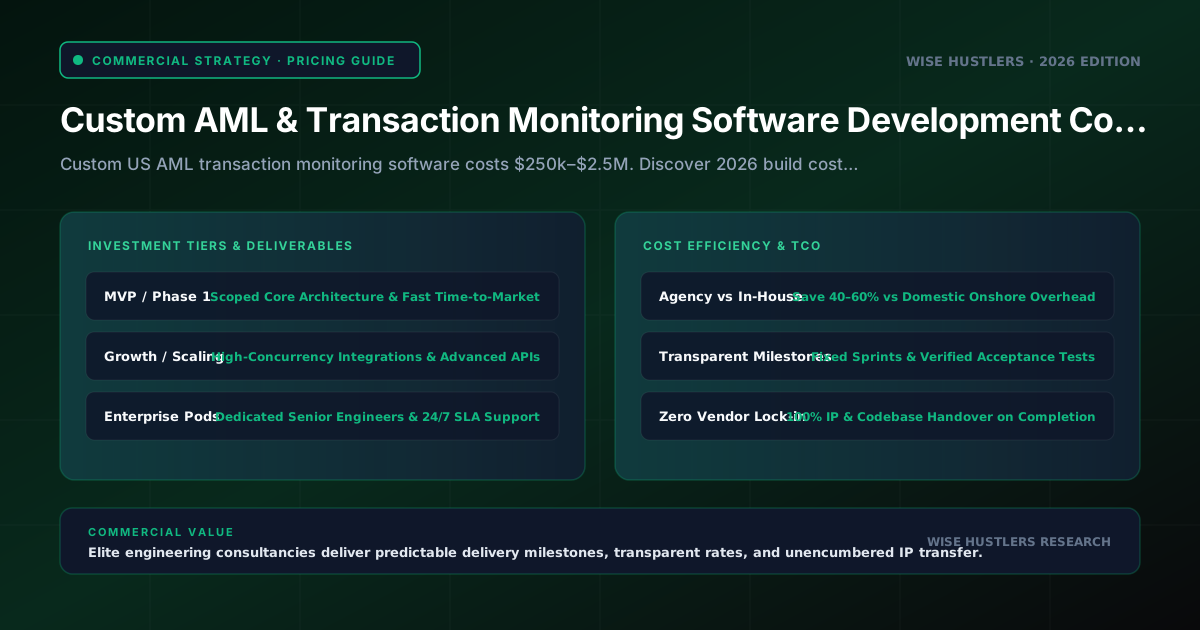
# AML Transaction Monitoring Software Development Cost USA: 2026 Pricing Matrix, FinCEN BSA Pipelines & Rule Tuning ROI
Summary: Custom AML transaction monitoring software development in the USA typically costs between $250,000 for a rules-based MVP and $2,500,000 for an enterprise streaming graph platform, based on standard engineering scope models. For institutions evaluating custom builds versus SaaS subscriptions, proprietary platforms offer architectural control, help mitigate third-party volume surcharges, improve alert tuning efficiency, and align with Federal Reserve SR 11-7 model risk management guidance.
---
The economics of anti-money laundering (AML) compliance have reached a critical inflection point for United States financial institutions, payment processors, neobanks, and fintech platforms. As instant settlement rails—notably The Clearing House's Real-Time Payments (RTP) network and the Federal Reserve’s FedNow Service—compress transaction finality to sub-second windows, legacy batch-monitoring systems are increasingly strained. Simultaneously, regulatory oversight from the Financial Crimes Enforcement Network (FinCEN), the Office of the Comptroller of the Currency (OCC), the Federal Deposit Insurance Corporation (FDIC), and the New York Department of Financial Services (NYDFS) under Part 504 requires institutions to maintain rigorous, auditable monitoring programs.
For Chief Compliance Officers (CCOs), Chief Technology Officers (CTOs), and Chief Financial Officers (CFOs), the decision to build bespoke financial crime detection infrastructure versus licensing commercial Software-as-a-Service (SaaS) platforms (such as Unit21 or ComplyAdvantage) or legacy enterprise suites (such as NICE Actimize or LexisNexis Risk Solutions) represents a major capital allocation decision.
This advisory guide provides a transparent 2026 pricing matrix for custom AML and transaction monitoring software development in the United States, details modern event-driven architectures for automated FinCEN Bank Secrecy Act (BSA) filing pipelines, outlines an SR 11-7 model risk governance framework, and models the operational return on investment (ROI) derived from algorithmic rule tuning.
---
1. AML Transaction Monitoring Software Development Cost in the USA: 2026 Pricing Matrix
The capital expenditure (CapEx) required to design, engineer, validate, and deploy a custom anti-money laundering transaction monitoring platform in the United States is governed by three primary architectural variables: ingestion throughput (events per second), rail diversity (ACH, Fedwire, FedNow, RTP, Card networks, and SWIFT ISO 20022), and detection engine sophistication (deterministic Boolean rules versus streaming graph analytics and machine learning anomaly detection).
Engineering costs in the US fintech sector reflect prevailing market rates for specialized distributed systems architects, financial data engineers, and regulatory compliance technologists, who typically bill between $140 and $220 per hour. Based on project scope and technical complexity, custom builds generally fall into three operational tiers.
+----------------------------------------------------------------------------------------------------+
|                                    2026 COST TIER SPECTRUM                                         |
|                                                                                                    |
|  Tier 1: Rules-Based MVP             Tier 2: Real-Time Stream & Graph       Tier 3: Enterprise Multi-Rail   |
|  $250,000 – $450,000                 $450,000 – $1,100,000                  $1,100,000 – $2,500,000+       |
|  (3–5 Months | 1,500–2,500 Eng Hrs)  (6–9 Months | 3,000–6,000 Eng Hrs)     (9–14 Months | 7,000–14,000+ Hrs)|
|  Single/Dual Rail | 50–200 TPS       Multi-Rail | 1,000–5,000 TPS           All US Rails + Instant | 25k+ TPS|
+----------------------------------------------------------------------------------------------------+
Table 1: 2026 Cost Tier Matrix for Custom US AML Software
| Architecture Tier | Target Monthly Volume | Supported Payment Rails | Core Detection & Compliance Capabilities | Build Timeline & Effort | Estimated Capital Expenditure (USD) | Annual AWS/GCP & Maintenance Cost |
|---|---|---|---|---|---|---|
| Tier 1: Rules-Based MVP | 50,000 to 300,000 transactions | ACH (CCD/PPD) & Fedwire | Deterministic rules engine (velocity, threshold, structuring), post-transaction batch ingestion, manual SAR export, basic audit log. | 3 to 5 months (1,500–2,500 engineering hours) | $250,000 – $450,000 | $40,000 – $75,000 |
| Tier 2: Real-Time Stream & Behavioral Graph | 300,000 to 3,000,000 transactions | ACH, Wire, RTP, Card (Visa/Mastercard ISO 8583) | Streaming Complex Event Processing (Kafka/Flink), sub-second latency, Neo4j/Neptune graph entity resolution, automated risk scoring, unified case management, semi-automated FinCEN Form 111 XML packaging. | 6 to 9 months (3,000–6,000 engineering hours) | $450,000 – $1,100,000 | $85,000 – $180,000 |
| Tier 3: Enterprise Multi-Rail & Automated FinCEN Pipeline | 3,000,000 to 50,000,000+ transactions | FedNow, RTP, ACH, Fedwire, SWIFT ISO 20022, Digital Assets | Microsecond in-memory stream processing, automated FinCEN BSA E-Filing pipeline (mTLS/SDX), isolation forest & GNN typology detection, Federal Reserve SR 11-7 validation framework, high-availability active-active disaster recovery. | 9 to 14 months (7,000–14,000+ engineering hours) | $1,100,000 – $2,500,000+ | $190,000 – $420,000 |
Note: Infrastructure costs depend on provisioned capacity, including managed Apache Kafka (AWS MSK), multi-AZ relational databases, memory caches, graph compute clusters, and cloud data egress fees.
Component-by-Component Engineering Cost Breakdown
Engineering budgets reflect the individual technical subsystems required for a production-grade, audit-ready financial crime platform:
1. High-Throughput Streaming Ingestion & Normalization Layer ($45,000 – $180,000): Builds fault-tolerant Kafka or Redpanda event ingestion fabrics (approx. 250 to 900 engineering hours). Converts disparate rail payloads (ISO 20022 XML, NACHA ACH fixed-width records, and proprietary JSON payloads) into a unified canonical financial event schema.
2. Dynamic Rule Engine with Domain-Specific Language (DSL) ($60,000 – $220,000): Delivers a business-logic interface (approx. 350 to 1,100 engineering hours) allowing compliance teams to author, test, and hot-reload rules (e.g., rapid velocity shifts, out-of-pattern geographic deviations, smurfing aggregations) without requiring complete system redeployment.
3. Graph Entity Resolution & Network Clustering Engine ($80,000 – $380,000): Deploys Amazon Neptune or Neo4j (approx. 450 to 1,900 engineering hours) to cluster counterparties across synthetic identities, shared device fingerprints, common bank routing numbers, and known high-risk ultimate beneficial owners (UBOs).
4. Machine Learning Anomaly Detection & Typology Models ($75,000 – $420,000): Trains supervised and unsupervised models (Isolation Forests, XGBoost, and Graph Neural Networks; approx. 400 to 2,100 engineering hours) targeting mule accounts, layering strategies, and illicit financing patterns while maintaining mathematical explainability for regulatory reviews.
5. Unified Investigator Case Management & Audit Interface ($65,000 – $250,000): Provides a single-pane-of-glass UI for compliance analysts (approx. 350 to 1,250 engineering hours). Incorporates timeline visualizations, counterparty relationship maps, automated narrative draft generation, and role-based access control (RBAC).
6. Automated FinCEN BSA E-Filing SAR/CTR Packaging Engine ($50,000 – $240,000): Collates suspicious activity records, transforms investigator dossiers into FinCEN Form 111 (SAR) and Form 112 (CTR) schema-compliant XML (v2.0), applies digital signatures, transmits via secure protocol, and logs FinCEN acceptance acknowledgments (approx. 300 to 1,200 engineering hours).
7. Security, Encryption, KMS, and Immutable Audit Trails ($40,000 – $190,000): Enforces Write-Once-Read-Many (WORM) storage, envelope encryption via AWS KMS or HashiCorp Vault, and field-level tokenization for non-public personal information (NPI) to support alignment with NYDFS Part 504 and GLBA standards (approx. 250 to 950 engineering hours).
8. SR 11-7 Model Governance, Backtesting Harness & Sandbox ($35,000 – $160,000): Establishes offline simulation environments to backtest rule adjustments against 12 months of historical transaction data, generating automated sensitivity documentation for banking examiners (approx. 200 to 800 engineering hours).
Institutions evaluating bespoke architecture often collaborate with specialized engineering firms. To explore how senior fintech architects construct compliant, production-grade transaction platforms, review Wise Hustlers custom fintech engineering.
---
2. Custom AML System vs. Commercial SaaS & Off-The-Shelf Platforms: Total Cost of Ownership (TCO)
Commercial off-the-shelf (COTS) AML platforms offer rapid initial onboarding and low initial engineering friction. However, as an institution's transaction throughput scales into millions of monthly events, the ongoing licensing economics warrant careful comparative analysis.
The Cost Structure of Third-Party SaaS & Commercial Platforms
Commercial AML vendors structure pricing through multi-layered enterprise agreements. While exact pricing is negotiated under non-disclosure agreements, procurement benchmarks across the fintech industry reveal consistent fee components:
- Base Platform Subscriptions: Annual commitments that cover core platform access, user seat allocations, and maintenance.
- Volume Consumption & Overage Charges: Graduated per-event or block-tiered fees for transaction processing exceeding standard base allocations.
- Third-Party Data Enrichment: Additional costs for PEP, sanctions, adverse media, and device intelligence queries, which are either billed per call or bundled with platform processing fees.
- Implementation & Professional Services: Upfront integration, workflow customization, and rule migration charges billed during onboarding.
When an institution scales from 500,000 monthly transactions to 5,000,000+ monthly transactions, variable volume fees can become a substantial recurring operational expense.
Table 2: 3-Year Total Cost of Ownership (TCO) Architectural Model (Normalized at 2,000,000 Transactions/Month)
The comparison below presents an illustrative financial model based on normalized enterprise operational parameters (2,000,000 monthly transactions / 24,000,000 annual transactions). Figures represent modeled benchmarks rather than specific commercial contract quotes.
| Cost & Operational Dimension | Proprietary In-House Build (Tier 2/3 Benchmark Model) | Multi-Tenant Commercial SaaS (Modeled Industry Archetype) | Legacy Enterprise Platform (Modeled Industry Archetype) |
|---|---|---|---|
| Year 1 Capital Expenditure (Build / Setup) | $750,000 (Development & Infrastructure) | $80,000 (Integration & Onboarding) | $450,000 (Implementation & Customization) |
| Year 1 Operational / Licensing Cost | $110,000 (Cloud Hosting & Tier-3 Support) | $480,000 (Base fee + 24M tx volume tier) | $620,000 (Annual enterprise license) |
| Year 2 Total Cost | $120,000 (Hosting, Tuning & Upgrades) | $540,000 (Volume growth adjustment) | $680,000 (Maintenance & License) |
| Year 3 Total Cost | $130,000 (Hosting & Feature Expansion) | $610,000 (Volume growth adjustment) | $740,000 (Maintenance & License) |
| Cumulative 3-Year TCO | $1,110,000 | $1,710,000 | $2,490,000 |
| Data Sovereignty & Model Ownership | Full proprietary code & database control | Vendor-hosted data; shared tenancy | Hosted or on-prem; vendor-locked models |
| Network & Execution Latency Profile | Sub-50ms (in-VPC streaming pipeline) | 150ms to 600ms+ (External REST round-trip) | Batch processing to multi-second delays |
| Regulatory Examination Auditability | Direct access to rule logic, weights & data lineage | Dependent on vendor documentation & roadmaps | Complex legacy change orders & reporting delays |
Disclaimer: Modeled data illustrates comparative financial trajectories based on typical market estimates. Actual commercial pricing varies based on negotiated master service agreements (MSAs), custom feature sets, and volume commitments.
TCO ($ Millions)
 2.5 |                                              /-- Legacy Enterprise Archetype ($2.49M)
 2.0 |                                 /-----------/
 1.5 |                     /----------/             /-- Commercial SaaS Archetype ($1.71M)
 1.0 |         /----------/              /---------/
 0.5 |  /-----/               /---------/               /-- Custom Build Model ($1.11M)
 0.0 +-------------------------------------------------
       Month 0               Month 18                 Month 36
       (Build Phase)         (Breakeven Inflection)   (Compounding Operational Efficiency)
Capital Amortization & The Breakeven Inflection Formula
The capital breakeven point ($T_{breakeven}$) for custom software development relative to recurring commercial software licensing can be evaluated using the standard capital amortization formula:
$$T_{breakeven} = \frac{\text{Initial Build CapEx} - \text{Commercial Setup Fee}}{\text{Monthly Commercial Licensing \& Volume Fees} - \text{Monthly Cloud Infrastructure \& Maintenance}}$$
Modeled Scenario: Consider a financial institution processing 1,500,000 monthly transactions. If commercial licensing, volume charges, and data fees total $45,000 per month ($540,000 annually) with a $50,000 setup fee, compared against a custom proprietary platform requiring $650,000 to design and deploy with $9,000 per month in managed cloud infrastructure:
$$T_{breakeven} = \frac{\$650,000 - \$50,000}{\$45,000 - \$9,000} = \frac{\$600,000}{\$36,000} \approx 16.7\text{ months}$$
In this modeled scenario, the upfront capital expenditure reaches parity at approximately 17 months. Beyond that threshold, the institution captures significant recurring cost savings while retaining proprietary intellectual property, customized detection models, and full operational control.
---
3. FinCEN BSA Transaction Monitoring Software Architecture
Modern financial crime detection systems require decoupled, event-driven distributed architectures capable of inspecting transactions prior to payment execution or within milliseconds of clearing.
FinCEN BSA E-Filing Event-Driven Architecture Blueprint
The diagram below outlines an end-to-end event-driven architecture for multi-rail monitoring and automated regulatory filing:
flowchart TD
    subgraph Ingestion["1. Multi-Rail Ingestion Layer"]
        R1[FedNow / RTP Stream] -->|ISO 20022 pacs.008| API[Streaming API Gateway]
        R2[ACH NACHA Files] -->|Batch / SFTP| P1[NACHA Parser]
        R3[Fedwire / SWIFT] -->|MT103 / pacs.008| API
        R4[Card Network ISO 8583] -->|Kafka Producer| API
    end

    subgraph Processing["2. Real-Time Event Processing Fabric"]
        API --> K1[Apache Kafka / Redpanda Cluster]
        P1 --> K1
        K1 --> Flink[Apache Flink Stream Processor]
        Flink <--> Cache[(Redis State Cache)]
        Flink <--> GraphDB[(Neo4j / Amazon Neptune Graph)]
    end

    subgraph Analytics["3. Hybrid Detection Engine"]
        Flink --> Rules[Deterministic Rules Engine]
        Flink --> ML[ML Anomaly & Typology Scorer]
        Rules --> Agg[Risk Score Aggregator]
        ML --> Agg
    end

    subgraph AlertOrchestration["4. Case Management & Investigator Review"]
        Agg -->|Score >= Threshold| AlertQ[High-Priority Alert Queue]
        Agg -->|Score < Threshold| AutoClear[Immutable Audit Log - Cleared]
        AlertQ --> CaseUI[Unified Case Management UI]
        CaseUI --> Inv[BSA Compliance Officer Review]
    end

    subgraph RegulatoryPipeline["5. Automated FinCEN BSA E-Filing Pipeline"]
        Inv -->|Approve SAR| SARPrep[SAR XML Form 111 Generator]
        Inv -->|Approve CTR| CTRPrep[CTR XML Form 112 Generator]
        SARPrep --> SchemaVal[FinCEN XML v2.0 Schema Validator]
        CTRPrep --> SchemaVal
        SchemaVal --> Sig[Cryptographic Digital Signer]
        Sig --> SDX[FinCEN SDX / Web Services via TLS]
        SDX --> ACK[FinCEN ACK / NACK Tracker]
        ACK --> WORM[(Immutable WORM Compliance Ledger)]
    end
Architectural Subsystem Breakdown
1. Multi-Rail Ingestion: Specialized parsers process ISO 20022 messages (pacs.008 financial institutional credit transfer, pacs.004 payment return), NACHA 94-character batch records, and card authorization streams. Normalization pipelines transform disparate payloads into an immutable canonical event envelope stamped with UTC timestamps, routing transit numbers (RTNs), and counterparty identifiers.
2. Stream Processing Fabric: Apache Flink processes events across sliding time windows (e.g., 10-minute velocity bursts, 24-hour structuring aggregates, 30-day inflow counters). Redis maintains sub-millisecond state counters, while graph databases track multi-hop counterparty connectivity to detect circular laundering loops.
3. Automated Regulatory Reporting Pipeline:
- Trigger Evaluation: Under 31 CFR § 1010.311, currency transactions exceeding $10,000 conducted by or on behalf of one individual in a single business day trigger a Currency Transaction Report (CTR). Under 31 CFR § 1020.320, suspicious activities involving known or suspected illicit behavior meeting statutory thresholds trigger a Suspicious Activity Report (SAR).
- XML Packaging: Transforms case dossier records into the official FinCEN BSA Electronic Filing XML Schema (Version 2.0). Ensures mandatory party identifiers, account data, TIN/EIN records, and narrative descriptions adhere strictly to schema constraints.
- Secure Transmission: Interfaces with FinCEN's BSA E-Filing System using Secure Data Exchange (SDX) over SFTP or Web Services using TLS and digital certificates issued to registered institutions.
- Acknowledgment Tracking: Ingests and parses FinCEN acknowledgment (ACK) files, linking the permanent BSA Identifier (BSAIR) to the internal audit record to guarantee complete regulatory traceability under 31 CFR § 1010.430.
Production Code Snippet: Real-Time Structuring & Velocity Evaluation Engine
The following Python component demonstrates an in-memory streaming evaluator that inspects transaction streams for classic structuring patterns (deposits designed to evade the $10,000 CTR reporting threshold under 31 CFR § 1010.311) using sliding time-window state tracking:
"""
FinCEN BSA Structuring & Velocity Evaluation Engine
Production-grade prototype demonstrating sliding time-window aggregation
and explainable alert scoring for AML compliance systems.
"""

from dataclasses import dataclass, field
from datetime import datetime, timezone
from typing import Dict, List, Optional
import json


@dataclass(frozen=True)
class FinancialTransaction:
    transaction_id: str
    account_id: str
    amount_cents: int
    rail: str  # ACH, FEDNOW, RTP, WIRE, CASH
    direction: str  # CREDIT, DEBIT
    timestamp: datetime
    counterparty_id: Optional[str] = None


@dataclass
class AlertPayload:
    alert_id: str
    account_id: str
    typology: str
    risk_score: float
    trigger_reason: str
    associated_transactions: List[str]
    metadata: Dict[str, str] = field(default_factory=dict)


class StructuringRuleEngine:
    def __init__(
        self,
        structuring_lower_bound_cents: int = 800_000,   # $8,000.00
        structuring_upper_bound_cents: int = 1_000_000,   # $10,000.00 (CTR Threshold)
        window_seconds: int = 86_400,                   # 24-hour rolling window
        velocity_count_threshold: int = 3,
    ):
        self.lower_bound = structuring_lower_bound_cents
        self.upper_bound = structuring_upper_bound_cents
        self.window_seconds = window_seconds
        self.velocity_threshold = velocity_count_threshold
        # In-memory window store; production implementations use Redis Sorted Sets (ZADD/ZREMRANGEBYSCORE)
        self._account_windows: Dict[str, List[FinancialTransaction]] = {}

    def ingest_transaction(self, tx: FinancialTransaction) -> Optional[AlertPayload]:
        now = tx.timestamp.replace(tzinfo=timezone.utc)
        cutoff = now.timestamp() - self.window_seconds

        # Retrieve and prune existing sliding window
        window = self._account_windows.setdefault(tx.account_id, [])
        window = [t for t in window if t.timestamp.replace(tzinfo=timezone.utc).timestamp() >= cutoff]
        window.append(tx)
        self._account_windows[tx.account_id] = window

        # Evaluation 1: Check for sub-threshold deposit structuring
        sub_threshold_txs = [
            t for t in window
            if t.direction == "CREDIT" and self.lower_bound <= t.amount_cents < self.upper_bound
        ]

        if len(sub_threshold_txs) >= self.velocity_threshold:
            total_cents = sum(t.amount_cents for t in sub_threshold_txs)
            return AlertPayload(
                alert_id=f"ALT-STRUC-{tx.account_id}-{int(now.timestamp())}",
                account_id=tx.account_id,
                typology="POTENTIAL_CTR_EVASION_STRUCTURING",
                risk_score=0.88,
                trigger_reason=(
                    f"Detected {len(sub_threshold_txs)} transactions between "
                    f"${self.lower_bound / 100:.2f} and ${self.upper_bound / 100:.2f} "
                    f"within 24 hours totaling ${total_cents / 100:.2f}."
                ),
                associated_transactions=[t.transaction_id for t in sub_threshold_txs],
                metadata={
                    "regulatory_predicate": "31 CFR § 1010.311",
                    "evaluation_engine": "Deterministic-DSL-v2",
                },
            )

        # Evaluation 2: Rapid Velocity Accumulation
        credit_txs = [t for t in window if t.direction == "CREDIT"]
        total_inflow = sum(t.amount_cents for t in credit_txs)
        if total_inflow >= 2_500_000 and len(credit_txs) >= 5:  # $25,000 across 5+ events
            return AlertPayload(
                alert_id=f"ALT-VELOC-{tx.account_id}-{int(now.timestamp())}",
                account_id=tx.account_id,
                typology="RAPID_INFLOW_VELOCITY_SPIKE",
                risk_score=0.76,
                trigger_reason=f"Aggregated {len(credit_txs)} inflows totaling ${total_inflow / 100:.2f} in 24h.",
                associated_transactions=[t.transaction_id for t in credit_txs],
                metadata={"regulatory_predicate": "31 CFR § 1020.320"},
            )

        return None


if __name__ == "__main__":  # Verification test execution
    engine = StructuringRuleEngine()
    test_account = "ACC-CORP-90210"
    base_time = datetime.now(timezone.utc)

    # Ingest 3 transactions just under the $10,000 threshold within a 4-hour span
    sample_events = [
        FinancialTransaction("TX-001", test_account, 920_000, "FEDNOW", "CREDIT", base_time),
        FinancialTransaction("TX-002", test_account, 890_000, "ACH", "CREDIT", base_time),
        FinancialTransaction("TX-003", test_account, 950_000, "RTP", "CREDIT", base_time),
    ]

    for event in sample_events:
        alert = engine.ingest_transaction(event)
        if alert:
            print(f"[ALERT TRIGGERED] ID: {alert.alert_id}")
            print(f"Typology: {alert.typology} | Risk Score: {alert.risk_score}")
            print(f"Reason: {alert.trigger_reason}")
            print(f"Filing Reference: {alert.metadata['regulatory_predicate']}\n")
---
4. Federal Reserve SR 11-7 Model Risk Management (MRM) Mitigation Framework
Deploying automated detection algorithms and machine learning models within regulated banking and fintech environments requires adherence to established model governance frameworks. The Board of Governors of the Federal Reserve System and the OCC established foundational guidance in SR 11-7 (Supervisory Guidance on Model Risk Management) and OCC Bulletin 2011-12.
Examiners evaluating an institution's BSA/AML transaction monitoring infrastructure review three fundamental governance components:
+----------------------------------------------------------------------------------------------------+
|                         FEDERAL RESERVE SR 11-7 COMPLIANCE ARCHITECTURE                            |
|                                                                                                    |
|  1. Conceptual Soundness         2. Ongoing Monitoring              3. Outcomes Analysis            |
|  - Theoretical Typology Basis   - Parameter Drift Detection        - Historical Backtesting        |
|  - Feature Lineage & Origin     - Shadow Model Comparison          - Sensitivity & Stress Testing  |
|  - Explainable Logic (SHAP/LIME)- Execution Latency Tracking       - Independent Validation Store  |
+----------------------------------------------------------------------------------------------------+
Pillar 1: Model Conceptual Soundness & Developmental Documentation
- Clear Typology Mapping: Every rule, algorithmic threshold, and machine learning classifier must be supported by documented business rationale tied to recognizable illicit typologies (e.g., structuring, rapid movement of funds, layering, funnel accounts).
- Mathematical Transparency & Explainability: Under SR 11-7, unexplainable "black-box" models pose significant validation risks during examinations. Custom systems employ explainable AI frameworks (such as TreeSHAP on gradient-boosted decision trees or localized surrogate models) to ensure every risk score includes quantifiable feature attribution scores that compliance analysts can explain to examiners.
Pillar 2: Ongoing Monitoring, Operational Benchmarking & Shadow Scoring
- Distributional Drift Tracking: Transaction patterns shift over time due to seasonal business cycles and evolving illicit methods. Automated monitoring harnesses evaluate model decay by tracking the Population Stability Index (PSI) and Kolmogorov-Smirnov (KS) metrics across incoming feature distributions.
- Champion-Challenger Framework: Proposed rule modifications and updated machine learning models run in a shadow mode alongside active production models, processing identical live event streams. This allows compliance leadership to measure alert volume changes and false-positive shifts before deploying changes to live production.
Pillar 3: Outcomes Analysis & Rigorous Backtesting
- Sensitivity & Stress Testing: Systems must provide analytical sandboxes to evaluate the impact of threshold modifications against historical transaction data (e.g., quantifying how shifting an ACH velocity trigger from $9,000 to $8,500 affects alert volume across 180 days of historical transactions).
- Independent Validation Readiness: Development code bases, model training pipelines, parameter configurations, and execution engines should be cleanly isolated with immutable versioning. This architectural segregation enables internal audit teams or independent third-party validators to review models without impacting production environments.
Production Config Snippet: SR 11-7 Model Validation & Drift Detection Pipeline
Below is a production-grade Python script illustrating how model risk management teams compute the Population Stability Index (PSI) to detect feature drift in transaction monitoring scoring distributions:
"""
SR 11-7 Population Stability Index (PSI) Drift Monitor
Calculates distributional shift between baseline (training/validation)
and production scoring distributions for AML transaction monitoring models.
Implemented using Python standard library for zero-dependency execution.
"""

import math
import random
from typing import Dict, List, Tuple


def calculate_psi(
    baseline_scores: List[float],
    production_scores: List[float],
    num_buckets: int = 10,
) -> Tuple[float, Dict[str, any]]:
    """
    Computes PSI across score distributions.
    Standard SR 11-7 interpretation guidelines:
      - PSI < 0.10: No significant shift; model stable.
      - 0.10 <= PSI < 0.25: Moderate shift; warrants monitoring and review.
      - PSI >= 0.25: Significant shift; model requires recalibration/revalidation.
    """
    baseline_sorted = sorted(baseline_scores)
    n_base = len(baseline_sorted)
    n_prod = len(production_scores)

    # Establish quantile bucket edges from baseline distribution
    bucket_edges = []
    for i in range(num_buckets + 1):
        idx = min(int(round((i / num_buckets) * (n_base - 1))), n_base - 1)
        bucket_edges.append(baseline_sorted[idx])

    bucket_edges[0] -= 1e-6
    bucket_edges[-1] += 1e-6

    # Bin counts
    def get_bucket_counts(scores: List[float], edges: List[float]) -> List[int]:
        counts = [0] * (len(edges) - 1)
        for val in scores:
            for b in range(len(edges) - 1):
                if edges[b] <= val < edges[b + 1] or (b == len(edges) - 2 and val == edges[b + 1]):
                    counts[b] += 1
                    break
        return counts

    baseline_counts = get_bucket_counts(baseline_scores, bucket_edges)
    production_counts = get_bucket_counts(production_scores, bucket_edges)

    # Convert to proportions with smoothing to prevent division by zero
    eps = 1e-4
    total_psi = 0.0
    for b in range(num_buckets):
        base_pct = (baseline_counts[b] + eps) / (n_base + eps * num_buckets)
        prod_pct = (production_counts[b] + eps) / (n_prod + eps * num_buckets)
        total_psi += (prod_pct - base_pct) * math.log(prod_pct / base_pct)

    # Determine governance status under SR 11-7 principles
    if total_psi < 0.10:
        status = "STABLE"
    elif total_psi < 0.25:
        status = "MODERATE_DRIFT_WARNING"
    else:
        status = "CRITICAL_DRIFT_RECALIBRATION_REQUIRED"

    report = {
        "total_psi": round(total_psi, 4),
        "status": status,
        "bucket_count": num_buckets,
        "sample_sizes": {"baseline": n_base, "production": n_prod},
    }
    return total_psi, report


if __name__ == "__main__":
    random.seed(42)
    # Baseline validation scores (beta distribution centered at lower risk values)
    baseline = [random.betavariate(2, 8) for _ in range(5000)]

    # Scenario A: Stable production traffic matching training distribution
    stable_prod = [random.betavariate(2.05, 7.95) for _ in range(2500)]
    psi_a, report_a = calculate_psi(baseline, stable_prod)
    print(f"Scenario A (Normal Traffic)       -> PSI: {psi_a:.4f} | Status: {report_a['status']}")

    # Scenario B: Significant drift (e.g., emergence of high-risk structuring network)
    drifted_prod = [random.betavariate(4, 5) for _ in range(2500)]
    psi_b, report_b = calculate_psi(baseline, drifted_prod)
    print(f"Scenario B (Distributional Shift) -> PSI: {psi_b:.4f} | Status: {report_b['status']}")
For engineering teams seeking strategic alignment on complex regulatory architectures and compliance data pipelines, consult with Wise Hustlers custom fintech engineering.
---
5. False-Positive Reduction & Rule Tuning ROI
In traditional threshold-based AML transaction monitoring systems, elevated false-positive rates represent one of the largest ongoing operational cost drivers for financial compliance departments.
The Operational Economics of Alert Inefficiency
According to research from industry analysis firms including Celent and the LexisNexis Risk Solutions True Cost of Financial Crime Compliance Study, traditional static rules engines generate false-positive rates that frequently span 90% to 98%. Each alert necessitates manual triage, identity verification, cross-account inspection, adverse media checks, and formal documented clearing rationale.
Based on compliance staffing benchmarks and US Bureau of Labor Statistics (BLS) data for financial compliance examiners, fully burdened analyst labor costs typically range from $45.00 to $75.00 per hour. With an average review time of 30 to 60 minutes per alert, the operational review cost ranges between $25.00 and $65.00 per generated alert.
Modeled Alert Funnel (15,000 Monthly Alerts @ 95% False-Positive Rate):
├── 14,250 False Positives (95%)  --> $356,250 to $926,250 / month in analyst review costs
└──    750 Legitimate Inquiries (5%) --> Escalated for formal SAR investigation
By transitioning from simplistic single-variable thresholds to multi-variable contextual filtering, streaming graph analysis, and supervised anomaly scoring, institutions can substantially lower alert noise while maintaining regulatory defensibility.
Table 3: False-Positive Reduction & Operational Labor Modeling Table
The model below illustrates the estimated annual labor cost required to manage alert queues for an institution processing 1,000,000 monthly transactions across differing detection methodologies:
| Detection & Filtering Methodology | Modeled False-Positive Range | Monthly Alerts (per 1M Tx Model) | Estimated Monthly Analyst Hours | Modeled Annual Labor Cost (@ $50/hr Burdened) | Supervisory Audit Defensibility |
|---|---|---|---|---|---|
| Basic Static Thresholds (e.g., Single rule: Wire > $10,000) | 90% – 97% | 12,000 alerts | 6,000 hours | $3,600,000 | Prone to significant backlogs and remediation consent orders |
| Dynamic Multi-Variable Rules (Velocity + Entity Age + Transaction Ratio) | 65% – 75% | 4,200 alerts | 2,100 hours | $1,260,000 | High (Clear, deterministic Boolean audit trails) |
| Graph-Based Entity Resolution (Synthetic Identity & Link Clustering) | 45% – 55% | 2,100 alerts | 1,050 hours | $630,000 | Very High (Clarifies coordinated ring networks) |
| Hybrid Rules + Supervised Anomaly Scoring (Isolation Forest + XGBoost) | 28% – 38% | 1,300 alerts | 650 hours | $390,000 | High (Requires feature attribution e.g. SHAP for SR 11-7) |
| AI-Assisted Case Triage & Narrative Pre-Filing | 15% – 25% | 750 alerts | 375 hours | $225,000 | High (Maintains human-in-the-loop signoff) |
Note: Model assumes an average review duration of 30 minutes per generated alert at a fully loaded analyst compensation rate of $50 per hour. Actual metrics depend on product portfolio, customer risk profiles, and historical alert baselines.
Financial Return on Investment (ROI) Modeling of Algorithmic Rule Tuning
Consider an institution processing 1,000,000 monthly transactions that refines its transaction monitoring platform from basic static rules to a hybrid graph and dynamic rules architecture:
- Baseline Operational Cost: 12,000 monthly alerts × 0.5 hours × $50/hour = $300,000/month ($3,600,000 annually).
- Tuned Model Operational Cost: 2,100 monthly alerts × 0.5 hours × $50/hour = $52,500/month ($630,000 annually).
- Modeled Annual Operational Savings: $2,970,000 annually.
Under this operational model, an initial capital investment of $650,000 to $850,000 in custom architecture and rule tuning can amortize within the first year of deployment, driven by the substantial reduction in manual investigator overhead.
---
6. Specialized Financial Crime Software Vendor Selection Criteria
When selecting an engineering partner to architect an institution's proprietary AML transaction monitoring platform, executive leadership should apply rigorous technical vetting. Generalist software agencies lacking deep capital markets and BSA/AML experience introduce significant regulatory vulnerability.
The 7 Technical Vetting Pillars
+----------------------------------------------------------------------------------------------------+
|                                 VENDOR SELECTION VETTING PILLARS                                   |
|                                                                                                    |
|  [1] FinCEN Schema v2.0   [2] Sub-100ms Ingestion    [3] ISO 20022 Multi-Rail                     |
|  Direct SDX XML packaging  Kafka/Flink throughput     pacs.008, FedNow native                     |
|                                                                                                    |
|  [4] Graph Resolution     [5] SR 11-7 Protocols      [6] Cryptographic Audit [7] Full IP Ownership |
|  Neptune/Neo4j clustering Explainable ML/SHAP       WORM / KMS immutability   Zero recurring fees  |
+----------------------------------------------------------------------------------------------------+
1. Direct FinCEN BSA E-Filing Specification Competency: The engineering team must have demonstrated experience implementing FinCEN's formal XML Schema Specifications for Suspicious Activity Reports (Form 111) and Currency Transaction Reports (Form 112), including schema validation routines, batch tracking conventions, and Secure Data Exchange (SDX) transmission protocols.
2. Sub-100 Millisecond Stream Processing Engineering: The architects must demonstrate verifiable production experience with high-throughput distributed messaging frameworks (Apache Kafka, Redpanda) and stream compute engines (Apache Flink, Spark Streaming). In modern instant-settlement environments like FedNow and RTP, transaction risk scoring must be capable of executing inline with payment processing workflows.
3. Multi-Rail ISO 20022 and NACHA Domain Knowledge: Ensure engineering architects understand payment clearing specifications—such as field mapping across pacs.008 (customer credit transfer), pacs.004 (payment return), NACHA IAT (International ACH Transactions), and Fedwire tag 5000/6000 structures.
4. Graph Database & Entity Resolution Experience: Financial crime networks frequently use coordinated rings of accounts. The engineering partner should possess practical experience modeling graph topologies (using Cypher or Gremlin) to identify cyclic fund routing, synthetic identity clustering, and shared digital attributes (IPs, device fingerprints, SSNs).
5. Model Governance & SR 11-7 Validation Frameworks: The partner must avoid unexplainable black-box models. Deliverables should include comprehensive model governance documentation, mathematical specifications, sensitivity testing harnesses, and drift detection metrics suitable for review by regulatory examination teams.
6. Immutable Cryptographic Audit Logging: The underlying architecture should support regulatory record-keeping standards (including 31 CFR § 1010.430) and evidentiary standards through Write-Once-Read-Many (WORM) storage, cryptographic checksums, and envelope encryption for non-public personal information (NPI).
7. Complete Intellectual Property Transfer & Source Code Ownership: The vendor should operate on a transparent work-for-hire model where the client retains full ownership of source code, Terraform/Kubernetes infrastructure scripts, model weights, and architectural documentation—avoiding recurring volume royalties or proprietary platform lock-in.
To partner with an engineering firm that embodies these capabilities and delivers robust enterprise software, consult with Wise Hustlers custom fintech engineering.
---
7. Strategic Implementation Roadmap: From Discovery to FinCEN Production
Constructing an enterprise-grade AML transaction monitoring system follows a structured 28-week phased engineering lifecycle:
gantt
    title Custom AML Platform Engineering Lifecycle (28 Weeks)
    dateFormat  WW
    axisFormat  W%W
    section 1. Architecture
    Regulatory Scoping & Rail Mapping     :a1, 01, 4w
    Canonical Data Schema Definition       :a2, 02, 3w
    section 2. Core Engine
    Streaming Ingestion Pipeline (Kafka)   :b1, 05, 6w
    Deterministic DSL Rules Engine         :b2, 07, 8w
    Graph Entity Resolution Store          :b3, 09, 8w
    section 3. UI & Compliance
    Case Management & Investigator UI      :c1, 13, 8w
    FinCEN E-Filing SAR/CTR XML Engine     :c2, 17, 6w
    section 4. Validation & Launch
    SR 11-7 Calibration & Shadow Execution :d1, 21, 6w
    Security Pentesting & Production Go-Live:d2, 25, 4w
Phased Engineering Lifecycle Breakdown
- Phase 1: Regulatory Scoping & Architecture Blueprinting (Weeks 1–4): Define the institution's AML risk assessment, map supported payment rails, catalog legacy alert thresholds, and establish canonical financial event schemas.
- Phase 2: Data Ingestion, Streaming Rules & Graph Engine Build (Weeks 5–14): Deploy managed Kafka/Flink event clusters, configure Redis state caches, construct the dynamic rule engine, and stand up the graph database for counterparty clustering.
- Phase 3: Case Management, FinCEN E-Filing & ML Scoring (Weeks 13–22): Develop the compliance analyst interface, implement the XML Form 111/112 auto-packaging pipeline, integrate secure transmission protocols, and calibrate machine learning scoring modules.
- Phase 4: Shadow Execution, SR 11-7 Calibration & Production Cutover (Weeks 21–28): Ingest live production streams in shadow execution mode, evaluate alert distributions against historical baselines, complete independent model risk validation, conduct security penetration testing, and transition to live monitoring.
---
8. Frequently Asked Questions (FAQ) for Executive Decision-Makers
How long does it take to deploy a custom, production-ready AML transaction monitoring platform?
A baseline rules-based MVP (Tier 1) can typically be developed, integrated, and validated within 3 to 5 months (approx. 1,500 to 2,500 engineering hours). An enterprise-grade, multi-rail real-time streaming platform featuring graph entity resolution, automated FinCEN BSA e-filing pipelines, and an SR 11-7 model governance framework (Tiers 2 and 3) generally requires 6 to 14 months from initial architecture to live production deployment.
Can custom-built AML software satisfy regulatory scrutiny during a BSA/AML examination?
Yes. Custom software can fully satisfy regulatory expectations, provided the institution implements sound model governance adhering to Federal Reserve SR 11-7 / OCC Bulletin 2011-12 standards and maintains immutable audit logging under 31 CFR § 1010.430. Regulatory examiners from the OCC, FDIC, and state banking authorities evaluate the clarity of the underlying logic, data lineage, validation backtesting, and independent testing documentation. In many instances, well-documented proprietary architectures provide greater transparency into rule weighting and decision boundaries than off-the-shelf black-box commercial platforms.
At what transaction volume does building proprietary AML software become cost-effective compared to commercial SaaS subscriptions?
The financial breakeven threshold typically occurs as monthly volumes reach between 500,000 and 1,500,000 transactions. At higher transaction tiers, commercial usage-based pricing, rule-evaluation add-ons, and data pass-through fees compound annually. Over a 3- to 5-year operational horizon, institutions with steady or rapidly scaling transaction volumes often find that investing in proprietary infrastructure preserves operational capital and establishes a proprietary technological asset.
How does automated FinCEN SAR filing handle cryptographic authentication and validation errors?
An automated regulatory filing pipeline integrates with FinCEN's BSA E-Filing System via Secure Data Exchange (SDX) over SFTP or Web Services using TLS and digital certificates issued by authorized Certificate Authorities (CAs). Before transmission, the system executes automated validation against the official FinCEN XML Schema (v2.0) to catch syntax and field-level constraint errors. Following submission, the system processes asynchronous acknowledgment (ACK) files from FinCEN, capturing the BSA Identifier (BSAIR) and binding it to the internal case record. If a rejection (NACK) occurs, the pipeline flags the schema discrepancy, alerts compliance personnel, and stages the record for remediation and resubmission.
---
9. Conclusion: Securing Compliance Autonomy & Capital Efficiency
As financial transaction volumes expand across real-time settlement rails like FedNow and RTP, offloading transaction monitoring and regulatory filing exclusively to multi-tenant commercial SaaS vendors introduces long-term cost escalations and operational constraints.
For institutions with substantial transaction volume, developing custom AML transaction monitoring infrastructure delivers three strategic advantages:
1. Capital Efficiency: Replaces recurring per-transaction volume fees with predictable cloud hosting costs, amortizing the initial engineering investment over an operational horizon of 14 to 22 months in high-volume environments.
2. Operational Productivity: Implements contextual multi-variable rules and graph-based entity resolution, significantly reducing false-positive alert overhead and focusing investigator resources on verified compliance risks.
3. Regulatory Audit Defensibility: Ensures complete transparency into model design, rule weights, and data lineage, aligning with FinCEN BSA filing rules and Federal Reserve SR 11-7 model risk management guidance without black-box dependency.
To evaluate your transaction volume, architect an audit-defensible BSA monitoring pipeline, and scope your proprietary system, engage the specialized engineering leadership at Wise Hustlers custom fintech engineering.
---
10. References & Verified Regulatory Sources
1. Financial Crimes Enforcement Network (FinCEN):
- BSA Electronic Filing Requirements For Report of Foreign Bank and Financial Accounts (FinCEN Form 114) and Suspicious Activity Report (FinCEN Form 111). XML Schema v2.0 Specifications. Available at: fincen.gov.
- 31 CFR § 1010.311 (Reports of transactions in currency) and 31 CFR § 1020.320 (Reports by banks of suspicious transactions).
- 31 CFR § 1010.430 (Nature of records and retention period - 5-year retention requirement).
2. Board of Governors of the Federal Reserve System & Office of the Comptroller of the Currency (OCC):
- SR Letter 11-7 / OCC Bulletin 2011-12: Supervisory Guidance on Model Risk Management. Available at: federalreserve.gov.
3. New York State Department of Financial Services (NYDFS):
- Superintendent's Regulations Part 504: Banking Division Transaction Monitoring and Filtering Program Requirements and Certifications. Available at: dfs.ny.gov.
- 23 NYCRR Part 500: Cybersecurity Requirements for Financial Services Companies.
4. LexisNexis Risk Solutions:
- True Cost of Financial Crime Compliance Study - United States and Canada. Industry Benchmark Report detailing compliance labor allocations, alert triage overhead, and operational technology expenditure.
5. Celent Research:
- Modernizing AML Transaction Monitoring: Moving Beyond Legacy Rules Engines. Analytical report on false-positive reduction, streaming event architecture, and graph analytics in Tier-1 and regional financial institutions.
6. Financial Action Task Force (FATF):
- Guidance on Risk-Based Supervision and Consolidated FATF Standards on Information Sharing and Transaction Monitoring. Available at: fatf-gafi.org.
7. U.S. Bureau of Labor Statistics (BLS):
- Occupational Employment and Wage Statistics: Financial Examiners and Compliance Officers (SOC 13-1041). Compensation and labor burden modeling data. Available at: bls.gov.