
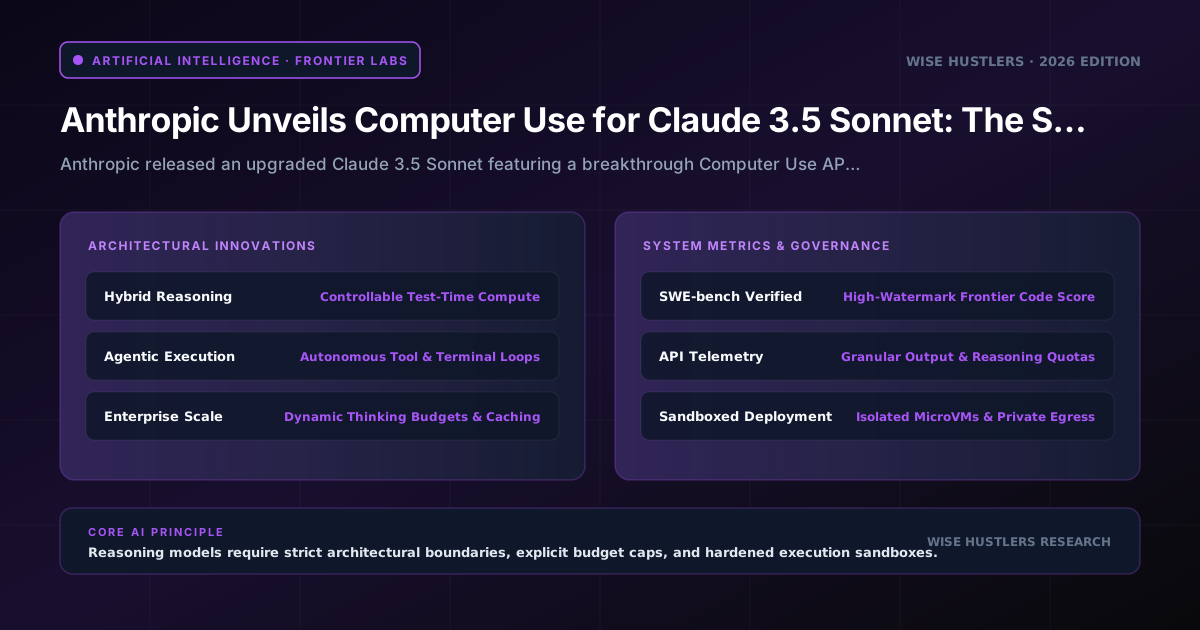
# Anthropic Unveils Computer Use for Claude 3.5 Sonnet: The Shift to Autonomous GUI Agents
Summary: Anthropic has released an upgraded Claude 3.5 Sonnet model featuring a public beta "computer use" API that enables AI agents to interpret desktop screens, position cursors, click buttons, and enter keystrokes. Scoring 49.0% on SWE-bench Verified and reaching 22.0% on OSWorld, the release transitions artificial intelligence from text-bound chatbots into operational graphical agents capable of navigating legacy enterprise software.
What Happened & Key Timeline
On October 22, 2024, Anthropic announced an infrastructure update headlined by an upgraded Claude 3.5 Sonnet model (claude-3-5-sonnet-20241022) alongside the public beta release of general-purpose "computer use." Simultaneously, Anthropic pre-announced Claude 3.5 Haiku, engineered to match earlier Claude 3 Opus capabilities at higher speeds and reduced operational costs.
Anthropic made computer use available across the Anthropic API, Amazon Bedrock, and Google Cloud Vertex AI. Rather than confining models to predefined function-calling schemas, Anthropic trained Claude 3.5 Sonnet to interact directly with standard operating systems. The model processes display captures, calculates x-y pixel coordinates, and issues synthetic mouse movements, clicks, and keystrokes.
Key benchmark evaluations released with the model demonstrate this progression:
- SWE-bench Verified: The upgraded Claude 3.5 Sonnet resolved 49.0% of real-world software engineering issues, advancing from 33.4% in its June 2024 release to lead frontier foundation models.
- TAU-bench: In multi-step agentic evaluations on TAU-bench, upgraded Claude 3.5 Sonnet increased its scores from 36.0% to 46.0% in the airline domain and from 62.6% to 69.2% in the retail customer domain, demonstrating measurable gains in multi-turn state tracking and tool invocation.
- OSWorld Benchmark: Evaluating multimodal models on open-domain desktop tasks, Claude 3.5 Sonnet reached 14.9% on screenshot-only tasks and 22.0% with multi-step execution. While human operators average 70% to 75%, prior models scored under 8.0%, marking a significant advance in graphical UI execution.
Anthropic designated specific enterprise partners to explore early computer use capabilities, including Asana, Canva, Cognition, DoorDash, Replit, and The Browser Company. Replit, for instance, evaluated Claude 3.5 Sonnet's ability to inspect and validate user interfaces during development and runtime. Separately, GitLab evaluated the upgraded model for DevSecOps and code development workflows, recording up to 10% stronger reasoning performance across software development tasks.
Technical & Architectural Impact
The release of computer use challenges a core assumption of enterprise systems: that automated integration requires bespoke programmatic APIs. For decades, connecting legacy software and desktop tools required brittle robotic process automation (RPA) scripts or custom middleware. Anthropic’s architecture replaces these mechanisms with a unified vision-language-action (VLA) execution loop.
The Agentic Vision-Action Loop
The API interaction uses a beta header (anthropic-beta: computer-use-2024-10-22) and exposes a predefined system tool (computer_20241022). System architects configure virtual display dimensions—such as 1024x768 pixels—and pair the computer tool with text-editor and bash execution modules.
The execution loop operates across four stages:
1. Screen Ingestion: The environment captures a display frame, encodes it as a base64 image, and submits it to Claude.
2. Spatial Coordinate Resolution: The vision layer scans UI elements, identifying buttons and input fields to compute precise x-y coordinates relative to the canvas.
3. Structured Tool Invocation: Claude emits a structured tool_use JSON payload detailing the action: mouse_move, left_click, right_click, type, key, or screenshot.
4. Local OS Execution: An orchestration worker running in an isolated container executes the command, captures a fresh display frame, and returns the result to close the cycle.
API Implementation: Minimal Python Integration
The following snippet demonstrates initializing Claude 3.5 Sonnet with the computer use tool in an isolated execution environment:
import anthropic

client = anthropic.Anthropic()  # Connect to Anthropic API

response = client.beta.messages.create(
    model="claude-3-5-sonnet-20241022",
    max_tokens=1024,
    betas=["computer-use-2024-10-22"],
    tools=[
        {
            "type": "computer_20241022",
            "name": "computer",
            "display_width_px": 1024,
            "display_height_px": 768,
            "display_number": 1,
        },
        {"type": "bash_20241022", "name": "bash"},
        {"type": "text_editor_20241022", "name": "str_replace_editor"},
    ],
    messages=[
        {
            "role": "user",
            "content": "Open the terminal, check disk usage, and report available space.",
        }
    ],
)

for block in response.content:
    if block.type == "tool_use":
        print(f"Action: {block.name} -> {block.input}")
Traditional RPA vs. Multimodal GUI Automation
The shift from scripted automation to vision-action execution introduces distinct operational differences:
| Evaluation Dimension | Traditional RPA (e.g., UiPath, Selenium) | Agentic Computer Use (Claude 3.5 Sonnet) |
|---|---|---|
| Element Targeting | Brittle DOM selectors, XPath queries, or hard-coded coordinates | Semantic visual comprehension across raw desktop pixels |
| Handling Dynamic Layouts | Breaks when CSS class names, DOM nodes, or button positions change | Dynamically identifies elements and adjusts cursor trajectories |
| Unforeseen Modals & Popups | Halts execution unless explicit catch blocks are pre-programmed | Interprets modal text, navigates dismiss actions, and resumes |
| Execution Latency | Sub-second deterministic execution per automated step | Multi-second round-trip latency per visual inference turn |
| Operational Unit Cost | Predictable server hosting and per-robot software licenses | Variable token consumption scaled by image resolution and turns |
| Interface Portability | Requires native drivers, browser extensions, or OS hooks | Universal across any OS exposing an X11, Wayland, or VNC framebuffer |
Architectural Tradeoffs: Token Overhead and Latency
While semantic vision allows agents to adapt to fluid software interfaces, it introduces engineering tradeoffs:
- Token Overhead and Latency: Streaming high-resolution screenshots on every execution step generates substantial token payloads and introduces latency. Production setups benefit from prompt caching and selective screenshot diffing.
- Stochastic Navigation: Unlike deterministic scripts, probabilistic vision models can miscalculate click targets on visually dense screens or enter retry loops if an interface responds sluggishly.
What This Means for Engineering Teams & Enterprises
Direct computer interaction alters how teams approach software testing, legacy systems integration, and sandbox security.
Autonomous Software QA & Exploratory Testing
Quality assurance is moving from static test scripts toward autonomous exploratory agents. Instead of writing brittle Selenium or Cypress scripts for every UI update, engineers can instruct Claude to simulate complete user journeys—such as onboarding an enterprise account, uploading invoice attachments, and validating dashboard analytics across disparate applications.
Because the model interprets visual layouts rather than underlying markup, it identifies visual anomalies, misaligned elements, and broken workflows that traditional headless test runners routinely overlook.
Legacy System Modernization Without APIs
Enterprises maintaining older operational software can employ GUI agents as universal adapters. Legacy internal systems lacking modern APIs no longer require comprehensive refactoring to participate in automated workflows. Claude can open native desktop accounting software, input batch entries, verify totals, and export reconciliations into cloud data warehouses.
Security Boundaries and Sandboxing Controls
Autonomous desktop interaction introduces cybersecurity exposure, primarily through prompt injection and unauthorized execution. If an agent encounters untrusted web content containing hidden adversarial instructions, it could attempt unauthorized file transfers or system modifications.
Engineering organizations implement defensive isolation controls:
- Isolated Sandbox Environments: Run computer use agents inside ephemeral Docker containers or virtual machines with restricted network egress.
- Privilege Separation: Virtual agent environments must operate without root access, production credentials, or persistent database permissions.
- Human-in-the-Loop (HITL) Controls: In production enterprise environments, architects standardly configure verification checkpoints for high-stakes operations—such as financial settlements, database schema modifications, or deployment promotions—preventing autonomous agents from executing irreversible actions without administrative confirmation.
Architectural Evaluation Framework: Testing Production Viability
To determine whether visual GUI automation is suitable for a given pipeline, software architects should establish an empirical evaluation protocol rather than deploying unassisted agents directly into production:
- Visual Flakiness and Drift Evaluation: Measure failure rates caused by UI coordinate drift, asynchronous rendering delays, and unexpected dialogue prompts across repeated execution cycles. If visual stochasticity causes error rates that exceed the target service-level objective (SLO), the workflow is ill-suited for unassisted autonomous execution.
- Economic and Latency Thresholds: Profile cumulative token consumption—especially high-resolution screenshot payloads—and end-to-end turnaround latency against traditional deterministic headless automation (e.g., Playwright or Selenium) and assisted human review.
- Deterministic Fallback Triggers: Workflows failing these operational thresholds should fall back to structured API endpoints or DOM-level headless scripts, reserving vision-language computer use for undocumented graphical interfaces where native APIs do not exist.
Engineering teams preparing to adopt agentic workflows standardly balance autonomous execution against organizational governance policies and infrastructure security controls. Organizations architecting bespoke agent loops, hardened sandboxes, and custom automated workflows can partner with Wise Hustlers custom AI solutions to design resilient, production-ready agentic architectures that protect core infrastructure while maximizing operational throughput.
Frequently Asked Questions
What is Anthropic's Computer Use API, and how does it differ from traditional tool calling?
Anthropic's Computer Use API allows Claude 3.5 Sonnet to interact directly with standard desktop interfaces by interpreting display captures and emitting synthetic mouse and keyboard commands (mouse_move, left_click, type, key). Traditional tool calling requires developers to write structured code functions and predefined API schemas; computer use enables the model to visually navigate graphical interfaces that lack APIs.
What are the primary security risks of deploying GUI agents?
The primary security risks involve indirect prompt injection and unintended actions. An agent processing untrusted web content can encounter hidden adversarial instructions that trick it into deleting data or transmitting sensitive files. Organizations mitigate this by running agents in ephemeral containers with restricted egress and enforcing human confirmation on sensitive actions.
How do enterprise teams handle sandboxing and network isolation?
Teams typically deploy computer-use agents inside containerized virtual desktop environments (using Docker containers configured with Xvfb and VNC). These environments enforce strict firewall egress rules, blocking access to internal intranet resources and private metadata endpoints, while disallowing root-level terminal execution.
Is Computer Use ready to replace human operators in enterprise production today?
Not completely. Anthropic released Computer Use as an experimental public beta, noting that it remains slower and more error-prone than human operators on complex tasks (scoring 22.0% on OSWorld versus 70–75% for humans). It is currently best suited for repetitive back-office tasks, developer sandboxes, automated software QA, and workflows overseen by human operators.
Sources
- Anthropic: Introducing computer use, a new Claude 3.5 Sonnet, and Claude 3.5 Haiku
- Anthropic Documentation: Computer use (beta)
- GitHub: Anthropic Quickstarts Computer Use Demo
- Arxiv: OSWorld: Benchmarking Multimodal Agents on Open-Domain Operating System Tasks
- TAU-bench: A Benchmark for Tool-Agent-User Interaction in Real-World Domains (Sierra Research)
- SWE-bench: Verified Benchmark for Software Engineering Frontier Models
- Reuters: Anthropic Launches AI Model That Can Operate Computers Like Humans