
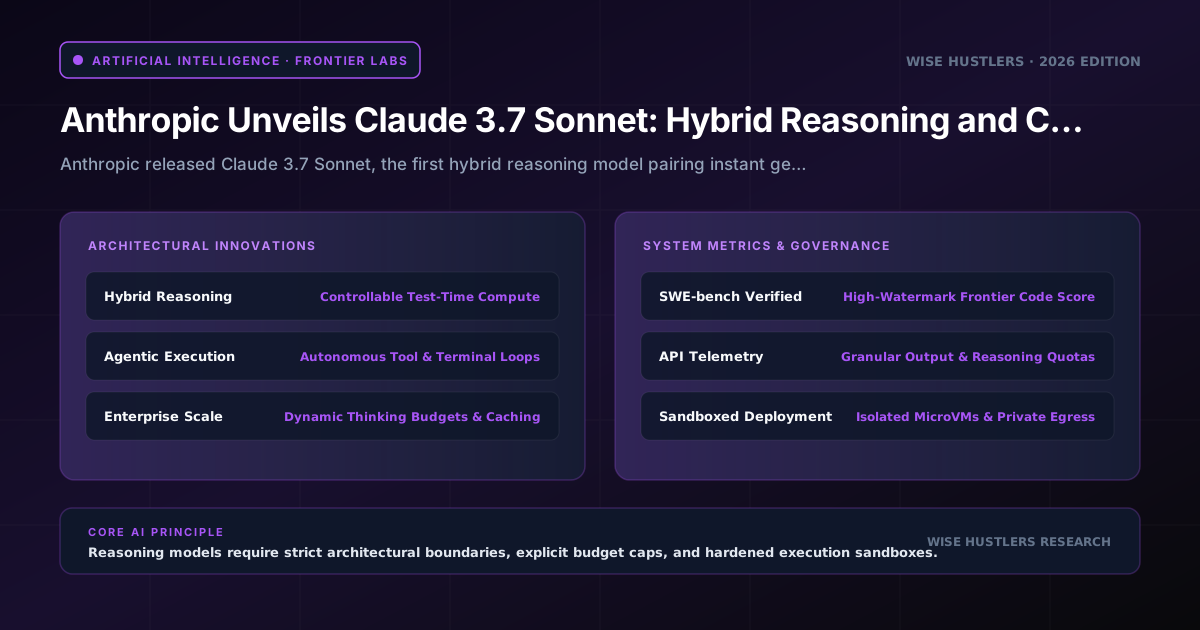
# Anthropic Unveils Claude 3.7 Sonnet: Hybrid Reasoning and the Rise of Terminal-Native Agentic Engineering
Summary: Anthropic released Claude 3.7 Sonnet on February 24, 2025, introducing the industry's first hybrid reasoning model capable of dynamically toggling between near-instant responses and extended chain-of-thought analysis. Paired with the new Claude Code CLI agent, this release sets a new state-of-the-art 70.3% benchmark on SWE-bench Verified. By introducing granular API control over thinking token budgets, Anthropic eliminates the tradeoff between conversational velocity and complex multi-step reasoning for enterprise software teams.
What Happened & Key Timeline
On February 24, 2025, Anthropic announced the general availability of Claude 3.7 Sonnet alongside the research preview of Claude Code, a terminal-native coding agent. The release represents a watershed architectural shift, establishing the market's first production-grade hybrid reasoning model. Rather than forcing software architects to choose between fast autoregressive models and high-latency reasoning models, Claude 3.7 Sonnet unifies both operational modes within a single neural network checkpoint.
The development timeline underscores intense competition across frontier AI labs over the past eight months:
- June 2024: Anthropic launched Claude 3.5 Sonnet, establishing dominance across coding benchmarks and web design using purely standard autoregressive generation without test-time reasoning.
- September 2024: OpenAI released the o1-preview series, demonstrating that test-time compute and reinforcement learning applied to reasoning chains could conquer complex STEM challenges. However, early reasoning models introduced noticeable latency overheads—frequently requiring tens of seconds before producing first-token output on complex prompts—while concealing raw reasoning chains behind summarized explanations.
- January 2025: DeepSeek launched DeepSeek-R1, proving that open-weights models trained with pure reinforcement learning could match proprietary reasoning benchmarks, accelerating industry demand for transparent reasoning tokens.
- February 24, 2025: Anthropic countered with Claude 3.7 Sonnet across the Anthropic API, Claude.ai, Amazon Bedrock, and Google Cloud Vertex AI at price parity with Claude 3.5 Sonnet ($3 per million input tokens, $15 per million output tokens), accompanied by the launch of Claude Code.
By collapsing the boundary between rapid conversational interaction and deliberate chain-of-thought reasoning, Anthropic delivered continuous, deterministic control over latency, token budgets, and output precision.
Technical & Architectural Impact
The core technical breakthrough in Claude 3.7 Sonnet is its hybrid execution model. In conventional architectures, reasoning capabilities are isolated: a model is either optimized for rapid token streaming or fine-tuned to emit extensive invisible chains of thought before answering. Claude 3.7 Sonnet removes this division by allowing callers to specify the exact degree of test-time compute expended per inference request.
Granular Thinking Budgets and API Control
Through the Anthropic API, engineers govern model behavior via a dedicated parameter: thinking: { type: "enabled", budget_tokens: N }. Developers can configure budget_tokens from 1,024 up to 128,000 tokens, dynamically aligning inference depth with problem complexity.
When thinking is disabled, Claude 3.7 Sonnet operates as a standard high-throughput LLM, matching the rapid latency of Claude 3.5 Sonnet. When enabled, the model systematically explores alternate solutions, verifies edge cases, and self-corrects prior to emitting its final answer. Crucially, thinking tokens are streamed and fully visible in API payloads.
In regulated enterprise environments and high-assurance engineering teams following SOC 2 or ISO 27001 internal control frameworks, opaque model behavior complicates auditability and root-cause analysis. Visible thinking tokens support engineering governance by providing inspectable reasoning traces, helping teams verify intermediate deductive steps before deploying generated code to production.
The following Python snippet demonstrates how to configure granular thinking budgets using the official Anthropic SDK:
import anthropic

client = anthropic.Anthropic()

response = client.messages.create(
    model="claude-3-7-sonnet-20250219",
    max_tokens=4096,
    thinking={
        "type": "enabled",
        "budget_tokens": 2048
    },
    messages=[
        {
            "role": "user",
            "content": "Analyze our distributed event pipeline for potential deadlocks during concurrent partition rebalancing."
        }
    ]
)

for block in response.content:
    if block.type == "thinking":
        print(f"--- Thinking Trace ---\n{block.thinking}\n")
    elif block.type == "text":
        print(f"--- Final Answer ---\n{block.text}")
State-of-the-Art Benchmark Breakthroughs
The hybrid architecture delivers decisive gains across rigorous industry benchmarks:
- SWE-bench Verified: Evaluated on the human-curated SWE-bench Verified benchmark (originating from Princeton NLP's evaluation framework), Claude 3.7 Sonnet scored 62.3% in standard mode and reached a record 70.3% when combined with agentic scaffolding and custom test harnesses. This benchmark measures an AI system's ability to resolve real-world GitHub issues by reproducing bugs, generating patches, and passing unit test suites.
- GPQA Diamond: On graduate-level physics, chemistry, and biology questions, Claude 3.7 Sonnet scored 84.8% with extended thinking enabled, compared to 68.0% in baseline mode.
- MATH-500: Extended thinking elevated mathematical problem-solving from 82.2% to 96.2%, virtually closing the margin of error on formal proofs.
- TAU-bench: Evaluating multi-turn enterprise tool use, the model scored 81.2% in retail workflow coordination and 58.4% in airline reservation logistics, demonstrating robust resilience against compounding execution errors.
The table below contrasts Claude 3.7 Sonnet across operational modes against previous-generation and contemporary frontier models:
| Benchmark / Capability | Claude 3.5 Sonnet | Claude 3.7 Sonnet (Standard) | Claude 3.7 Sonnet (Extended Thinking) | OpenAI o1 (High Reasoning) |
|---|---|---|---|---|
| Reasoning Architecture | Autoregressive Base | Hybrid (Thinking Disabled) | Hybrid (Configurable Budget) | Standalone Reasoning |
| SWE-bench Verified | 49.0% | 62.3% | 70.3% (Agentic Scaffold) | 61.8% |
| GPQA Diamond | 65.0% | 68.0% | 84.8% | 75.7% |
| MATH-500 | 78.3% | 82.2% | 96.2% | 96.4% |
| Thinking Token Visibility | N/A | N/A | Fully Visible & Streamed | Concealed / Summarized |
| Input / Output Pricing (per MTok) | $3.00 / $15.00 | $3.00 / $15.00 | $3.00 / $15.00 | $15.00 / $60.00 |
The Claude Code Subsystem
Co-released with the foundation model, Claude Code is a terminal-based command-line agent distributed via Node.js (npm install -g @anthropic-ai/claude-code). Operating directly in the developer's terminal rather than inside an IDE sidebar, Claude Code indexes repositories, executes shell commands, inspects local file diffs, executes test suites, and orchestrates Git workflows.
Claude Code incorporates project-level context through a root CLAUDE.md markdown file, encoding corporate code styles, build instructions, test commands, and architectural constraints:
Project Architecture and Development Commands:

Build and Test:
- npm run build
- npm test
- npm run test:e2e

Engineering Standards:
- All state mutations must use immutable update patterns.
- Keep business logic decoupled from transport and API layers.
- Enforce strict typing with zero TypeScript any annotations.
Because Claude Code runs on Claude 3.7 Sonnet, it navigates complex codebases, tracks cross-module dependencies, and executes multi-file refactoring autonomously.
What This Means for Engineering Teams & Enterprises
The emergence of hybrid reasoning and terminal-level autonomous agents fundamentally transforms enterprise software delivery.
Eliminating Routing Fragility
Enterprise architects previously maintained complex routing layers to shuttle queries between standard models and dedicated reasoning models like OpenAI o1. These heuristic routers frequently misclassified edge cases, either delaying simple queries or starving complex logic tasks of needed compute. Claude 3.7 Sonnet centralizes model infrastructure into a single endpoint, allowing systems to modulate thinking budgets dynamically based on context, user role, or SLA tiers.
Shifting from Autocomplete to Autonomous Agent Workflows
With SWE-bench Verified performance exceeding 70%, engineering workflows are shifting from code writing to code auditing. Developers no longer spend hours on migration boilerplate, API schema bindings, or test regression triage. Claude Code reproduces failures, drafts patches, and presents unified Git diffs for human code review.
However, enterprise adoption requires robust governance. Organizations must enforce sandboxed execution boundaries, secret masking, and deterministic API caching. Anthropic's prompt caching feature—documented to deliver up to 90% cost savings on cache-hit tokens with a 5-minute time-to-live (TTL)—dramatically lowers the operating cost of running multi-turn agentic loops over enterprise repositories.
Organizations seeking to capitalize on this shift often find that integrating autonomous agents into legacy CI/CD pipelines, regulated databases, and proprietary systems demands specialized architecture. Building production-grade agent scaffolding, custom tool-calling frameworks, and auditable reasoning conduits is where Wise Hustlers custom engineering services helps enterprises deploy frontier AI safely while enforcing strict security controls.
Frequently Asked Questions
How does Claude 3.7 Sonnet differ from standalone reasoning models like OpenAI o1?
Unlike standalone reasoning models that always invoke high-latency thinking, Claude 3.7 Sonnet is a unified hybrid model. Engineers can dynamically toggle extended thinking, configure exact token budgets (up to 128,000 tokens), and directly inspect visible reasoning traces in real-time.
Can Claude Code be safely integrated into enterprise repositories?
Yes. Claude Code runs locally on the developer's machine or within sandboxed containers. It requires explicit user approval before executing state-changing bash commands, modifying files, or pushing Git commits. Teams can also enforce repository standards via a version-controlled CLAUDE.md file.
How are extended thinking tokens billed, and can costs be managed?
Thinking tokens are billed as standard output tokens at $15 per million tokens, matching Claude 3.5 Sonnet pricing. Teams control costs by setting strict API budget_tokens caps and utilizing prompt caching for a 90% discount on repeated context across iterative agent prompts.
Sources
- Anthropic Official Announcement: Claude 3.7 Sonnet and Claude Code
- Anthropic Developer Documentation: Claude Code CLI Architecture and Overview
- Anthropic Prompt Caching Documentation: Prompt Caching Overview and Pricing
- AWS News Blog: Anthropic's Claude 3.7 Sonnet, the First Hybrid Reasoning Model, is Now Available in Amazon Bedrock
- Google Cloud Blog: Anthropic Claude 3.7 Sonnet Available on Google Cloud Vertex AI
- TechCrunch Enterprise Coverage: Anthropic Launches a New AI Model That Thinks as Long as You Want
- SWE-bench Consortium: SWE-bench Official Benchmark and Evaluation Suite