
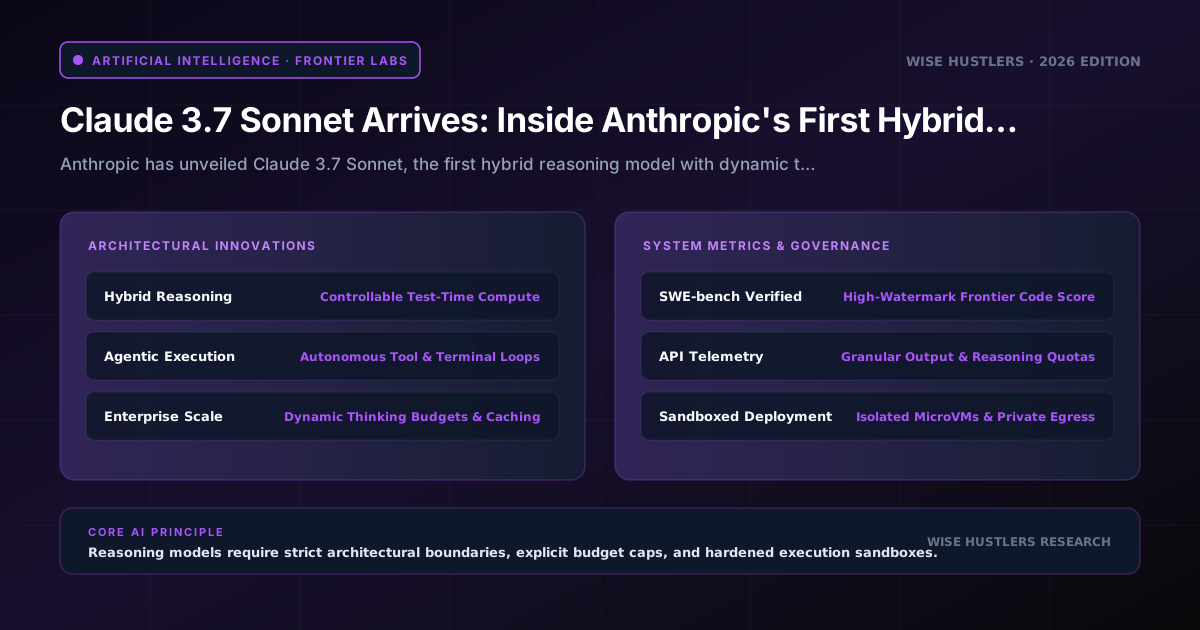
# Claude 3.7 Sonnet Arrives: Inside Anthropic's First Hybrid Reasoning Model and Claude Code
Summary: Anthropic has officially unveiled Claude 3.7 Sonnet, the industry's first production hybrid reasoning model, alongside Claude Code, an agentic command-line interface. By combining instant response generation with extended, step-by-step reasoning within a single controllable architecture, the model resolves the long-standing enterprise tradeoff between latency and analytical precision. Reaching a state-of-the-art 70.3% on SWE-bench Verified with agentic scaffolding, Claude 3.7 Sonnet establishes a new operational baseline for autonomous enterprise software engineering.
What Happened & Key Timeline
On February 24, 2025, Anthropic announced the general availability of Claude 3.7 Sonnet, introducing what the lab designates as the market's inaugural hybrid reasoning model. Following the emergence of dedicated reasoning models in late 2024, enterprise software architects navigated an awkward architectural bifurcation: deploying fast, intuitive models (such as Claude 3.5 Sonnet or GPT-4o) for real-time interfaces, while routing complex analytical tasks to separate reasoning engines (such as OpenAI o1 or DeepSeek-R1).
Claude 3.7 Sonnet dissolves this friction by unifying standard inference and deep chain-of-thought deliberation into a single foundation checkpoint. Instead of maintaining fragile upstream routing heuristics, engineers can now modulate reasoning depth dynamically via API request parameters.
Simultaneously, Anthropic introduced Claude Code in research preview. Operating directly inside developer terminal environments, Claude Code functions as an agentic partner capable of navigating codebases, executing test suites, editing multiple files, and managing Git version control workflows autonomously.
The release rolled out immediately across major cloud providers:
- Core Platform Availability: Available to Free, Pro, Team, and Enterprise subscribers across Claude web, desktop, and mobile applications.
- Enterprise Cloud Ecosystem: Deployed natively on Amazon Bedrock, Google Cloud Vertex AI, and the Anthropic API.
- Cost Parity: Maintained pricing parity with Claude 3.5 Sonnet at $3.00 per million input tokens and $15.00 per million output tokens (with thinking tokens billed at standard output rates), supported by prompt caching reads at $0.30 per million tokens.
Technical & Architectural Impact
Claude 3.7 Sonnet introduces foundational shifts in inference mechanics, test-time compute scaling, and developer ergonomics.
1. Dynamic Test-Time Compute and Thinking Budgets
Traditional reasoning models enforce rigid latency penalties. Every prompt incurs seconds or minutes of opaque deliberation, regardless of task complexity.
Claude 3.7 Sonnet introduces a continuous spectrum of test-time compute. In standard mode, the model functions as an instantaneous drop-in replacement for Claude 3.5 Sonnet, maintaining high-throughput responsiveness. When extended thinking is enabled, the model generates internal reasoning tokens—up to a customizable ceiling of 64,000 output tokens—to systematically explore hypotheses, verify assumptions, and self-correct logic before outputting final text.
Developers control this process programmatically through the thinking API parameter:
{
  "model": "claude-3-7-sonnet-20250219",
  "max_tokens": 20000,
  "thinking": {
    "type": "enabled",
    "budget_tokens": 8192
  }
}
In production applications using the official TypeScript SDK, developers can configure thinking parameters and inspect reasoning traces directly:
import Anthropic from "@anthropic-ai/sdk";

const anthropic = new Anthropic();

async function runHybridInference() {
  const response = await anthropic.messages.create({
    model: "claude-3-7-sonnet-20250219",
    max_tokens: 20000,
    thinking: {
      type: "enabled",
      budget_tokens: 8192,
    },
    messages: [
      {
        role: "user",
        content: "Audit this distributed database transaction handler for race conditions and propose an idempotent retry mechanism.",
      },
    ],
  });

  for (const block of response.content) {
    if (block.type === "thinking") {
      console.log("Internal Reasoning Trace:\n", block.thinking);
    } else if (block.type === "text") {
      console.log("Response Output:\n", block.text);
    }
  }
}

runHybridInference();
By decoupling computational depth from model endpoints, architects can scale compute budgets dynamically based on prompt complexity, downstream SLAs, or cost ceilings.
2. Observable, Inspectable Thought Traces
In enterprise software environments, opaque thought traces complicate auditability and make root-cause debugging more challenging. Anthropic addresses this architectural concern by keeping Claude 3.7 Sonnet's reasoning traces visible and inspectable. Engineering teams can monitor intermediate reasoning steps, enabling internal governance audits, constraint validation, and rapid diagnosis of logic flaws prior to downstream execution. Furthermore, developers can log thinking blocks alongside generated diffs in CI/CD pipelines to ensure deterministic traceability across automated code refactoring.
3. Frontier Benchmark Dominance
Empirical evaluations demonstrate that Claude 3.7 Sonnet establishes new baselines across software engineering and agentic tool execution:
- SWE-bench Verified: On the human-validated benchmark of 500 real-world GitHub issues, Claude 3.7 Sonnet scored 62.3% in standalone extended thinking mode, outperforming Claude 3.5 Sonnet (49.0%) and OpenAI o1 (48.9%). When evaluated with a high-compute agentic research scaffold—combining test-time compute scaling, parallel candidate generation, and automated test-based verification—performance reached a state-of-the-art 70.3%.
- TAU-bench: In multi-turn enterprise tool orchestration, the model reached 81.2% in Retail domain workflows (surpassing OpenAI o1's 73.5%) and 58.4% in Airline domain workflows (surpassing OpenAI o1's 54.2%).
- Science and Mathematics: In academic reasoning, Claude 3.7 Sonnet scored 78.2% on GPQA Diamond under extended thinking (compared to 65.0% for Claude 3.5 Sonnet) and achieved 61.3% pass@1 on AIME 2024, scaling to 80.0% when paired with test-time compute sampling.
The table below outlines comparative benchmark performance across frontier model checkpoints:
| Benchmark / Evaluation | Claude 3.5 Sonnet | OpenAI o1 (High) | Claude 3.7 Sonnet (Standard) | Claude 3.7 Sonnet (Extended Thinking) | Claude 3.7 Sonnet (Agentic Scaffold) |
|---|---|---|---|---|---|
| SWE-bench Verified | 49.0% | 48.9% | 40.3% | 62.3% | 70.3% |
| TAU-bench (Retail) | 69.2% | 73.5% | 73.5% | 81.2% | — |
| TAU-bench (Airline) | 46.0% | 54.2% | 48.5% | 58.4% | — |
| GPQA Diamond | 65.0% | 75.7% | 68.0% | 78.2% | — |
| AIME 2024 | 16.0% | 79.2% | 34.0% | 61.3% | 80.0% |
What This Means for Engineering Teams & Enterprises
For enterprise engineering leadership, the arrival of Claude 3.7 Sonnet and Claude Code signals an operational turning point. Artificial intelligence is shifting from passive code autocomplete into proactive, autonomous terminal agents.
The Rise of Terminal-Native Agentic Engineering
Developer tooling is expanding beyond sidebar chat boxes. Claude Code operates natively across the local development lifecycle: parsing repository hierarchies, checking dependencies, running local linters, diagnosing failing tests, and authoring git commits under developer supervision. This terminal-first posture minimizes developer context-switching and automates the mechanical maintenance overhead that slows engineering velocity.
Consolidating Model Pipelines and Latency Arbitrage
Previously, engineering organizations building agentic workflows spent substantial resources designing heuristic classifiers. Incoming queries were routed upstream to balance cost and latency between conversational models and reasoning engines. Claude 3.7 Sonnet eliminates this brittle routing layer. Teams can standardize on a single foundation checkpoint, modulating reasoning budgets per pipeline stage.
For enterprise organizations navigating this architectural transition, executing production agentic deployments requires disciplined systems engineering. Partnering with specialized engineering providers—such as the custom engineering team at Wise Hustlers AI Solutions—ensures that enterprises implement rigorous evaluation harnesses, secure token-budgeting guardrails, and deterministic CI/CD pipelines without accumulating architectural debt.
Falsifiability and Failure Modes
How do systems analysts evaluate whether hybrid reasoning delivers genuine business value? Organizations must monitor key failure signals:
1. Token Cost-to-Resolution Ratio: If extended thinking expands token consumption by 300% without reducing bug ticket reopen rates or code review duration, the reasoning budget is misallocated.
2. Circular Deliberation Loops: Unconstrained reasoning budgets can prompt models to overthink simple deterministic logic, creating latency spikes without accuracy gains.
3. Deterministic Verification: Teams must maintain automated unit tests and isolated sandbox environments to validate agent-generated pull requests prior to production merge.
Frequently Asked Questions
How does Claude 3.7 Sonnet differ from discrete reasoning models like OpenAI o1?
Unlike models that force extended deliberation on every request, Claude 3.7 Sonnet unites instant generation and deep reasoning into one checkpoint. Developers can disable thinking for sub-second responses or allocate dedicated token budgets for complex reasoning, all within a single unified API endpoint.
How does the thinking budget operate, and what are its cost implications?
The thinking budget allows developers to specify a token ceiling for internal reasoning (from 1,024 up to 64,000 tokens). Reasoning tokens are billed at the standard output rate of $15.00 per million tokens. Because budgets are explicitly capped per request, teams can prevent runaway inference costs while providing adequate compute for difficult tasks.
What distinguishes Claude Code from traditional IDE code assistants?
Traditional assistants act primarily as inline autocompletion engines or sidebar chat windows. Claude Code is an autonomous command-line interface that runs directly in the terminal. It can inspect entire file structures, execute shell commands, run test suites, analyze compiler errors, and author git commits under developer supervision.
Are extended thinking traces visible for debugging and audit compliance?
Yes. Unlike models that conceal intermediate reasoning chains, Claude 3.7 Sonnet exposes thinking tokens directly in the API response payload under the thinking block type. This allows engineering teams to inspect the model's intermediate logic, verify adherence to internal policies, and log audit trails for compliance validation.
Sources
- Anthropic: Claude 3.7 Sonnet and Claude Code Announcement
- Anthropic Documentation: Model Specifications, Pricing, and Extended Thinking
- SWE-bench Leaderboard & Evaluation Standards
- Amazon Web Services: Anthropic Claude 3.7 Sonnet Hybrid Reasoning Model in Amazon Bedrock
- Google Cloud: Anthropic's Claude 3.7 Sonnet Available on Vertex AI