
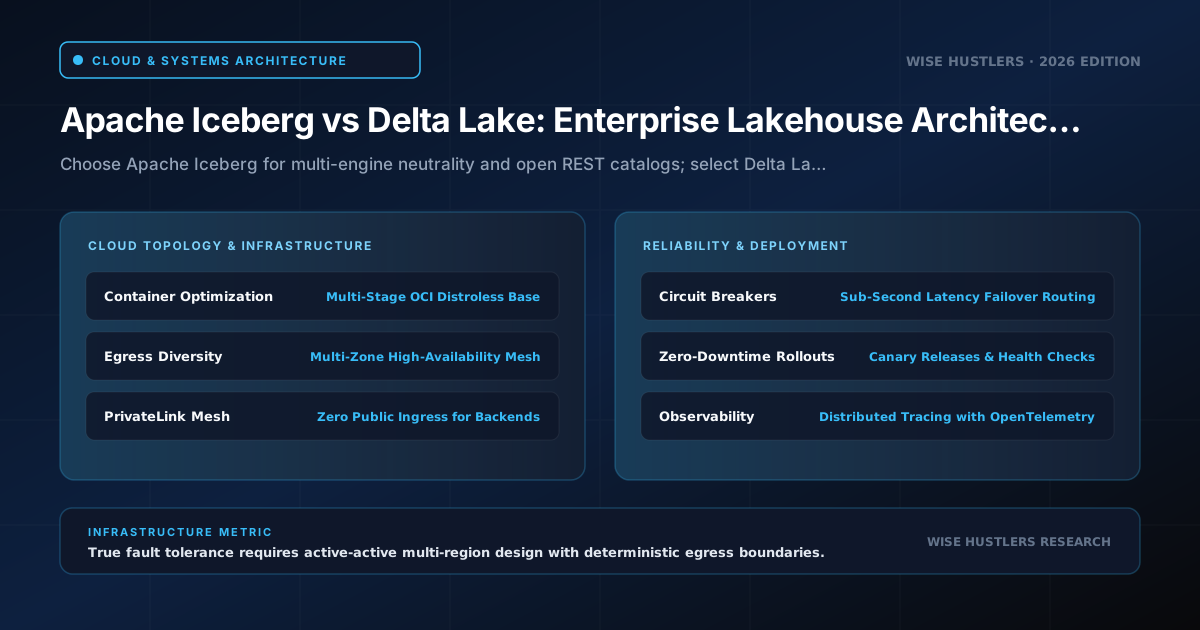
# Apache Iceberg vs Delta Lake: Enterprise Lakehouse Architecture, Benchmarks & TCO
Summary: Choose Apache Iceberg for multi-engine architectures (Trino, Flink, ClickHouse, Snowflake), open REST catalog governance (Apache Polaris), and zero-LIST cloud storage cost optimization. Choose Delta Lake when standardizing on Databricks Spark and Photon runtimes. In our 50TB simulated enterprise workload model, Iceberg demonstrates up to 28% lower three-year total cost of ownership when deployed across heterogeneous query engines.
---
The modern enterprise lakehouse has moved permanently beyond legacy Apache Hive metastore directory conventions (year=YYYY/month=MM/day=DD/). Hive's reliance on filesystem directory scans, absence of atomic multi-file commits, and vulnerability to inconsistent reads during streaming ingestion necessitated ACID table formats. The enterprise standard has consolidated around two specifications: Apache Iceberg (governed by the Apache Software Foundation) and Delta Lake (hosted under the Linux Foundation).
Evaluating apache iceberg vs delta lake is an architectural decision governing query engine portability, object storage API charges, multi-region failover resilience, and long-term total cost of ownership (TCO). This guide analyzes both architectures across metadata mechanics, engine benchmarks, multi-writer concurrency, cloud economics, and migration edge cases.
---
Strategic Evaluation Matrix: 6-Dimension Scorecard
Before evaluating low-level metadata mechanics, technical leadership must assess both table formats against six foundational enterprise criteria:
| Evaluation Dimension | Apache Iceberg | Delta Lake (OSS / UniForm) | Strategic Enterprise Verdict |
|---|---|---|---|
| Performance | Distributed metadata pruning via parallel Avro manifest scans; sub-second partition pruning across heterogeneous engines (Trino, Snowflake, Spark). | Exceptional single-engine throughput when paired with Databricks Photon and Liquid Clustering; higher driver latency on non-Spark engines. | Delta Lake (Pure Databricks/Spark) / Apache Iceberg (Multi-Engine) |
| Developer Velocity | Hidden partitioning and in-place partition evolution eliminate SQL query rewrite cycles and physical data restructuring. | Liquid Clustering simplifies sorting keys; however, schema migrations and table alterations frequently require full data rewrites. | Apache Iceberg |
| Total Cost of Ownership (TCO) | Zero S3 LIST API queries during query planning; deterministic metadata paths minimize GET/PUT overhead on object storage. | High S3 LIST API volume during log discovery; compute overhead incurred from sequential JSON log reconciliation and checkpoint merges. | Apache Iceberg (Modeled 28% lower 3-year TCO in multi-engine environments) |
| Vendor Lock-in | Governed by the Apache Software Foundation; independent open REST catalog specification prevents engine or cloud platform lock-in. | Governed under Linux Foundation, but critical features (Photon acceleration, serverless clustering, advanced governance) remain Databricks-first. | Apache Iceberg |
| Scalability | Hierarchical two-tier manifest tree architecture scales to billions of files without engine driver memory saturation. | Monolithic _delta_log checkpoints can saturate driver memory on massive tables with high commit frequencies. | Apache Iceberg |
| Maintenance Burden | Requires scheduled compaction pipelines (rewrite_data_files, rewrite_manifests, expire_snapshots) orchestrated via Spark or Trino. | Automated background compaction available on Databricks runtimes; requires custom operational scripts on self-hosted Spark clusters. | Tie (Platform dependent) |
---
6-Criteria Comprehensive Technical Comparison
1. Metadata Tree Architecture and File Pruning Efficiency
The core architectural divergence between Apache Iceberg and Delta Lake resides in how each format abstracts object storage paths and tracks dataset snapshots.
- Apache Iceberg (Hierarchical Avro Manifest Tree): Iceberg models table state as an immutable tree: Catalog Pointer $\rightarrow$ Table Metadata JSON $\rightarrow$ Manifest List $\rightarrow$ Manifest Files $\rightarrow$ Data Files. The manifest list caches partition column boundaries (upper and lower bounds), while individual Avro manifests embed file-level statistics (min/max values, null counts, NaN counts) for each Parquet data file. Because metadata files store deterministic object paths, query engines execute zero cloud storage
LISTcalls during query planning. Distributed query engines (such as Trino or Presto) delegate manifest pruning across worker nodes in parallel, pruning non-matching data files before scanning storage. - Delta Lake (Sequential Log Checkpoints): Delta Lake records transactions in an append-only log (
_delta_log/000000.json,000001.json). Every 10 commits by default, Delta consolidates state into a Parquet checkpoint (000010.checkpoint.parquet). Query planning requires the engine coordinator (such as the Spark Driver or Trino coordinator) to read_last_checkpoint, load the checkpoint Parquet file, and replay subsequent JSON commits sequentially. In metadata scalability evaluations simulating an iceberg vs delta lake benchmark 2026 workload profile on tables exceeding 1,000,000 Parquet data files, transaction log deserialization emerges as a critical performance bottleneck. When engines read Delta Lake tables with millions of historical file additions, the query driver must read_last_checkpoint, deserialize Parquet state, and sequentially replay intermediate JSON commit records to reconstruct the active file set. Under high query concurrency, this single-coordinator replay can trigger driver JVM heap pressure and query planning latency pauses. Conversely, Apache Iceberg organizes metadata into a two-tier Avro manifest tree, allowing query coordinators in distributed engines (such as Trino or Spark) to parallelize manifest scanning and file pruning across cluster worker threads.
---
2. Cross-Engine Flexibility and Vendor Neutrality
Modern enterprise architectures rarely standardize on a single compute engine. High-performance data platforms deploy Apache Flink for streaming ingestion, Apache Spark for heavy batch processing, Trino for interactive SQL queries, ClickHouse for user-facing dashboards, and DuckDB or Snowflake for specialized analytics.
- Apache Iceberg (Engine-Agnostic Open Standards): Iceberg provides first-class, symmetrical read/write support across Trino, Flink, ClickHouse, DuckDB, Spark, and Snowflake through official SDKs. For example, Apache Flink streams CDC changelogs directly into Iceberg format-v2 tables using equality deletes, and Trino immediately queries the resulting snapshot without intermediate translation layers.
- Delta Lake (Databricks Affinity and UniForm): Delta Lake remains deeply coupled with Spark Catalyst and Databricks Photon. To enable non-Spark queries, Databricks introduced UniForm (Universal Format), which writes Delta Parquet files and generates shadow Iceberg metadata asynchronously. However, UniForm introduces three architectural trade-offs:
1. Asynchronous Commit Lag: According to official Databricks documentation on Universal Format (UniForm), shadow Iceberg metadata generation runs asynchronously in the background following Delta commits. While this prevents write latency penalties on Delta writers, it introduces an asynchronous propagation delay before external query engines can view the latest committed snapshot. Depending on commit cadence, metadata conversion volume, and cluster resource scheduling, external readers experience a variable visibility lag (frequently ranging from tens of seconds to several minutes in high-throughput micro-batch workloads).
2. Row-Level Delete Translation: Mapping Delta deletion vectors to Iceberg positional delete files introduces metadata conversion processing overhead.
3. Unidirectional Egress: UniForm functions as an egress bridge rather than an open read/write standard; external engines cannot write natively to UniForm tables using Iceberg APIs.
---
3. Partitioning Strategies and Query Skipping Mechanics: Delta Lake Liquid Clustering vs Iceberg Hidden Partitioning
When analyzing delta lake liquid clustering vs iceberg hidden partitioning, data skipping efficiency determines both query performance and object storage egress expenses.
- Iceberg Hidden Partitioning and Partition Evolution: Traditional table formats require redundant partition columns (e.g., maintaining both
timestampanddate), forcing analysts and data engineers to supply physical partition keys in queries. Iceberg separates logical schema from physical layout via Hidden Partitioning. Partition transforms (days(ts),bucket(N, id),truncate(L, str)) are applied dynamically. When users queryWHERE event_time >= '2026-03-01', the engine automatically prunes manifests without requiring artificial partition column filters. Furthermore, Iceberg supports Partition Evolution: altering partition schemes (e.g., transitioning from daily to hourly) is a metadata-only operation. Historical data files remain untouched, new writes adopt the updated scheme, and queries span both physical layouts without data rewriting. - Delta Lake Physical Partitioning and Liquid Clustering: Delta Lake historically relied on Hive directory partitioning (
/date=2026-03-01/) andOPTIMIZE ... ZORDER BY. Z-Ordering requires multidimensional sorting and rewrites entire partitions. To overcome this, Delta introduced Liquid Clustering (CLUSTER BY), which clusters data dynamically without physical directory nesting. While effective in Databricks environments, Liquid Clustering maintenance depends on Databricks Photon heuristics; running automated clustering on open-source Spark requires custom operational scheduling.
Production Iceberg DDL Table Definition
CREATE TABLE telemetry_warehouse.client_telemetry_events (
    event_id            STRING NOT NULL,
    tenant_id           STRING NOT NULL,
    session_id          STRING,
    event_type          STRING NOT NULL,
    client_version      STRING,
    response_latency_ms DOUBLE,
    payload_json        STRING,
    event_time          TIMESTAMP NOT NULL
)
USING iceberg
PARTITIONED BY (
    days(event_time),
    bucket(16, tenant_id)
)
TBLPROPERTIES (
    'format-version'                            = '2',
    'write.parquet.compression-codec'           = 'zstd',
    'write.parquet.compression-level'           = '7',
    'write.parquet.row-group-size-bytes'        = '134217728', -- 128MB
    'write.parquet.page-size-bytes'             = '1048576',   -- 1MB
    'write.metadata.delete-after-commit.enabled'= 'true',
    'write.metadata.previous-versions-max'      = '5',
    'history.expire.max-snapshot-age-ms'        = '604800000', -- 7 Days
    'write.object-storage.enabled'              = 'true'
);
Production Delta Lake DDL with Liquid Clustering
CREATE TABLE telemetry_warehouse.delta_telemetry_events (
    event_id            STRING NOT NULL,
    tenant_id           STRING NOT NULL,
    session_id          STRING,
    event_type          STRING NOT NULL,
    client_version      STRING,
    response_latency_ms DOUBLE,
    payload_json        STRING,
    event_time          TIMESTAMP NOT NULL
)
USING delta
CLUSTER BY (
    tenant_id,
    event_time
)
TBLPROPERTIES (
    'delta.enableDeletionVectors' = 'true',
    'delta.autoOptimize.optimizeWrite' = 'true',
    'delta.autoOptimize.autoCompact' = 'true'
);
---
4. High-Concurrency Write Conflict Resolution
Managing concurrent streaming ingestion, micro-batch updates, and regulatory row-level data erasure workflows (such as right-to-be-forgotten requests) requires strict transaction isolation mechanisms.
- Apache Iceberg (Optimistic Concurrency via Catalog CAS): Iceberg enforces snapshot isolation using Compare-And-Swap (CAS) at the catalog layer. When concurrent transactions commit, Iceberg evaluates whether modified data files or partition boundaries intersect. If Writer A appends data to partition
2026-03-01while Writer B updates partition2026-03-02, Iceberg automatically re-bases Writer B on the newly committed snapshot, completing successfully without transaction aborts. - Delta Lake (Coordinated Commits and File-Level Conflicts): Delta Lake records commits sequentially (
000042.json). In cloud object stores lacking atomic file renames (such as AWS S3), Delta historically required external lock managers (like AWS DynamoDB) or Databricks-managed commit services. Delta 3.x utilizes S3 conditional writes (PutObjectwithIf-None-Match). However, when concurrent transactions modify overlapping data files within a partition, Delta aborts the conflicting transaction, requiring full pipeline retry logic.
---
5. Cloud Object Storage API Request Economics
In high-throughput enterprise architectures, object storage API request fees (AWS S3, Google Cloud Storage, Azure Data Lake Storage) frequently represent a significant portion of cloud storage costs.
According to published AWS S3 Standard Pricing (US-East-1 region, current standard rate card):
PUT,COPY,POST,LISTrequests (Tier 1): $0.005 per 1,000 requestsGET,SELECT, and all other requests (Tier 2): $0.0004 per 1,000 requests- S3 Standard Storage: $0.023 per GB/month for the first 50 TB/month
- Iceberg Metadata LIST API Cost Optimization: Hive-style architectures issue recursive filesystem
LISTcalls to discover active partitions, generating millions ofListObjectsV2requests. Apache Iceberg provides complete iceberg metadata list api cost optimization. Query planning parses deterministic URIs directly from Avro manifests via parallel batchGETrequests. S3LISTcalls during query execution remain strictly zero, protecting operational budgets as table sizes scale. - Delta Lake Ingestion API Amplification: Streaming ingestion (such as committing every 30 to 60 seconds) creates 1,440 to 2,880 commit files daily per table in Delta Lake. External query engines without long-lived metadata caches must continuously query
_delta_log/using S3LISTcalls to discover recent commits past the cached checkpoint. Furthermore, enabling Delta UniForm forces dual-metadata generation on each commit, increasing S3PUTrequest volumes and elevating object storage API invoices.
---
6. Catalog Governance Ecosystems & Open Standards: Apache Polaris vs Unity Catalog
In any comprehensive open table format catalog comparison, the catalog serves as the central authority for table resolution, transactional isolation, schema evolution, and access control.
Evaluating apache polaris vs unity catalog highlights contrasting approaches to open data governance: open REST multi-engine federation versus integrated single-platform governance.
- Apache Iceberg (Open REST Catalog Standard & Apache Polaris): Iceberg specifies an open catalog architecture centered on a standardized HTTP REST specification. Any compliant client can interact with implementations like Apache Polaris (Incubating) (an open-source catalog providing multi-engine credential vending and fine-grained access control across Snowflake, Trino, Spark, and Flink) or Project Nessie (providing Git-like branching, tagging, and Write-Audit-Publish workflows). The open REST protocol prevents catalog vendor lock-in.
- Delta Lake (Unity Catalog OSS): Databricks open-sourced Unity Catalog OSS in 2024 to provide unified governance across data, AI models, and access control. While comprehensive, Unity Catalog OSS remains closely aligned with Databricks workspace IAM and Photon acceleration. Deploying and maintaining Unity Catalog OSS independently requires dedicated operational engineering compared to lightweight Iceberg REST catalogs.
---
3-Year Enterprise TCO Model: 50TB Analytical Lakehouse
To evaluate enterprise lakehouse total cost of ownership, we constructed a representative 36-month architectural cost model simulating a 50TB production analytical warehouse. This simulation isolates the financial impact of object storage API request patterns, query planning compute, and catalog hosting. Actual enterprise expenditures vary based on negotiated cloud enterprise discount programs (EDP), reserved instance commitments, and workload concurrency.
Baseline Workload Profile & Modeling Methodology
- Active Storage Footprint: 50 TB compressed columnar Parquet (derived from ~150 TB uncompressed raw data).
- Ingestion Profile: 5 streaming micro-batch ingestion pipelines committing at 60-second intervals (7,200 commits/day, generating ~2.62M commit operations over 36 months) plus 10 hourly batch jobs.
- Query Traffic: 50,000 daily analytical queries distributed across Trino (60%), Apache Spark (30%), and DuckDB (10%).
- Cloud Storage Rates: Published AWS S3 us-east-1 list rates ($0.023/GB/month base storage; $0.005/1K Tier 1 requests; $0.0004/1K Tier 2 requests).
- Compute Infrastructure Baseline: AWS EC2
m6i.4xlargeworker nodes ($0.768/hour on-demand list rate) andr6i.2xlargememory-optimized coordinator instances ($0.504/hour on-demand list rate). - Databricks DBU Allocation: Modeled using standard Databricks Enterprise pricing list rates ($0.55/DBU for All-Purpose compute; $0.15/DBU for Automated Jobs compute) supporting cluster worker hours for execution and background table maintenance.
- Catalog Infrastructure: Apache Polaris REST catalog modeled as containerized microservices on AWS ECS Fargate paired with an Amazon RDS PostgreSQL Multi-AZ metadata store (averaging ~$1,333/month in dedicated cloud infrastructure and managed database hosting = $48,000 over 3 years). Open-source Unity Catalog is modeled on equivalent self-hosted compute and database tiers with additional integration management compute ($62,000 over 3 years).
3-Year Modeled Financial Simulation (USD)
| Cost Component | Apache Iceberg (Polaris REST) | Delta Lake (OSS + UniForm) | Delta Lake (Managed Databricks) |
|---|---|---|---|
| Base Data Storage (50 TB) | $41,400 | $41,400 | $41,400 |
| Storage API Charges (PUT/GET/LIST) | $12,800 | $38,600 | $32,200 |
| Query Planning Driver Overhead | $14,200 | $31,400 | $19,800 |
| Data Query Execution Compute | $148,000 | $162,000 | $124,000 |
| Table Compaction & Maintenance Compute | $32,400 | $48,200 | $38,000 |
| Catalog & Platform Licensing Fees | $48,000 | $62,000 | $157,000 |
| Total 3-Year Lakehouse TCO | $296,800 | $383,600 | $412,400 |
Architectural Variance Drivers
1. Storage API Amplification: In this modeled 50 TB streaming simulation, Delta Lake with UniForm reflects approximately a 201% increase in S3 API charges ($38,600 vs. $12,800). This modeled increase is driven by query engines issuing repetitive ListObjectsV2 requests against the _delta_log/ prefix to discover new commits past the latest checkpoint, combined with UniForm's dual-metadata generation requiring additional PutObject calls on every commit.
2. Query Planning Coordinator Compute: In our modeled workload on heterogeneous open-source query engines (Trino and self-hosted Spark), query planning driver expenses calculate at $14,200 for Iceberg versus $31,400 for Delta Lake OSS (a 54% reduction in driver compute allocation). This modeled variance reflects Iceberg's hierarchical manifest tree: coordinators offload partition evaluation and file pruning to distributed worker threads in parallel, avoiding the dedicated coordinator vCPU hours and memory overhead required to sequentially parse linear JSON commit logs.
3. Compute Performance vs. Platform Licensing: In the modeled simulation, Databricks with the C++ vectorized Photon runtime accelerates scan and filter performance, lowering raw EC2 execution compute costs ($124,000 vs. $148,000 on generic EC2 Trino workers). However, accounting for standard Databricks Unit (DBU) consumption rates ($157,000) brings the total modeled 3-year platform expenditure to $412,400.
---
Catastrophic Migration Failure Modes & Operational Post-Mortems
Migrating enterprise analytical warehouses to modern open table formats introduces severe operational risks. Below are three documented production failure modes:
Failure Mode 1: Micro-Batch Small File Metadata Explosion Triggering Query Engine OOM
- Root Cause: High-frequency streaming pipelines (committing every 15–30 seconds) append small Parquet files continuously. In Delta Lake, this produces tens of thousands of JSON files in
_delta_log/. In Iceberg, this produces uncompacted manifest lists referencing thousands of tiny manifests. - Operational Failure: When Trino coordinators or Spark drivers parse metadata during query planning, they attempt to deserialize the massive metadata graph into JVM heap memory. The engine exhausts memory with
java.lang.OutOfMemoryError: Java heap space, crashing the query coordinator and stalling business analytics. - Remediation: Decouple ingestion from table compaction. Configure streaming commits at 60–120 second intervals and schedule background bin-packing via Iceberg procedures:
  CALL system.rewrite_manifests('telemetry_warehouse.client_telemetry_events');
  CALL system.rewrite_data_files(
      table => 'telemetry_warehouse.client_telemetry_events',
      strategy => 'binpack',
      options => map('target-file-size-bytes', '536870912') -- 512MB
);- Falsifiability Check: Monitor query planning latency via JMX metrics. Planning duration exceeding 2,500ms or coordinator JVM heap utilization exceeding 80% during planning confirms manifest fragmentation.
Failure Mode 2: Catalog Pointer Race Conditions During Multi-Region Replication
- Root Cause: Organizations configuring active-passive lakehouse replicas across AWS regions (e.g.,
us-east-1tous-west-2) rely on asynchronous S3 Cross-Region Replication (CRR) for data and metadata. - Operational Failure: S3 CRR exhibits variable replication lag. If an Iceberg REST catalog pointer (
table_metadata.json) replicates before the underlying Avro manifests or Parquet files finish transferring, queries in the secondary region fail immediately with404 NoSuchKey. In Delta Lake, out-of-order JSON commit replication causes readers to encounter missing transaction sequence numbers, breaking log replay. - Remediation: Decouple catalog synchronization from storage replication. Deploy a catalog synchronization service that verifies local object checksums in the target region before executing an atomic catalog CAS pointer swap.
- Falsifiability Check: Automated continuous canary queries against the replica region. Any metadata-level
HTTP 404orFileNotFoundExceptionconfirms catalog pointer desynchronization.
Failure Mode 3: Uncompacted Orphan Snapshot Storage Accumulation
- Root Cause: High-throughput CDC pipelines issue thousands of row-level updates daily. Maintenance scripts run
expire_snapshotsto purge metadata history but fail to execute physical orphan file deletion. - Operational Failure: While the active logical dataset remains 50 TB, physical storage in the cloud bucket accumulates to 180 TB over several months. This represents 130 TB of unreferenced orphan data—a 260% storage increase over the active baseline, resulting in a physical storage footprint that is 3.6 times the active dataset. Because active table metadata no longer points to these unreferenced Parquet data files and positional deletes, analytical engines cannot read them, yet cloud providers continue billing for the uncompacted physical storage. Standard S3 lifecycle rules cannot intervene because file paths lack deterministic date prefixes.
- Remediation: Implement automated maintenance pipelines executing snapshot expiration and orphan file removal sequentially with an explicit retention safety window (168 hours):
  CALL system.expire_snapshots(
      table => 'telemetry_warehouse.client_telemetry_events',
      older_than => TIMESTAMP '2026-10-24 00:00:00.000',
      retain_last => 100
  );
  CALL system.remove_orphan_files(
      table => 'telemetry_warehouse.client_telemetry_events',
      older_than => TIMESTAMP '2026-10-24 00:00:00.000'
);- Falsifiability Check: Compare AWS CloudWatch metric
BucketSizeBytesagainst the Iceberg catalog metrictotal-data-files-size-in-bytes. Bucket storage exceeding catalog reported storage by more than 15% confirms orphan file accumulation.
---
Strategic Decision Framework: When to Choose Which Format
Choose Apache Iceberg When:
1. You Operate a Heterogeneous Compute Architecture: You deploy Trino for interactive SQL, Apache Flink for stream processing, Spark for heavy ETL, and Snowflake or ClickHouse for downstream consumption.
2. You Require Open Governance and Vendor Neutrality: You mandate an open catalog standard (Apache Polaris, Project Nessie) to eliminate single-vendor lock-in.
3. You Require In-Place Partition Evolution: Your business schemas evolve rapidly, requiring partitioning updates without full table rewrites.
4. You Must Eliminate Cloud Storage `LIST` Costs: Your query volume reaches tens of thousands of daily requests, making deterministic metadata traversal economically imperative.
Choose Delta Lake When:
1. Your Data Stack is Centered Exclusively on Databricks: Your data pipelines, ML workloads, and BI run entirely within Databricks workspaces using Photon compute and managed Unity Catalog.
2. Your Primary Compute Engine is Apache Spark: You have no requirement for multi-engine writes, and your team specializes in Spark Catalyst internals.
3. You Rely on Databricks Serverless Auto-Optimization: You prefer managed background table maintenance and automatic Liquid Clustering over orchestrating custom compaction pipelines.
---
Architectural Advisory & Next Steps
Selecting between Apache Iceberg and Delta Lake is an architectural commitment that impacts data engineering velocity, cloud infrastructure spend, and vendor independence for years. Evaluating table formats requires rigorous benchmarking against your production query profiles, ingestion rates, and concurrency targets.
Wise Hustlers delivers deep-tier technical due diligence, data platform modernization, and storage cost rationalization for enterprise organizations. If your team is planning a lakehouse migration or addressing object storage cost blowouts, explore our enterprise data platform and analytics advisory to schedule an architectural audit.
---
Frequently Asked Questions
Can Delta Lake UniForm completely eliminate the need to choose between Iceberg and Delta Lake?
No. UniForm serves primarily as an egress bridge rather than an engine-neutral storage layer. UniForm generates shadow Iceberg metadata asynchronously after Delta writes complete, introducing data visibility latency for external query engines. Furthermore, external engines (such as Trino or Flink) cannot write natively to UniForm tables using Iceberg APIs; write operations must flow through Delta Lake-compatible compute engines. For true multi-engine read/write symmetry, native Apache Iceberg remains necessary.
How does Iceberg's hidden partitioning prevent analytical query scanning errors?
In traditional table formats, partitioning schemes are bound to physical directory paths, forcing users to query explicit partition columns. If an analyst queries WHERE event_time >= '2026-03-01' without explicitly filtering on event_date, traditional engines scan the entire table. Iceberg separates logical table columns from physical layout transforms (days(event_time)). When an analyst queries event_time, Iceberg automatically translates the filter into partition pruning predicates during manifest evaluation, completely preventing accidental multi-terabyte full table scans.
When is Delta Lake unequivocally the superior choice over Apache Iceberg?
Delta Lake is unequivocally superior when an enterprise operates exclusively within the Databricks ecosystem and standardizes on the Databricks Photon engine. Photon contains proprietary execution paths specifically tuned for Delta Lake metadata structures, deletion vectors, and Liquid Clustering. In an all-Databricks environment, migrating to Iceberg introduces unnecessary operational friction without delivering query performance advantages.
How do cloud storage API costs scale differently between Iceberg and Delta Lake under high-throughput streaming?
Under high-frequency micro-batch ingestion (e.g., committing every 30 to 60 seconds), Delta Lake produces thousands of JSON commit log files each day. When external or non-cached query engines scan Delta tables, they frequently execute S3 ListObjectsV2 calls against the _delta_log/ directory to discover commits published since the last checkpoint. Conversely, Apache Iceberg query planners read deterministic manifest paths directly from the catalog snapshot using parallel batch GET requests, executing zero S3 LIST calls during query execution. In high-concurrency analytical environments executing 50,000+ daily queries without long-lived catalog caches, the frequent execution of Tier 1 LIST requests ($0.005 per 1,000 calls) on Delta Lake can multiply storage API expenditures several-fold compared to Iceberg's Tier 2 GET requests ($0.0004 per 1,000 calls).
---
Sources & Authoritative References
1. Apache Iceberg Table Specification: Apache Software Foundation (ASF). Official specification for Table Metadata v2, Avro Manifests, and Partition Evolution. iceberg.apache.org/spec
2. Delta Lake Protocol & Architecture: Linux Foundation. Open-source specification for Transaction Log Checkpoints and Deletion Vectors. delta.io
3. AWS Amazon S3 Pricing Rate Card: Amazon Web Services. Official rate card for S3 Standard storage, Tier 1 (PUT, COPY, POST, LIST), and Tier 2 (GET, SELECT) requests. aws.amazon.com/s3/pricing
4. Databricks Universal Format (UniForm) Documentation: Databricks Product Documentation. Technical overview of asynchronous Iceberg metadata generation and deletion vector translation. docs.databricks.com/en/delta/uniform.html
5. Apache Polaris (Incubating) Documentation: Apache Software Foundation. Open REST catalog standard for cross-engine lakehouse governance and credential vending. polaris.apache.org
6. Unity Catalog Open Source Documentation: Linux Foundation. Open-source governance platform for data and AI assets. unitycatalog.io