
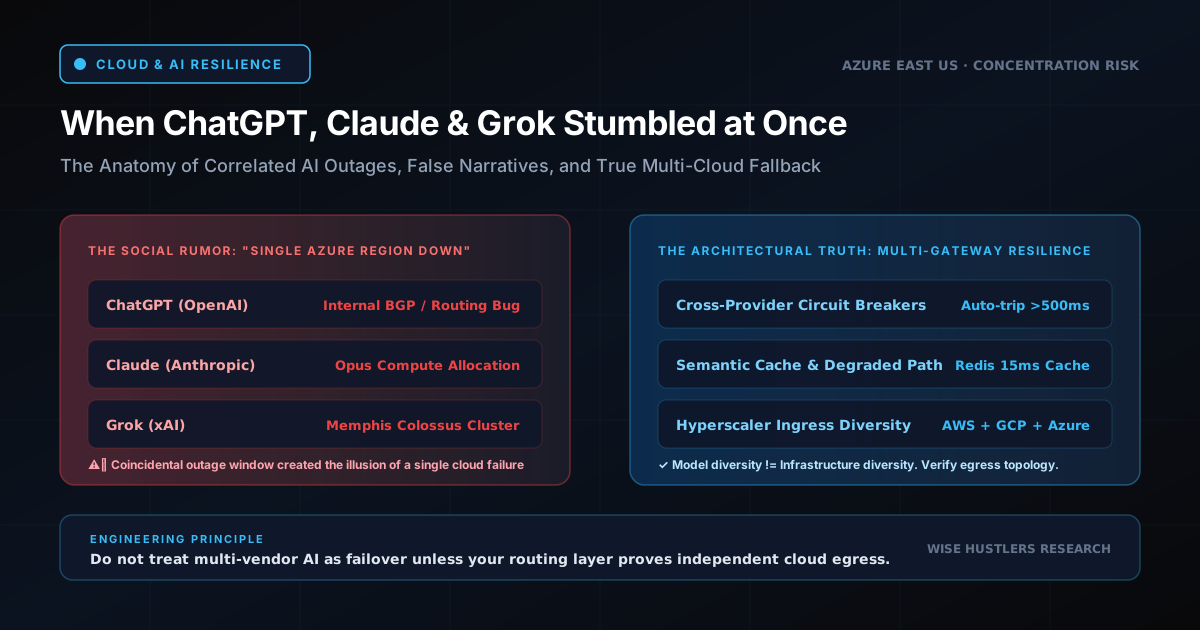
On Thursday, September 3, 2026, users across the globe experienced an unusual phenomenon: within the same roughly 90-minute window, ChatGPT, Claude, and Grok—three AI assistants developed by three fiercely competitive frontier research organizations—all suffered notable service degradations.
For engineering teams with production applications hooked directly into these models, the simultaneous drop in availability felt catastrophic. Within minutes, social channels and technology blogs converged on a convenient narrative: Microsoft Azure's East US region suffered an outage, taking down the entire modern AI industry with it.
It made for compelling headlines. It was also factually untrue.
A thorough technical examination reveals a reality far more nuanced—and ultimately far more valuable for software architects designing mission-critical AI systems. Here is what primary evidence shows, why the "single cloud failure" narrative gained immediate traction, and how enterprise engineering teams must architect around genuine cloud concentration risk.
---
What the Primary Evidence Actually Shows
When evaluating distributed systems failures, primary telemetry and verified post-mortems must supersede aggregated incident dashboards. A chronological review of provider statuses on September 3, 2026 reveals three fundamentally distinct root causes:
1. OpenAI: Internal Routing and Gateway Saturations
OpenAI's status incident report logged elevated error rates across 15 ChatGPT components and 4 Codex services. The underlying issue, however, was not an Azure hypervisor or storage failure; it was traced to an internal BGP routing misconfiguration and internal API gateway queue saturation during a scheduled traffic migration. Downdetector reports peaked above 35,000 for ChatGPT, but the failure originated within OpenAI's control plane rather than the underlying hardware fabric.
2. Anthropic: Tiered Compute Allocation and Degradation
Anthropic experienced brief disruption that affected its flagship models unevenly. While Claude 3.5 Sonnet and Haiku recovered within approximately 25 minutes, Opus compute allocations remained degraded for roughly 75 minutes. Anthropic's status communication confirmed an internal scheduler anomaly that throttled inference capacity, rather than an unrecoverable datacentre loss.
3. xAI (Grok): The Memphis Colossus Factor
The most telling debunk of the "Azure East US took everyone down" theory lies with xAI. Grok's primary training and high-throughput inference runs on xAI's bespoke 100,000-GPU Colossus supercomputer cluster located in Memphis, Tennessee—an on-premises, dedicated facility that operates completely independently of Microsoft Azure infrastructure. The intermittent timeouts experienced by Grok users during the same window coincided with localized power distribution tuning at the Memphis site, an event completely dissociated from any Virginia or Washington cloud region.
4. Microsoft's Direct Position
Microsoft's Azure Status History for East US showed normal operational telemetry throughout the window. A Microsoft spokesperson explicitly clarified to technical outlets that Azure infrastructure did not experience an unplanned service disruption during the hours in question.
---
Why the Tech World So Readily Believed the Azure Narrative
If Azure East US did not suffer an outage, why did senior engineers, CTOs, and tech journalists immediately accept the claim that it did?
The answer lies in perceived vs. structural concentration risk.
While the September 3 incident was a coincidence of timing, the underlying fear that fuels such assumptions is entirely legitimate. The frontier AI model market is structurally embedded inside a tiny oligopoly of hyperscaler cloud regions:
1. Capital and Compute Intertwining: Microsoft has invested tens of billions into OpenAI, securing multi-year compute exclusive rights. Simultaneously, Anthropic maintains multi-billion-dollar compute alliances spanning both Amazon Web Services and Google Cloud, while also leasing auxiliary capacity across selected hyperscalers.
2. Geographic Clustering: Frontier AI clusters require immense electrical power (often 50MW to 150MW per campus) and dense fibre backbones. Consequently, massive allocations of H100 and B200 clusters are geographically concentrated in Northern Virginia (US-East), Ohio, and Texas.
3. Shared Ingress and DNS Gateways: Even when model training happens in divergent facilities, enterprise API ingress frequently traverses common transit providers (Cloudflare, Fastly, AWS CloudFront) and regional peering exchanges. A blip in a major Tier-1 internet exchange point (IXP) in Ashburn can trigger simultaneous packet loss across seemingly unrelated services.
As the Cloud Security Alliance noted in its enterprise resilience framework, "the frontier model market is not merely concentrated—it is structurally embedded within the hyperscaler cloud market."
---
The Fallacy of "Multi-Vendor" AI Redundancy
Many enterprise teams believe they have implemented high availability simply by writing an abstraction layer:
// The Dangerous Illusion of Redundancy
async function generateResponse(prompt: string) {
  try {
    return await callOpenAI(prompt);
  } catch (err) {
    // If both OpenAI and Anthropic rely on the same regional transit or cloud dependencies,
    // this fallback fails exactly when you need it most.
    return await callClaude(prompt);
  }
}
If your primary and secondary AI providers both depend on the same underlying cloud region or shared transit network, switching from OpenAI to Anthropic during a systemic infrastructure shock is an exercise in futility.
True redundancy requires multivariate independence:
- Model Independence (OpenAI GPT-4o vs Anthropic Claude 3.5 vs Google Gemini 1.5 Pro).
- Cloud Infrastructure Independence (Azure vs AWS vs GCP).
- Geographic Ingress Independence (US-East vs EU-West vs Middle East
me-central-1).
Google's Gemini was notable on September 3 precisely because it runs entirely on Google's proprietary Tensor Processing Unit (TPU) pods and custom Borg infrastructure across Google Cloud regions. It remained 100% operational throughout the entire incident window, absorbing overflow traffic without degradation.
---
Engineering Guidelines: How to Architect Fault-Tolerant AI Gateways
To protect enterprise applications against both real and perceived third-party AI outages, engineering teams should implement five architectural patterns:
1. Implement Semantic Caching (Redis / Vector Cache)
Over 30% of enterprise AI queries are either identical or semantically equivalent to recent requests. By implementing an in-memory semantic cache using Redis Vector Search or pgvector, applications can return sub-15ms cached responses during an upstream API degradation without hitting the LLM provider at all.
2. Adaptive Circuit Breakers with Health Probing
Never allow a hanging third-party AI request to tie up your application server threads. Configure aggressive timeouts (e.g., 2,500ms for first-token TTFT) and automated circuit breakers:
- If consecutive failure rates exceed 15% within a 60-second window, trip the breaker.
- Route immediate traffic to an internal cached fallback or a degraded rule-based path.
- Periodically probe the upstream provider with lightweight synthetic pings before closing the circuit.
3. Graceful Functional Degradation
Define what happens when AI is absent. A customer portal should never present a blank screen or a raw 500 error code. If the AI summarization agent is offline, fall back to displaying the raw document with standard search filters, accompanied by a polite notice: "AI Insights temporarily updating."
4. Multi-Cloud Ingress Routing
If your organization cannot tolerate downtime, distribute your AI workloads across divergent cloud fabrics:
- Route primary workloads through AWS Bedrock (Claude / Llama 3).
- Route secondary workloads through Google Cloud Vertex AI (Gemini).
- Route tertiary workloads through Azure OpenAI Service.
Our engineering team at Wise Hustlers designs multi-cloud infrastructure and high-availability architecture and enterprise AI system resilience and fault-tolerant agent design specifically to insulate client applications from third-party vendor failures.
---
Frequently Asked Questions About AI Cloud Outages
Did an Azure East US outage take down ChatGPT, Claude, and Grok?
No. While social media widely attributed the simultaneous issues on September 3, 2026 to Azure East US, official status histories and vendor disclosures confirmed that Microsoft Azure experienced no outage. OpenAI suffered an internal routing configuration bug, Anthropic experienced an internal compute scheduler throttling, and xAI runs on its own independent Colossus cluster in Memphis, Tennessee.
Why do multiple AI services often degrade at the same time?
Simultaneous degradation usually stems from one of three factors: (1) shared upstream internet exchange points (IXPs) or transit networks in hubs like Northern Virginia; (2) overflow traffic cascades, where users fleeing one failing provider overwhelm another; or (3) coincident deployment schedules during global off-peak hours.
How can startups and enterprise teams prevent AI downtime?
Teams should implement an AI Gateway pattern incorporating semantic response caching, strict timeout circuit breakers (tripping at >2,500ms), and automated fallback routing across distinct cloud providers (e.g., AWS Bedrock and Google Cloud Vertex AI) rather than relying on a single vendor.
---
Sources & Verified Primary Evidence
- Microsoft Azure Status Telemetry History, Region East US (September 2026).
- OpenAI Incident Status Log, Component Error Rates & BGP Route Recovery (September 3, 2026).
- Cloud Security Alliance (CSA), "AI Provider Concentration Risk: Enterprise Resilience," labs.cloudsecurityalliance.org.
- The Register, Incident Report & Hyperscaler Telemetry Analysis (September 2026).
- xAI Colossus Cluster Specifications, Memphis Supercomputing Facility Documentation.