
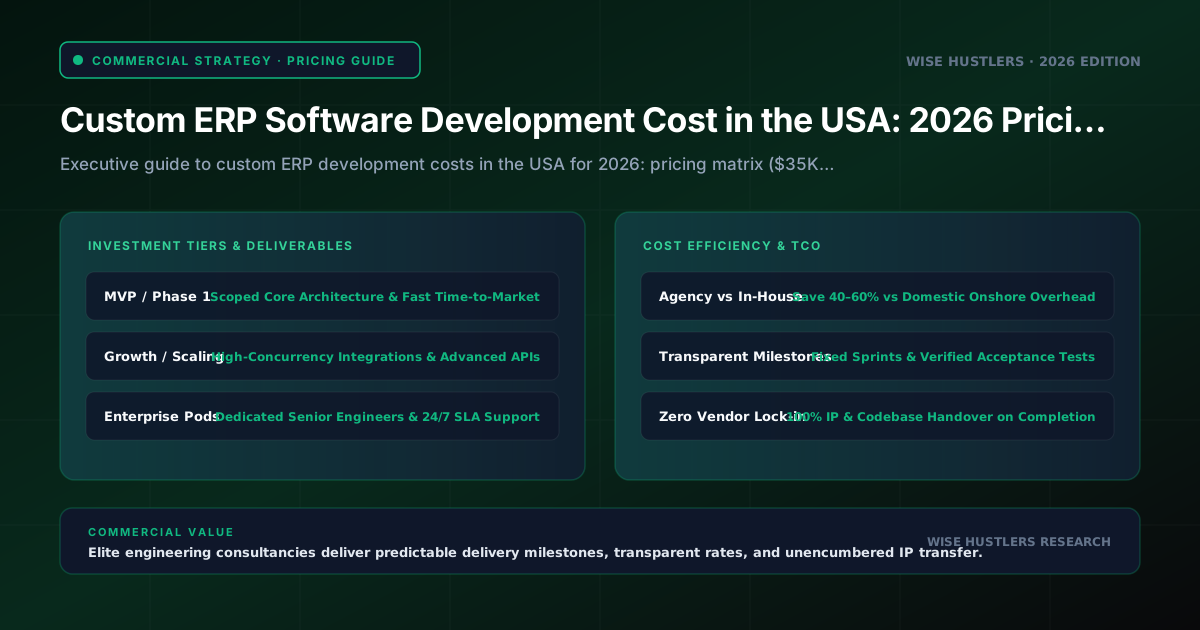
# Custom ERP Development Cost USA 2026: Pricing Matrix, Module Breakdown & Buyer Evaluation Guide
Summary: In 2026, the custom ERP development cost in the USA typically ranges from $35,000 for a focused single-module MVP to over $650,000 for an enterprise multi-entity platform, with mid-market core implementations averaging $90,000 to $220,000 based on standard US engineering rates ($110–$195/hr). While bespoke systems require higher upfront capital than off-the-shelf subscriptions, organizations with 75+ users frequently achieve positive ROI within 24 to 36 months by eliminating compounding per-seat SaaS licensing, vendor lock-in, and integration friction.
---
For chief financial officers, chief information officers, and operations executives, selecting an enterprise resource planning (ERP) system is one of the most consequential capital allocation decisions of the decade. Historically, mid-market and enterprise organizations defaulted to commercial off-the-shelf (COTS) platforms such as SAP S/4HANA, Oracle NetSuite, or Microsoft Dynamics 365.
However, by 2026, shifting software economics, aggressive annual subscription fee escalations, and the architectural rigidity of closed platforms have shifted the calculation. According to enterprise software procurement research from firms such as Gartner and Vertice (2024–2025 SaaS Inflation Indices), enterprise application renewal costs experience annual contract escalations frequently ranging from 8% to 15% year-over-year upon renewal, driven by contract indexation clauses, tier reclassifications, and bundle restructurings. Building bespoke software is no longer an eccentric luxury for Fortune 50 technology giants; it has become an economically advantageous strategy for mid-market operators seeking operational sovereignty, proprietary workflow automation, and predictable long-term balance sheet performance.
This advisory guide provides an exhaustive financial and technical analysis of the cost to build custom erp software in the United States in 2026. Below, we break down pricing matrices across system complexity, detail individual module engineering investments, analyze multi-year total cost of ownership (TCO) benchmarks, outline a 6-phase capital allocation model, and provide an executive vendor scorecard to vet prospective engineering partners.
---
The Macroeconomic Shift: Why US Enterprises Are Re-Evaluating COTS Platforms
Enterprise software procurement has entered a pragmatic cycle. For over a decade, cloud SaaS vendors promised lower upfront costs, continuous automated updates, and rapid time-to-value. For standard accounting or simple retail operations, those promises often materialized. But for complex mid-market manufacturers, specialized distributors, healthcare networks, logistics operators, and multi-entity holding companies, standard SaaS ERP systems frequently introduce severe organizational friction.
Three financial and technical forces explain why executive teams are investing in custom ERP solutions:
1. Compounding Per-Seat Costs and Subscription Escalation
Commercial ERP platforms monetize through per-seat licensing models. As an organization scales from 50 to 250 employees, annual licensing commitments multiply proportionally. In addition, multi-tenant commercial SaaS vendors manage shared computing infrastructure through platform governance limits—such as Oracle NetSuite SuiteCloud concurrency governance limits or SAP S/4HANA Cloud API throughput thresholds. When transactional volume or integration density expands, organizations must purchase higher service tiers, premium add-on packs, and additional integration concurrency licenses, creating an escalating operational expenditure (OpEx) profile. Over a five-to-ten-year lifecycle, this variable OpEx frequently outpaces the initial capital expenditure (CapEx) of engineering a dedicated proprietary platform.
2. The Customization and Integration Consulting Overhead
Off-the-shelf ERP platforms are rarely usable out of the box for specialized workflows. Implementing SAP or NetSuite typically requires contracting external systems integrators and certified functional consultants. According to IT consulting benchmarks and professional staffing surveys from Robert Half Technology and The Hackett Group, certified systems integration specialists standardly bill between $175 and $300 per hour. Furthermore, empirical research from Panorama Consulting Group's ERP Report demonstrates that implementation consulting, data configuration, and third-party customization services routinely consume 3x to 5x the first-year software license costs, frequently totaling $150,000 to well over $500,000 for mid-market implementations attempting to adapt rigid software to proprietary workflows. When the vendor releases a major version upgrade, those external custom scripts frequently break, requiring recurring maintenance engagements.
3. Balance Sheet Capitalization vs. Perpetual Operating Expense
From a financial accounting perspective, qualifying internal-use software development costs incurred during the application development stage may be capitalized on the balance sheet under US GAAP (specifically Financial Accounting Standards Board ASC 350-40, Internal-Use Software). For federal corporate tax purposes, under Internal Revenue Code (IRC) Section 174 (as amended by the Tax Cuts and Jobs Act), specified domestic software development expenditures are amortized over a 5-year period. Capitalizing custom software development builds a proprietary enterprise asset that enhances company valuation during private equity recapitalizations, debt financing, or M&A transactions. In contrast, SaaS subscription payments remain pure operational expenses with zero recoverable residual equity. Organizations should consult their CPA or accounting advisory firm to structure capitalization schedules according to their specific tax and reporting status.
---
2026 Custom ERP Pricing Matrix by System Complexity
The total investment required to engineer a custom ERP depends directly on architectural scope, data model complexity, concurrent user volume, third-party integration points, and regulatory compliance mandates.
In the United States, senior software architects and specialized enterprise engineers command standard market rates ranging from $110 to $195 per hour, based on data from the Robert Half Technology Salary Guide and compensation benchmarks from the US Bureau of Labor Statistics (BLS) for computer systems architects and senior software developers. The matrix below outlines realistic 2026 market benchmarks for bespoke ERP development delivered by US-led engineering teams:
| System Complexity Tier | Investment Range (USD) | Implementation Timeline | Target Organization Profile | Architectural Scope & Core Modules | Integration & Compliance Complexity |
|---|---|---|---|---|---|
| Single-Module MVP | $35,000 – $80,000 | 2 – 4 Months | High-growth startups, boutique manufacturers, single-site distributors ($5M–$15M revenue) | 1 focused vertical module (e.g., custom inventory tracking or production scheduling), relational database, basic role-based access control (RBAC), and lightweight reporting. | 1–2 standard APIs (e.g., QuickBooks Online, Stripe, Shopify); architected with foundational security baselines aligning with SOC 2 Trust Services Criteria. |
| Mid-Market Core ERP | $90,000 – $220,000 | 5 – 9 Months | Established mid-sized enterprises, regional logistics operators, multi-facility fabricators ($15M–$80M revenue) | 3–5 integrated operational modules (Inventory/WMS, Order Management, Core Accounting, Supplier Procurement), executive dashboards, automated approval pipelines. | 4–8 bi-directional integrations (EDI 850/856/810 protocols, 3PL logistics, banking Open API feeds, CRM); automated audit trails and role-level data masking. |
| Enterprise Multi-Entity System | $250,000 – $650,000+ | 9 – 18+ Months | Multi-entity corporations, international distributors, regulated healthcare/defense suppliers ($80M–$500M+ revenue) | Comprehensive multi-company ledger, automated intercompany consolidation, multi-currency engine, advanced MRP, dynamic supply chain forecasting, custom rules engines. | 10+ complex integrations (legacy systems, warehouse IoT hardware/PLCs, automated clearing house ACH networks, CAD/PLM suites); designed to align with SOC 2 Type II audit standards, ISO/IEC 27001 information security controls, and HIPAA security safeguards where applicable. |
Tier 1: Single-Module MVP ($35,000 – $80,000)
This tier targets organizations struggling with an acute operational bottleneck that generic software fails to address. Rather than replacing their entire operational stack at once, leadership commissions a focused module—such as a custom warehouse staging application or a proprietary job-costing engine—that operates alongside their existing general ledger.
- Primary Objective: Validate custom architecture, eliminate a mission-critical operational bottleneck, and establish a foundational data layer.
- Estimated Effort: Approximately 300 to 500 engineering hours at standard US billing rates ($110–$195/hr).
- Typical Team: 1 Lead Solutions Architect, 2 Full-Stack Engineers, 1 QA Engineer (Part-Time).
- Core Milestone: Functional production deployment within 60 to 120 days.
Tier 2: Mid-Market Core ERP ($90,000 – $220,000)
The mid-market tier represents the operational core for growing US enterprises. At this level, the software replaces disconnected legacy tools (such as aging on-premise systems, fragmented SaaS subscriptions, and fragile spreadsheets) with a single, unified database and event-driven backend.
- Primary Objective: Complete operational synchronization across sales, warehouse, procurement, and financial reporting.
- Estimated Effort: Approximately 800 to 1,500 engineering hours across systems design, core business logic, and API integration.
- Typical Team: 1 Technical Project Manager / Product Strategist, 1 Solutions Architect, 3 Full-Stack Engineers, 1 DevOps / Infrastructure Engineer, 1 Dedicated QA Specialist.
- Core Milestone: Phased rollout across business units within two to three quarters.
Tier 3: Enterprise Multi-Entity System ($250,000 – $650,000+)
For multi-entity holding companies, global trading firms, or advanced manufacturers, an enterprise ERP must orchestrate cross-border transactions, automate intercompany eliminations, manage complex bills of materials (BOM), and enforce strict compliance controls.
- Primary Objective: Total corporate operational governance, multi-subsidiary consolidation, high-throughput data processing, and absolute data sovereignty.
- Estimated Effort: 2,000 to 4,500+ engineering hours including data migration ETL pipelines, performance stress testing, and formal compliance auditing.
- Typical Team: 1 Delivery Lead, 2 Principal Architects (Domain & Infrastructure), 4–6 Senior Engineers, 2 Integration Specialists, 2 QA Engineers, 1 Security & Compliance Engineer.
- Core Milestone: Multi-stage departmental cutover with automated shadow runs over 9 to 18 months.
---
Granular Module Breakdown: Engineering Scope & Pricing Matrix
A modern ERP is not a monolithic block of software; it is a suite of tightly coupled domain services. Understanding this enterprise erp development pricing breakdown allows leadership to budget incrementally, deploying high-ROI modules first while deferring secondary capabilities.
The table below outlines individual module investments, engineering complexity, and technical deliverables based on 2026 US development benchmarks:
| ERP Module | 2026 Investment Range (USD) | Engineering Complexity | Core Technical Deliverables | Primary Business Impact |
|---|---|---|---|---|
| Inventory & Warehouse (WMS) | $20,000 – $45,000 | Medium | Real-time barcode/RFID scanning, multi-bin and multi-location tracking, automated FIFO/LIFO valuation, dynamic safety stock alerts, return merchandise authorization (RMA). | Eliminates stockouts, targets 15% to 25% reductions in inventory carrying costs according to ASCM/APICS supply chain benchmarks, accelerates pick-and-pack fulfillment. |
| Accounting & Multi-Currency | $25,000 – $60,000 | High | Double-entry general ledger aligned with US GAAP accounting principles, AP/AR automation, automated bank feed reconciliation via Plaid/Finicity APIs, multi-currency conversion, certified tax engine integrations (Avalara/Vertex). | Shortens monthly financial close cycles, eliminates manual reconciliation errors, provides real-time gross margin visibility. |
| Supply Chain & Procurement | $25,000 – $55,000 | Medium – High | Vendor management portal, purchase order approval workflows, lead-time variance tracking, 3-way invoice matching, supplier scorecard metrics. | Prevents maverick spending, optimizes supplier payment terms, reduces raw material delivery delays. |
| HR, Workforce & Payroll | $20,000 – $50,000 | Medium | Employee directory, role-based organizational charts, PTO tracking, shift scheduling, commission calculators, integrations with certified payroll calculation APIs (Gusto Embedded/Check). | Reduces manual routine HR administrative tasks by up to 35% to 40% based on SHRM workflow automation studies, centralizes workforce compliance records. |
| Production Planning & MRP | $35,000 – $80,000 | Very High | Multi-level Bill of Materials (BOM), capacity requirements planning (CRP), machine telemetry integration, work-in-progress (WIP) tracking, shop-floor dispatch terminals. | Increases machine utilization rates, minimizes material scrap, provides exact job-level profitability analysis. |
Module Deep-Dive: Where Engineering Hours Are Invested
1. Inventory Management & WMS ($20,000 – $45,000): Developing a production-ready WMS requires engineering low-latency mobile interfaces for warehouse personnel, resilient offline sync capabilities for hand-held scanners, and race-condition-safe inventory deduction algorithms to prevent dual-allocation during peak order surges.
2. Accounting & Financial Ledger ($25,000 – $60,000): Financial modules require strict mathematical determinism. Engineering focuses on transactional ACID compliance, immutable audit log tables, automated foreign exchange rate fetching via banking APIs, and financial reporting aligned with US GAAP principles.
3. Supply Chain & Procurement ($25,000 – $55,000): The core technical challenge involves automating document ingestion (such as PDF purchase orders and shipping manifests), multi-tier approval hierarchies with role-based signing thresholds, and supplier lead-time variance tracking.
4. Human Resources & Payroll ($20,000 – $50,000): Engineering investments center on security and granular permission controls. Adheres to enterprise security standards including AES-256 encryption at rest and TLS 1.3 in transit, alongside integration with certified third-party tax calculation and benefits administration APIs.
5. Production Planning & MRP ($35,000 – $80,000): The most mathematically intensive ERP component. Building an MRP engine requires recursive graph traversal algorithms to calculate sub-assembly lead times, machine bottleneck detection, and telemetry pipelines linking shop-floor PLCs (programmable logic controllers) to the central database.
---
6-Phase Budget Allocation Framework
A common failure mode in custom software development is poor capital distribution—allocating 80% of funds to raw coding while neglecting systems architecture, data migration, and automated quality assurance.
To ensure stability, enterprise ERP budgets should follow this disciplined 6-phase capital allocation model:
| Phase | Budget Allocation (%) | Benchmark Budget ($200K Build) | Critical Technical Deliverables | Primary Failure Mode If Underfunded |
|---|---|---|---|---|
| 1. Architecture & Solution Design | 12% | $24,000 | Domain-driven design (DDD) schemas, Entity-Relationship Diagrams (ERDs), API specifications, UI/UX design systems, technical blueprint. | Architectural debt, fragmented database schemas, costly mid-project redesigns. |
| 2. Core Software Engineering | 45% | $90,000 | Frontend web/mobile applications, backend modular monolith or microservices, transactional business logic, database migrations. | Slow feature delivery, unstable operational workflows, unmaintainable spaghetti code. |
| 3. Third-Party & API Integrations | 15% | $30,000 | Bi-directional connectors for banking, EDI, logistics (FedEx/UPS/3PL), legacy databases, CRM platforms, and payment gateways. | Manual data handoffs, data silos, fragile polling mechanisms that crash under load. |
| 4. Legacy Data Cleansing & Migration | 12% | $24,000 | Automated ETL pipelines, schema mapping, historical data deduplication, reconciliation scripts, trial cutover runs. | Corrupted historical records, missing customer balances, operational standstill on launch day. (According to data migration benchmarks from TDWI, legacy data preparation standardly consumes 10% to 15% of project scope). |
| 5. QA & Automated Test Engineering | 10% | $20,000 | End-to-end integration test suites, stress/load testing, security vulnerability scans, user acceptance testing (UAT) harness. | Production regressions, system downtime, transaction processing errors in live environments. |
| 6. DevOps, Infrastructure & Project Governance | 6% | $12,000 | CI/CD deployment pipelines, Infrastructure as Code (Terraform), container orchestration (Docker/Kubernetes), observability monitoring, sprint management. | Inconsistent server environments, lack of automated rollbacks, delayed incident resolution. |
---
5-Year Total Cost of Ownership (TCO): Custom Cloud ERP vs. SAP / NetSuite
When evaluating enterprise software, comparing Year 1 upfront costs alone presents an incomplete financial picture. Commercial SaaS vendors often offer promotional first-year discounts to capture contracts, only to increase prices significantly upon renewal.
To establish an objective comparison, the financial model below tracks custom erp vs sap netsuite tco over a 5-year operational lifecycle. This scenario models a representative mid-market enterprise with 100 system users and moderate transaction volume, comparing a bespoke cloud application against published baseline list price benchmarks for Tier-1 commercial cloud ERP (e.g., standard mid-market base tier starting at ~$999/month plus ~$99/user/month for 100 full-access users, with an 8% annual renewal escalation in accordance with Gartner and Vertice SaaS inflation studies):
| Cost Category | Custom Cloud ERP (Bespoke Architecture) | Tier-1 SaaS ERP (NetSuite / SAP S/4HANA Cloud Benchmark) |
|---|---|---|
| Year 1: Implementation & Software | • Initial Custom Development: $160,000<br>• Cloud Hosting (AWS/GCP): $4,800<br>• Initial Architecture & Scoping: $20,000<br>• Staff Training & Onboarding: $8,000<br>Year 1 Total: $192,800 | • Base License & 100 User Seats (List Benchmark): $84,000<br>• Certified Implementation Partner: $145,000<br>• Vendor Support Package: $18,000<br>• Staff Training & Certification: $12,000<br>Year 1 Total: $259,000 |
| Year 2: Operations & Maintenance | • Cloud Infrastructure (AWS): $6,000<br>• Retainer Maintenance & Enhancements: $30,000<br>• Zero Per-Seat Licensing Fees: $0<br>Year 2 Total: $36,000 | • Annual Seat Licensing (8% Escalation): $90,720<br>• Vendor Annual Support Contract: $19,440<br>• Script Breakage & Consultant Upkeep: $28,000<br>Year 2 Total: $138,160 |
| Year 3: Expansion & Upgrades | • Cloud Infrastructure Scaling: $7,200<br>• Planned Module Extension: $35,000<br>• Zero Per-Seat Licensing Fees: $0<br>Year 3 Total: $42,200 | • Annual Seat Licensing (8% Escalation): $97,980<br>• Vendor Support Package: $21,000<br>• Additional Tier / Connector Fees: $15,000<br>Year 3 Total: $133,980 |
| Year 4: Steady-State Operations | • Cloud Infrastructure: $8,400<br>• Continuous DevOps & Security Patching: $24,000<br>• Zero Per-Seat Licensing Fees: $0<br>Year 4 Total: $32,400 | • Annual Seat Licensing (8% Escalation): $105,820<br>• Vendor Support Package: $22,680<br>• Upgrades & Version Migration Consulting: $32,000<br>Year 4 Total: $160,500 |
| Year 5: Operational Optimization | • Cloud Infrastructure: $9,600<br>• Continuous DevOps & Feature Iteration: $26,000<br>• Zero Per-Seat Licensing Fees: $0<br>Year 5 Total: $35,600 | • Annual Seat Licensing (8% Escalation): $114,280<br>• Vendor Support Package: $24,500<br>• Maintenance & Additional Module Add-ons: $38,000<br>Year 5 Total: $176,780 |
| 5-Year Cumulative TCO | $339,000 | $868,420 |
| Strategic Balance Sheet Impact | Proprietary Capital Asset ($200K+ capitalized book value; 100% IP ownership; zero operational restrictions). | 100% Sunk Operating Expense ($0 equity value; complete dependency on vendor roadmap and terms). |
The TCO Inflection Point
In this modeled 100-user enterprise scenario, the projected financial crossover occurs between Month 26 and Month 32.
During Year 1, commercial SaaS appears competitive on paper because initial licensing feels lower than full custom development. However, once implementation consulting fees, mandatory annual subscription escalations, and third-party connector subscriptions compound, off-the-shelf software becomes substantially more expensive.
By Year 5 under this baseline scenario model, the bespoke cloud ERP yields modeled net cash outflow savings of approximately $529,420 while eliminating user-seat friction—allowing the enterprise to expand from 100 to 500 users without incurring additional per-seat software license fees.
In enterprise software procurement modeling, organizations with 75 to 100+ active system users frequently encounter an economic inflection threshold: the compounding cost of recurring monthly seat subscriptions ($100–$250 per user/month) exceeds the steady-state cloud infrastructure and retainer maintenance costs of a dedicated custom application within 24 to 36 months.
---
Enterprise Architecture Blueprint: Designing for Scalability & Resilience
A high-performing custom ERP must be architected for long-term maintainability, deterministic data consistency, and high transactional throughput. In 2026, building bespoke enterprise software does not mean building every component from scratch; it means integrating production-grade open-source ecosystems with clear domain boundaries.
Recommended Technology Stack
[ Frontend Client Layer ]
  ├── Web Application: Next.js 15 / React 19 / TypeScript
  ├── Mobile / Warehouse Scanners: React Native / Progressive Web App (PWA)
  └── UI Design System: Tailwind CSS / Radix UI Primitive Components

[ API & Orchestration Layer ]
  ├── Gateway & Load Balancer: Cloudflare Enterprise / AWS ALB
  ├── Backend Services: Go (High-Throughput Services) & Node.js / NestJS (Business Logic)
  └── Event Bus: Apache Kafka / RabbitMQ (Asynchronous Task Dispatch)

[ Persistence & Data Architecture ]
  ├── Relational Core: PostgreSQL 16+ (ACID-compliant, Row-Level Security)
  ├── Cache & Session Store: Redis Enterprise Cluster
  └── Analytics & Reporting: ClickHouse / Amazon Redshift (OLAP Columnar Store)

[ Infrastructure & Security ]
  ├── Container Orchestration: Docker / AWS EKS (Kubernetes)
  ├── Infrastructure as Code: Terraform
  └── Observability & Audit: Datadog / OpenTelemetry / Prometheus
Production-Ready Schema Implementation: Double-Entry Transaction Ledger with RLS
A foundational requirement for enterprise ERP systems is mathematical immutability in the financial core and strict tenant isolation across operating entities. The runnable PostgreSQL schema below illustrates double-entry ledger design with Row-Level Security (RLS) and transaction balance verification:
-- Production-Ready PostgreSQL Schema: Double-Entry Transaction Ledger with Row-Level Security (RLS)
-- Demonstrates multi-subsidiary data isolation and deterministic debit/credit balance validation.

CREATE EXTENSION IF NOT EXISTS "uuid-ossp";

-- 1. Organization Tenants / Operating Subsidiaries
CREATE TABLE IF NOT EXISTS tenants (
    id UUID PRIMARY KEY DEFAULT uuid_generate_v4(),
    name VARCHAR(255) NOT NULL,
    created_at TIMESTAMPTZ NOT NULL DEFAULT NOW()
);

-- 2. Chart of Accounts Table
CREATE TABLE IF NOT EXISTS accounts (
    id UUID PRIMARY KEY DEFAULT uuid_generate_v4(),
    tenant_id UUID NOT NULL REFERENCES tenants(id) ON DELETE CASCADE,
    account_number VARCHAR(64) NOT NULL,
    name VARCHAR(255) NOT NULL,
    account_type VARCHAR(32) NOT NULL CHECK (account_type IN ('ASSET', 'LIABILITY', 'EQUITY', 'REVENUE', 'EXPENSE')),
    currency VARCHAR(3) NOT NULL DEFAULT 'USD',
    is_active BOOLEAN NOT NULL DEFAULT TRUE,
    created_at TIMESTAMPTZ NOT NULL DEFAULT NOW(),
    CONSTRAINT uq_account_per_tenant UNIQUE (tenant_id, account_number)
);

-- 3. Journal Entry Header
CREATE TABLE IF NOT EXISTS journal_entries (
    id UUID PRIMARY KEY DEFAULT uuid_generate_v4(),
    tenant_id UUID NOT NULL REFERENCES tenants(id) ON DELETE CASCADE,
    entry_number VARCHAR(64) NOT NULL,
    posted_at TIMESTAMPTZ NOT NULL DEFAULT NOW(),
    memo TEXT,
    created_at TIMESTAMPTZ NOT NULL DEFAULT NOW(),
    CONSTRAINT uq_entry_per_tenant UNIQUE (tenant_id, entry_number)
);

-- 4. Journal Entry Line Items (Debits and Credits)
CREATE TABLE IF NOT EXISTS journal_lines (
    id UUID PRIMARY KEY DEFAULT uuid_generate_v4(),
    tenant_id UUID NOT NULL REFERENCES tenants(id) ON DELETE CASCADE,
    journal_entry_id UUID NOT NULL REFERENCES journal_entries(id) ON DELETE CASCADE,
    account_id UUID NOT NULL REFERENCES accounts(id) ON DELETE RESTRICT,
    debit_amount NUMERIC(14, 4) NOT NULL DEFAULT 0.0000 CHECK (debit_amount >= 0),
    credit_amount NUMERIC(14, 4) NOT NULL DEFAULT 0.0000 CHECK (credit_amount >= 0),
    created_at TIMESTAMPTZ NOT NULL DEFAULT NOW(),
    CONSTRAINT chk_nonzero_entry CHECK (debit_amount > 0 OR credit_amount > 0),
    CONSTRAINT chk_not_both CHECK (NOT (debit_amount > 0 AND credit_amount > 0))
);

-- 5. Enable Row-Level Security (RLS) for Subsidiary Data Isolation
ALTER TABLE accounts ENABLE ROW LEVEL SECURITY;
ALTER TABLE journal_entries ENABLE ROW LEVEL SECURITY;
ALTER TABLE journal_lines ENABLE ROW LEVEL SECURITY;

-- Dynamic tenant isolation policy using session context variable
CREATE POLICY tenant_isolation_accounts ON accounts
    FOR ALL
    USING (tenant_id = NULLIF(current_setting('app.current_tenant_id', true), '')::UUID);

CREATE POLICY tenant_isolation_journal_entries ON journal_entries
    FOR ALL
    USING (tenant_id = NULLIF(current_setting('app.current_tenant_id', true), '')::UUID);

CREATE POLICY tenant_isolation_journal_lines ON journal_lines
    FOR ALL
    USING (tenant_id = NULLIF(current_setting('app.current_tenant_id', true), '')::UUID);
Architectural Principles for Long-Term Maintainability
1. Modular Monolith First: Unless your engineering organization employs hundreds of developers, avoid premature microservice fragmentation. A cleanly structured modular monolith—with strictly separated domain boundaries, independent data schemas, and internal event buses—delivers high development velocity without the networking complexity and distributed transaction overhead of microservices.
2. Row-Level Security (RLS) & Multi-Tenancy: Enforce data isolation directly at the database engine level using PostgreSQL Row-Level Security. This prevents data leakage across subsidiaries, regional branches, or customer divisions, supporting data privacy controls aligned with state privacy legislation (such as CCPA/CPRA) and regulatory data segmentation standards.
3. Immutable Event Auditing: Every financial posting, inventory adjustment, and status modification should be recorded in an append-only audit ledger table. This guarantees traceability for external auditors, forensic accounting, and compliance reviews.
---
Enterprise Vendor Evaluation Scorecard
Selecting the wrong software development agency is the single greatest risk in a custom ERP initiative. Many generalist agencies excel at building consumer mobile applications or marketing websites but lack the systems engineering discipline required for transactional databases, double-entry ledgers, and complex supply chain logic.
Use this weighted evaluation framework to vet prospective development partners:
| Evaluation Dimension | Weight (%) | Critical Audit Questions for Engineering Leadership | Disqualifying Red Flags | Elite Partner Standard |
|---|---|---|---|---|
| 1. System Architecture & Domain Depth | 25% | • Have they architected double-entry ledgers or complex inventory logic before?<br>• Can they explain how they handle concurrent writes and distributed transactions? | • Proposing no-code/low-code tools for core ERP workflows.<br>• Inability to produce detailed ERDs or database schema designs during discovery. | Demonstrates deep fluency in relational schema design, ACID transactions, event-driven architecture, and domain-driven design (DDD). |
| 2. Data Migration & Legacy Modernization | 20% | • What is their specific methodology for extracting, cleaning, and validating historical data?<br>• How do they conduct automated trial cutover runs? | • Treating data migration as an afterthought scheduled for the final sprint.<br>• Relying on manual spreadsheet copy-pasting for cutover. | Employs automated ETL pipelines, automated reconciliation checksums, and structured staging dry runs prior to cutover. |
| 3. Commercial Alignment & Contract Structure | 15% | • Do they offer milestone-based deliverables with clear acceptance criteria?<br>• How do they structure scope changes and sprint transparency? | • Vague time-and-materials contracts without milestone caps.<br>• Demanding large upfront retainers without demonstrable prototypes. | Fixed-fee discovery phases followed by phased milestone billing linked directly to functional user acceptance testing (UAT). |
| 4. Intellectual Property & Code Ownership | 15% | • Does the contract provide complete IP assignment for code, schemas, and assets upon payment?<br>• Are there proprietary third-party agency dependencies? | • Agency retains ownership of core framework or charges perpetual internal licensing fees.<br>• Obfuscated source code or restricted repository access. | Full, unencumbered contractual transfer of intellectual property, repository access from sprint one, and clean architectural documentation. |
| 5. Post-Launch SLAs & DevOps Governance | 15% | • What are the guaranteed uptime and bug-remediation SLAs post-launch?<br>• Do they provide automated CI/CD pipelines and infrastructure documentation? | • "Build-and-dump" handover without formal maintenance agreements.<br>• Manual server configurations without Infrastructure as Code (IaC). | Comprehensive SLA tiers, automated monitoring dashboards, documented rollback procedures, and dedicated DevOps support. |
| 6. Security & Regulatory Alignment | 10% | • How do they manage secrets, encryption keys, and role-based access?<br>• Have they built systems aligned with SOC 2 Type II, HIPAA, or ISO 27001 control frameworks? | • Hardcoded API keys in code repositories.<br>• Lack of field-level encryption for sensitive financial or personnel data. | Automated static/dynamic security testing (SAST/DAST), zero-trust access controls, and strict adherence to OWASP Top 10 guidelines. |
---
Partnering with Wise Hustlers for Mission-Critical Engineering
Executing a custom ERP project requires more than generic programming talent; it requires a strategic engineering partner that understands executive business models, unit economics, and complex operational workflows.
Wise Hustlers provides elite custom application development services in the USA, partnering with mid-market enterprises, high-growth operators, and institutional organizations to design, architect, and deploy mission-critical software platforms.
Why Forward-Thinking Executives Build with Wise Hustlers:
- Senior-Only Engineering Squads: We do not staff projects with junior apprentices. Your ERP architecture is designed and built by seasoned systems architects with extensive experience in high-throughput transactional backends.
- Fixed-Milestone Governance: We de-risk software procurement. Through structured architectural discovery sprints, we establish concrete functional specifications, deterministic data schemas, and capped milestones tied to rigorous acceptance criteria.
- 100% Intellectual Property Sovereignty: You own every line of code, every architectural diagram, and every database migration script upon milestone completion. No proprietary framework lock-in. No artificial licensing restrictions.
- Production-Ready from Day One: Every release is backed by automated CI/CD pipelines, containerized infrastructure (Docker/Kubernetes), automated test coverage, and enterprise observability.
Whether you are looking to replace an aging legacy system, escape escalating SaaS licensing fees, or build a proprietary operational engine tailored to your unique market advantage, our advisory team is prepared to evaluate your architectural roadmap.
---
Executive Frequently Asked Questions
What is the realistic delivery timeline for custom ERP software in the USA?
A custom ERP implementation typically requires 4 to 12 months, depending on functional scope and integration requirements. A focused, single-module MVP (such as a proprietary WMS or job-costing engine) can be deployed into production within 60 to 90 days. A comprehensive mid-market core ERP covering inventory, procurement, and accounting averages 6 to 9 months. Highly complex, multi-entity systems with legacy mainframe data migrations and strict regulatory certifications typically require 12 to 18 months, conducted via phased departmental rollouts to minimize operational risk.
What are the primary hidden costs associated with custom ERP development?
The three most common unbudgeted costs in custom ERP initiatives are:
1. Legacy Data Cleansing: Historical data in legacy databases or spreadsheets is frequently fragmented, duplicated, or corrupted. According to enterprise data engineering benchmarks from TDWI (The Data Warehousing Institute), cleaning, reformatting, and validating legacy data standardly requires 10% to 15% of the total engineering budget.
2. Third-Party API Certification: Connecting to legacy banking networks, EDI protocols, or proprietary logistics vendors often involves third-party certification fees and prolonged testing cycles.
3. Change Management and Staff Training: Software success depends on employee adoption. Budgeting for internal training materials, user acceptance testing (UAT) sessions, and operational adjustment periods is vital to prevent productivity dips during cutover.
When does custom ERP development financially outperform SAP S/4HANA or Oracle NetSuite?
Custom ERP development becomes financially superior under three specific conditions:
1. Seat Count Scaling: In mid-market procurement analysis, organizations with 75 or more users face compounding per-seat SaaS costs that surpass custom software hosting and maintenance within 24 to 36 months.
2. Proprietary Operational Workflows: If your competitive moat stems from specialized manufacturing steps, unique pricing algorithms, or complex supply chain networks, forcing those processes into standard SAP or NetSuite workflows requires massive consulting expenditures that often fail to deliver a competitive advantage.
3. High Integration Overhead: When an enterprise must connect dozens of internal databases, IoT shop-floor sensors, or custom client portals, commercial SaaS vendors impose heavy API overage fees and connector surcharges that make custom API architectures significantly more cost-effective.
How can enterprises eliminate data migration failure and business interruption during ERP transition?
To prevent business interruption, elite engineering teams execute a dual-run migration strategy:
- Automated ETL Pipelines: Rather than performing a single manual cutover, automated extraction, transformation, and loading (ETL) scripts run continuously in a staging environment, synchronizing data between the old and new systems.
- Reconciliation Auditing: Automated validation scripts compare transactional balances, general ledger totals, and inventory counts between both databases down to the cent.
- Parallel Run Operations: For 30 to 60 days prior to formal decommissioning, core accounting and order management teams operate both systems simultaneously. The legacy system remains the fallback record until the custom ERP demonstrates zero discrepancy over two full financial close cycles.
---
Verified Industry Sources & Benchmark References
- US Bureau of Labor Statistics (BLS): Occupational Employment and Wage Statistics (OEWS) — Software Developers, Quality Assurance Analysts, and Computer Systems Architects (May 2024 / 2025 Release). URL: bls.gov/ooh/computer-and-information-technology
- Robert Half Technology: 2025–2026 Salary Guide: IT & Technology Hiring and Compensation Benchmarks. URL: roberthalf.com/salary-guide
- Panorama Consulting Group: Annual ERP Report: ERP Implementation Durations, Failure Rates, and Budget Benchmarks. URL: panorama-consulting.com/resource-center/erp-report
- Gartner Research: Forecast: Enterprise Software Spending and Renewal Escalation Trends. URL: gartner.com
- Vertice SaaS Inflation Index: Annual Analysis of B2B SaaS Contract Escalations and Pricing Models. URL: vertice.one
- Association for Supply Chain Management (ASCM / APICS): Supply Chain Operations Reference (SCOR) Benchmarks: Inventory Carrying Cost and Warehouse Efficiency Metrics. URL: ascm.org
- Society for Human Resource Management (SHRM): HR Technology Benchmarks: Administrative Time Allocation and Workflow Automation Impacts. URL: shrm.org
- TDWI (The Data Warehousing Institute): Data Migration and Cleansing Benchmark Guide: Legacy System Cutover Economics. URL: tdwi.org
- Financial Accounting Standards Board (FASB): Accounting Standards Codification (ASC) Topic 350-40: Internal-Use Software. URL: fasb.org
- Internal Revenue Service (IRS): Internal Revenue Code (IRC) Section 174: Amortization of Specified Research and Experimental Expenditures. URL: irs.gov