
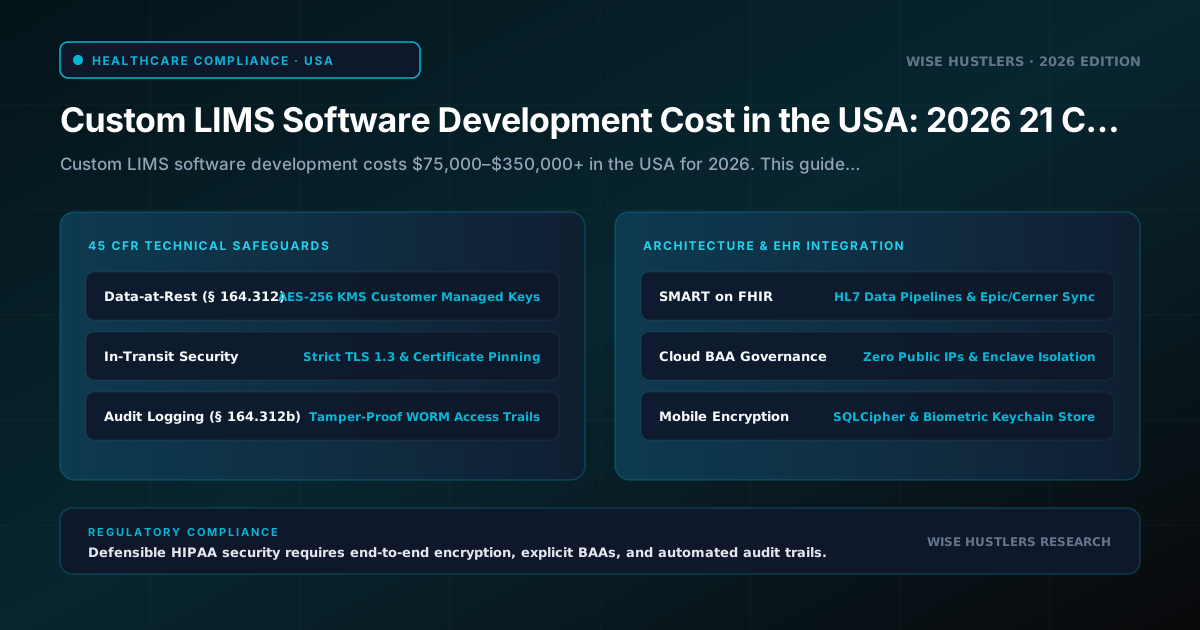
# Custom LIMS Software Development Cost in the USA: 2026 21 CFR Part 11 Compliance & Pricing Guide
Summary: In 2026, custom LIMS software development cost in the USA typically ranges from $75,000 to over $350,000, based on US engineering rates ($120–$200/hr) across 600 to 2,500+ development hours. Final investment depends on regulatory scope (FDA 21 CFR Part 11, GxP) and analytical instrument automation, delivering tailored workflows and native ALCOA+ data integrity without recurring per-seat licensing fees.
---
For laboratory directors, Chief Technology Officers, and Quality Assurance executives in the life sciences sector, the Laboratory Information Management System (LIMS) is the operational backbone of testing, compliance, and scientific throughput. Whether managing high-throughput genomic sequencing, biobanking, pharmaceutical batch release, or contract research assays, laboratory software directly determines operational efficiency, data integrity, and inspection readiness.
Commercial off-the-shelf (COTS) enterprise laboratory platforms frequently require substantial capital commitments when factoring in named or concurrent user licenses, recurring annual maintenance agreements (typically 18% to 22% of baseline software license value), database licensing fees, and proprietary configuration charges. In multi-analyst research or regulated testing facilities, annual licensing and maintenance outlays often reach into six figures. More critically, off-the-shelf platforms frequently compel laboratory teams to adapt proprietary assay workflows into standardized vendor data models, introducing operational bottlenecks, administrative friction, and custom validation challenges.
Commissioning bespoke laboratory software eliminates recurring user seat fees while establishing a software architecture tailored specifically to unique analytical pipelines. This guide provides an executive-level analysis of custom LIMS software development cost in the United States for 2026, breaking down engineering labor tiers, 21 CFR Part 11 compliance architecture, GAMP 5 Computer Software Assurance (CSA) validation frameworks, analytical instrument middleware, and the long-term build-versus-buy financial equation.
---
1. 2026 Custom LIMS Software Development Cost Matrix
Custom LIMS engineering costs depend on regulatory classification, data ingestion velocity, instrument integration density, and organizational scale. In the United States, specialized life sciences software engineering rates generally range from $120 to $200 per hour for senior full-stack developers, bioinformatics data architects, and regulatory validation engineers (reflecting data from the U.S. Bureau of Labor Statistics for specialized software systems engineering).
Applying these professional labor rates across standard project development scopes yields the capital expenditure ranges detailed below.
Table 1: Custom LIMS Pricing Tiers (Engineering Labor & Scope Model)
| Development Tier | Target Operational Scope | Core Technical Capabilities | Project Timeline & Labor Hours | Representative Capital Range (USD) |
|---|---|---|---|---|
| Tier 1: Core Sample Tracking & Biobanking MVP | Academic labs, non-regulated R&D facilities, seed-stage biotech startups. | 2D barcode/RFID intake, hierarchical sample topology (freezer, rack, box, well), basic metadata schemas, custody chain logging, and RESTful export endpoints. | 3 – 4 Months (~500 – 800 engineering hours) | $75,000 – $120,000 |
| Tier 2: GxP Enterprise Workflow & 21 CFR Part 11 Baseline | GLP/GMP testing labs, contract research organizations (CROs), and clinical diagnostics. | Cryptographic audit trails (SHA-256 hash chaining), dual-authentication electronic signatures (21 CFR § 11.50/70/200), role-based access control (RBAC), chain-of-custody enforcement, assay workflow pipelines, and automated Certificate of Analysis (CoA) generation. | 5 – 7 Months (~900 – 1,400 engineering hours) | $130,000 – $210,000 |
| Tier 3: Instrument IoT Middleware & Multi-Assay Automation | High-throughput diagnostic labs, central reference facilities, and clinical trial testing sites. | Direct bidirectional instrument interfaces (RS-232, TCP/IP, MQTT, REST), automated raw data parsing (HPLC, GC-MS, NGS, PCR), robotic liquid handler worklist dispatch, reagent inventory tracking with lot expiration alerts, and automated anomaly flagging. | 7 – 10 Months (~1,500 – 2,100 engineering hours) | $220,000 – $320,000 |
| Tier 4: Mission-Critical Enterprise LIMS & High-Throughput Omics | Multi-site pharma enterprises, commercial reference laboratories, and CAP/CLIA/FDA-regulated manufacturers. | Distributed microservices architecture, petabyte-scale multi-modal data ingestion, bidirectional ERP/MES integration (SAP, NetSuite), multi-tenant security architecture, GAMP 5 CSA automated verification suite, and predictive assay analytics. | 10 – 14 Months (~2,200 – 3,200+ engineering hours) | $330,000 – $480,000+ |
Note: Estimates represent turnkey development executed by specialized US-based engineering teams. Projects utilizing internal engineering personnel or hybrid staffing models will adjust capital requirements accordingly.
---
Representative Engineering Capital Allocation Breakdown
To illustrate how development capital is deployed across technical disciplines during a custom GxP laboratory software build, consider a representative resource allocation model for a Tier 2 to Tier 3 compliance build ($200,000 to $280,000 budget range). This functional allocation is derived from typical Agile sprint resource distribution across multidisciplinary engineering teams:
┌─────────────────────────────────────────────────────────────────────────┐
│       REPRESENTATIVE ARCHITECTURAL ALLOCATION MODEL (TIER 2/3 GxP)      │
├───────────────────────────────────────────────────┬─────────────────────┤
│ Core Engineering Discipline                       │ Allocation Share    │
├───────────────────────────────────────────────────┼─────────────────────┤
│ Backend Services, Microservices & Data Model      │ 26% ($52K - $73K)   │
│ 21 CFR Part 11 Audit Trail & Security Engine      │ 18% ($36K - $50K)   │
│ Instrument Middleware & Protocol Ingestion Layer  │ 16% ($32K - $45K)   │
│ Responsive Frontend & Laboratory Technician UI/UX │ 15% ($30K - $42K)   │
│ GAMP 5 Computer Software Assurance (CSA) & V-Model│ 13% ($26K - $36K)   │
│ DevOps, Infrastructure as Code & GxP Cloud Setup  │  7% ($14K - $20K)   │
│ Architecture Oversight & Regulatory Project Mgmt  │  5% ($10K - $14K)   │
└───────────────────────────────────────────────────┴─────────────────────┘
1. Backend & Relational/Timeseries Architecture (26%): Database schema modeling for sample genealogy, assay run parameters, multi-well plate topologies (96/384/1536-well), and relational metadata stores using PostgreSQL, TimescaleDB, or distributed document repositories.
2. 21 CFR Part 11 Compliance Engine (18%): Construction of cryptographic hash chains, immutable append-only event tables, dual-credential authorization gateways, session timeouts, and tampering tripwires.
3. Instrument Integration Middleware (16%): Protocol translation engines supporting serial RS-232, raw socket connections, MQTT brokers, REST webhooks, and automated file parsers (CSV, XML, JSON, proprietary instrument outputs).
4. Lab Interface UI/UX (15%): High-contrast, keyboard-optimized, barcode-scanner-friendly web interfaces engineered for bench scientists wearing nitrile gloves in cleanroom or biosafety cabinet environments.
5. GAMP 5 Validation Artifacts & Automated Verification (13%): Execution of automated traceability matrices (RTM), Installation Qualification (IQ), Operational Qualification (OQ), and Performance Qualification (PQ) automated test suites.
6. DevOps & Cloud Security (7%): Automated CI/CD pipelines, immutable infrastructure provisioning via Infrastructure as Code (Terraform), SOC 2 and HIPAA-aligned VPC isolation, automated offsite encrypted backups, and KMS key management.
7. Advisory & Project Oversight (5%): Dedicated life sciences software architect and regulatory liaison managing scope, risk management files (FMEA), and milestone governance.
---
2. Core Drivers Dictating Custom LIMS Development Costs
The investment required for custom laboratory software development is governed by four foundational engineering parameters:
A. Regulatory Scope (Non-GxP vs. FDA 21 CFR Part 11 / CLIA / CAP)
Software built purely for exploratory academic discovery without regulatory oversight carries minimal verification overhead. Conversely, applications that support regulated clinical trials, diagnostic patient testing, or pharmaceutical drug manufacturing must comply with relevant statutory frameworks, such as FDA 21 CFR Part 11, cGMP (21 CFR Parts 210/211), GLP (21 CFR Part 58), or CLIA '88 (42 CFR Part 493) and CAP accreditation standards.
In regulated life sciences software projects, validation activities represent a substantial portion of overall project investment. Industry IT project management experience indicates that traditional Computerized System Validation (CSV)—including formal requirements traceability matrices (RTM), qualification protocols (IQ/OQ/PQ), and extensive compliance documentation—typically adds an estimated 20% to 40% in engineering and quality assurance effort compared to non-regulated software builds. Applying the FDA's risk-based Computer Software Assurance (CSA) framework focuses formal verification on high-risk features that directly affect patient safety and product quality, helping optimize validation effort while maintaining full regulatory compliance.
B. Analytical Instrument Fleet Heterogeneity & Automation Topology
A modern testing facility relies on an array of analytical instrumentation: High-Performance Liquid Chromatography (HPLC), Liquid Chromatography-Mass Spectrometry (LC-MS), Next-Generation Sequencing (NGS) platforms, automated plate readers, and robotic liquid handlers (e.g., Hamilton, Tecan). Connecting modern network-enabled analyzers via REST APIs or WebSockets requires standard API engineering. However, interfacing legacy instruments limited to RS-232 serial ports or proprietary binary outputs demands custom edge daemons, protocol decoders, and file-drop watchers.
C. Laboratory Workflow Complexity & Assay Mathematical Engines
A standardized biobank tracking vials across liquid nitrogen dewars follows straightforward parent-child relational logic. In contrast, complex multiplex assays involving serial dilutions, non-linear standard curve calibrations (such as 4-parameter and 5-parameter logistic regression models), kinetic enzymatic measurements, and conditional plate re-runs require sophisticated mathematical calculation engines. Coding custom mathematical models, automated standard curve fitting, and QC pass/fail heuristics directly into business logic accounts for significant development time.
D. Interoperability with Enterprise Systems (ERP, MES, SDMS, EHR)
Isolated laboratory data creates administrative drag and transcription risks. Integrating a custom LIMS into an existing software ecosystem requires bidirectional synchronization with Electronic Lab Notebooks (ELN), Enterprise Resource Planning (ERP) software (SAP, Oracle NetSuite), Manufacturing Execution Systems (MES), Scientific Data Management Systems (SDMS), or electronic medical record (EMR/EHR) feeds via HL7 v2 and FHIR interfaces.
---
3. FDA 21 CFR Part 11 Compliance Architecture Blueprint
Developing custom software for FDA-regulated environments requires strict adherence to Title 21 of the Code of Federal Regulations, Part 11 (21 CFR Part 11). This regulation governs electronic records and electronic signatures to ensure they are trustworthy, reliable, and legally equivalent to paper records.
Engineering a compliant system requires baking regulatory controls directly into the underlying database schema and API framework rather than attempting to apply them as an external administrative layer.
sequenceDiagram
    autonumber
    actor Tech as "Bench Scientist"
    participant UI as "LIMS Web Frontend"
    participant API as "Secure API Gateway"
    participant Auth as "Dual-Auth Signature Engine"
    participant DB as "Operational Database"
    participant Ledger as "Immutable Audit Ledger (SHA-256)"

    Tech->>UI: Modify Assay Parameter / Sign Run
    UI->>API: POST /api/v1/assay-run/sign (Payload + Manifest)
    API->>Auth: Validate Credentials & Signing Reason
    Auth-->>API: Cryptographic Verification Token
    critical Database Write Operation
        API->>DB: UPDATE assay_run (State: Approved)
        API->>Ledger: INSERT Audit Event (User, Timestamp, OldVal, NewVal, Reason, PrevHash)
        Note over Ledger: Compute SHA-256: H(PrevHash + RecordData)
    end
    Ledger-->>API: Confirmation & Hash Receipt
    API-->>UI: Operation Verified & Immutable Stamp Generated
    UI-->>Tech: Display Signed Approval Manifest
1. Cryptographic Audit Trail Architecture (21 CFR § 11.10(e))
Under 21 CFR § 11.10(e), the FDA mandates the use of secure, computer-generated, time-stamped audit trails to independently record the date and time of operator entries and actions that create, modify, or maintain electronic records. Furthermore, record changes must never obscure previously recorded information, and audit trail documentation must be retained for at least as long as that required for the subject electronic records.
To satisfy this mandate in a modern custom LIMS:
- Append-Only Event Sourcing: Audit logs are written to dedicated append-only tables where
UPDATEandDELETEoperations are completely disabled at the database engine level via security triggers and role permissions. - Cryptographic Hash Chaining: Every audit entry computes a cryptographic SHA-256 hash that incorporates the hash of the immediately preceding record, the record timestamp (UTC synchronized via Network Time Protocol), the executing user's UUID, the source IP address, the exact field-level state change (JSON delta), and the declared operational reason code.
- Tamper-Evident Detection: Any manual modification of a prior database record invalidates the entire subsequent cryptographic hash chain, triggering automated alerts to Quality Assurance and logging an unalterable system fault.
-- Architectural Pattern: PostgreSQL Immutable 21 CFR Part 11 Audit Trail Schema
CREATE TABLE audit_log_ledger (
    audit_id BIGSERIAL PRIMARY KEY,
    transaction_uuid UUID NOT NULL DEFAULT gen_random_uuid(),
    entity_name VARCHAR(64) NOT NULL,
    entity_id VARCHAR(128) NOT NULL,
    action_type VARCHAR(16) NOT NULL CHECK (action_type IN ('INSERT', 'UPDATE', 'DELETE', 'SIGN')),
    performed_by UUID NOT NULL REFERENCES system_users(user_id),
    performed_at TIMESTAMP WITH TIME ZONE NOT NULL DEFAULT clock_timestamp(),
    reason_code VARCHAR(255) NOT NULL,
    state_delta JSONB NOT NULL,
    previous_hash CHAR(64) NOT NULL,
    current_hash CHAR(64) NOT NULL
);

-- Trigger enforcement preventing modification or deletion
CREATE OR REPLACE FUNCTION enforce_audit_immutability()
RETURNS TRIGGER AS $$
BEGIN
    RAISE EXCEPTION 'CRITICAL COMPLIANCE VIOLATION: Records in audit_log_ledger are immutable and cannot be updated or deleted.';
END;
$$ LANGUAGE plpgsql;

CREATE TRIGGER trg_protect_audit_log
BEFORE UPDATE OR DELETE ON audit_log_ledger
FOR EACH ROW EXECUTE FUNCTION enforce_audit_immutability();
2. Dual-Authentication Electronic Signature Engine (21 CFR § 11.50, § 11.70 & § 11.200)
Electronic signatures executed within the LIMS must meet specific statutory criteria:
- Identification Components (21 CFR § 11.200(a)(1)): Electronic signatures not based on biometrics must employ at least two distinct identification components, such as an identification code and password. When an individual executes a series of signings during a single continuous period of controlled system access, the first signing must be executed using all electronic signature components; subsequent signings during that continuous session require at least one electronic signature component that is designed to be used only by that individual.
- Signature Manifestation (21 CFR § 11.50): Every signed electronic record must clearly display:
1. The printed name of the signer;
2. The date and time when the signature was executed (including UTC offset);
3. The meaning associated with the signature (e.g., review, approval, authorship, or responsibility).
- Signature Linking (21 CFR § 11.70): Signatures must be cryptographically linked to their respective electronic records. If underlying record data is altered after a signature is applied, the signature manifest is flagged as invalidated.
3. ALCOA+ Data Integrity Framework Implementation
Under FDA guidance (Data Integrity and Compliance With Drug CGMP: Questions and Answers, 2018), data integrity is evaluated against the ALCOA+ framework. A custom LIMS enforces these principles through automated software architecture:
- Attributable: Every sample movement, dilution calculation, and instrument calibration is tied to a verified digital identity via authenticated user sessions or secure service tokens.
- Legible: Data is stored in human-readable, standardized JSON or structured SQL schemas, with long-term retention decoupled from obsolete binary formats.
- Contemporaneous: Instrument output and bench data are recorded at the exact moment of execution via real-time ingestion daemons, preventing delayed retrospective data entry.
- Original: Raw instrument signals and primary sensor files are preserved unmodified alongside calculated downstream analytical values.
- Accurate: Built-in boundary validation rules, dual-entry verification for critical manual fields, and automated range checking prevent typographical entry errors.
- + Complete, Consistent, Enduring, and Available: Full contextual metadata (reagent lot numbers, pipettor calibration dates, ambient sensor readings) is permanently indexed and instantly retrievable during regulatory audits.
---
4. GAMP 5 Computer Software Assurance (CSA) & Validation Matrix
When deploying software into GxP environments, the software validation process is an indispensable component of the engineering lifecycle. Historically, Good Automated Manufacturing Practice (GAMP 5) Computer System Validation (CSV) produced reams of repetitive, manual paperwork. In modern engineering environments, forward-thinking development teams adopt the FDA's Computer Software Assurance (CSA) framework, prioritizing automated verification, continuous integration testing, and risk-calibrated documentation.
Software Classification Under GAMP 5 Guidelines
Under ISPE GAMP 5 (Second Edition, 2022), software applications are categorized into distinct classes:
- Category 1: Infrastructure software (operating systems, database engines).
- Category 3: Non-configured software (commercial off-the-shelf tools used as-is).
- Category 4: Configured software (COTS platforms configured to customer workflows).
- Category 5: Custom application software.
Custom LIMS platforms fall under GAMP Category 5 (Custom Application Software). Because Category 5 systems are authored specifically for an organization, they require structured lifecycle management and comprehensive qualification across the V-Model architecture.
Table 2: Custom LIMS Validation Deliverables Matrix
| Validation Phase | Technical Artifact / Deliverable | Engineering Focus | Regulatory Objective |
|---|---|---|---|
| Requirements | User Requirements Specification (URS) & Functional Specs (FS) | Exhaustive documentation of intended use, laboratory throughput targets, calculation algorithms, and security boundaries. | Establishes the formal operational baseline against which all functional verification is measured. |
| Risk Assessment | Failure Mode and Effects Analysis (FMEA) | Identifying high-risk failure modes affecting sample misidentification, audit trail corruption, or data alteration. | Directs testing focus toward patient safety, product quality, and data integrity risks per FDA CSA guidelines. |
| Installation Qualification (IQ) | Infrastructure as Code (IaC) verification, automated environment provisioning tests | Verifying that cloud infrastructure, database versions, encryption ciphers, and network security firewalls match specifications. | Proves the operating environment is properly configured, repeatable, and locked against unapproved configuration drift. |
| Operational Qualification (OQ) | Automated integration test suites, boundary condition tests, security penetration tests | Verifying functional logic: 21 CFR Part 11 audit logging triggers, e-signature rejection on bad credentials, assay limits. | Demonstrates that the software functions precisely as intended across standard and edge-case boundary scenarios. |
| Performance Qualification (PQ) | User acceptance testing (UAT) executed under production-simulated conditions | Real-world lab stress testing: high-concurrency plate processing, network latency handling, multi-operator workflows. | Confirms that the system consistently produces compliant results within the operational laboratory environment. |
| Traceability | Requirements Traceability Matrix (RTM) | Automated matrix mapping every URS requirement to functional code modules, unit tests, and validation test scripts. | Provides audit inspectors with verifiable proof that every stated requirement has been tested and passed. |
Automated Verification vs. Traditional CSV Overhead
The FDA's draft guidance on Computer Software Assurance for Production and Quality System Software (September 2022) encourages a risk-based testing strategy that shifts focus from non-value-added paperwork to critical thinking and automated testing.
By incorporating automated end-to-end testing frameworks (such as Playwright, Cypress, and Selenium) and automated unit test suites directly into CI/CD pipelines, modern engineering teams substantially compress validation lifecycles. Rather than manually capturing screenshots for hundreds of non-critical functional paths, automated execution generates verifiable, tamper-evident test logs upon every deployment, delivering audit-ready verification packages that satisfy regulatory inspectors while accelerating delivery.
---
5. Build vs. Buy Financial Model: 5-Year Total Cost of Ownership (TCO)
The decision between subscribing to a Commercial Off-The-Shelf (COTS) LIMS and engineering a custom platform is fundamentally an executive capital allocation choice. While COTS platforms may appear cost-effective in Year 1 due to standardized onboarding packages, their total cost of ownership compounds over time through recurring per-seat fees, vendor price increases, and custom configuration consulting.
Illustrative Financial Modeling Scenario: 50-User Analytical Laboratory
To examine long-term cost dynamics, consider an illustrative comparative model for a growing analytical testing laboratory supporting 50 active users over a 5-year operational horizon.
Modeling Assumptions:
- Commercial SaaS Model: Assumes an illustrative commercial licensing fee of $150 per user per month ($90,000 annually), an estimated 5% to 8% annual vendor price adjustment, standard vendor implementation fees, and periodic vendor configuration change orders at prevailing professional services rates (~$200–$250/hr).
- Custom LIMS Model: Assumes a turnkey Tier 2 GxP custom build ($185,000 initial development) and CSA automated validation suite ($35,000), dedicated GxP cloud hosting on AWS/Azure (~$1,200/month baseline), and elective annual engineering maintenance sprints for new assays and integration updates.
Note: The following scenario is a hypothetical financial model designed to illustrate long-term cost dynamics. Actual vendor pricing varies based on negotiated agreements, seat volume, and configuration complexity.
Table 3: Illustrative 5-Year TCO Comparison (Commercial SaaS vs. Bespoke LIMS Model)
| Expenditure Category | COTS Enterprise SaaS (Illustrative Market Model) | Custom Engineered LIMS (Wise Hustlers Model) |
|---|---|---|
| Year 1: Upfront Engineering / Licensing | $65,000 (Initial onboarding & configuration fees) | $185,000 (Turnkey custom software development) |
| Year 1: User Seat Licenses | $90,000 (Illustrative $150/user/month × 50 users) | $0 (Unlimited internal user licensing) |
| Year 1: Validation Package & Deployment | $45,000 (Vendor-provided CSV paperwork) | $35,000 (Automated GAMP 5 CSA validation suite) |
| Year 1 Total | $200,000 | $220,000 |
| Year 2: Licensing & Hosting | $97,200 (Model assumes 8% annual SaaS price hike) | $14,400 (AWS/Azure GxP cloud hosting infrastructure) |
| Year 2: Maintenance & Custom Changes | $35,000 (Vendor change requests at professional rates) | $20,000 (Elective feature enhancement sprint) |
| Year 3: Licensing & Hosting | $104,976 (8% SaaS price hike) | $15,800 (Cloud hosting infrastructure) |
| Year 3: Maintenance & Upgrades | $40,000 (Version upgrade consulting & re-validation) | $15,000 (Routine maintenance & driver updates) |
| Year 4: Licensing & Hosting | $113,374 (8% SaaS price hike) | $17,400 (Cloud hosting infrastructure) |
| Year 4: Maintenance & Custom Changes | $45,000 (Module additions & workflow updates) | $20,000 (Elective feature enhancement sprint) |
| Year 5: Licensing & Hosting | $122,444 (8% SaaS price hike) | $19,100 (Cloud hosting infrastructure) |
| Year 5: Maintenance & Upgrades | $50,000 (Major version migration & re-validation) | $15,000 (Routine maintenance & driver updates) |
| Cumulative 5-Year Investment | $807,994 | $376,700 |
| Illustrative 5-Year Financial Advantage | — | +$431,294 (~53% Relative Cost Advantage) |
5-YEAR CUMULATIVE EXPENDITURE TRAJECTORY: COTS VS. CUSTOM LIMS
$900k ──────────────────────────────────────────────────────────── COTS SaaS: $808K
$800k ─────────────────────────────────────────────────── ╱
$700k ────────────────────────────────────────── ╱
$600k ────────────────────────────────── ╱
$500k ────────────────────────── ╱
$400k ────────────────── ╱ ─────────────── Custom LIMS: $377K
$300k ────────── ╱ ────────────────────── (Breakeven ~Month 19)
$200k ──●───────
$100k
   $0 └─── Year 1 ────── Year 2 ────── Year 3 ────── Year 4 ────── Year 5
The Financial Crossover Point (Illustrative Months 18 to 24)
In this illustrative 50-seat operational model, custom LIMS development reaches a capital breakeven point between Month 18 and Month 22. Beyond Year 2, because the organization owns the software outright and incurs zero per-seat licensing fees, laboratory headcount can expand without scaling software licensing overhead. In practice, an organization's specific breakeven horizon depends on user volume, negotiated COTS licensing fees, customization requirements, and internal infrastructure governance.
Non-Financial Strategic Advantages of Custom Engineering
Beyond balance-sheet dynamics, proprietary laboratory software delivers substantial operational and strategic benefits:
1. Complete Intellectual Property Ownership: The custom platform represents proprietary corporate IP that enhances enterprise valuation during capital fundraising, mergers, or acquisitions.
2. Elimination of Vendor Lock-In: Organizations avoid risks associated with third-party vendor end-of-life announcements, forced version migrations, or unexpected licensing changes.
3. Exact Workflow Alignment: Software conforms to the laboratory's proprietary Standard Operating Procedures (SOPs)—rather than forcing technicians to compromise workflows to match generic vendor software constraints.
4. Data Sovereignty & Direct API Autonomy: Direct, unrestricted access to the underlying database allows internal data science teams to train proprietary machine learning models without paying vendor API egress fees.
---
6. Analytical Instrument IoT Middleware & Bidirectional Integration
A primary source of laboratory operational friction is manual data transcription. Transcribing results from an instrument screen or transferring CSV files via USB thumb drives introduces human error risks that violate FDA ALCOA+ principles.
A modern custom LIMS incorporates an Instrument IoT Middleware Layer that automates bidirectional communication between testing hardware and the database.
flowchart LR
    subgraph Lab_Floor ["Laboratory Instrument Fleet"]
        A1["HPLC / GC-MS System"]
        A2["NGS DNA Sequencer"]
        A3["Automated Liquid Handler"]
        A4["Legacy Plate Reader"]
    end

    subgraph IoT_Middleware ["Custom Instrument Middleware Layer"]
        B1["RS-232 Edge Daemon"]
        B2["TCP/IP Socket Listener"]
        B3["Secure File Drop Watcher"]
        B4["REST / MQTT Ingestion Engine"]
    end

    subgraph Core_LIMS ["Custom LIMS Core Engine"]
        C1["Data Normalizer & Validation Engine"]
        C2["Calculation & Curve Fitting Engine"]
        C3["21 CFR Part 11 Audit & Storage Gateway"]
    end

    A1 -->|Raw Serial Output| B1
    A2 -->|Network File Stream| B3
    A3 -->|REST Webhook / JSON| B4
    A4 -->|TCP Stream| B2

    B1 --> C1
    B2 --> C1
    B3 --> C1
    B4 --> C1

    C1 --> C2
    C2 --> C3
Technical Integration Methodologies & Protocol Standards
1. Direct Network TCP/IP & MQTT Stream Integration:
Modern analytical hardware communicates directly across local laboratory subnets. The custom LIMS provisions isolated MQTT brokers or WebSocket daemons that ingest real-time telemetry (temperatures, pump pressures, run progression) and trigger automated alerts if run parameters drift beyond validated tolerances.
2. Secure File-Drop Watchers (SFTP/SMB):
Enterprise instruments (e.g., sequencers, chromatography data stations) frequently output structured run reports upon assay completion. Lightweight edge services monitor dedicated local network folders, securely ingest newly generated files, verify cryptographic SHA-256 checksums, parse raw data arrays into structured relational tables, and archive source files to immutable cloud storage (e.g., AWS S3 Object Lock in compliance mode).
3. Legacy Serial Port Interfacing (RS-232 to Ethernet Converters):
Older analytical balances, pH meters, and osmometers communicate via serial RS-232 ports. Custom hardware daemons installed on low-cost edge controllers (such as industrial edge PCs) capture ASCII serial streams, filter line noise, parse measurement values, and relay verified weights and readings directly to the active bench technician's browser session.
4. Bidirectional Worklist Dispatch:
Efficiency reaches its peak when the LIMS dispatches sample worklists directly to instruments. Technicians load a 96-well or 384-well plate, scan the plate barcode, and the LIMS transmits the exact sample layout, dilution parameters, and target analyte list directly to the instrument software, eliminating manual run setup.
Practical Implementation: Instrument Ingestion Pipeline Configuration
The following runnable Python script demonstrates an enterprise edge daemon pattern. It monitors an instrument directory, computes an immutable SHA-256 hash receipt for raw telemetry files, normalizes assay results, and posts the cryptographically verified payload to the LIMS secure gateway:
import hashlib
import json
import logging
import os
import requests
import time

logging.basicConfig(level=logging.INFO, format="%(asctime)s [%(levelname)s] %(message)s")

LIMS_ENDPOINT = os.getenv("LIMS_INGEST_URL", "https://lims.lab.internal/api/v1/instrument-telemetry")
API_TOKEN = os.getenv("LIMS_EDGE_TOKEN", "mock-token-xyz-123")
WATCH_DIR = os.getenv("INSTRUMENT_OUTPUT_DIR", "/opt/instruments/output")

def compute_sha256(filepath: str) -> str:
    """Compute SHA-256 hash for raw instrument file to satisfy ALCOA+ Original/Accurate requirements."""
    hasher = hashlib.sha256()
    with open(filepath, "rb") as f:
        while chunk := f.read(65536):
            hasher.update(chunk)
    return hasher.hexdigest()

def process_instrument_file(filepath: str):
    try:
        raw_hash = compute_sha256(filepath)
        filename = os.path.basename(filepath)

        with open(filepath, "r", encoding="utf-8") as f:
            raw_content = f.read()

        payload = {
            "source_instrument": "HPLC-AGILENT-04",
            "file_name": filename,
            "raw_sha256_hash": raw_hash,
            "captured_at_utc": time.strftime("%Y-%m-%dT%H:%M:%SZ", time.gmtime()),
            "content_payload": raw_content
        }

        headers = {
            "Authorization": f"Bearer {API_TOKEN}",
            "Content-Type": "application/json"
        }

        response = requests.post(LIMS_ENDPOINT, json=payload, headers=headers, timeout=15)
        response.raise_for_status()

        logging.info("Successfully ingested and verified %s (Hash: %s)", filename, raw_hash)
        # Archive file after verified ingestion
        os.rename(filepath, os.path.join(WATCH_DIR, "archive", filename))
    except Exception as exc:
        logging.error("Failed to process instrument file %s: %s", filepath, exc)

if __name__ == "__main__":
    logging.info("Starting LIMS Instrument Ingestion Daemon...")
    # Production implementations utilize inotify/watchdog event loops
---
7. Technical Vendor Evaluation Scorecard: Vetting Your Engineering Agency
Selecting an engineering partner to design and build a laboratory information management system requires careful due diligence. Regulated life sciences software development demands specialized engineering rigor, familiarity with laboratory automation protocols, and mastery of compliance mandates.
Use the following evaluation scorecard to assess prospective engineering partners before awarding a contract.
Table 4: Technical Vendor Evaluation Scorecard
| Evaluation Dimension | Passing Technical Criteria | Critical Red Flags to Reject | Weight |
|---|---|---|---|
| 1. 21 CFR Part 11 Engineering Competency | Vendor demonstrates practical implementation of cryptographic hash chaining, append-only database audit schemas, and dual-credential electronic signatures. | Vendor proposes standard relational database logging or believes a simple "created_at / updated_at" column satisfies Part 11. | 25% |
| 2. GAMP 5 & Computer Software Assurance (CSA) | Vendor possesses established frameworks and automated pipelines for URS, FMEA, IQ/OQ/PQ execution, and Traceability Matrices (RTM). | Vendor claims "Agile development doesn't require formal validation documentation" or lacks familiarity with GxP. | 20% |
| 3. Analytical Instrument Connectivity | Proven experience parsing raw instrument telemetry, constructing edge daemons, and handling serial/TCP/REST data ingestion. | Vendor has only built standard CRUD web forms and lacks experience with hardware protocols or raw data parsing. | 20% |
| 4. Cloud Security, HIPAA & SOC 2 Compliance | Infrastructure-as-Code (Terraform) incorporating zero-trust network segmentation, AWS KMS / HashiCorp Vault key management, and strict RBAC. | Proposes shared tenancy databases without row-level encryption, lacks formal disaster recovery plans, or ignores PHI security. | 15% |
| 5. Full IP & Source Code Transfer | Complete assignment of all software intellectual property, clean Git repository handover, comprehensive documentation, and zero proprietary agency lock-in. | Agency retains underlying software frameworks or charges recurring licensing fees to access the source code. | 10% |
| 6. Post-Deployment SLA & Re-Validation Support | Formal service level agreements (SLAs) covering bug resolution, security patching, and automated regression re-validation support. | Agency treats deployment as the end of engagement, leaving internal teams without support during regulatory audits. | 10% |
---
8. Engineering Your Custom LIMS with Wise Hustlers
At Wise Hustlers, we engineer high-performance, compliant digital platforms for organizations operating in mission-critical environments. Building life sciences software requires an uncompromising balance of modern software development velocity and meticulous regulatory compliance.
When life sciences leaders partner with our team for custom app development in the USA, they access an elite engineering collective experienced in building scalable, 21 CFR Part 11-compliant laboratory architectures.
Our Engineering Principles for Regulated Life Sciences Software:
- Compliance by Design: We architect cryptographic audit logs, immutable event tables, and multi-factor electronic signature manifests directly into the database and API foundation from Day One.
- Modern High-Throughput Tech Stacks: We utilize robust backend languages (Go, Rust, Node.js), high-performance relational and timeseries databases (PostgreSQL, TimescaleDB), and reactive frontends (React, TypeScript) engineered for rapid, error-free bench operation.
- Automated CSA Validation Acceleration: We embed automated testing suites into CI/CD deployment pipelines, generating auditable verification evidence on every build and optimizing the delivery of GAMP 5 compliance packages.
- Complete Technical Sovereignty: You own 100% of the intellectual property, source code, database architectures, and deployment configurations from project inception.
Whether replacing an inflexible legacy COTS platform or building a custom platform for novel assay workflows, our technology consultants provide the architectural clarity and engineering execution required to deliver on time and within budget.
---
9. Executive Frequently Asked Questions (FAQ)
How does a custom LIMS compare to commercial COTS platforms during an FDA or CAP inspection?
During an FDA inspection or CAP accreditation audit, inspectors evaluate whether your software is validated for its specific intended use and strictly enforces ALCOA+ data integrity principles. Commercial off-the-shelf (COTS) platforms provide broad baseline compliance capabilities, but their out-of-the-box validation packages are generic. Because your laboratory must configure custom workflows, user roles, and assay calculations on top of COTS software, your organization remains legally responsible for validating those custom configurations. A bespoke LIMS engineered under GAMP 5 CSA guidelines is validated specifically for your exact Standard Operating Procedures (SOPs). Its cryptographic audit trails, automated traceability matrices, and focused operational scope often make it more straightforward to defend during an inspection than a complex commercial platform with hundreds of unvalidated, unused features.
What specific technical mechanisms satisfy FDA 21 CFR Part 11 compliance in custom code?
Compliance is achieved through three foundational architectural controls:
1. Append-Only Cryptographic Audit Trails (21 CFR § 11.10(e)): Database-level constraints prevent updating or deletion of historical records. Each transaction generates a cryptographic SHA-256 hash containing the previous record's hash, creating an immutable, tamper-evident audit trail recording user identity, UTC timestamp, and exact state deltas.
2. Dual-Credential Signature Gates (21 CFR § 11.50, § 11.70, & § 11.200): Critical operations (such as releasing assay results or modifying specifications) require a distinct authentication event capturing the operator’s credentials, exact UTC timestamp, and a declared regulatory meaning code. Signatures are cryptographically linked to records to prevent alteration.
3. Strict System Access Controls & Session Management: Role-Based Access Control (RBAC) enforced via multi-factor authentication (MFA), automated session expirations, and account lockout mechanisms to prevent unauthorized system access.
How does the FDA's Computer Software Assurance (CSA) framework impact validation costs?
The FDA's draft guidance on Computer Software Assurance for Production and Quality System Software (September 2022) advocates a risk-based testing strategy that shifts emphasis from producing voluminous manual documentation to critical thinking and automated testing. Rather than manually capturing screenshots for hundreds of low-risk functional paths, CSA encourages engineering teams to utilize continuous automated testing (unit, API integration, and automated end-to-end UI testing). By focusing formal, high-touch scripted testing and documentation strictly on high-risk software functions that directly affect patient safety, product quality, or data integrity, laboratories substantially reduce manual test execution hours and document maintenance overhead compared to legacy CSV approaches.
What is the realistic development timeline for an enterprise custom LIMS?
Depending on organizational scope, analytical instrument density, and regulatory requirements, a custom LIMS implementation typically spans 3 to 12 months from discovery to validated production deployment. A typical delivery lifecycle for a mid-scale regulated system is structured across five sequential stages:
- Phase 1: Architecture Discovery, URS Definition, & Data Modeling (Weeks 1–4): Define laboratory workflows, sample schemas, regulatory risk files (FMEA), and cloud infrastructure architecture.
- Phase 2: Core Engineering Sprints (Weeks 5–18): Build the database schemas, business logic, 21 CFR Part 11 audit logging engines, and user interfaces.
- Phase 3: Instrument Integration & Middleware Engineering (Weeks 12–22): Interface laboratory hardware, build automated data parsers, and configure bidirectional data streams.
- Phase 4: Formal Qualification & User Acceptance Testing (Weeks 20–28): Execute automated IQ/OQ testing suites, conduct user acceptance testing (PQ), and assemble the Traceability Matrix (RTM).
- Phase 5: Production Deployment, Migration, & Cutover (Weeks 28–32): Complete historic data migration, staff training, and formal system go-live.
---
10. Verified Regulatory & Technical References
1. U.S. Food and Drug Administration (FDA) – Code of Federal Regulations Title 21, Part 11: Electronic Records; Electronic Signatures (21 CFR Part 11). Current e-CFR edition, 21 CFR §§ 11.10, 11.50, 11.70, 11.200.
2. U.S. Food and Drug Administration (CDRH / CBER) – Computer Software Assurance for Production and Quality System Software: Draft Guidance for Industry and Food and Drug Administration Staff. Issued September 13, 2022.
3. U.S. Food and Drug Administration (CDER / CBER / CDRH) – Data Integrity and Compliance With Drug CGMP: Questions and Answers Guidance for Industry. Pharmaceutical Quality/Manufacturing Standards, Issued December 2018.
4. International Society for Pharmaceutical Engineering (ISPE) – GAMP® 5: A Risk-Based Approach to Compliant GxP Computerized Systems (Second Edition). Published July 2022.
5. U.S. Bureau of Labor Statistics (BLS) – Occupational Outlook Handbook: Software Developers, Quality Assurance Analysts, and Testers. U.S. Department of Labor (Wage and Compensation Benchmarks for Systems Software Engineering).
6. Centers for Medicare & Medicaid Services (CMS) & CDC – Clinical Laboratory Improvement Amendments of 1988 (CLIA), Title 42 CFR Part 493. Laboratory Certification Standards & College of American Pathologists (CAP) Accreditation Requirements.