
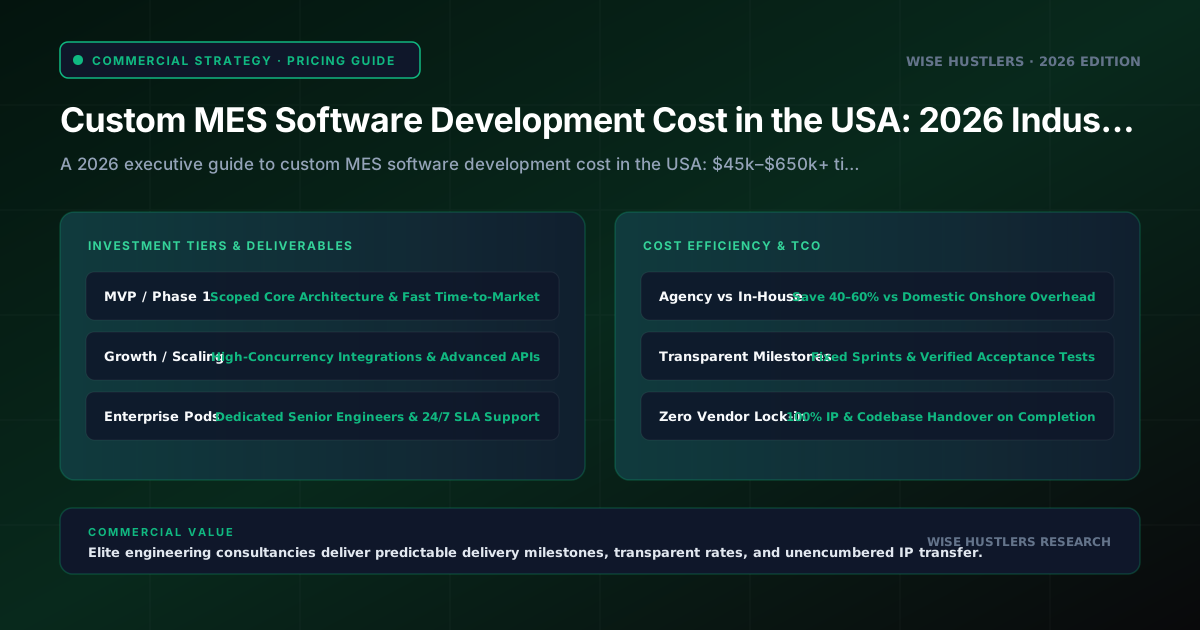
# Custom MES Software Development Cost in the USA: 2026 Industry 4.0 Pricing Matrix, ISA-95 Architecture & Vendor Audit
In 2026, custom MES software development cost in the USA typically ranges from $45,000 to $650,000+: Single-Line OEE MVPs run $45,000–$75,000 (300–450 engineering hours), Single-Facility production platforms span $120,000–$240,000 (800–1,500 hours), and Enterprise Multi-Plant Unified Namespace (UNS) platforms require $300,000–$650,000+ (2,000–4,000+ hours) at standard US industrial engineering rates ($140–$180/hr). Custom builds eliminate per-tag and per-seat licensing penalties associated with commercial off-the-shelf (COTS) suites.
---
The 2026 Economics of Manufacturing Execution Systems: Market Realities & CapEx Trends
American industrial manufacturing is experiencing a decisive operational realignment. Driven by domestic reshoring, semiconductor packaging investments, defense modernization, and electric vehicle battery gigafactories, plant operators face intense pressure to eliminate shop-floor blind spots. Across discrete, batch, and continuous process facilities, leadership teams are confronting a critical technological bottleneck: legacy software architectures.
Historically, industrial automation compelled plant owners to procure monolithic Commercial-Off-The-Shelf (COTS) Manufacturing Execution Systems from automation conglomerates like Rockwell Automation (FactoryTalk), Siemens (Opcenter), or Schneider Electric/AVEVA. In 2026, operational leadership increasingly evaluates alternative approaches to the traditional COTS paradigm due to four structural friction points:
- Substantial upfront software licensing capital requirements;
- Escalating recurring "tag-based" or concurrent "seat-based" licensing schedules;
- Vendor lock-in requiring certified system integrators (according to Control System Integrators Association benchmarks, certified integration specialists bill between $175 and $300+ per hour, with principal consultants commanding $250 to $350 per hour);
- Inflexible, proprietary data schemas that isolate plant telemetry from modern cloud analytics, data warehouses, and enterprise resource planning (ERP) platforms.
Consequently, mid-market and enterprise manufacturers are reallocating capital expenditure (CapEx) toward bespoke software engineering. Investing in custom industrial software development provides 100% intellectual property (IP) ownership, purpose-built shop-floor ergonomics, open event-driven architectures, and native integration with ERP platforms.
Evaluating the true custom mes software development cost usa requires analyzing technical line items, edge hardware topologies, protocol mediation layers, and long-term operating costs.
---
2026 Custom MES Pricing Matrix: 3 Production Tiers
The capital expenditure required for custom manufacturing execution system development cost usa varies primarily by machine connectivity density, PLC heterogeneity, industry compliance frameworks (such as FDA 21 CFR Part 11 electronic records for pharmaceuticals and medical devices or AS9100 quality management in aerospace), and multi-site orchestration requirements.
The matrix below benchmarks realistic 2026 United States development budgets, engineering delivery timelines, and facility profiles, calculated using standard US industrial software engineering rates ($140–$180 per hour):
| Tier | Investment Range (USD) | Delivery Timeline & Labor Hours | Core Functional Scope | Edge & PLC Integration | Target Facility Profile |
|---|---|---|---|---|---|
| Tier 1: Single-Line MVP / OEE Tracker | $45,000 – $75,000 | 6 – 10 Weeks<br>(300 – 450 engineering hours) | Automated OEE tracking, downtime classification, shift performance logging, operator run-screen | 1–3 PLCs via OPC-UA or Modbus TCP; 1 edge IPC gateway; local web display | Machine shops, pilot assembly lines, packaging cells testing digital conversion |
| Tier 2: Single-Facility Production MES | $120,000 – $240,000 | 14 – 20 Weeks<br>(800 – 1,500 engineering hours) | Work order dispatching, BOM validation, material genealogy, scrap logging, bidirectional ERP sync | 10–35 PLCs, barcode/RFID scanners, torque tools, weigh scales, MQTT Sparkplug B | High-mix mid-market discrete or batch manufacturers (50–300 shop-floor staff) |
| Tier 3: Multi-Plant Enterprise MES & UNS | $300,000 – $650,000+ | 6 – 12 Months<br>(2,000 – 4,000+ engineering hours) | Global multi-site scheduling, finite capacity planning, electronic batch records (eBR), full genealogy, PLM sync | 100+ PLCs, robotics cells, vision systems, Unified Namespace (UNS) broker, IEC 62443 DMZ | Enterprise multi-plant operations, regulated aerospace, medical devices, automotive Tier-1 |
Tier 1: Single-Line MVP / OEE Tracker ($45,000 – $75,000)
The Single-Line MVP calculates real-time Overall Equipment Effectiveness (OEE) directly from machine state registers, replacing manual whiteboards and operator paperwork.
- Engineering Effort & Labor Modeling: Based on 300 to 450 engineering hours across an agile pair (lead industrial systems engineer and full-stack developer) at $140–$175/hr.
- Architecture: An industrial edge computer (such as an Advantech UNO or Siemens IPC) interfaces with 1 to 3 PLCs (e.g., Rockwell ControlLogix, Siemens S7) via Ethernet/IP or OPC-UA, streaming metrics to a containerized local web application.
- Scope & Modules: Real-time line visualizer, automated micro-stop and changeover categorization, shift handoff reporting, and scrap tallying.
- Engineering Drivers: Tag address mapping, PLC register polling loops, edge gateway containerization, and responsive UI engineering for rugged operator tablets.
Tier 2: Single-Facility Production MES ($120,000 – $240,000)
This tier orchestrates entire plant operations, coordinating workflows, quality inspections, and material movements across multiple production cells.
- Engineering Effort & Labor Modeling: Estimated at 800 to 1,500 engineering hours across a multi-disciplinary squad (solutions architect, edge systems engineer, backend API developer, frontend engineer, and QA specialist) at prevailing rates ($140–$175/hr).
- Architecture: Decoupled microservices deployed in Docker/Kubernetes on an on-premise industrial server cluster, writing to a centralized PostgreSQL and TimescaleDB storage engine.
- Scope & Modules: Work order dispatching, digital travelers, BOM verification, integrated SPC quality check sheets, barcode/RFID scanner SDKs, scrap reason code enforcement, and automated shift-end reconciliation.
- Engineering Drivers: Heterogeneous PLC environments (Rockwell, Siemens, Omron, legacy Modbus), workstation counts, and bidirectional transactional ERP inventory integration.
Tier 3: Multi-Plant Enterprise MES with Unified Namespace ($300,000 – $650,000+)
For multi-site manufacturers or facilities operating within regulated environments (such as cGMP, FDA 21 CFR Part 11 electronic records, or aerospace AS9100 quality systems), Tier 3 establishes an enterprise-wide event-driven backbone decoupled through a Unified Namespace (UNS).
- Engineering Effort & Labor Modeling: Estimated at 2,000 to 4,000+ engineering hours ($140–$180/hr) encompassing distributed systems architecture, enterprise broker clustering, high-availability database replication, and cross-plant synchronization.
- Architecture: Enterprise event-driven architecture using MQTT Sparkplug B brokers (EMQX, HiveMQ). Edge nodes, SCADA systems, and enterprise tools (SAP S/4HANA, NetSuite) publish and subscribe to a standardized ISA-95 topic hierarchy (
Enterprise/Site/Area/Line/Cell). - Scope & Modules: Multi-site lot genealogy, automated quarantine, e-signatures, audit trails, dynamic capacity balancing, preventative tooling trackers, and executive analytics.
- Engineering Drivers: High-availability clustering, alignment with ISA/IEC 62443 industrial cybersecurity standards, formal validation testing protocols (such as IQ/OQ/PQ protocols where required by site quality systems), and legacy machinery connectivity.
---
5-Year Total Cost of Ownership (TCO): Custom Modern MES vs. Legacy COTS
Evaluating manufacturing execution system development cost usa requires analyzing financial commitments across a 5-year operational lifecycle. Monolithic legacy COTS platforms (Rockwell FactoryTalk, Siemens Opcenter, AVEVA) advertise entry licenses that appear accessible, but frequently incur compounding long-term expenses through mandatory software maintenance contracts, per-tag licensing tiers, and specialized third-party integration billing.
Illustrative 5-Year Total Cost of Ownership (TCO) Model
The model below compares a representative mid-market discrete manufacturing plant (3 facilities, 12 active production lines, ~150 connected machine nodes, and 85 concurrent operator interfaces) over a 5-year operational lifecycle:
| Financial Category | Custom Modern Web MES | Legacy COTS MES (Rockwell / Siemens) | Financial Variance & Strategic Assumptions |
|---|---|---|---|
| Year 0: Software & Base Build | $285,000 | $190,000 | Custom build requires higher initial CapEx; COTS base license appears cheaper upfront. |
| Year 0: System Integration & Setup | $45,000 | $185,000 | COTS requires certified vendor integration specialists at $175–$300+/hr (CSIA benchmark) to map proprietary schemas. |
| Years 1–5: Software Maintenance Fees | $0 (Zero software royalties) | $220,000 (18–22% annual software assurance) | Commercial COTS agreements typically require 18%–22% annual software assurance based on Gartner enterprise software benchmarks. |
| Years 1–5: Tag & Seat Expansion Costs | $0 (Compute-only scaling) | $145,000 (Per-tag and concurrent seat fees) | Assumes adding 15,000 tags ($3–$5/tag = $60k) and 35 concurrent seats ($2,000–$2,500/seat = $85k); custom scales at compute cost. |
| Years 1–5: Enhancements & Custom Features | $60,000 | $195,000 | Models ~400 hrs custom dev @ $150/hr ($60k) vs. ~650 hrs proprietary COTS scripting @ $250–$300/hr ($162.5k–$195k). |
| Years 1–5: Infrastructure & Cloud/Server | $32,000 (Linux / PostgreSQL / TimescaleDB) | $55,000 (Windows Server / Microsoft SQL Server) | Custom runs on 2 Linux nodes (~$530/mo); COTS requires dual Windows Server packs + SQL Server core licenses + SA. |
| Total 5-Year Financial Outlay | $422,000 | $990,000 | Illustrative modeled variance: $568,000 (~57% lower cumulative cost for custom MES). |
Structural Cost Drivers in Commercial Automation Suites
The financial divergence between custom and commercial platforms stems from three structural realities:
1. Tag-Based and Client-Seat Licensing Structures: Modern production lines generate tens of thousands of data points. Legacy COTS pricing models bill customers based on active tags. A plant expanding from 5,000 to 25,000 tags faces significant licensing step-ups. In contrast, an open architecture on TimescaleDB, ClickHouse, or PostgreSQL handles millions of time-series data points without software licensing penalties, scaling strictly on compute and storage capacity.
2. Systems Integrator Market Economics: Modifying a legacy COTS platform requires specialized automation engineers. According to Control System Integrators Association (CSIA) benchmarks, certified integration specialists bill between $175 and $300+ per hour, with senior principal engineers from premier integrator firms billing $250 to $350 per hour. Conversely, a custom modern MES built on standard web technologies (TypeScript, Node.js, Python, Go, React) enables any qualified software engineering team to maintain and evolve the application at prevailing market rates ($140–$180/hr).
3. Intellectual Property Control & Long-Term Valuation: Commercial COTS requires licensing third-party runtimes that prescribe specific data structures. In contrast, custom MES development delivers full source code ownership, allowing manufacturers to tailor workflows directly to plant operations and maintain their intellectual property as an in-house digital asset.
When manufacturers evaluate industrial modernization, collaborating with an experienced custom industrial software development team allows leadership to eliminate recurring software subscription taxes while building an agile software asset tailored to their operational requirements.
---
Modern ISA-95 & Unified Namespace (UNS) Architecture
The standard structural model for manufacturing computer systems is ANSI/ISA-95. Historically, ISA-95 was implemented through the rigid "Purdue Model" hierarchy, where data crawled sequentially from Level 0 (sensors) up through Level 1 (PLCs), Level 2 (SCADA), Level 3 (MES), and finally to Level 4 (ERP). Point-to-point connections under the traditional Purdue model create an unmaintainable "spaghetti architecture."
Modern custom MES engineering replaces point-to-point coupling with an event-driven Unified Namespace (UNS). In this architecture, all industrial participants publish their state changes to a single, standardized message broker using lightweight MQTT Sparkplug B or Kafka topics. The custom MES acts as both a consumer and publisher within this namespace.
ISA-95 Edge-to-Enterprise Architecture Diagram
flowchart TD
    subgraph Level_0_1["ISA-95 Level 0/1: Physical Floor & Field Devices"]
        D1["CNC Machines & Robotics"]
        D2["Sensors, Actuators & Scales"]
        PLC1["Rockwell ControlLogix PLC"]
        PLC2["Siemens S7-1500 PLC"]
        PLC3["Legacy Modbus / Serial RTU"]
        D1 --> PLC1
        D2 --> PLC2
        D2 --> PLC3
    end

    subgraph Edge_Mediation["Edge Protocol Mediation Layer (On-Premise IPCs)"]
        GW1["Edge Gateway: Advantech / Siemens IPC"]
        GW1_Proto["Protocol Converters: OPC-UA, Ethernet/IP, Modbus TCP"]
        SP_B["MQTT Sparkplug B Encoder / Store-and-Forward Buffer"]
        PLC1 --> GW1_Proto
        PLC2 --> GW1_Proto
        PLC3 --> GW1_Proto
        GW1_Proto --> GW1
        GW1 --> SP_B
    end

    subgraph Level_2_3_UNS["Unified Namespace (UNS) & Core MES Services (IEC 62443 DMZ)"]
        Broker["UNS Broker (EMQX / HiveMQ Cluster)"]
        SP_B -->|"TLS 1.3 / mTLS Payload"| Broker

        subgraph MES_Core["Custom Modern Web MES Engine"]
            Dispatch["Production Dispatching & Scheduling Engine"]
            OEE["Real-Time OEE & Downtime Engine"]
            Trace["Genealogy, Lot Tracking & eBR"]
            Quality["Quality Inspection & SPC Engine"]
            WIP["WIP Inventory & Tooling Tracker"]
        end

        Broker <-->|"Bi-directional Pub/Sub"| Dispatch
        Broker <-->|"Bi-directional Pub/Sub"| OEE
        Broker <-->|"Bi-directional Pub/Sub"| Trace
        Broker <-->|"Bi-directional Pub/Sub"| Quality
        Broker <-->|"Bi-directional Pub/Sub"| WIP

        DB[("Time-Series & Relational Storage: PostgreSQL + TimescaleDB")]
        MES_Core --> DB
    end

    subgraph ShopFloor_UX["Operator & Shop-Floor HMI Interfaces"]
        Tablet1["Rugged Operator Tablets (Zebra / Toughbook - Next.js PWA)"]
        HMI1["Andon Wallboards & Production Displays"]
        Scanner["Barcode / RFID Handheld Readers"]
        Tablet1 <--> MES_Core
        HMI1 <--> MES_Core
        Scanner <--> MES_Core
    end

    subgraph Level_4["ISA-95 Level 4: Enterprise Business Systems"]
        ERP["Enterprise ERP: SAP S/4HANA / NetSuite / Dynamics 365"]
        PLM["PLM: Siemens Teamcenter / PTC Windchill"]
        CloudBI["Executive Analytics & Data Lake"]

        ERP <-->|"REST / GraphQL / Idempotent Webhooks"| MES_Core
        PLM -->|"Engineering BOM & Revisions"| MES_Core
        DB -->|"ETL / CDC Pipeline"| CloudBI
    end
Edge-to-Enterprise Data Flow & Protocol Mediation
1. Edge Protocol Mediation: Industrial PLCs communicate over fieldbus protocols (Profinet, Ethernet/IP, Modbus TCP). Edge gateways (Advantech UNO or Siemens IPC running Linux) poll PLC registers locally at high frequency (10ms to 100ms intervals).
2. Semantic Normalization (Sparkplug B): The edge mediation layer decodes raw PLC memory addresses (N7:0, DB1.DBD0) and maps them into context-rich JSON/Protobuf payloads following the Sparkplug B standard.
3. Decoupled Messaging Hub: Telemetry publishes to the UNS broker under structured topic hierarchies (spBv1.0/Enterprise/Site/Area/Line/Cell/DDATA).
4. Deterministic Store-and-Forward: If the local plant network experiences an upstream disconnect, the edge gateway caches metrics to local non-volatile storage, replaying buffered records chronologically when connectivity restores.
5. Bidirectional ERP Synchronization: Work orders from SAP or NetSuite route down to the MES core via idempotent REST or GraphQL APIs. As operators execute steps on the floor, production counts, scrap tallies, and labor hours immediately post back to the ERP ledger without manual clerk entry.
Python Edge Store-and-Forward Implementation (ISA-95 & Sparkplug B)
The following runnable Python implementation illustrates edge protocol normalization and local store-and-forward caching. When the plant network disconnects from the central UNS broker, telemetry records are persisted to an embedded SQLite buffer. Once network connectivity is re-established, the edge node drains the queue chronologically, ensuring zero data loss:
"""
Edge Store-and-Forward Buffer for ISA-95 Unified Namespace Telemetry
Demonstrates local SQLite buffering and chronological retransmission.
"""
import sqlite3
import json
import time
from typing import List, Dict, Any, Tuple

class EdgeStoreAndForwardBuffer:
    def __init__(self, db_path: str = ":memory:"):
        self.conn = sqlite3.connect(db_path)
        self._init_db()

    def _init_db(self) -> None:
        with self.conn:
            self.conn.execute("""
                CREATE TABLE IF NOT EXISTS telemetry_queue (
                    id INTEGER PRIMARY KEY AUTOINCREMENT,
                    topic TEXT NOT NULL,
                    payload TEXT NOT NULL,
                    timestamp_ms INTEGER NOT NULL,
                    delivered INTEGER DEFAULT 0
                );
            """)
            self.conn.execute("""
                CREATE INDEX IF NOT EXISTS idx_delivered ON telemetry_queue(delivered, id);
            """)

    def buffer_telemetry(self, topic: str, metrics: Dict[str, Any]) -> int:
        """Stores normalized ISA-95 metric payload to local queue."""
        payload_str = json.dumps(metrics)
        now_ms = int(time.time() * 1000)
        with self.conn:
            cursor = self.conn.execute(
                "INSERT INTO telemetry_queue (topic, payload, timestamp_ms) VALUES (?, ?, ?);",
                (topic, payload_str, now_ms)
            )
            return cursor.lastrowid

    def fetch_pending(self, limit: int = 50) -> List[Tuple[int, str, Dict[str, Any]]]:
        """Retrieves oldest undelivered records chronologically."""
        cursor = self.conn.cursor()
        cursor.execute(
            "SELECT id, topic, payload FROM telemetry_queue WHERE delivered = 0 ORDER BY id ASC LIMIT ?;",
            (limit,)
        )
        rows = cursor.fetchall()
        return [(r[0], r[1], json.loads(r[2])) for r in rows]

    def acknowledge_delivery(self, record_ids: List[int]) -> None:
        """Marks successfully published records as delivered."""
        if not record_ids:
            return
        placeholders = ",".join("?" for _ in record_ids)
        with self.conn:
            self.conn.execute(
                f"UPDATE telemetry_queue SET delivered = 1 WHERE id IN ({placeholders});",
                record_ids
            )

    def prune_delivered(self, max_retained: int = 10000) -> None:
        """Prunes historical delivered records to manage local flash storage."""
        with self.conn:
            self.conn.execute(
                """
                DELETE FROM telemetry_queue
                WHERE delivered = 1 AND id NOT IN (
                    SELECT id FROM telemetry_queue WHERE delivered = 1 ORDER BY id DESC LIMIT ?
                );
                """,
                (max_retained,)
            )

if __name__ == "__main__":
    # Initialize edge buffer (use a persistent path such as '/data/edge_buffer.db' in production)
    edge_buffer = EdgeStoreAndForwardBuffer()

    # Standard ISA-95 topic structure: spBv1.0/<Enterprise>/<Site>/<Area>/<Line>/<Cell>/DDATA
    isa95_topic = "spBv1.0/EnterpriseHQ/Facility01/Machining/Line03/Cell01/DDATA"

    # Normalized Sparkplug B metric payload from PLC registers
    sample_metrics = {
        "timestamp": int(time.time() * 1000),
        "metrics": [
            {"name": "Machine/State", "type": "Int32", "value": 2},  # 2 = Running
            {"name": "Production/TotalUnits", "type": "UInt64", "value": 8540},
            {"name": "Production/ScrapUnits", "type": "UInt32", "value": 12},
            {"name": "OEE/Availability", "type": "Float", "value": 94.5},
            {"name": "OEE/Performance", "type": "Float", "value": 91.2},
            {"name": "OEE/Quality", "type": "Float", "value": 99.8}
        ]
    }

    # 1. Simulate offline edge buffering during network disruption
    record_id = edge_buffer.buffer_telemetry(isa95_topic, sample_metrics)
    print(f"[Edge Buffer] Telemetry buffered with record ID: {record_id}")

    # 2. Simulate broker connection restoration: drain and publish
    pending = edge_buffer.fetch_pending(limit=10)
    print(f"[Edge Buffer] Retrieved {len(pending)} pending messages for dispatch.")

    # 3. Acknowledge successful delivery to MQTT Sparkplug B broker
    edge_buffer.acknowledge_delivery([msg[0] for msg in pending])
    print("[Edge Buffer] Message delivery acknowledged. Buffer fully synchronized.")
---
8-Point Industrial Software Agency Vetting Framework
Developing factory floor software requires specialized expertise far beyond standard commercial web development. While physical machine safety interlocks and emergency stops must always reside within SIL-rated safety PLCs and hardware circuits (independent of software layers), software errors or stale telemetry in an MES can still disrupt production scheduling, cause material misallocation, or corrupt batch quality records.
When evaluating an engineering partner for custom industrial software development, technical decision-makers should enforce this 8-point audit framework:
1. Direct OT Field Experience & Industrial Protocol Fluency
The vendor must possess authentic plant-floor experience. Their engineering team must demonstrate fluency with Modbus memory mapping, OPC-UA node sets, Ethernet/IP CIP messaging, Profinet, and MQTT Sparkplug B. If an agency cannot explain how to poll a register without crashing a legacy PLC processor, they should not write code for your manufacturing lines.
2. Hardware-in-the-Loop (HIL) Simulation & Formal FAT/SAT Protocols
Never permit an agency to perform primary integration debugging directly on active manufacturing equipment. Vetted engineering partners maintain dedicated hardware-in-the-loop (HIL) test rigs. They simulate PLC inputs and outputs using software emulators (CODESYS, FactoryTalk Logix Echo) and mock physical sensor payloads before deploying code to staging environments, supported by formal Factory Acceptance Testing (FAT) and Site Acceptance Testing (SAT) milestones.
3. OT Cybersecurity & ISA/IEC 62443 Alignment
Industrial control systems face heightened cybersecurity exposure. Engineering partners should structure architectures aligned with the ISA/IEC 62443 series: establishing clear network segmentation into Zones and Conduits, enforcing mutual TLS (mTLS) for broker communications, implementing identity federation (OIDC/OAuth 2.0 with RBAC), and isolating edge data collectors within a dedicated industrial DMZ.
4. ISA-95 Semantic Data Modeling & Namespace Hygiene
Agencies accustomed to generic web development often create arbitrary database columns and non-standard JSON bodies. Insist that the partner model machine data, production orders, and material tracking strictly to ISA-95 Part 2 and Part 4 standards (Operations Management, Equipment Hierarchies, Material Models). Clean data schemas ensure that downstream data engineers and corporate analytics platforms can digest factory metrics consistently.
5. Deterministic Edge Reliability & Offline Store-and-Forward Autonomy
An industrial-grade MES cannot freeze operator screens or lose telemetry during network outages. The agency must demonstrate edge failover architectures with local store-and-forward buffers, ensuring operators can continue running production orders offline with automatic synchronization upon network recovery.
6. Bidirectional ERP Financial & Inventory Transactional Integrity
Connecting custom MES software to enterprise ERPs (SAP S/4HANA, Oracle NetSuite, Microsoft Dynamics 365) requires rigorous transactional controls. The partner must implement idempotent API patterns, distributed transactional safety, and durable dead-letter queues, ensuring every material movement and scrap deduction balances against ERP ledgers with zero duplicate postings.
7. Ergonomic Industrial Shop-Floor UX/UI Engineering
Factory floors have poor lighting, heavy electromagnetic noise, vibrating mounts, and operators wearing heavy protective gloves. The agency must demonstrate experience designing high-contrast, touch-tolerant web interfaces: minimum 48px touch targets, streamlined workflows that minimize typing, hardware SDK integrations for Zebra barcode scanners and RFID readers, and high-visibility auditory and visual inspection cues.
8. Complete Intellectual Property (IP) Transfer & Unencumbered Code Ownership
Manufacturing software contracts must clearly delineate ownership. Ensure your software services agreement explicitly assigns complete, unencumbered ownership of all bespoke software deliverables upon payment: source code, deployment scripts, automated testing suites, container configurations, and database schemas, ensuring your team has full operational independence without third-party vendor lock-in.
---
Why Manufacturing Leaders Partner with Wise Hustlers
Modernizing shop-floor software requires more than theoretical software architecture—it demands seasoned technical execution capable of bridging the cultural and technical divide between Information Technology (IT) and Operational Technology (OT).
At Wise Hustlers, we combine high-performance web software engineering with deep industrial automation expertise. Our engineering consultants deliver:
- Full-Stack Industrial Systems: From low-level PLC register polling and MQTT Sparkplug B edge infrastructure to modern, responsive React/Next.js touch-screen interfaces.
- Enterprise ERP Connectors: Production-tested integration pipelines with SAP S/4HANA, NetSuite, Dynamics 365, and on-premise relational databases.
- True IP Ownership: We deliver clean, fully documented codebases without recurring software royalties, proprietary framework dependencies, or hidden licensing fees.
Explore how our dedicated custom industrial and enterprise software development team can build, deploy, and scale your manufacturing execution platform.
---
Executive FAQ: Commercial & Technical Considerations
1. Why choose custom MES development over commercial suites like Rockwell FactoryTalk or Siemens Opcenter?
Commercial COTS platforms provide pre-packaged functional modules, but their architectures are designed around proprietary runtimes and ecosystem hardware. Customizing them to match unique plant workflows typically requires specialized automation integrators billing at premium rates ($175–$300+/hr per CSIA benchmarks) and commits your operation to ongoing annual software assurance contracts (frequently 18%–22% of license value annually according to industry procurement norms). Custom MES development builds software around your exact plant logic, delivers 100% intellectual property ownership, scales without per-tag or per-seat licensing penalties, and integrates natively with modern cloud analytics and enterprise ERP platforms.
2. How does an event-driven Unified Namespace (UNS) impact deployment timelines and maintenance costs?
Traditional point-to-point SCADA/MES integrations become increasingly brittle as machinery is added or modified. By implementing a Unified Namespace (UNS) using MQTT Sparkplug B, every machine, sensor, edge gateway, and software application acts as an independent node communicating through a central broker. Standardized pub/sub namespaces eliminate custom point-to-point translation layers, simplifying line expansion and preventing changes in one system from breaking downstream applications.
3. What cybersecurity controls are required when connecting OT plant networks to a custom web MES?
Connecting industrial networks to enterprise systems introduces attack vectors if improperly segmented. Modern custom MES architectures mitigate this risk by adhering strictly to ISA/IEC 62443 principles. Edge gateways reside within an OT Demilitarized Zone (DMZ), initiating outbound-only, encrypted connections (mTLS) to the message broker. PLCs on Level 1 and Level 2 networks remain completely non-routable from the corporate network and the public internet, eliminating direct external attack surfaces while providing real-time data visibility.
4. What is the typical capital payback period and ROI timeframe for a custom MES project?
According to manufacturing research and ROI surveys conducted by MESA International (Manufacturing Enterprise Solutions Association), well-scoped MES implementations typically target capital payback within 12 to 24 months post-commissioning, with targeted single-line OEE deployments often reaching break-even more rapidly when focused on eliminating critical bottleneck downtime. Documented operational targets from MESA and NIST digital manufacturing studies include:
- OEE improvements commonly targeting 3% to 6% through systematic bottleneck identification;
- Reductions in unplanned machine downtime of 10% to 25% via automated real-time alerts and root-cause classification;
- Scrap and rework reductions of 15% to 30% through automated recipe parameter verification and inline error-proofing (poka-yoke);
- Reductions in manual paperwork and shift-end reconciliation, saving documented labor hours across production supervision.
While attractive returns are commonly modeled when capital investments displace recurring software royalty overhead, project IRR must be evaluated against site-specific scrap baselines and downtime records rather than generalized guarantees.
---
Authoritative Standards & References
- MESA International - Manufacturing Enterprise Solutions Association Research & ROI Studies
- Control System Integrators Association (CSIA) - Annual System Integrator Benchmarking Reports
- International Society of Automation (ISA) - ANSI/ISA-95 Enterprise-Control System Integration Standards
- International Society of Automation (ISA) - ISA/IEC 62443 Industrial Network & System Security
- National Institute of Standards and Technology (NIST) - Smart Manufacturing Systems Design & Metrics
- Eclipse Foundation - Sparkplug B MQTT Specification & Working Group
- Gartner Research - IT Procurement & Industrial Enterprise Software Licensing Benchmarks
- ARC Advisory Group - Manufacturing Execution Systems Market Analysis & Selection Guides