
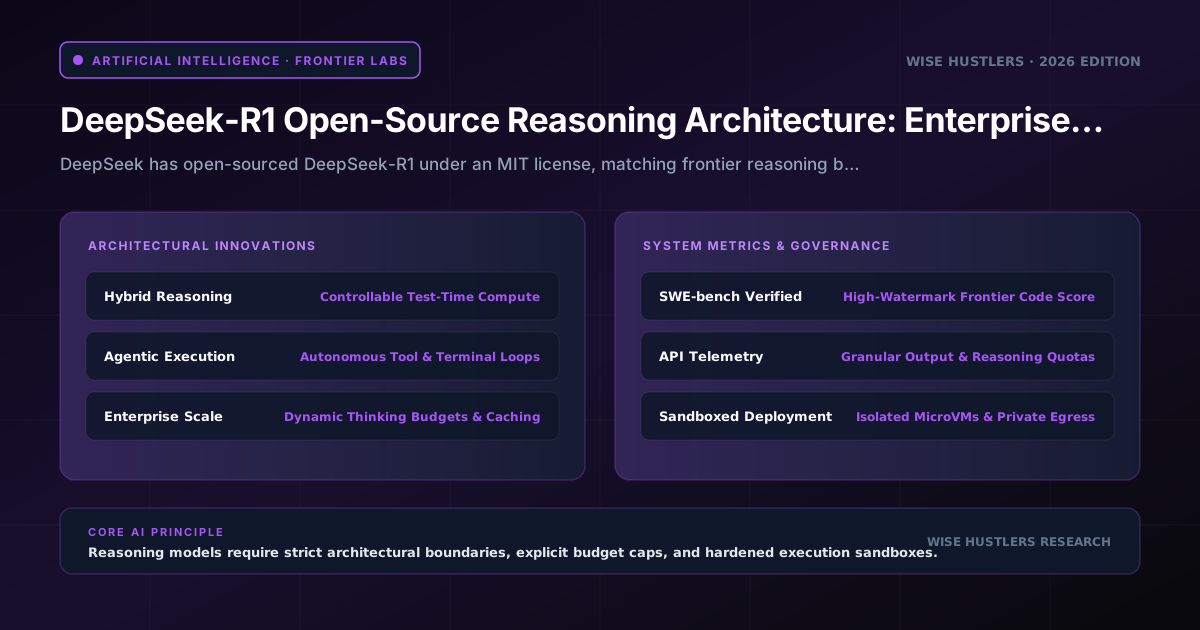
# DeepSeek-R1 Open-Source Reasoning Architecture: Enterprise Systems Breakdown
Summary: DeepSeek has open-sourced DeepSeek-R1, a 671-billion parameter mixture-of-experts model matching frontier proprietary reasoning benchmarks at competitive cost structures. Released under the permissive MIT license alongside distilled models, DeepSeek-R1 introduces Group Relative Policy Optimization, eliminating dedicated critic networks and validating cold-start reinforcement learning. For enterprise engineering organizations, the release alters self-hosted inference economics, removing dependencies on black-box commercial APIs while providing verifiable chain-of-thought traces for mission-critical software automation.
What Happened & Key Timeline
On January 20, 2025, AI research lab DeepSeek officially released DeepSeek-R1 and DeepSeek-R1-Zero, publishing full model weights, technical documentation, and an academic paper titled DeepSeek-R1: Incentivizing Reasoning Capability in LLMs via Reinforcement Learning (arXiv:2501.12948). The release published the 671-billion parameter flagship weights on Hugging Face and GitHub under the permissive MIT license, permitting enterprise engineering organizations to inspect, host, modify, and commercially deploy the system.
Alongside the primary 671-billion parameter mixture-of-experts (MoE) model, DeepSeek released six dense distilled models across two base architectures: DeepSeek-R1-Distill-Qwen (1.5B, 7B, 14B, and 32B), published under the MIT license, and DeepSeek-R1-Distill-Llama (8B and 70B), governed by Meta's Llama Community License Agreement. This dual-track release strategy provided engineering organizations with both a flagship frontier reasoning engine and lightweight dense models deployable on standard workstations and departmental clusters.
Benchmark evaluations reported in DeepSeek's technical report demonstrated parity with leading closed frontier systems on rigorous quantitative benchmarks:
- AIME 2024: DeepSeek-R1 achieved 79.8% Pass@1, competitive with OpenAI o1-0912 (79.2%) on competitive mathematics.
- MATH-500: The model attained 97.3% Pass@1, matching top-tier mathematical deduction benchmarks in proprietary systems.
- SWE-bench Verified: DeepSeek-R1 reached 49.2%, resolving complex real-world software engineering issues from open-source repositories.
- Codeforces: The model secured an Elo rating of 2,029, placing it in the 96.3rd percentile of human competitive programmers.
The table below contrasts the flagship DeepSeek-R1 MoE model against its primary distilled variants and proprietary frontier baselines:
| Model | Architecture & Parameters | Active Parameters | License | Cluster VRAM Requirements | SWE-bench Verified | AIME 2024 (Pass@1) |
|---|---|---|---|---|---|---|
| DeepSeek-R1 | MoE (671B Total) | 37B per token | MIT License | FP8: ~750–800+ GB (16x 80GB or 8x 141GB H200)<br>4-bit: ~380–420 GB (8x 80GB GPUs) | 49.2% | 79.8% |
| DeepSeek-R1-Distill-Llama-70B | Dense (70.6B) | 70.6B | Meta Llama Community License | FP16: ~145 GB (2x 80GB GPUs)<br>4-bit: ~42 GB (2x 24GB or 1x 48GB GPU) | 42.4% | 70.0% |
| DeepSeek-R1-Distill-Qwen-32B | Dense (32.8B) | 32.8B | MIT License | FP16: ~68 GB (1x 80GB or 2x 48GB GPUs)<br>4-bit: ~20 GB (1x 24GB GPU, RTX 4090) | 40.7% | 72.6% |
| DeepSeek-R1-Distill-Qwen-7B | Dense (7.6B) | 7.6B | MIT License | FP16: ~16 GB (1x 24GB GPU)<br>4-bit: ~5.5 GB (Consumer GPU / Apple Silicon) | 26.8% | 55.5% |
| OpenAI o1 (0912) | Proprietary MoE | Undisclosed | Proprietary Commercial API | Cloud API Hosted Only ($15.00/M in, $60.00/M out) | 48.9% | 79.2% |
Technical & Architectural Impact
The release introduces architectural innovations across reinforcement learning, memory management, and reasoning distillation.
Group Relative Policy Optimization (GRPO)
Traditional reinforcement learning with human feedback (RLHF) pipelines rely on Proximal Policy Optimization (PPO), which pairs an actor policy network with an equally sized critic (value) network to compute reward baselines. In models exceeding several hundred billion parameters, maintaining an auxiliary critic model doubles GPU memory allocations and inflates cluster overhead.
DeepSeek-R1 replaces PPO with Group Relative Policy Optimization (GRPO). Instead of training a separate value network, GRPO prompts the active policy model to generate a cohort of candidate completions $\{o_1, o_2, \dots, o_G\}$ for each query. The algorithm scores outputs using rule-based reward functions and normalizes advantages relative to the cohort's statistical mean and standard deviation:
$$A_i = \frac{r_i - \text{mean}(\{r_1, r_2, \dots, r_G\})}{\text{std}(\{r_1, r_2, \dots, r_G\})}$$
Eliminating the critic model lowers VRAM consumption during training. DeepSeek grounded rewards in deterministic verification—compiler execution for code syntax and mathematical equivalence checks—mitigating reward hacking risks common in subjective reward models.
Emergence of Self-Reflection in DeepSeek-R1-Zero
Prior to training the production model, DeepSeek evaluated DeepSeek-R1-Zero, applying GRPO directly to the base DeepSeek-V3 checkpoint without preliminary Supervised Fine-Tuning (SFT). The system operated purely on rule-based validation rewards and explicit formatting constraints (<think>...</think>).
Through iterative reinforcement steps, DeepSeek-R1-Zero exhibited an autonomous capacity for self-correction. When encountering complex algorithmic problems, the model learned to re-evaluate early assumptions, isolate logical fallacies, and redirect execution paths toward verified solutions. DeepSeek demonstrated that multi-step reasoning emerges organically from policy optimization without human-curated demonstrations.
Multi-Stage Pipeline and Cold-Start Stabilization
Because DeepSeek-R1-Zero generated inconsistent formatting and repetitive loops, engineers developed a four-stage training architecture for the production model:
1. Cold-Start Data Initialization: Fine-tuning the base model on thousands of curated chain-of-thought examples to enforce readable formatting.
2. Reasoning-Oriented RL: Executing large-scale GRPO on mathematics, logic, and code execution.
3. Rejection Sampling and Broad-Domain SFT: Generating 600,000 synthetic reasoning samples and 200,000 general task samples to prevent catastrophic forgetting.
4. All-Scenario Alignment RL: Running a final policy optimization stage balancing logical rigor with human preference alignment.
Inference Efficiency via DeepSeekMoE and Latent Attention
DeepSeek-R1 inherits the underlying architecture of DeepSeek-V3, combining Multi-Head Latent Attention (MLA) with DeepSeekMoE. Standard multi-head attention architectures allocate massive Key-Value (KV) caches that saturate memory during concurrent workloads. As detailed in DeepSeek's architectural paper DeepSeek-V2: A Strong, Economical, and Efficient Mixture-of-Experts Language Model (arXiv:2405.04434), MLA compresses key and value projections into low-dimensional latent vectors, reducing KV cache memory footprints by up to 93.3% relative to standard Multi-Head Attention.
Concurrently, the DeepSeekMoE architecture routes tokens through fine-grained routed experts alongside dedicated shared experts. While the network encompasses 671 billion total parameters, only 37 billion parameters activate per token. This sparse activation design allows enterprise clusters to achieve high token throughput and low latency.
Distillation Mechanics and Edge Deployment
DeepSeek used 800,000 curated reasoning trajectories generated by DeepSeek-R1 to fine-tune standard open-weight architectures, including Qwen 2.5 and Llama 3. The resulting distilled models confirm that reasoning behaviors discovered by a massive MoE teacher can transfer into dense, smaller networks. DeepSeek-R1-Distill-Qwen-32B matches earlier proprietary reasoning benchmarks on mathematical tasks while running on dual-GPU workstations.
What This Means for Engineering Teams & Enterprises
The emergence of an open-weights reasoning model shifts enterprise software engineering strategies, procurement cycles, and data architecture.
Private Infrastructure and Data Governance
Enterprise engineering organizations operating under strict internal compliance frameworks or data protection mandates (such as HIPAA for healthcare workloads, SOC 2 Type II, or corporate trade-secret governance) frequently establish policies that restrict streaming proprietary source code or confidential datasets to multi-tenant third-party API endpoints. Deploying open-weight reasoning models within private Virtual Private Clouds (VPCs) or on-premise clusters provides architectural perimeter isolation, ensuring that source code and customer data remain confined to internal network boundaries.
To deploy DeepSeek-R1 in 4-bit AWQ precision across an 8x NVIDIA A100/H100 80GB GPU cluster, platform engineers can launch a high-throughput vLLM instance using tensor parallelism:
  # Launch DeepSeek-R1 4-bit AWQ across an 8x 80GB GPU cluster
python3 -m vllm.entrypoints.openai.api_server \
  --model deepseek-ai/DeepSeek-R1-AWQ \
  --tensor-parallel-size 8 \
  --max-model-len 32768 \
  --gpu-memory-utilization 0.92 \
  --port 8000
Lower Inference Unit Economics
Accessing proprietary frontier reasoning models via commercial APIs involves significant recurring token expenses. For example, OpenAI's published API rate card for o1 lists standard pricing at $15.00 per million input tokens and $60.00 per million output tokens. In contrast, DeepSeek's published API rate card for DeepSeek-R1 offers pricing at $0.55 per million input tokens ($0.14 per million input tokens for cached context hits) and $2.19 per million output tokens. For organizations deploying private infrastructure, distilled checkpoints (such as the 14B and 32B variants) allow teams to run continuous reasoning workloads on standard workstation hardware or modest cloud GPU instances, significantly reducing the marginal cost of automated code refactoring, system architecture analysis, and batch testing pipelines.
Transparent Chain-of-Thought Auditing
Unlike closed reasoning APIs that conceal thinking traces behind opaque summaries or omit them from responses entirely, DeepSeek-R1 surfaces its raw reasoning tokens in cleartext within <think> tags. Engineering teams can construct programmatic parsers that inspect intermediate logic before authorizing critical system commands. If a model exhibits flawed reasoning or misidentifies a critical database parameter, automated guardrails can halt execution prior to state changes:
import re
from openai import OpenAI

client = OpenAI(base_url="http://localhost:8000/v1", api_key="EMPTY")

response = client.chat.completions.create(
    model="deepseek-ai/DeepSeek-R1-AWQ",
    messages=[{"role": "user", "content": "Analyze SQL transaction isolation levels for an order ledger."}],
    temperature=0.6,
    max_tokens=4096,
)

raw_content = response.choices[0].message.content

  # Separate reasoning trace from final synthesized output
think_match = re.search(r"<think>(.*?)</think>", raw_content, re.DOTALL)
reasoning_trace = think_match.group(1).strip() if think_match else ""
final_answer = re.sub(r"<think>.*?</think>", "", raw_content, flags=re.DOTALL).strip()

print(f"[REASONING AUDIT LOG]:\n{reasoning_trace[:200]}...\n")
print(f"[SYNTHESIZED ANSWER]:\n{final_answer}")
Enterprise teams evaluating self-hosted topologies, private inference clusters, or domain-specific agent pipelines can partner with Wise Hustlers custom AI solutions to implement production-grade reasoning architectures aligned with corporate governance requirements.
Frequently Asked Questions
How does Group Relative Policy Optimization differ from traditional Proximal Policy Optimization?
Traditional Proximal Policy Optimization (PPO) pairs an actor model with an equally large critic model that estimates token value baselines, doubling memory consumption during training. Group Relative Policy Optimization (GRPO) eliminates the critic network entirely. Instead, it generates a cohort of candidate completions for each prompt, measures outcomes with rule-based reward functions, and computes relative advantage scores using the cohort's statistical mean and standard deviation.
Can enterprises legally deploy and commercialize software built on DeepSeek-R1 and its distilled models?
Yes, subject to the specific checkpoint license. DeepSeek released the flagship DeepSeek-R1 (671B), DeepSeek-R1-Zero, and the four DeepSeek-R1-Distill-Qwen models (1.5B, 7B, 14B, and 32B) under the permissive MIT license, allowing private hosting, structural modification, and royalty-free commercialization. Conversely, the DeepSeek-R1-Distill-Llama models (8B and 70B) are derived weights governed by Meta's Llama Community License Agreement, which permits commercial use but enforces Meta's Acceptable Use Policy and requires a commercial license from Meta for products exceeding 700 million monthly active users.
What hardware configurations are required to run DeepSeek-R1 versus its distilled variants?
Running the full 671-billion parameter DeepSeek-R1 model in FP8 precision requires ~671 GB for weights and ~750–800+ GB total VRAM including activations and KV cache. Serving FP8 at scale requires at least two 8x80GB nodes (16x 80GB NVIDIA H100/A100 GPUs) or a single node with higher memory density, such as 8x 141GB NVIDIA H200 or 8x 192GB AMD Instinct MI300X systems. A single 8x80GB GPU cluster (640 GB total VRAM) can run 4-bit quantized variants (such as AWQ or GGUF at ~380–420 GB VRAM), providing ample memory for KV cache and multi-user concurrency. In contrast, distilled variants have modest requirements: the 1.5B, 7B, and 8B models run on a single consumer GPU (16GB–24GB VRAM), the 32B model runs on dual workstation GPUs, and the 70B model serves comfortably on dual 80GB GPUs.
How does Multi-Head Latent Attention (MLA) compress memory consumption during production inference?
As established in DeepSeek's foundational architectural paper DeepSeek-V2 (arXiv:2405.04434), Multi-Head Latent Attention compresses key and value projections into low-dimensional latent vectors during inference. Conventional Multi-Head Attention requires caching full key and value vectors across all layers and attention heads, which quickly exhausts GPU memory under long context windows and concurrent sessions. MLA reduces the Key-Value (KV) cache memory footprint by up to 93.3%, allowing enterprise clusters to sustain longer context windows and substantially higher concurrent request density per GPU.
Sources
- Arxiv: DeepSeek-R1: Incentivizing Reasoning Capability in LLMs via Reinforcement Learning (arXiv:2501.12948)
- Arxiv: DeepSeek-V2: A Strong, Economical, and Efficient Mixture-of-Experts Language Model (arXiv:2405.04434)
- GitHub: DeepSeek-AI DeepSeek-R1 Repository
- Hugging Face: DeepSeek-R1 Model Card & Weights
- DeepSeek Platform: API Pricing & Documentation
- SWE-bench Verified Leaderboard & Benchmarking System
- TechCrunch: DeepSeek updates its R1 reasoning AI model