
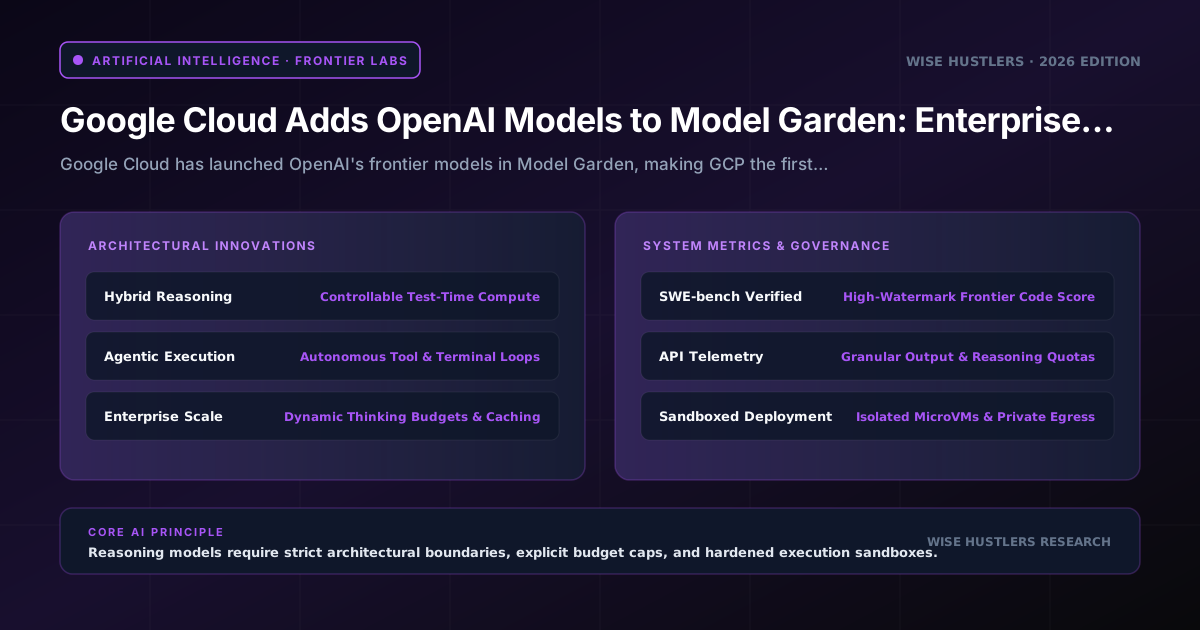
# Google Cloud Adds OpenAI Models to Model Garden: Enterprise Multi-LLM Architecture Review
Summary: On October 21, 2026, Google Cloud launched OpenAI frontier models—including GPT-6 Astra, GPT-6.1 Sol, and GPT-6 Luna—within Google Cloud Model Garden and Marketplace. The release establishes Google Cloud as the first hyperscaler natively hosting all three frontier closed-source model families: Google Gemini, Anthropic Claude, and OpenAI GPT. For enterprise engineering organizations, this transition consolidates multi-model infrastructure under a single billing account, draws down existing cloud commitments, and enforces unified VPC security boundaries across competing foundation models.
What Happened & Key Timeline
On October 21, 2026, Michael Gerstenhaber, Vice President of Product Management for Gemini at Google Cloud, officially announced the introduction of OpenAI frontier models into Google Cloud Model Garden and the Google Cloud Marketplace. The initial rollout brings three distinct models to enterprise customers in private preview:
1. GPT-6 Astra: Engineered for high-complexity engineering tasks, deep automated reasoning, computer use, and scientific workflows.
2. GPT-6.1 Sol: Tailored for agentic programming and professional production pipelines, matching near-Astra performance profiles at significantly lower operational cost.
3. GPT-6 Luna: Designed for high-throughput, low-latency utility tasks and distributed operational workflows operating at scale.
The announcement marks a fundamental shift in hyperscale cloud strategy. Historically, enterprise cloud providers operated under exclusive or semi-exclusive distribution arrangements: Microsoft Azure previously served as the primary cloud provider hosting OpenAI's commercial APIs and enterprise infrastructure, while Amazon Web Services and Google Cloud focused on Anthropic Claude and open-weights models. With this release, Google Cloud becomes the only hyperscale cloud provider offering native API access, marketplace provisioning, and unified governance across the three primary closed-source frontier model families: Google Gemini, Anthropic Claude, and OpenAI GPT.
Customer validation accompanied the release. In the Google Cloud announcement blog, Yashodha Bhavnani, Vice President of AI Products at Box, noted that integrating OpenAI frontier models through Google Cloud enables enterprise teams to apply frontier reasoning capabilities directly over enterprise content repositories while maintaining strict security policies and compliance guarantees.
Google Cloud confirmed that general availability will follow the private preview phase over the coming weeks. Furthermore, the integration roadmap extends beyond Model Garden APIs to include upcoming support within Google Antigravity and Gemini for Business environments, alongside direct connections for local OpenAI Codex CLI and Desktop developer workflows.
Technical & Architectural Impact
For cloud architects and systems engineers, this release addresses several architectural bottlenecks associated with multi-model enterprise infrastructure.
Comparison: Direct API vs. Model Garden Hosting
Deploying foundation models natively within a cloud platform alters network security, data custody, and operational overhead compared to invoking external public endpoints.
| Architectural Dimension | Direct Third-Party API Endpoints | Google Cloud Model Garden Unified Hosting |
|---|---|---|
| Network Perimeter | Egress over public internet; requires outbound firewall exceptions | Intra-cloud routing protected by VPC Service Controls (VPC-SC) |
| Authentication & IAM | Static, long-lived API keys managed per vendor | Short-lived OAuth2 / IAM tokens and Google Service Accounts |
| Billing & Procurement | Disjointed vendor contracts, credit pools, and minimum commits | Consolidated Google Cloud invoice drawing down Flexible Savings Plans (FSP) |
| Audit & Governance | Disparate vendor telemetry and separate logging pipelines | Unified Google Cloud Audit Logs in a single enterprise telemetry sink |
| Data Custody & Training | Dependent on individual SaaS privacy agreements | Bound by Google Cloud enterprise data terms; prompt data not used for training |
| Multi-Model Routing | Cross-cloud transit latency and outbound data egress fees | Private VPC networking with minimal internal dispatching overhead |
1. Isolated Access Boundaries and Network Hardening
Running external LLM endpoints previously forced engineering teams to configure outbound rules in corporate firewalls or deploy bespoke reverse proxies to route inference traffic over the public internet to third-party endpoints.
Under the new Google Cloud deployment architecture, OpenAI models execute on dedicated infrastructure within isolated Google Cloud perimeters. All inference queries route through hardened, isolated gateways protected by VPC Service Controls (VPC-SC) and Private Service Connect (PSC). This topology ensures that data transit remains within the controlled cloud network boundary, preventing outbound data exfiltration risks and keeping inference pipelines within the enterprise security perimeter. Google Cloud also announced that hardware-enforced Confidential Compute isolation will be introduced across these model execution paths to protect data in use.
2. Strict Data Perimeters and Policy-Based Retention
Enterprise adoption of third-party foundation models frequently requires detailed review regarding data custody and lifecycle management. Google Cloud's deployment framework enforces defined data perimeters:
- Customer prompts, system instructions, retrieval context, and model outputs are scoped to the customer's designated Google Cloud project and IAM boundary.
- Under Google Cloud enterprise terms and Model Garden service policies, customer input prompts and generated completions are not used to train, fine-tune, or improve Google or OpenAI foundation models.
- Forthcoming Zero Data Retention (ZDR) operational commitments are designed to purge volatile prompt memory immediately upon completion generation. For environments demanding hardware-level protection during inference, Google Cloud plans to augment these administrative policies with hardware-enforced Confidential Compute memory encryption.
3. Unified Identity, Auditing, and Policy Enforcement
Because the models are provisioned through Google Cloud's control plane, authentication and authorization map directly to Google Cloud Identity and Access Management (IAM). System architects no longer need to manage, rotate, and safeguard disparate API keys across external vendor dashboards.
Every automated agent, background worker, and developer workstation authenticates using short-lived OAuth tokens or Google Service Accounts. Detailed audit logs are emitted natively to Google Cloud Audit Logs, giving security teams visibility into token usage, caller identities, invocation timestamps, and request statuses across Gemini, Claude, and GPT workloads in a single telemetry sink.
4. Marketplace Billing and Spend Commitment Drawdown
Managing separate procurement tracks, credit pools, and minimum commit thresholds across individual AI vendors creates significant administrative friction. Under this integration, OpenAI model consumption transacts directly through Google Cloud Marketplace. All usage appears as unified line items on the organization's master Google Cloud invoice and draws down against existing enterprise spending commitments, including Google Cloud Flexible Savings Plans (FSP).
What This Means for Engineering Teams & Enterprises
The arrival of OpenAI models on Google Cloud fundamentally changes how platform teams construct, evaluate, and scale production AI systems.
High-Efficiency Multi-Model Routing
Production systems rarely benefit from routing every query to a single massive model. Complex production workflows typically distribute tasks: lightweight models handle classification, structured extraction, and caching, while heavy reasoning models handle complex code synthesis and architectural evaluations.
By centralizing Gemini, Claude, and GPT within a single cloud provider boundary, platform engineers can deploy intelligent model routers over private VPC networks without traversing the public internet. An internal routing gateway can direct high-throughput summaries to GPT-6 Luna or Gemini Flash, route complex refactoring passes to Claude Sonnet or GPT-6 Astra, and conduct automated model evaluation comparisons without configuring cross-cloud network interconnects.
Multi-Model Gateway Dispatch Implementation
Engineering teams can implement an internal dispatch gateway using the standard OpenAI SDK client configured with Google Cloud IAM credentials and private Model Garden endpoints:
"""
Multi-Model Gateway Dispatcher on Google Cloud Model Garden.
Routes requests across Gemini, Anthropic Claude, and OpenAI GPT
using Google Cloud IAM authentication and private VPC endpoints.
"""
import os
import google.auth
from google.auth.transport.requests import Request
from openai import OpenAI

def get_model_garden_client(project_id: str, location: str = "us-central1") -> OpenAI:
    """Initialize an OpenAI client routed through Google Cloud Model Garden."""
    credentials, _ = google.auth.default(
        scopes=["https://www.googleapis.com/auth/cloud-platform"]
    )
    credentials.refresh(Request())

    # Model Garden provides an OpenAI-compatible endpoint secured by Google IAM
    endpoint_url = (
        f"https://{location}-aiplatform.googleapis.com/v1beta1/"
        f"projects/{project_id}/locations/{location}/endpoints/openapi"
    )

    return OpenAI(
        base_url=endpoint_url,
        api_key=credentials.token,
    )

def route_inference(task_complexity: str, user_prompt: str, client: OpenAI) -> str:
    """Dispatches queries to the appropriate frontier model based on task needs."""
    model_dispatch_table = {
        "fast_utility": "openai/gpt-6-luna",
        "deep_reasoning": "openai/gpt-6-astra",
        "agentic_code": "openai/gpt-6.1-sol",
    }

    target_model = model_dispatch_table.get(task_complexity, "openai/gpt-6.1-sol")

    response = client.chat.completions.create(
        model=target_model,
        messages=[{"role": "user", "content": user_prompt}],
        temperature=0.2,
    )
    return response.choices[0].message.content

if __name__ == "__main__":
    gcp_project = os.environ.get("GCP_PROJECT_ID", "enterprise-ai-core")
    gateway_client = get_model_garden_client(project_id=gcp_project)
    completion = route_inference(
        task_complexity="deep_reasoning",
        user_prompt="Evaluate circuit breaker patterns for multi-model inference gateways.",
        client=gateway_client,
    )
    print("Inference completion:", completion)
Elimination of Multi-Cloud Egress and Network Bottlenecks
When enterprise applications run in Google Cloud (e.g., on Google Kubernetes Engine, Compute Engine, or Cloud Run), querying third-party models hosted on competing clouds incurs measurable latency overhead, egress bandwidth costs, and additional points of network failure. Co-locating OpenAI inferences within Google Cloud data centers minimizes round-trip times and eliminates cross-cloud egress fees.
Operational Redundancy and Failover Resilience
Vendor outages and capacity constraints represent an operational reality for AI-native applications. Having native access to Gemini, Claude, and GPT on one platform allows engineering teams to construct automated failover policies. If an upstream service degradation occurs on one model family, runtime circuit breakers can automatically redirect traffic to an equivalent model family without changing authentication schemes or networking rules.
For organizations designing resilient multi-model architectures across private VPC perimeters, Wise Hustlers custom engineering services helps technical teams build production-grade routing gateways, automated evaluation pipelines, and compliance-ready agentic infrastructure.
Frequently Asked Questions
How does using OpenAI models on Google Cloud differ from calling OpenAI direct APIs?
Deploying OpenAI models through Google Cloud Model Garden routes all requests through Google Cloud infrastructure, authenticating via Google IAM rather than static OpenAI API keys. Usage is billed directly against Google Cloud enterprise agreements and Flexible Savings Plans, while traffic stays within Google Cloud VPC Service Controls rather than traversing the public web.
Is customer prompt data used to train OpenAI or Google models?
No. Under Google Cloud enterprise terms and Model Garden service policies, customer prompts, system messages, retrieved context, and generated completions are treated as customer data and are not used to train foundation models. In addition, upcoming Zero Data Retention (ZDR) operational options provide contractual commitments against data persistence, which Google Cloud plans to augment with hardware-enforced Confidential Compute encryption in use.
When will OpenAI models be available in developer tooling like Google Antigravity?
OpenAI models are currently available in private preview for enterprise customers via Model Garden APIs and local Codex CLI and Desktop workflows. Google Cloud confirmed that native integrations for Google Antigravity and Gemini for Business are scheduled to roll out following the initial preview period.