
<h1>Google Launches Gemini Agent and Gemini 4 Argon: Inside the Enterprise Shift to Autonomous Digital Coworkers</h1>
Summary: Google Cloud has officially debuted the Gemini agent alongside its new frontier reasoning model, Gemini 4 Argon. Moving enterprise tech past stateless chat windows, the Gemini agent introduces persistent, cloud-based autonomous orchestration across Google Workspace and enterprise infrastructure via open protocols. With dedicated coworker identities, sandbox security, and multi-model routing, Google is reshaping how modern organizations automate complex knowledge work and multi-step software engineering workflows.
What Happened & Key Timeline
At its Gemini at Work conference, Google Cloud unveiled the enterprise rollout of the Gemini agent—Google’s universal agent for work. Powered by Gemini 4 Argon, Google's new frontier reasoning model, the release marks a decisive transition from conversational AI copilots toward stateful, delegable digital agents operating across heterogeneous enterprise environments.
Many enterprise generative AI initiatives have encountered operational friction when relying solely on stateless chat interfaces: while employees use chat windows for ad-hoc drafting and document summarization, isolated interactions rarely translate into automated, end-to-end organizational workflows. Google's strategic response bypasses prompt engineering via autonomous task delegation. Rather than issuing procedural commands, enterprise operators assign high-level business or engineering objectives to the Gemini agent, which formulates an execution plan, invokes enterprise tools, verifies intermediate states, and delivers completed work.
The release reflects intensifying competition across enterprise agent orchestration stacks. Gemini reasoning models are accessible via Vertex AI and Google AI Studio with production quotas, providing foundational inference for custom agent runtimes. System integrations interface with enterprise platforms through the open Model Context Protocol (MCP) and Vertex AI extension APIs, allowing engineering teams to build custom connectors to issue trackers, CRM systems, and internal data stores under centralized enterprise governance controls.
Technical & Architectural Impact
The introduction of the Gemini agent and Gemini 4 Argon establishes several foundational architectural shifts:
Frontier Reasoning with Gemini 4 Argon
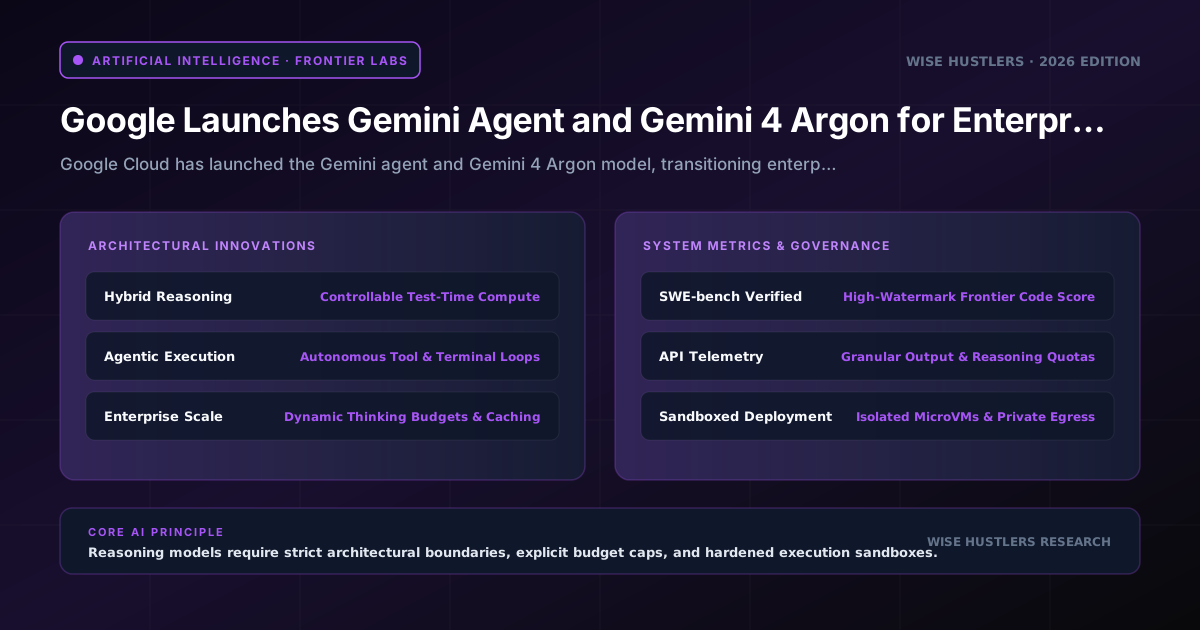
Powering the agent’s core cognitive loop is Gemini 4 Argon, a frontier model architected for extended multi-step reasoning and agentic code execution. Argon features a 1-million-token unified context window, paired with dynamic thinking budgets (low, medium, and high) that allow systems architects to balance latency against inference depth. In software engineering evaluation regimes such as SWE-bench Verified, agentic effectiveness hinges on test-driven validation and syntactic self-correction. Argon's extended reasoning budget enables iterative hypothesis testing, dependency inspection, and automated code review before committing changes.
Stateful Cloud Runtimes vs. Ephemeral Sessions
Traditional generative assistants operate within ephemeral browser sessions; if a user closes their laptop, execution halts. The Gemini agent fundamentally shifts execution into persistent, cloud-hosted runtimes. Tasks assigned to an agent continue executing asynchronously on Google Cloud infrastructure. If an automated data reconciliation or pull request validation takes hours, the agent manages its state machine independently, logging intermediate milestones and alerting human operators only upon task completion or policy exceptions.
Agent Identity and Role-Based Directory Primitives
To solve governance hurdles common to unmanaged AI tooling, Google integrates agents directly into enterprise Identity and Access Management (IAM) systems. Agents are provisioned with unique, auditable enterprise credentials (such as audit-bot@agents.enterprise.com). These digital coworker identities are bound by standard directory policies, single sign-on (SSO) boundaries, role-based access control (RBAC), and immutable audit logging, preventing autonomous agents from inheriting excessive blanket permissions.
Smart Routing and Multi-Model Orchestration
The Gemini agent architecture is not constrained to a single neural network. Google Cloud implements an intelligent routing engine that decouples task coordination from inference execution. For heavy architectural planning or complex refactoring, the system routes tasks to Gemini 4 Argon with an expanded reasoning budget. For latency-sensitive triage or basic formatting, execution falls back to lighter models like Gemini Flash. Enterprises managing hybrid infrastructure can also connect external endpoints and open-weight architectures (such as Google Gemma) into their orchestration topology via API gateways, granting systems architects flexibility over compute expenditure and data residency.
Sandboxed Isolation and Defense-in-Depth Guardrails
Executing untrusted code creates severe security vulnerabilities, notably indirect prompt injection. Google mitigates these vectors through robust isolation layers:
- Agent Sandbox MicroVMs: Deterministic micro-virtual machines where agents execute generated Python scripts, Bash commands, and SQL queries in complete network isolation from production databases.
- Agent Gateway Firewall: A real-time inspection proxy that monitors inter-agent tool calls, scrubs sensitive telemetry, enforces hard spend caps via Cloud Billing APIs, and blocks unverified outbound network requests.
- Zero-Copy Data Grounding: Using Google Cloud's Dataplex and BigQuery schema inspection, agents query structured data warehouses and semantic metadata catalogs directly via authorized, read-only SQL interfaces, eliminating the need to duplicate datasets into separate vector stores or redundant ETL pipelines.
Architectural Comparison: Stateless Copilots vs. Autonomous Agent Runtimes
The shift from interactive chat assistants to persistent cloud agents changes every layer of the enterprise software stack:
| Architectural Dimension | Stateless Copilots (Chat Interfaces) | Gemini Agent & Frontier Reasoning Runtimes |
|---|---|---|
| Execution Lifecycle | Ephemeral, synchronous browser sessions bound to user client state | Persistent, asynchronous cloud-hosted state machines executing independently |
| Identity & Governance | Shared API tokens or delegated user browser credentials | Dedicated IAM identity (bot@agents.enterprise.com) with discrete RBAC policies |
| Tool Orchestration | Client-side function calling or manual copy-paste workflows | Standardized server-side execution via Model Context Protocol (MCP) and tool registries |
| Compute & Reasoning | Fixed per-turn inference depth with prompt-dependent accuracy | Dynamic thinking budgets (low, medium, high) with self-verification loops |
| Execution Security | Unrestricted local execution or direct API invocation | Network-isolated MicroVM sandboxes with policy-enforced egress proxies |
| State Persistence | Session resets upon tab closure or token window exhaustion | Cloud-backed durable state store tracking intermediate task checkpoints |
Implementation: Configuring an Enterprise Agent with Vertex AI and Model Context Protocol
Engineering teams can implement autonomous agent loops by combining reasoning models with structured tool definitions and dynamic thinking configurations. The following runnable Python example demonstrates configuring an enterprise agent session using the Google GenAI SDK:
"""
Enterprise Agent Configuration Example
Demonstrates setting up a persistent reasoning loop with dynamic thinking budgets
and tool calling using the Google GenAI SDK.
"""

from google import genai
from google.genai import types

def inspect_database_schema(table_name: str) -> dict:
    """Queries enterprise metadata catalog for authorized table schemas.

    Args:
        table_name: The fully qualified BigQuery or catalog table identifier.

    Returns:
        dict: Verified schema fields and column constraints.
    """
    # Read-only schema verification inside sandboxed boundary
    allowed_tables = {"analytics_events", "customer_orders", "inventory_snapshots"}
    if table_name not in allowed_tables:
        return {"error": "Access denied: Table outside permitted enterprise boundary"}

    return {
        "table": table_name,
        "columns": ["id", "timestamp", "status", "payload"],
        "read_only": True,
    }

def main():
    # Initialize the client (picks up GEMINI_API_KEY or GOOGLE_APPLICATION_CREDENTIALS)
    client = genai.Client()

    # Configure reasoning budget and security boundaries
    config = types.GenerateContentConfig(
        system_instruction=(
            "You are an enterprise software engineering agent. "
            "You operate with read-only database permissions. "
            "Verify all schemas before formulating migration or refactoring plans."
        ),
        temperature=0.2,
        thinking_config=types.ThinkingConfig(
            thinking_budget=2048  # Allocated tokens for intermediate reasoning steps
        ),
        tools=[inspect_database_schema],
    )

    # Dispatch multi-step objective to frontier model endpoint
    response = client.models.generate_content(
        model="gemini-2.5-pro",
        contents="Inspect schema for analytics_events and verify column constraints for the Q4 reporting pipeline.",
        config=config,
    )

    print("Agent Execution Plan:\n", response.text)

if __name__ == "__main__":
    main()
To connect the agent to external enterprise services, architects define server-side connectors through the Model Context Protocol (MCP). Below is a declarative MCP host configuration:
{
  "mcpServers": {
    "enterprise-catalog": {
      "command": "python",
      "args": ["-m", "catalog_mcp_server"],
      "env": {
        "CATALOG_ENV": "production_read_only",
        "AUDIT_LOG_DESTINATION": "cloudaudit.googleapis.com"
      }
    }
  }
}
What This Means for Engineering Teams & Enterprises
For engineering leaders, the launch of the Gemini agent represents a shift from building custom prompt wrappers to orchestrating scalable Agent Operations (AgentOps). Engineering teams are no longer tasked with writing bespoke API glue code for basic summarization; instead, their primary responsibility becomes architecting robust tool registries, defining deterministic state machines, and enforcing rigorous security boundaries.
In software development life cycles, the operational impact is immediate. With native CLI, IDE, and GitHub integrations, the agent can be assigned complex maintenance chores: upgrading deprecated library dependencies across a monorepo, generating unit test coverage for uncovered endpoints, and submitting clean pull requests with detailed architectural changelogs. Because the agent executes within dedicated sandbox containers, development teams can safely delegate automated triage without risking local workstation compromise.
However, operationalizing autonomous multi-agent systems at scale introduces significant architectural hurdles. Enterprisewide rollouts require harmonizing legacy monolithic architectures, establishing strict model context protocols (MCP), and preventing runaway API token burn. For organizations navigating this transformation, partnering with Wise Hustlers custom engineering services provides the specialized architectural expertise needed to design deterministic agent pipelines, implement multi-model failover topologies, and securely integrate autonomous agents into mission-critical production environments.
FAQ Section
How does the Gemini agent differ from traditional generative AI chatbots?
Traditional AI chatbots operate as stateless, conversational prompt-response interfaces that depend on continuous active user sessions. In contrast, the Gemini agent is an asynchronous, stateful system capable of executing multi-step goals autonomously. It runs in persistent cloud environments, maintains its own enterprise directory identity, interacts directly with external SaaS systems via tool registries, and continues working independently even when the human user goes offline.
What technical role does Gemini 4 Argon fulfill in this framework?
Gemini 4 Argon serves as the core cognitive reasoning and orchestration engine. With a 1-million-token context window and adjustable thinking budgets, Argon evaluates high-level objectives, creates multi-stage execution plans, audits code syntax, and coordinates specialized sub-agents. It provides the deep analytical horsepower required to execute complex knowledge work without succumbing to context drift or tool hallucinations.
Can enterprises connect the Gemini agent to non-Google infrastructure and alternative models?
Yes. The architecture supports open interoperability protocols, notably the Model Context Protocol (MCP), enabling agents to communicate securely with third-party software tools, git repositories, and external databases. While the Gemini agent is optimized for Gemini reasoning models on Google Cloud, enterprises can deploy hybrid AgentOps gateways to route specific domain tasks to alternative models hosted across private clusters or cloud model gardens.
How do sandboxed environments mitigate prompt injection and unauthorized execution?
Agent sandboxes isolate tool execution within lightweight MicroVMs that lack network access to sensitive internal networks. Even if an agent encounters adversarial instructions or indirect prompt injection within untrusted external documents, any code executed by the agent runs in an ephemeral, memory-isolated runtime with egress filtering and strict filesystem quotas, preventing credential extraction or unauthorized database writes.