
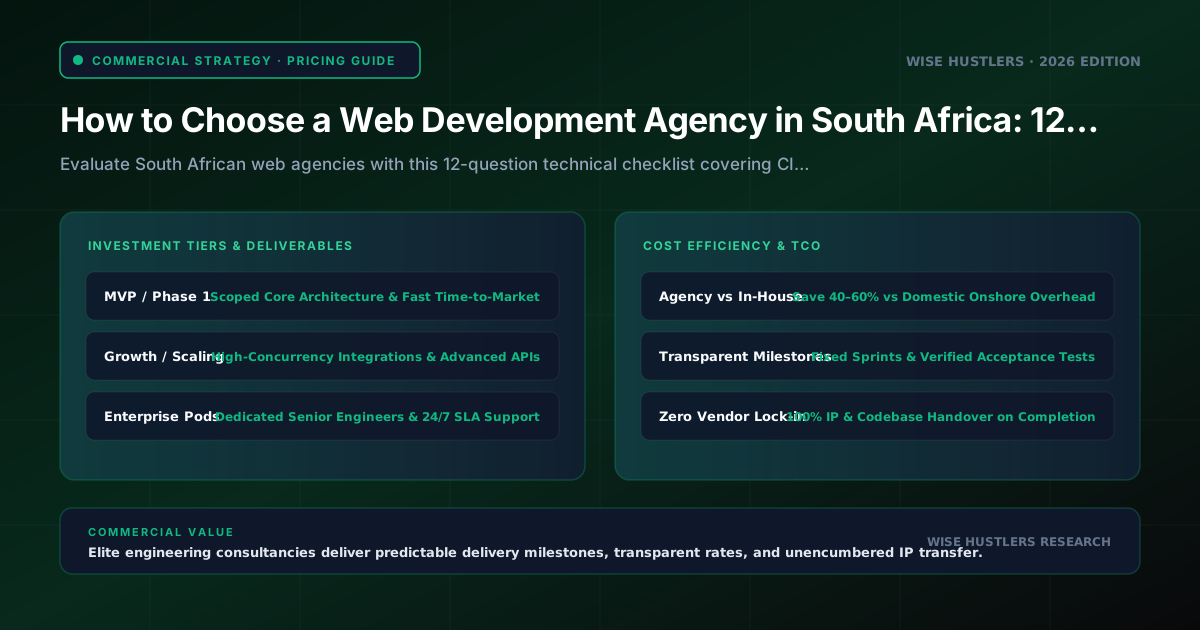
# How to Choose a Web Development Agency in South Africa: 12 Questions
Summary: Selecting an engineering partner in South Africa requires evaluating corporate standing, code ownership, and regulatory compliance. This 12-question guide explains how to choose web development agency South Africa teams with verified CIPC registration, active SARS Tax Compliance Status, explicit IP assignment under Section 22 of the South African Copyright Act, and POPIA data governance. Use our technical checklist to audit architecture, realistic ZAR milestone pricing, and domestic payment integrations before signing.
---
Selecting an external engineering partner is a critical technical and commercial decision for South African enterprises. The domestic digital sector features top-tier software consultancies in Sandton, Rosebank, Pretoria, and Cape Town alongside under-resourced studios and offshore sales fronts.
A polished pitch deck and Figma prototype do not guarantee secure architecture, maintainable code, or statutory compliance. Without thorough vendor vetting, organizations risk budget overruns, security vulnerabilities, and intellectual property disputes. This twelve-question guide establishes a practical framework to evaluate prospective vendors across corporate governance, engineering standards, delivery pipelines, and commercial safeguards.
---
Pillar 1: Corporate Governance, Legal Protection, and Local Compliance
Statutory compliance and clear intellectual property protections form the legal foundation of every software engagement in South Africa.
1. Are You a Registered CIPC Entity, and Can You Provide a SARS Tax Compliance PIN?
While informal freelancers may operate as sole proprietors, an established software agency in South Africa typically registers with the Companies and Intellectual Property Commission (CIPC) as a private company ((Pty) Ltd) or close corporation (CC). Incorporating as a registered entity provides legal standing, contractual accountability, and limited liability if commercial disputes arise.
Request the agency’s official CIPC enterprise number and verify its status via the CIPC BizPortal. In addition, request an active South African Revenue Service (SARS) Tax Compliance Status (TCS) PIN. A valid TCS PIN allows your procurement team to verify real-time good standing across Corporate Income Tax (CIT), employee Pay-As-You-Earn (PAYE), and Unemployment Insurance Fund (UIF) contributions. Furthermore, verify their Value-Added Tax (VAT) registration: under Section 23 of the South African Value-Added Tax Act No. 89 of 1991, businesses with taxable supplies exceeding R1 million within any consecutive 12-month period must register for VAT. An agency claiming a sizable engineering team without a valid 10-digit VAT number signals financial non-compliance.
2. How Do You Assign Intellectual Property Under the South African Copyright Act?
Intellectual property ownership is one of the most misunderstood legal pitfalls in South African tech procurement. Many clients assume that settling an agency's invoices automatically transfers full ownership of custom code. Under South African statutory law, this assumption is false.
Under Section 21(1)(a) of the South African Copyright Act No. 98 of 1978, copyright in any original work defaults automatically to the author—in this context, the external agency or developer. Section 21(1)(c) creates a statutory commissioning exception where copyright vests in the client upon payment, but this exception applies strictly to photographs, portraits, gravures, and cinematograph films. Computer programs and software code are excluded from this commissioning exception. Furthermore, Section 21(1)(d) applies only to works created by employees under a contract of service with their employer, not to commercial engagements with independent agencies.
Consequently, paying invoices in full for commissioned software does not grant you ownership under South African law; without an explicit contract, you acquire only an implied, non-exclusive license. To secure complete ownership of custom source code, documentation, and database schemas, your contract must include a written deed of assignment executed in accordance with Section 22(1) of the Copyright Act, accompanied by direct access to your private Git repository.
3. How Does Your Architecture Comply with POPIA and Handle Data Residency?
The Protection of Personal Information Act No. 4 of 2013 (POPIA), enforced by the Information Regulator of South Africa, regulates how personal data is captured, processed, and stored. In software delivery, your organization is the "Responsible Party," while the agency acts as an "Operator" under Section 1 of the Act.
Your agency must sign a comprehensive Data Processing Agreement (DPA) or Operator Agreement specifying role-based access control (RBAC), transport layer security (TLS 1.3), and AES-256 encryption at rest. Pay special attention to Section 72 of POPIA regarding cross-border data transfers; hosting data outside South Africa requires verified equivalent legal protections or binding corporate rules. Provisioning infrastructure within local cloud regions—such as AWS Africa (Cape Town) af-south-1 or Microsoft Azure South Africa North (Johannesburg)—simplifies compliance while keeping data traffic within national borders.
---
Pillar 2: Technical Architecture, Performance, and South African Digital Realities
South Africa’s digital landscape combines advanced financial rails with mobile connectivity constraints and domestic data costs. Software teams must engineer platforms suited to these realities.
4. What Technical Architecture Do You Recommend for Our Scale, and Why?
A competent engineering firm tailors architecture to your specific business requirements rather than forcing a proprietary or outdated stack. Monolithic systems can suit simple corporate websites, while modern modular architectures (such as Next.js frontends paired with Node.js, Python, or Go backends) support high-volume transactional scale.
Avoid agencies that lock clients into proprietary, closed-source content management systems that prevent external maintenance. If your digital strategy demands unified platforms spanning web portals and mobile products, consult specialists in custom app development in South Africa to establish shared REST or GraphQL APIs, unified data models, and centralized authentication from day one.
5. How Do You Optimize for South African Mobile Latency and Bandwidth Costs?
According to web analytics reports from Statcounter Global Stats and DataReportal South Africa, mobile devices account for approximately 75% to 80% of domestic web page views across Vodacom, MTN, Telkom, and Cell C networks. Because mobile data costs remain a tangible consideration for domestic consumers, heavy, unoptimized platforms suffer from elevated bounce rates.
Require the agency to commit to measurable Core Web Vitals targets on 4G mobile profiles: a Largest Contentful Paint (LCP) under 2.5 seconds, an Interaction to Next Paint (INP) under 200 milliseconds, and a Cumulative Layout Shift (CLS) under 0.1.
Furthermore, verify that the agency deploys local edge caching via Content Delivery Networks (CDNs) with Points of Presence (PoPs) in Johannesburg, Cape Town, and Durban. According to routing metrics and interconnection data from NAPAfrica (the primary domestic internet exchange point) and Cloudflare, routing dynamic or static web requests overseas to Western European origins incurs an intercontinental round-trip time (RTT) of approximately 160ms to 200ms. In contrast, serving cached assets through local South African exchange points drops edge latency to under 20ms.
6. Which Local South African Payment Gateways and Enterprise Systems Can You Integrate?
South African commercial platforms rely on regional payment networks. An agency familiar only with overseas processors like Stripe or PayPal is unsuited to domestic transactions.
Verify proven integration experience with:
- Domestic Payment Gateways: PayFast (by Network International), Peach Payments, Ozow, Stitch, Yoco, and Capitec Pay.
- PayShap: South Africa’s rapid interbank payment rail backed by the South African Reserve Bank (SARB) and BankservAfrica, facilitating instant, low-cost bank-to-bank settlements.
- Local Logistics and ERPs: Direct API connections with domestic couriers (The Courier Guy, ShipLogic, Bob Go) and accounting platforms (Xero, Sage Pastel).
To verify the agency's technical depth, examine how they handle webhook notifications and cryptographic signature verification. Below is a production-ready TypeScript implementation demonstrating how to validate PayFast Instant Transaction Notifications (ITN) using cryptographic hashing:
import crypto from "crypto";
import { Request, Response } from "express";

interface PayFastNotification {
  m_payment_id: string;
  pf_payment_id: string;
  payment_status: string;
  item_name: string;
  amount_gross: string;
  amount_fee: string;
  amount_net: string;
  signature: string;
  [key: string]: string;
}

/**
 * Validates PayFast ITN signature per South African payment gateway security standards.
 * Verifies payload integrity before fulfilling orders or crediting user balances.
 */
export function verifyPayFastSignature(
  data: PayFastNotification,
  passphrase?: string
): boolean {
  const { signature, ...rest } = data;

  // 1. Sort parameters alphabetically by key (excluding signature)
  const sortedKeys = Object.keys(rest).sort();
  const paramPairs = sortedKeys.map(
    (key) => `${key}=${encodeURIComponent(rest[key].trim()).replace(/%20/g, "+")}`
  );

  let paramString = paramPairs.join("&");

  // 2. Append passphrase salt if configured in gateway dashboard
  if (passphrase) {
    paramString += `&passphrase=${encodeURIComponent(passphrase.trim()).replace(/%20/g, "+")}`;
  }

  // 3. Compute MD5 checksum hash
  const calculatedSignature = crypto
    .createHash("md5")
    .update(paramString)
    .digest("hex");

  return calculatedSignature.toLowerCase() === signature.toLowerCase();
}

/**
 * Idempotent Express route handler for South African gateway callbacks
 */
export async function handlePayFastWebhook(req: Request, res: Response): Promise<void> {
  const payload = req.body as PayFastNotification;
  const passphrase = process.env.PAYFAST_PASSPHRASE;

  if (!verifyPayFastSignature(payload, passphrase)) {
    res.status(400).json({ error: "Cryptographic signature mismatch" });
    return;
  }

  if (payload.payment_status === "COMPLETE") {
    // Process transaction idempotently in database
    console.log(`Payment confirmed: ${payload.pf_payment_id} for order ${payload.m_payment_id}`);
  }

  // Return HTTP 200 to acknowledge notification
  res.status(200).send("OK");
}
---
Pillar 3: Engineering Standards, Delivery Pipeline, and Team Structure
Software stability depends on engineering discipline, automated testing, and deployment governance.
7. What Is Your Exact Team Allocation, and Who Writes the Code?
Ensure the engineers presented during initial discovery meetings are the ones actually building your software. Agencies sometimes introduce senior architects during sales pitches, then quietly reassign the implementation to junior offshore subcontractors.
Clarify team roles: who is the Lead Architect, the Senior Full-Stack Engineer, and the QA Lead? Ensure direct collaboration within South African Standard Time (SAST / UTC+2) to avoid communication friction and delivery bottlenecks.
8. What Does Your Testing and Continuous Deployment (CI/CD) Pipeline Look Like?
Manual file transfers via FTP or direct editing on production servers represent unacceptable operational risks. Professional teams automate quality control through continuous deployment pipelines.
Confirm that the agency uses structured Git branching workflows (such as GitHub Flow) with mandatory code reviews. Their pipeline should run automated unit tests, integration tests, and end-to-end browser tests (via Playwright or Cypress) across distinct Development, Staging, and Production environments before code is released.
9. What Are Your Post-Launch Warranty Terms and SLA Guarantees?
Even well-tested software can exhibit edge-case defects under live operational loads. Reputable agencies back their code with concrete post-launch protections.
Secure a formal 30- to 90-day defect liability warranty in your contract, guaranteeing that bugs and scope deviations are resolved without extra charges. For high-availability platforms, establish a Service Level Agreement (SLA) defining incident response times (such as 1-hour response for critical P1 outages) and a predictable schedule for dependencies and security patches.
---
Pillar 4: Commercial Terms, Pricing Models, and South African Red Flags
Transparent milestone schedules and comprehensive cost forecasting safeguard your investment against unexpected overruns.
10. What Is Your Milestone Payment Structure, and How Are Changes Handled?
Demanding 100% payment upfront is an immediate warning sign. Professional South African agencies tie payments to measurable project milestones:
- Kickoff & Architecture (25% – 30%): Discovery, UI/UX architecture, and environment setup.
- Functional Alpha/Beta (30%): Core business logic deployed to a staging environment.
- User Acceptance & Testing (30%): Full functional sign-off, security checks, and data migration.
- Final Release & Warranty (10% – 15%): Deployed to production, source code assigned, and warranty active.
Establish an explicit Change Request (CR) framework for scope additions, quoted at transparent hourly rates. According to industry rate surveys and OfferZen's State of the South African Software Developer Nation benchmark data, senior South African software engineers typically bill between R650 and R1,400+ per hour depending on technical domain (such as distributed backend architecture, cloud infrastructure, or fintech integration).
11. What Are the Total Ongoing Costs of Ownership Beyond Development?
A realistic budget accounts for ongoing operational requirements beyond the initial build cost. Request an itemized forecast of:
- Cloud Hosting: AWS, Azure, or local VPS instances quoted in ZAR or indexed against foreign exchange movements.
- Domains & Registrations: Annual .co.za domain renewals via ZACR-accredited registrars.
- Third-Party Subscriptions: Transactional email services (Postmark, SendGrid), SMS gateways (BulkSMS, SMSPortal), and monitoring tools.
12. Can You Provide Verifiable South African Client References and Live Case Studies?
Request direct contact details for two or three enterprise or mid-market clients in South Africa. Contact these references to assess project delivery, architectural reliability, adherence to budget, and the agency's conduct during technical challenges.
---
Web Agency Checklist Johannesburg & South African Market
When preparing to hire web developer South Africa teams or selecting a digital agency, use this web agency checklist Johannesburg and national procurement matrix:
| Evaluation Dimension | Verification Method | Acceptable Industry Standard | Critical Red Flag |
|---|---|---|---|
| Corporate Identity | CIPC search & SARS TCS PIN | Registered (Pty) Ltd; active tax compliance | Unregistered sole trader; missing tax profile |
| Tax Compliance | 10-digit VAT number on quotes | Registered for VAT if claiming mid-to-large team | Turnover > R1m without VAT registration |
| IP Assignment | Contract review under SA Copyright Act s21 & s22 | Written deed assigning 100% IP & source code | Agency retains code; requires licensing buyout |
| POPIA Compliance | Signed Data Processing Agreement (DPA) | End-to-end encryption; local hosting / s72 | No DPA; customer PII stored without controls |
| Payment Schedule | Milestone-based contract | 25%–30% initial deposit; phased milestones | Demands 100% upfront; personal bank account |
| Code Access | Version control provisioning | Direct client access to private Git repository | Withheld repository; proprietary closed CMS |
| Local Integrations | Technical review of past builds | Native PayShap, Ozow, Stitch, PayFast | Unfamiliar with South African payment rails |
| Post-Launch SLA | Written warranty clause | 30–90 day defect warranty; defined incident SLA | Zero warranty; billable hourly bug fixes on launch |
---
Critical South Africa-Specific Red Flags to Avoid
Watch for these warning signs during agency procurement:
1. Informal Banking Details: Invoices requesting payments into personal savings accounts instead of FICA-verified corporate accounts registered under the agency's CIPC entity name.
2. Ambiguous Copyright Terms: Contracts lacking explicit assignment clauses under Section 21(1)(a) and Section 22(1) of the South African Copyright Act No. 98 of 1978.
3. Absence of POPIA Protocols: Refusal to sign a Data Processing Agreement or failure to specify encryption and data sovereignty standards.
4. Unrealistic Low-Ball Estimates: Quoting R5,000 to R10,000 for a complex transactional system that requires hundreds of engineering hours, leading to project abandonment.
5. Restricted Source Code Access: Refusing to grant private Git repository access throughout development.
---
Frequently Asked Questions
How much does it cost to hire a web development agency in South Africa?
According to South African digital agency market surveys and OfferZen developer benchmark data, project costs generally fall into four commercial tiers:
- Corporate Marketing Sites: R25,000 to R55,000 for modern CMS or static site platforms.
- Custom Web Applications & Portals: R70,000 to R180,000 for transactional portals with authenticated user workflows.
- Complex Enterprise Platforms: R200,000 to R600,000+ for high-availability systems, custom fintech architectures, and multi-tenant SaaS.
- Senior Hourly Rates: R650 to R1,400+ per hour for senior engineering consultancies and ad-hoc architecture changes.
Why is IP ownership a unique risk under South African law when hiring an agency?
Under Section 21(1)(a) of the South African Copyright Act No. 98 of 1978, copyright defaults to the author (the developer or agency). The commissioning exception in Section 21(1)(c) excludes computer programs, meaning that paying for software development does not automatically transfer copyright to the client. Ownership only transfers if the contract includes a written deed of assignment executed under Section 22(1) of the Act. Without this explicit assignment, the client holds only an implied non-exclusive license.
What should be included in a web agency checklist for Johannesburg enterprise procurement?
An enterprise procurement checklist in Johannesburg should verify CIPC company registration, active SARS Tax Compliance Status, VAT registration, explicit Section 22 IP assignment deeds, POPIA data processing agreements, B-BBEE status documentation, CI/CD deployment pipelines, and verifiable local enterprise references.
How do local payment systems like PayFast, Ozow, and PayShap affect project scope?
Integrating South African payment rails requires dedicated architectural planning. Instant EFT and open-banking gateways like Ozow and Stitch require secure webhook listeners, idempotent transaction handlers, and automated reconciliation. PayShap necessitates real-time interbank proxy lookups and instant clearing callbacks, while PayFast and Peach Payments require cryptographic signature verification and tokenization protocols.
---
Sources
- Companies and Intellectual Property Commission (CIPC) — South African company registry and enterprise compliance.
- South African Revenue Service (SARS) — Tax Compliance Status (TCS) PIN verification and VAT regulations.
- Information Regulator of South Africa — Statutory authority overseeing POPIA enforcement and data sovereignty.
- South African Copyright Act No. 98 of 1978 (Gov.za) — Legal statutes on author ownership and assignment of computer programs.
- Payments Association of South Africa (PASA) — National payment regulations, Instant EFT standards, and PayShap specifications.
- BankservAfrica — Clearing house operator managing South Africa's PayShap automated settlement network.
- OfferZen — State of the South African Software Developer Nation benchmark reports on compensation and engineering rates.
- NAPAfrica — Africa's largest Internet Exchange Point, measuring domestic peering throughput and transit latencies.
- Statcounter Global Stats — Mobile vs. desktop market share data for South African internet usage.