
# How to Choose an App Development Company in the USA: The 10-Point Technical Vendor Audit
TL;DR: Selecting the wrong software agency in the United States results in blown budgets, missed market windows, and expensive full-codebase rewrites. To make an objective decision, evaluate prospective agencies across 10 non-negotiable technical criteria: direct Day-1 Git ownership, verified senior engineering leads, automated CI/CD and test coverage (>80%), strict US compliance (HIPAA, SOC 2, PCI-DSS), and transparent sprint governance.
---
The US Software Procurement Dilemma
The US software market is filled with thousands of development firms ranging from high-overhead legacy agencies ($250k+ minimums) to generic subcontracting brokerages that outsource code to unqualified junior developers.
According to industry surveys, over 48% of custom software projects suffer from scope creep, architectural failure, or require a ground-up rewrite within 18 months due to poor technical diligence during the procurement phase.
To safeguard your capital and product roadmap, use this 10-Point Technical Vendor Audit Checklist during your agency vetting process.
---
The 10-Point Technical Vendor Audit Checklist
┌─────────────────────────────────────────────────────────────┐
│              10-POINT TECHNICAL AUDIT FRAMEWORK             │
├────┬────────────────────────────────────────────────────────┤
│ 01 │ Day-1 Direct Git Repository & IP Ownership             │
│ 02 │ Architecture-First Discovery & System Design Docs      │
│ 03 │ Senior Developer Allocation (No Junior Bait-and-Switch)│
│ 04 │ Automated CI/CD & Automated Unit/E2E Test Suites       │
│ 05 │ Native US Compliance (HIPAA, SOC 2, PCI-DSS, ADA)      │
│ 06 │ Real Case Studies With Verifiable Production Metrics   │
│ 07 │ Modern Modular Tech Stack (Next.js, Flutter, RN, AWS)  │
│ 08 │ Transparent Agile Sprint Cadence & Live Demos          │
│ 09 │ Fixed-Price / Capped Milestone Commercial Terms        │
│ 10 │ Long-Term SLA, Monitoring & DevOps Handover Support    │
└────┴────────────────────────────────────────────────────────┘
1. Day-1 Direct Git Repository & IP Ownership
- The Red Flag: Agencies that keep your codebase on their private internal servers and only release compiled binaries or source code upon final payment.
- The Standard: You must have administrative access to the GitHub/GitLab repository from Sprint 1. All intellectual property, designs, schemas, and infrastructure scripts must transfer to your company continuously.
2. Architecture-First Discovery & System Design Docs
- The Red Flag: Agencies that jump directly into frontend mockup Figma design without specifying database normalization, API schema contracts, authentication state machines, or data flow diagrams.
- The Standard: Insist on an architectural blueprint covering database ERDs (PostgreSQL/MySQL), caching strategies (Redis), API documentation (OpenAPI / Swagger), and cloud infrastructure diagrams (AWS CloudFormation / Terraform).
3. Senior Developer Allocation (No Bait-and-Switch)
- The Red Flag: The agency pitches you with their senior US partners and architects, but once the contract is signed, the daily commits are authored by untested junior interns.
- The Standard: Review the GitHub profiles or resumes of the specific engineers assigned to your sprint squad. Require a minimum of 5+ years of production experience for tech leads.
4. Automated CI/CD & Automated Test Coverage
- The Red Flag: Manual testing only. No automated GitHub Actions or GitLab CI pipelines running linting, TypeScript type-checking, unit tests, or end-to-end integration tests.
- The Standard: A modern production pipeline must automatically trigger test suites on every pull request, enforce code reviews, and deploy to automated staging environments.
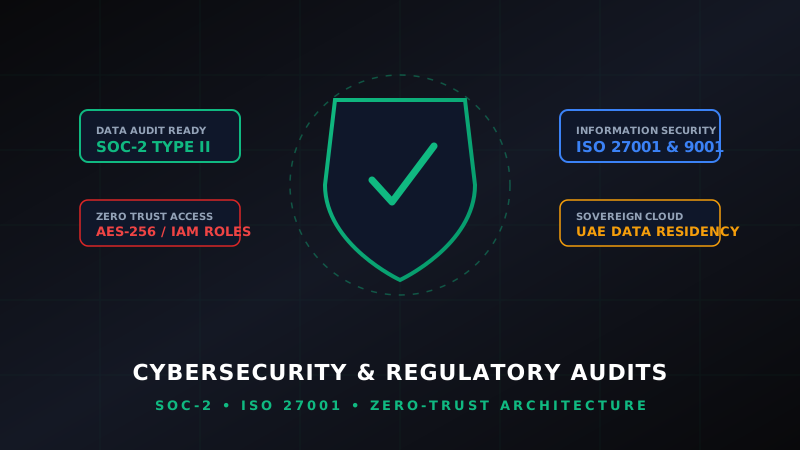
5. Native US Regulatory & Security Compliance
- The Red Flag: Treating security as an afterthought or an expensive add-on.
- The Standard: Built-in compliance standards:
Healthcare:* HIPAA security rules, BAA agreement readiness, end-to-end AES-256 data encryption at rest and TLS 1.3 in transit.
Fintech:* PCI-DSS Level 1 tokenization, Plaid/Stripe Financial Connections integration, and SOC 2 Type II audit trail logging.
Accessibility:* WCAG 2.1 Level AA and Section 508 ADA compliance.
6. Real Case Studies With Verifiable Production Metrics
- The Red Flag: Vague agency portfolio cards displaying only Photoshop mockups with no live App Store links, customer names, or quantifiable performance data.
- The Standard: Inspect live production apps on the Apple App Store and Google Play Store. Verify store reviews, app load speeds, and crash-free session rates (>99.5%).
7. Modern Modular Tech Stack
- The Red Flag: Recommending obsolete monoliths (e.g. PHP 5.x, Cordova, Ionic, or proprietary proprietary low-code builders with high lock-in).
- The Standard: Clean modern ecosystems:
Mobile:* React Native (Fabric / TurboModules) or Flutter 3.x.
Web:* Next.js (App Router), React, TypeScript, Tailwind CSS.
Backend:* Node.js, Python (FastAPI), Go, PostgreSQL, Redis, Docker.
Cloud:* AWS (ECS, Lambda, RDS, CloudFront) or Google Cloud Platform.
8. Transparent Agile Sprint Cadence & Live Demos
- The Red Flag: Disappearing for 8 weeks and returning with a finished product that doesn't match what you envisioned.
- The Standard: 2-week sprint cycles with live recorded demo builds (TestFlight for iOS, Firebase App Distribution for Android), shared Slack/Teams channels, and bi-weekly sprint reviews.
9. Fixed-Price or Capped Milestone Commercial Terms
- The Red Flag: Open-ended "Time & Materials" billing without milestone checkpoints or deliverable acceptance criteria.
- The Standard: Clearly defined Scope of Work (SOW) structured around milestone deliverables, with payment tranches released upon passing automated QA and acceptance criteria.
10. Long-Term SLA, Monitoring & DevOps Handover
- The Red Flag: Delivering code and immediately abandoning the client without post-launch crash monitoring, server alerts, or bug-fix warranties.
- The Standard: A mandatory 30–60 day post-launch warranty period, integration of APM tools (Sentry, Datadog), and complete documentation for seamless internal team handover.
---
Agency Comparison: Legacy US Consultancies vs. Modern Product Partners
| Factor | Legacy US Consultancies (WillowTree, Fueled, Thoughtbot) | Offshore Freelance Mills | Wise Hustlers Product Partner Model |
|---|---|---|---|
| Hourly Rate | $180 – $275/hr | $20 – $35/hr | $45 – $75/hr (Optimal ROI) |
| Minimum Project Size | $150,000 – $250,000 | No minimum | $25,000 – $75,000 |
| Source Code Ownership | Complex retainers | Disputed / fragmented | 100% Day-1 Direct Git Transfer |
| Compliance Readiness | Billed as expensive enterprise tier | Non-compliant / risks data breach | Pre-audited HIPAA, SOC 2 & PCI-DSS patterns |
| Tech Lead Access | Account executive layer | No direct communication | Direct access to senior tech architects via Slack |
---
Summary & Next Steps
Choosing the right development partner is the single most critical decision for the trajectory of your digital product. By enforcing a rigorous 10-point technical audit, US founders and engineering leaders eliminate guesswork and secure a resilient software foundation from Day 1.
Looking for a battle-tested engineering team? Explore our [US App Development Capabilities](https://wise-hustlers.com/app-development-usa) or [Request a Free Architecture Review](https://wise-hustlers.com/contact).
---
Frequently Asked Questions
What questions should I ask an app development agency during an initial interview?
Ask for their live GitHub repository structure, how they manage automated testing and CI/CD pipelines, who will be the specific technical lead on your project, and how they handle IP transfer and post-launch bug warranties.
Is fixed-price or time-and-materials better for custom app development?
For MVPs and scoped V1 products, Milestone-Based Fixed Pricing provides the best balance of predictability and accountability. For ongoing enterprise scaling post-launch, a Dedicated Sprint Squad (T&M) offers optimal agility.
---