
# Real Estate App Development in the USA: MLS, RETS & RESO Web API Integration Architecture
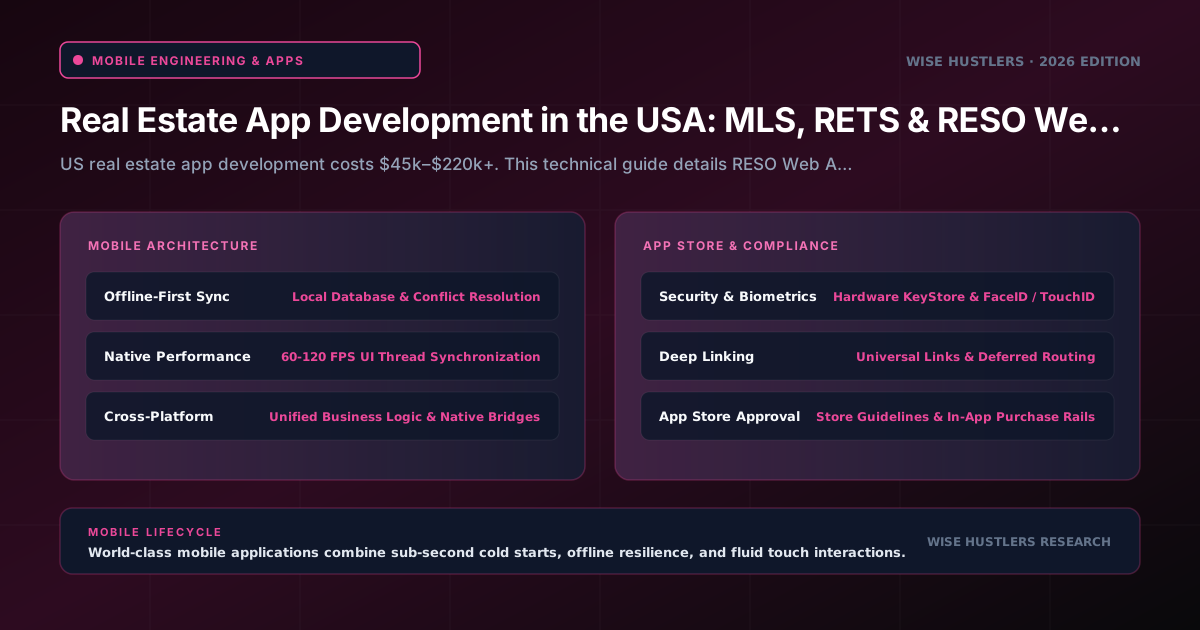
Summary: Custom real estate app development in the USA ranges from $45,000 for a regional single-MLS brokerage application to upwards of $220,000 for an enterprise multi-MLS proptech platform, based on standard US engineering rate benchmarks ($100–$175/hr) and integration scope. With the Real Estate Standards Organization (RESO) retiring legacy RETS standards in favor of the RESO Web API, production systems require event-driven data pipelines, strict National Association of Realtors (NAR) display compliance, and sub-second spatial querying.
Building a competitive real estate mobile application in the United States requires navigating an exceptionally fragmented ecosystem. According to the National Association of Realtors (NAR) and Real Estate Standards Organization (RESO) market directories, the US real estate market spans between 500 and 600 independent Multiple Listing Services (MLSs), each enforcing independent licensing rules, data schemas, and access protocols.
Off-the-shelf templates cannot deliver competitive speed, spatial querying, or data ownership. Defensible proptech platforms require custom architecture capable of multi-board synchronization, optimized map rendering, and automated lead capture.
---
MLS Data Protocols: The Technical Shift from RETS to RESO Web API
First introduced in 1999 under the auspices of the National Association of Realtors and later transitioned to the Real Estate Standards Organization (RESO), the Real Estate Transaction Standard (RETS) relied on XML payloads queried via Data Mining Query Language (DMQL). Over two decades, RETS created operational bottlenecks for mobile applications by forcing compute-heavy full-sync requests, monolithic XML parsing, and fragile polling scripts.
| Architectural Dimension | Legacy RETS 1.x / 2.0 | Modern RESO Web API (2026) |
|---|---|---|
| Protocol Standard | Proprietary XML over HTTP | RESTful OData v4 JSON |
| Data Normalization | Board-specific custom tags | RESO Data Dictionary 2.0 |
| Authentication | Basic / Digest HTTP Auth | OAuth 2.0 / OpenID Connect |
| Query Syntax | DMQL (Custom syntax) | Standardized OData $filter |
| Synchronization | Full bulk pulls / Fragile polling | Delta Tokens (@odata.deltaLink) |
| Mobile Readiness | Low (requires server proxy) | Native JSON payload delivery |
| Deprecation Status | Phased out across NAR MLSs | Active Standard of Record |
Engineered by RESO on the OASIS OData v4 standard, the RESO Web API provides a modern RESTful foundation for property data exchange. Under NAR Multiple Listing Policy guidelines, Realtor-affiliated MLSs transitioned to the RESO Web API standard of record, initiating the nationwide sunsetting of legacy RETS servers across certified boards.
Core Architectural Advantages of RESO Web API
1. Standardized Schema: RESO Data Dictionary normalizes thousands of fields (BedroomsTotal, ListPrice, StandardStatus) into a unified ontology across disparate regional boards.
2. Native JSON Serialization: Lightweight payloads eliminate XML parsing overhead on ingestion servers, reducing compute utilization.
3. Differential Delta Sync: Endpoints utilize @odata.deltaLink change tokens to request only modified, deleted, or newly created records, reducing synchronization bandwidth.
4. OAuth 2.0 Authorization: Secure token authentication enables granular broker and vendor access permissions with token rotation.
---
Production Ingestion Architecture: Decoupling MLS Sync from Mobile Clients
Client mobile applications must never query MLS Web API endpoints directly. Upstream providers and gateway aggregators (such as MLS Grid, Bridge Interactive, and regional board feeds) enforce strict throttling and rate limits—commonly calibrated between 10 and 60 requests per minute per developer client token—while lacking spatial indexing. Production systems deploy an event-driven ingestion pipeline that decouples upstream synchronization from consumer queries by loading data into an optimized primary database cluster.
flowchart TD
    subgraph Upstream MLS Providers
        MLS1["Bright MLS"]
        MLS2["CRMLS"]
        MLS3["Stellar MLS"]
    end

    subgraph Ingestion & Storage
        WorkerPool["Worker Pool"]
        Queue["Kafka / AWS SQS"]
        Transformer["RESO Normalization"]
        PostGIS[("PostgreSQL + PostGIS")]
        Elastic[("Elasticsearch")]
        Redis[("Redis Cache")]
    end

    subgraph Client Layer
        AppAPI["GraphQL & REST Gateway"]
        Clients["iOS & Android Apps"]
    end

    MLS1 -->|OAuth2 / Delta| WorkerPool
    MLS2 -->|OAuth2 / Delta| WorkerPool
    MLS3 -->|OAuth2 / Delta| WorkerPool
    WorkerPool --> Queue
    Queue --> Transformer
    Transformer --> PostGIS
    Transformer --> Elastic
    PostGIS --> AppAPI
    Elastic --> AppAPI
    Redis --> AppAPI
    AppAPI --> Clients
Ingestion Pipeline Execution Workflow
1. Delta Polling: Containerized workers query MLS endpoints on scheduled intervals (every 5 to 15 minutes) using stored @odata.deltaLink tokens.
2. Message Queuing: Incoming property records stream to Apache Kafka or AWS SQS, decoupling ingestion from downstream database writes.
3. Normalization: Workers normalize board-specific tags to RESO Data Dictionary 2.0 standards, process photography, and upload WebP assets to AWS S3.
4. Partitioned Storage: PostgreSQL with PostGIS manages relational data and spatial coordinates (GEOMETRY(Point, 4326)), Elasticsearch handles faceted filtering, and Redis caches hot listing pages.
GET /reso/odata/Property?$filter=StandardStatus eq 'Active'
  and PropertyType eq 'Residential'
  and ModificationTimestamp gt 2026-10-06T00:00:00Z
  &$select=ListingKey,ListPrice,BedroomsTotal,BathroomsFull,City,Latitude,Longitude
  &$top=250
Host: api.mlsgrid.com
Authorization: Bearer eyJhbGciOiJSUzI1NiIs...
Accept: application/json
---
Geospatial Search Architecture: Mapbox GL & Dynamic Vector Tiles
Location is the primary filter in residential real estate. Downloading thousands of raw GeoJSON points causes client-side frame drops and high memory usage. High-performance apps deploy dynamic Mapbox Vector Tiles (MVT) generated directly in PostGIS.
PostGIS Vector Tile Pipeline
PostgreSQL binary protocol buffers replace heavy GeoJSON coordinate arrays:
WITH tile_bounds AS (
  SELECT ST_TileEnvelope(:zoom, :x, :y) AS bbox
),
mvt_geom AS (
  SELECT
    listing_id, list_price, bedrooms_total, bathrooms_total,
    ST_AsMVTGeom(geom, bbox) AS geom
  FROM property_listings, tile_bounds
  WHERE ST_Intersects(geom, bbox) AND standard_status = 'Active'
)
SELECT ST_AsMVT(mvt_geom.*, 'listings') FROM mvt_geom;
Mobile Map Performance Strategies
- Spatial Clustering: For zoom levels 1 through 11, the database runs spatial clustering (
ST_ClusterKMeansor Supercluster) returning aggregate pin counts. - GPU-Accelerated Rendering: Mapbox GL renders vector tiles on mobile GPUs via Metal (iOS) and Vulkan (Android) at a steady 60 FPS.
- Lasso Polygon Search: Coordinates from freehand map drawing translate into spatial bounding queries using
ST_Within(listing.geom, ST_PolygonFromText(:user_lasso_wkt, 4326)).
---
Immersive Media Streaming: Matterport 3D Tours & Video Walkthroughs
High-ticket buyers expect digital inspections before visiting properties. Real estate apps decouple complex spatial media from core application memory through specialized rendering pipelines.
Matterport 3D Showcase Integration
1. Embedded WebGL Shell: The mobile app embeds a hardened WebKit (iOS) or Android WebView dedicated to the Matterport Showcase player.
2. SDK Deep Linking: Matterport player documentation specifies URL parameters (such as &play=1&qs=1&brand=0&mls=1) to suppress agent contact details and branding headers, directly fulfilling MLS rules that require unbranded virtual tours on public IDX feeds.
3. Bi-Directional Bridge: A native-to-web event bridge captures user interactions (e.g., viewing floor plans) to prompt context-aware lead inquiries.
Adaptive Video Walkthroughs via HLS
Source MP4 walkthroughs upload to AWS S3, where AWS Elemental MediaConvert encodes them into multi-bitrate HTTP Live Streaming (HLS) packages (1080p to 360p). Native players (AVPlayer and ExoPlayer) dynamically adjust resolution to mobile network conditions, eliminating playback pauses.
---
Regulatory Compliance: NAR Display Rules & Lead Capture Engineering
Publishing MLS listings requires strict compliance with Realtor association policies, contractual data agreements, and federal housing laws. Violations trigger board penalties and feed revocation.
Mandatory Compliance Rules
- IDX vs. VOW Operational Boundaries: Under National Association of Realtors (NAR) MLS Policy Statements, Internet Data Exchange (IDX) feeds allow public, unauthenticated display of active listings, while omitting confidential information such as expired records, seller contact info, and internal agent compensation remarks. Conversely, Virtual Office Website (VOW) feeds permit broader historical sales data and detailed transaction logs, subject to mandatory user registration, terms of service acceptance, and an established broker-consumer relationship.
- Display Attribution & Mandatory Disclaimers: To comply with standard MLS licensing covenants, applications must display the listing brokerage's legal name, listing agent attribution, local MLS copyright emblems, and explicit consumer disclaimers clarifying that data is deemed reliable but not guaranteed.
- 12-Hour Synchronization Policy: NAR MLS Policy Statement 7.58 stipulates that IDX database copies must be refreshed at least once every 12 hours. Modern engineering architectures exceed this threshold by polling RESO delta feeds every 5 to 15 minutes.
- Fair Housing Act Compliance: In accordance with Title VIII of the Civil Rights Act of 1968 (Fair Housing Act), search algorithms, filtering taxonomies, and notification triggers must strictly avoid demographic, racial, or religious proximity filters that could result in digital steering.
High-Converting Lead Capture Workflows
1. Buyer submits a showing inquiry or saves a favorite property.
2. API Gateway validates request parameters and verifies anti-bot tokens via Cloudflare Turnstile.
3. Event router dispatches real-time webhooks to brokerage CRM platforms (such as Follow Up Boss, Salesforce, or HubSpot).
4. Instant notification dispatches to the assigned agent via SMS (Twilio) and native push notifications within seconds of submission, aligning with published sales velocity research (e.g., the Lead Response Management Study) indicating that sub-5-minute outreach significantly increases qualified lead qualification rates over delayed email digests.
---
Real Estate App Development Costs & Timelines in the USA
Custom software development budgets in the US proptech market correlate directly with engineering hours, architectural concurrency, and the number of distinct MLS integrations. Based on standard US software development rates ($100 to $175 per hour) across product strategy, UI/UX design, cloud backend engineering, and native mobile development, production costs and delivery cycles map across three primary implementation tiers:
Production Cost Matrix by Platform Tier
| Platform Tier | Scope & Core Capabilities | MLS Integration Architecture | Estimated Timeline | Investment Range (USD) |
|---|---|---|---|---|
| Tier 1: Boutique Brokerage App | Branded iOS & Android apps, IDX search, listing detail views, favoriting, agent inquiry forms (~400–600 engineering hours). | Single local MLS board via RESO Web API endpoint | 10–14 Weeks (5–7 Sprints) | $45,000 – $75,000 |
| Tier 2: Multi-Market Regional Portal | Custom Mapbox GL vector tile search, polygon drawing, push notifications, agent round-robin routing, VOW authenticated portal (~800–1,200 engineering hours). | 2 to 5 regional MLS feeds with normalization & deduplication | 16–22 Weeks (8–11 Sprints) | $80,000 – $140,000 |
| Tier 3: Enterprise PropTech Platform | Nationwide ingestion pipeline, Matterport 3D streaming, automated valuation models (AVM), mortgage calculators, high-volume CRM sync (~1,500–2,200+ engineering hours). | 10+ MLS feeds or unified aggregators (MLS Grid, Bridge Interactive) | 24–36 Weeks (12–18 Sprints) | $150,000 – $220,000+ |
Ongoing Infrastructure & Operating Expenses
- MLS Board Licensing & Vendor Fees: $150 to $1,500/month per board. Sourced from published fee schedules across regional MLS organizations (e.g., Bright MLS, CRMLS, Stellar MLS) and data aggregators. Boards typically assess separate developer licensing, setup fees, and broker participant pass-through charges, which scale depending on whether the feed is IDX, VOW, or back-office data.
- Cloud Infrastructure (AWS/GCP): $400 to $2,500/month. Estimated on standard AWS pricing models for an architecture supporting 20,000 to 150,000 monthly active users (MAUs): Amazon RDS Multi-AZ PostgreSQL with PostGIS ($250–$900/mo), Amazon OpenSearch/Elasticsearch cluster ($120–$600/mo), AWS ElastiCache Redis ($50–$250/mo), S3 listing photo storage with CloudFront CDN egress ($80–$500/mo), and container compute (ECS/Fargate).
- Mapbox Geospatial API Usage: $100 to $800/month. Based on Mapbox published pay-as-you-go pricing: the Mapbox Mobile Maps SDK includes 25,000 free monthly active users, scaling at $4.00 to $5.00 per 1,000 additional MAUs, alongside Vector Tiles API ($0.25 per 1,000 requests after 200,000 free requests) and Search/Geocoding API requests.
- Twilio Communications & Alert Gateways: $50 to $350/month. Calculated using Twilio's standard US pay-as-you-go rate card ($0.0079 per domestic SMS segment, plus 10DLC registration and carrier fees), assuming an active brokerage platform processing 5,000 to 35,000 outbound lead dispatches, verification codes, and client SMS alerts monthly.
- Maintenance & Regulatory Compliance SLA: $1,500 to $5,000/month. Reflects standard industry maintenance benchmarks (typically 15% to 20% of initial development capital expenditure annually) for 15 to 40 hours of dedicated monthly engineering support covering RESO Data Dictionary updates, MLS compliance audit adherence, mobile OS updates (iOS/Android), and security patching.
---
10-Point Technical Vendor Audit for US PropTech Engineering
Selecting an engineering partner requires evaluating architectural capability beyond generic interface design:
1. RESO Web API Certification: Verifiable track record deploying RESO Data Dictionary 2.0 schemas and OData v4 replication endpoints certified by RESO.
2. MLS Board Onboarding Expertise: Demonstrated capability coordinating tripartite licensing agreements across US Realtor associations, brokers, and technical vendors.
3. Native Spatial Indexing: Deep proficiency with PostGIS geometry indexing (GIST, ST_AsMVT, ST_Intersects) over unindexed SQL or client-side coordinate parsing.
4. Decoupled Data Architecture: Ingestion designs utilizing event queues (Kafka or AWS SQS) and caching to adhere strictly to MLS rate-limiting thresholds.
5. Entity Deduplication Algorithms: Automated resolution of overlapping listings cross-posted across neighboring regional MLS feeds.
6. Matterport & Media Pipelines: Native WebGL shells and HLS streaming integrations that avoid mobile binary bloat and maintain unbranded display compliance.
7. NAR Display Compliance Safeguards: Automated injection of required MLS disclaimers, agent attribution, and strict separation between public IDX and authenticated VOW tiers.
8. Sub-100ms Spatial Query Optimization: Architectural benchmarks designed for sub-100ms viewport response times, validated via database query planning (EXPLAIN ANALYZE), PostGIS spatial bounding, and Redis tile caching.
9. Full IP & Code Ownership: Complete contractual assignment of all repository source code, database schemas, and cloud deployment scripts upon milestone completion.
10. Enterprise Security Standards: Implementation of industry-standard security protocols, including AES-256 encryption at rest, TLS 1.3 in transit, and role-based access control for consumer financial data and personally identifiable information (PII).
Partnering with Wise Hustlers
Engineering a high-performance real estate application demands technical precision, deep data compliance awareness, and distributed systems architecture. At Wise Hustlers, we architect and engineer scalable proptech platforms and mobile applications, executing end-to-end real estate app development in the USA with hardened RESO Web API pipelines, high-concurrency spatial databases, and automated compliance safeguards.
Our engineering teams construct resilient data ingestion engines that normalize multi-board MLS feeds into sub-100ms spatial APIs, providing your business with a distinct technological advantage in competitive property markets.
---
Frequently Asked Questions About Real Estate App Development in the USA
Why did the National Association of Realtors (NAR) mandate retiring RETS in favor of RESO Web API, and how does this affect legacy database schemas?
NAR adopted RESO Web API standards to replace legacy RETS XML feeds with standardized RESTful OData v4 JSON endpoints. RETS imposed heavy bandwidth overhead, lacked modern OAuth 2.0 authentication, and required custom data mapping for each board. For organizations with legacy RETS infrastructure, transitioning to RESO Web API involves re-architecting data ingestion pipelines to consume OData endpoints, utilizing delta tokens (@odata.deltaLink) for incremental synchronization, and re-mapping database fields to the RESO Data Dictionary 2.0 ontology.
How much does MLS data licensing cost in the United States, and how do software teams secure board approvals?
According to fee schedules published by regional MLS boards and data aggregators, MLS data licensing fees generally range from $100 to $1,500 per month per board, depending on the feed type (IDX vs. VOW) and whether vendor pass-through fees apply. Securing access requires executing a tripartite data licensing agreement between the technology vendor, the sponsoring broker participant, and the MLS board. Approval timelines vary by board administrative capacity; automated aggregators (such as MLS Grid) can expedite approvals within days, whereas individual regional associations typically take 2 to 6 weeks to process compliance reviews and issue developer API credentials.
What is the technical difference between IDX (Internet Data Exchange) and VOW (Virtual Office Website) data feeds?
Under NAR policy frameworks, IDX feeds power public, unauthenticated search portals and omit sensitive data points, including expired listings, historical sold prices, agent private remarks, and commission splits. In contrast, VOW feeds provide access to comprehensive market history, sold property data, and automated valuation models (AVMs), but legally mandate consumer authentication, explicit agreement to terms of service, and an established broker-consumer relationship prior to granting data access.
How long does end-to-end real estate app development take from initial architecture design to production App Store deployment?
Based on standard two-week agile development sprints, delivery timelines typically range from 10 to 14 weeks (5–7 sprints) for a single-MLS boutique brokerage app, 16 to 22 weeks (8–11 sprints) for a regional multi-market portal with custom Mapbox GL spatial search, and 24 to 36 weeks (12–18 sprints) for an enterprise nationwide proptech platform. These estimates encompass architectural scoping, RESO data ingestion engineering, PostGIS spatial indexing, UI/UX design, MLS compliance validation, and App Store / Google Play Store certification.
---
Sources
- Real Estate Standards Organization (RESO) — Official specifications for RESO Web API, Data Dictionary 2.0, and certification guidelines.
- National Association of Realtors (NAR) — Multiple Listing Policy, Handbook on Multiple Listing Policy, IDX and VOW governance.
- Mapbox Documentation & Pricing — Architecture references for Mapbox GL, Mobile Maps SDK, and dynamic Vector Tile generation.
- Matterport Developer Platform — Technical specifications for 3D Showcase SDK, URL parameters, and WebGL embedding.
- U.S. Department of Housing and Urban Development (HUD) — Fair Housing Act guidelines, Title VIII compliance, and digital advertising policies.
- Twilio Pricing & API Reference — SMS and communication gateway rate schedules.