
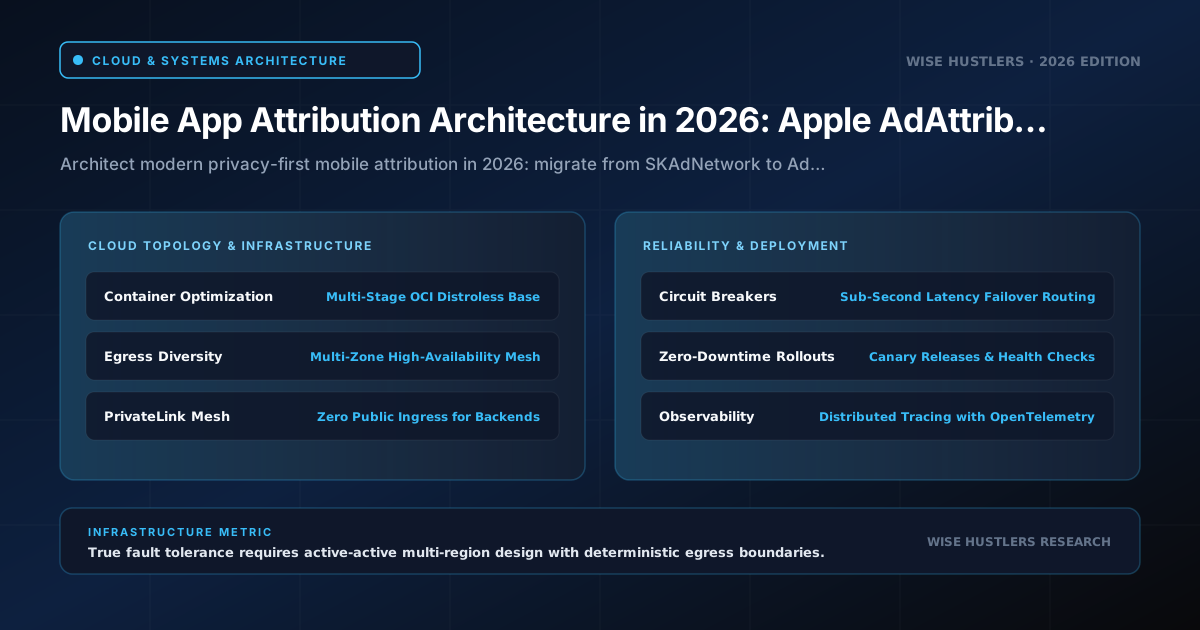
# Mobile App Attribution Architecture 2026: Apple AdAttributionKit, SKAdNetwork Sunset, and Server-Side Postback Infrastructure
Summary: Designing an enterprise mobile app attribution architecture 2026 requires engineering leaders to navigate Apple AdAttributionKit alongside SKAdNetwork and Android Privacy Sandbox standards. This guide details end-to-end dual-track event ingestion, developer postback validation using ES256 cryptographic signatures, client-side Swift 6 implementation for fine and coarse conversion values, and an architectural total cost of ownership analysis comparing commercial MMP licensing models against first-party server-side pipelines.
---
The 2026 Attribution Paradigm: SKAdNetwork Evolution and AdAttributionKit Migration
The mobile user acquisition landscape has reached a decisive architectural turning point. Apple introduced AdAttributionKit starting with iOS 17.4 and expanded its capabilities across iOS 18 and subsequent runtime releases. While industry discussions frequently analyze a potential skadnetwork 4.0 sunset, Apple has not announced an official deprecation schedule or end-of-life timeline for SKAdNetwork. Instead, SKAN 4 and AdAttributionKit operate interoperably on supported iOS releases. For mobile architects, Chief Technology Officers, and Product VPs, supporting AdAttributionKit represents a foundational evolution in conversion attribution, native re-engagement tracking, alternative app marketplace coverage, and cryptographic validation.
Historically, mobile marketing relied on persistent device identifiers (IDFA on iOS, GAID on Android) and probabilistic fingerprinting techniques such as combining IP addresses, user agents, screen dimensions, and battery states. Platform privacy frameworks—specifically Apple App Tracking Transparency (ATT) policy prohibitions against fingerprinting, network obfuscation via iCloud Private Relay, and Google Android Privacy Sandbox—have rendered cross-app probabilistic fingerprinting non-compliant with platform developer agreements and technically unreliable.
       +--------------------------------------------------------------+
       |             2026 Privacy-Safe Mobile Attribution             |
       +--------------------------------------------------------------+
                                       |
                 +---------------------+---------------------+
                 |                                           |
                 v                                           v
    +-------------------------+                 +-------------------------+
    |    Apple Platforms      |                 |    Android Ecosystem    |
    |   AdAttributionKit      |                 |  Privacy Sandbox APIs   |
    |   Developer Postbacks   |                 |  Play Install Referrer  |
    +-------------------------+                 +-------------------------+
                 |                                           |
                 +---------------------+---------------------+
                                       |
                                       v
                    +-------------------------------------+
                    |   First-Party Edge Ingestion Proxy  |
                    |   (Cloudflare Workers / Envoy)      |
                    +-------------------------------------+
                                       |
                 +---------------------+---------------------+
                 |                                           |
                 v                                           v
    +-------------------------+                 +-------------------------+
    |   Internal Analytics    |                 |   Authenticated Ad      |
    |   (ClickHouse / Lake)   |                 |   Server Postbacks      |
    +-------------------------+                 +-------------------------+
The Technical Drivers Behind the AdAttributionKit Migration
When comparing apple adattributionkit vs skadnetwork, three primary technical drivers explain Apple’s structural shift:
1. Alternative Marketplace Interoperability: In compliance with European Union Digital Markets Act (DMA) regulations on iOS 17.4 and later, Apple introduced support for alternative app marketplaces in the EU. Legacy SKAN frameworks were tightly coupled to App Store item identifiers (adam-id). AdAttributionKit abstracts attribution mechanics across both the App Store and certified alternative marketplaces using universal publisher and marketplace identifiers.
2. First-Class Re-Engagement Measurement: SKAN 4 focused primarily on install attribution, offering limited native separation for retargeting campaigns without custom schema workarounds. AdAttributionKit introduces native re-engagement attribution, providing dedicated deep-link conversion tracking and postbacks specifically for re-opened applications.
3. Cryptographic Integrity via JSON Web Signatures (JWS): SKAN 2.0–3.0 iterations utilized custom byte strings concatenated with invisible Unicode separators (\u2063) to represent signatures. AdAttributionKit replaces this approach with standard RFC 7515 JSON Web Signatures (JWS) signed via ECDSA P-256 (ES256), establishing transparent cryptographic validation across modern data pipelines.
Organizations that proactively adapt their measurement stack gain independent access to raw attribution data, eliminate reliance on black-box modeling, and establish full compatibility with alternative app marketplaces while maintaining SKAN 4 interoperability across major ad networks.
---
Dual-Track Attribution Blueprint: iOS AdAttributionKit and Android Play Infrastructure
Operating high-velocity mobile acquisition campaigns across iOS and Android requires a unified, dual-track ingestion topology. Rather than scattering vendor SDKs across the client codebase, modern enterprise mobile applications route raw signals through a centralized first-party edge proxy.
Architectural Data Flow Diagram
The following blueprint illustrates how client-side Apple AdAttributionKit triggers and Android tracking mechanisms feed into an internal edge ingestion proxy, dispatching direct copies of developer postbacks to internal data warehouses while forwarding authenticated conversions to ad networks.
flowchart TD
    subgraph ClientLayer["Mobile Client Tier (iOS & Android)"]
        iOSApp["iOS App (AdAttributionKit Client)"]
        AndroidApp["Android App (Play Referrer & Sandbox)"]
        OfflineDB["Local SQLite / MMKV Cache"]
        QueueWorker["Background Queue Worker"]

        iOSApp -->|"Record Milestones"| OfflineDB
        AndroidApp -->|"Track Installs"| OfflineDB
        OfflineDB -->|"Batched Dispatch"| QueueWorker
    end

    subgraph AppleInfra["Apple Ecosystem Infrastructure"]
        AdNetAd["Ad Network Display / Ad Impression"]
        AppleAttributionDaemon["Apple AdAttributionKit Daemon"]
        AdNetAd -.->|"Click / View"| AppleAttributionDaemon
        iOSApp -.->|"Update Postback (0..63)"| AppleAttributionDaemon
    end

    subgraph EdgeTier["First-Party Edge Ingestion Gateway"]
        EdgeProxy["Edge Ingestion Proxy (Cloudflare / AWS Lambda)"]
        DevPostbackEndpoint["Direct Postback Receiver (/.well-known/)"]
        AuthValidator["HMAC & JWS Verification Service"]

        QueueWorker -->|"HTTPS POST /v1/telemetry"| EdgeProxy
        AppleAttributionDaemon -->|"JWS Signed Developer Postback"| DevPostbackEndpoint
        DevPostbackEndpoint --> AuthValidator
        EdgeProxy --> AuthValidator
    end

    subgraph InternalData["Internal Data Platform"]
        Kafka["Event Stream (Apache Kafka / Redpanda)"]
        ClickHouse["Analytics Warehouse (ClickHouse / S3)"]

        AuthValidator -->|"Normalized Ingestion"| Kafka
        Kafka --> ClickHouse
    end

    subgraph NetworkDispatch["Authenticated Ad Network Postbacks"]
        MetaCAPI["Meta Conversions API (CAPI)"]
        GoogleOffline["Google Ads Offline Conversions API"]
        TikTokCAPI["TikTok Events API"]
        AppleSearch["Apple Search Ads Attribution API"]

        Kafka -->|"Event Router"| MetaCAPI
        Kafka -->|"Event Router"| GoogleOffline
        Kafka -->|"Event Router"| TikTokCAPI
        Kafka -->|"Event Router"| AppleSearch
    end
Client-Side Ingestion and Cross-Platform Considerations
In a dual-track architecture, the iOS client communicates with Apple system-level attribution daemon, while Android relies on the Google Play Install Referrer API alongside the Google Privacy Sandbox Attribution Reporting runtime.
For engineering teams working in cross-platform environments such as React Native or Flutter, maintaining clean isolation between native attribution engines and cross-platform UI state is critical:
- Flutter Native Modules: Implement a dedicated
MethodChannel(com.wisehustlers.attribution/adattributionkit) bridging Dart runtime events to native Swift/Kotlin handlers. Conversion updates must never block Dart UI isolates. - React Native Turbo Modules: Utilize modern C++ JSI TurboModules to execute attribution updates off the JavaScript main thread, preventing frame drops during high-frequency purchase animations or onboarding flows.
Resilient Edge Ingestion Proxy and API Gateway Architecture
The edge ingestion proxy serves as the initial gateway for all first-party telemetry and direct attribution webhooks. Deployed on Cloudflare Workers, Fastly Compute, or AWS Lambda@Edge, this tier fulfills three core responsibilities:
1. Schema Validation and Sanitization: Enforces strict JSON Schema validation on client telemetry payloads, dropping malformed payloads before they reach internal message brokers.
2. Token Bucket Rate Limiting: Prevents client-side network thrashing and anomalous request surges by enforcing per-device IP rate limiting.
3. Payload Normalization: Unifies disparate incoming formats (Apple JWS payloads, Android Play Referrer parameters, and first-party event logs) into a standardized internal attribution schema.
Offline Sync, Idempotency, and Local Queue Engines
Mobile devices operate under intermittent connectivity. If a user completes an in-app subscription while traveling through a cellular dead zone, the attribution payload must not be lost:
- Local Persistence Store: Telemetry events are committed to a fast, local transactional store (such as MMKV or SQLite) before network transport is attempted.
- Monotonic Sequence Identifiers: Each event includes a UUID v4 along with a client-generated monotonic sequence counter (
device_seq_id). - Idempotency Keys: When the edge proxy ingests events, it caches the idempotency key in an in-memory Redis cluster with a 72-hour TTL. Duplicate submissions caused by network re-transmissions are acknowledged with HTTP 200 but excluded from downstream Kafka event streams.
- Exponential Backoff: Failed transmissions employ jittered exponential backoff (starting at 1.5 seconds up to a maximum delay of 30 minutes) to prevent retry storms upon connection recovery.
Push Notification Delivery and Re-Engagement Attribution
Push notifications represent a major conversion vector for mobile applications. Under privacy safe mobile campaign tracking, attributing re-engagement to specific push campaigns requires careful token orchestration:
- Silent APNs Receipts: When an APNs push arrives with
content-available: 1, the iOS client logs the campaign identifier to local storage. - Engagement Timeout Windows: If the user launches the application via the notification banner within a defined attribution window (e.g., 6 hours), the client flags subsequent monetization events with the notification tracking ID.
- AdAttributionKit Re-Engagement Integration: If the push was triggered by an ad network retargeting campaign containing an AdAttributionKit re-engagement URL, the application invokes the system completion handler to record the re-engagement postback directly with Apple.
Downstream Server-Side Postback Dispatching
The server-side postback dispatching engine routes validated conversion signals from Apache Kafka or Redpanda to third-party ad networks. Unlike client-side tracking pixels that are vulnerable to ad blockers, network timeouts, and tracking protection mechanisms, server side mobile attribution postbacks offer guaranteed delivery, cryptographic replay defenses, and precise payload control. The dispatcher interfaces directly with:
- Meta Conversions API (CAPI) for App Events, transmitting hashed customer parameters (
em,ph,client_ip_address). - Google Ads Offline Conversion API, injecting GCLID, GBRAID, or WBRAID identifiers.
- TikTok Events API, providing real-time ROAS data via server-to-server TLS connections.
---
Technical Comparison Matrix: AdAttributionKit vs. SKAdNetwork 4.0 vs. Android Tracking
Understanding the trade-offs between contemporary attribution protocols is essential for configuring measurement models and conversion schemas.
| Dimension | Apple AdAttributionKit (iOS 17.4+, iOS 18+) | Legacy SKAdNetwork 4.0 | Android Deterministic & Privacy Sandbox |
|---|---|---|---|
| Framework Status | Active Apple Standard | Active Apple Standard (Interoperable with AdAttributionKit) | Active Hybrid (Play Install Referrer + Privacy Sandbox APIs) |
| Re-Engagement Attribution | Native support via dedicated re-engagement postbacks and deep-linking | Limited; required custom schema workarounds | Fully supported via intent data and Play Referrer parameters |
| Crowd Anonymity Tiers | 4 Tiers (Tier 0 to Tier 3) determining data fidelity | 4 Tiers (Tier 0 to Tier 3) | Aggregation Service & Local Privacy Budgets |
| Conversion Windows | 3 sequential windows (0-2d, 3-7d, 8-35d) with window locking | 3 sequential windows (0-2d, 3-7d, 8-35d) with window locking | Configurable custom lookback windows (up to 30+ days) |
| Conversion Values | Fine (0–63) + Coarse (high, medium, low) | Fine (0–63) + Coarse (high, medium, low) | Arbitrary continuous values (revenue, tier, custom values) |
| Alternative App Marketplaces | Native support across App Store and certified alternative marketplaces (EU / iOS 17.4+) | Strictly limited to standard App Store distribution (adam-id) | Native support across Google Play and third-party stores |
| Postback Format | RFC 7515 JSON Web Signature (JWS) | Custom JSON string with Unicode separator signature | Standard JSON payloads via direct HTTPS POST |
| Signature Algorithm | ECDSA with SHA-256 (ES256) via Apple Public Key | Custom ECDSA over concatenated UTF-8 byte arrays | Network-specific HMAC-SHA256 or OAuth 2.0 mTLS |
| Developer Postback Copy | Direct HTTPS delivery to /.well-known/appattribution/report-attribution/ | Direct HTTPS delivery to /.well-known/skadnetwork/report-attribution/ | Direct server-to-server webhook callback / Google Play Developer API |
| Web-to-App Attribution | Native Safari and external browser transition support | Partial support via Safari attribution tags | Full support through Chrome attribution headers & Referrer |
Detailed Architectural Breakdown: Why AdAttributionKit Expands Beyond SKAN
The transition to AdAttributionKit addresses structural limitations present in earlier frameworks. In SKAN 4.0, handling deep links and conversions from non-App Store distribution channels was restricted by packaging dependencies on App Store item IDs. AdAttributionKit decouples attribution logic from the underlying store installer, enabling consistent operation across enterprise distributions and alternative app stores.
Furthermore, AdAttributionKit standardizes payload handling via RFC 7515 JWS tokens. Rather than parsing raw string arrays separated by hidden delimiters—a frequent failure mode in custom data pipelines—backend systems consume standard base64url-encoded headers and payloads verifiable with standard cryptographic libraries.
---
Production Swift Implementation: AdAttributionKit & Developer Postback Configuration
To capture developer postbacks directly on your internal infrastructure without intermediary MMP filtering, you must configure your application's developer postback endpoint in Info.plist and implement native Swift update routines.
Developer Postback Configuration in Info.plist
Apple requires the developer postback server domain to be declared statically in the application Info.plist. The domain must use HTTPS with a valid TLS certificate.
To receive AdAttributionKit postbacks, configure the AttributionCopyEndpoint key inside the AdAttributionKit dictionary. For backward compatibility with SKAdNetwork campaigns, retain the NSAdvertisingAttributionReportEndpoint key.
<?xml version="1.0" encoding="UTF-8"?>
<!DOCTYPE plist PUBLIC "-//Apple//DTD PLIST 1.0//EN" "http://www.apple.com/DTDs/PropertyList-1.0.dtd">
<plist version="1.0">
<dict>
    <!-- AdAttributionKit Developer Postback Copy Configuration (iOS 17.4+) -->
    <key>AdAttributionKit</key>
    <dict>
        <!-- Defines the server endpoint receiving copies of winning postbacks -->
        <key>AttributionCopyEndpoint</key>
        <string>https://attribution.wise-hustlers.com</string>
        <!-- Optional: Opt in to receive copies of re-engagement postbacks -->
        <key>EligibleForAdAttributionKitReengagementPostbackCopies</key>
        <true/>
    </dict>

    <!-- Legacy / Concurrent SKAdNetwork Developer Postback Endpoint (iOS 15.0+) -->
    <key>NSAdvertisingAttributionReportEndpoint</key>
    <string>https://attribution.wise-hustlers.com</string>
</dict>
</plist>
When an attribution event concludes, Apple's operating system daemon automatically dispatches an HTTP POST request to:
- AdAttributionKit postback copies:
https://attribution.wise-hustlers.com/.well-known/appattribution/report-attribution/ - SKAdNetwork postback copies:
https://attribution.wise-hustlers.com/.well-known/skadnetwork/report-attribution/
Swift 6 Production Implementation
Managing adattributionkit conversion values requires strict adherence to monotonically non-decreasing states across measurement windows. The following production-grade Swift implementation demonstrates thread-safe conversion value management using modern Swift concurrency (actor) and the AdAttributionKit framework.
import Foundation
import AdAttributionKit
import OSLog

/// Thread-safe enterprise attribution manager for Apple AdAttributionKit.
/// Handles fine and coarse conversion value progression and postback window locking.
public actor AttributionManager {
    public static let shared = AttributionManager()

    private let logger = Logger(subsystem: "com.wisehustlers.attribution", category: "AdAttributionKit")
    private var highestRecordedValue: Int = 0

    private init() {}

    /// Updates the AdAttributionKit conversion value based on in-app monetization milestones.
    /// - Parameters:
    ///   - fineValue: Granular integer metric (0–63) mapping to specific revenue or conversion tiers.
    ///   - coarseValue: Fallback privacy tier (.low, .medium, .high) when crowd anonymity thresholds are not met.
    ///   - lockWindow: Forces the attribution measurement window to close early and triggers postback dispatch.
    public func updateConversion(
        fineValue: Int,
        coarseValue: PostbackUpdate.CoarseConversionValue,
        lockWindow: Bool = false
    ) async {
        // Enforce valid conversion value boundary constraints
        guard fineValue >= 0 && fineValue <= 63 else {
            logger.error("Invalid fineConversionValue: \(fineValue). Must reside between 0 and 63.")
            return
        }

        // AdAttributionKit requires conversion values to be monotonically non-decreasing
        guard fineValue >= highestRecordedValue else {
            logger.warning("Supplied fineValue (\(fineValue)) is lower than current highest (\(self.highestRecordedValue)). Update skipped.")
            return
        }

        self.highestRecordedValue = fineValue

        do {
            // Construct the AdAttributionKit postback update configuration
            let update = PostbackUpdate(
                fineConversionValue: fineValue,
                lockPostback: lockWindow,
                coarseConversionValue: coarseValue
            )

            // Submit update asynchronously to Apple's system daemon
            try await Postback.updateConversionValue(update)

            logger.info("AdAttributionKit postback successfully updated: fine=\(fineValue), coarse=\(String(describing: coarseValue)), locked=\(lockWindow)")
        } catch {
            // Attribution failures must never interrupt the primary user experience
            logger.error("AdAttributionKit conversion update failed: \(error.localizedDescription)")
        }
    }

    /// Convenience helper for milestone purchase events that immediately lock the postback window.
    public func recordHighValueSubscription(tierRevenue: Double) async {
        let mappedFineValue = min(63, Int(tierRevenue / 2.0))
        await updateConversion(
            fineValue: mappedFineValue,
            coarseValue: .high,
            lockWindow: true
        )
    }
}
---
Risk Analysis: Timer Delays, Crowd Anonymity, and Cryptographic Signature Verification
Operating privacy-preserving attribution introduces operational and technical factors that engineering and growth analytics teams must accommodate in their data modeling.
Conversion Window Delays and Randomized Timer Locks
Under AdAttributionKit, conversion reporting is decoupled from real-time user actions to prevent cross-app user identification:
- Window 1 (0 to 2 days): Captures early install and onboarding events. Once the window closes (or is locked via
lockPostback: true), Apple applies a randomized 24-to-48-hour delay before dispatching the postback. - Window 2 (3 to 7 days): Captures mid-funnel retention and repeat engagement. Following window closure, postback delivery is subject to a randomized 24-to-144-hour delay (1 to 6 days).
- Window 3 (8 to 35 days): Tracks long-term retention and lifecycle subscription activity. Following window closure, postback delivery is also subject to a randomized 24-to-144-hour delay (1 to 6 days).
Engineering Impact: Real-time ROAS optimization cannot rely on delayed postbacks. Because Window 2 and Window 3 postbacks can arrive up to 6 days after their respective windows close, downstream analytics pipelines must accommodate up to 41 days of latency (35 days window duration + up to 144 hours randomized delay) before final lifecycle cohort maturation. Automated bidding models must rely on predictive early-lifetime models built on Window 1 signals. Locking the window early (lockPostback: true) closes the measurement window immediately and initiates the random delay, reducing waiting time when primary milestones occur early.
Privacy Thresholds and Crowd Anonymity Penalties
Apple implements a 4-tier crowd anonymity matrix (Tier 0 to Tier 3) calculated based on the install volume of the advertising campaign:
- Tier 0 (Lowest Volume): Returns null fine conversion values, null coarse conversion values, and truncates the source identifier from 4 digits down to 2 digits.
- Tier 1: Returns coarse conversion value only, with a 2-digit source ID.
- Tier 2: Returns fine conversion values for Window 1, coarse values for Windows 2 and 3, and a 3-digit or 4-digit source ID.
- Tier 3 (Highest Volume): Returns complete fine conversion values across Window 1 and full 4-digit source IDs.
Architectural Mitigation: Mobile engineering and acquisition teams must consolidate campaign structures. Fragmenting ad spend across numerous granular ad sets risks dropping campaigns below the Tier 1 threshold, resulting in null conversion values that blind performance algorithms.
Server-Side Webhook Signature Validation (ES256 / ECDSA P-256)
Because developer postbacks arrive as raw HTTP webhooks, validation is mandatory to prevent unauthorized parties from injecting fraudulent conversions into your database.
An incoming developer postback contains an Apple-signed JWS token. The server-side verification pipeline executes the following sequence:
1. JWS Header Extraction: Parse the JOSE header to extract the key identifier (kid) and algorithm ("alg": "ES256"). In production, Apple signs with its official public key; during Xcode test runs, kid equals apple-development-identifier/0.
2. Public Key Retrieval: Fetch and cache Apple official root certificate and AdAttributionKit public key from Apple public key infrastructure (PKI).
3. ECDSA P-256 Signature Verification: Compute the SHA-256 digest over the signing input (header_base64url + "." + payload_base64url) and verify the signature using the P-256 elliptic curve.
4. Replay Defense: Extract the postback unique transaction-id or combination of source-identifier, app-id, and postback-sequence-index. Verify against an operational Redis cache to reject duplicate replays.
Incoming Webhook POST
       |
       v
+-----------------------------------------------------------+
| 1. Split JWS String into Header, Payload, and Signature   |
+-----------------------------------------------------------+
       |
       v
+-----------------------------------------------------------+
| 2. Verify Algorithm ("alg": "ES256") and Key ID ("kid")   |
+-----------------------------------------------------------+
       |
       v
+-----------------------------------------------------------+
| 3. Execute ECDSA P-256 Verification with Apple Public Key |
+-----------------------------------------------------------+
       |
  [Valid Signature?]
       |
       +---> NO  ---> [Reject: HTTP 401 Unauthorized]
       |
      YES
       |
       v
+-----------------------------------------------------------+
| 4. Check Transaction ID Against Redis Deduplication Cache |
+-----------------------------------------------------------+
       |
  [Is Duplicate?]
       |
       +---> YES ---> [Acknowledge: HTTP 200 (Drop Replay)]
       |
       NO
       |
       v
+-----------------------------------------------------------+
| 5. Stream Normalized Attribution Event to Apache Kafka    |
+-----------------------------------------------------------+
---
2026 Enterprise Attribution TCO Breakdown: Commercial MMP vs. Self-Hosted Modern Data Stack
Engineering leadership frequently debates whether to license a commercial Mobile Measurement Partner (MMP) such as AppsFlyer, Adjust, Singular, or Branch, or construct an internal first-party attribution engine. Evaluating this decision requires examining the appsflyer adjust postback architecture against modern cloud-native event pipelines.
The Cost Structure of Commercial Mobile Measurement Partners
Commercial MMPs typically operate on consumption-based pricing models structured around user acquisition volume:
- Contractual Pricing Dynamics: Commercial MMP contracts are negotiated on an enterprise basis, generally benchmarked against Monthly Tracked Users (MTU), Monthly Active Users (MAU), or attributed event volume. Because vendors do not publish uniform rate cards under non-disclosure agreements, unit pricing varies widely based on negotiated commitments, volume brackets, and contractual overage terms.
- Unbundled Enterprise Modules: Core attribution plans frequently unbundle advanced operational modules. Features such as raw real-time streaming data export (e.g., automated cloud storage lockers), behavioral fraud detection suites, deep audience syndication, and multi-touch modeling are commonly sold as premium add-ons, increasing total annual software commitments.
- Switching Friction: Deep dependency on proprietary client SDKs creates technical lock-in. Migrating attribution vendors requires deploying app updates, deprecating legacy SDK versions across historical client releases, and reconfiguring server postback endpoints with ad partners.
The Self-Hosted Cloud-Native Attribution Pipeline
Building a self-hosted pipeline utilizing edge serverless functions (Cloudflare Workers), event streaming (Kafka/Redpanda), and analytical storage (ClickHouse Cloud) shifts expenditure from vendor software licensing to cloud infrastructure and internal engineering allocation:
- Cloud Infrastructure Drivers: Ingestion costs scale directly with network request volume, message broker throughput, and analytical query compute rather than tracked user metrics. Columnar storage engines like ClickHouse provide high compression ratios (often 4x to 8x for structured attribution logs), keeping data retention costs manageable even at high ingestion volumes.
- Engineering Maintenance and API Drift: The primary cost in a self-hosted architecture is engineering labor. Ad networks regularly modify their server-side Conversions APIs (e.g., Meta CAPI, Google Ads Offline API, TikTok Events API), introduce schema updates, or mandate new parameter requirements. Internal platform teams must allocate regular engineering bandwidth to monitor partner API deprecations, maintain schema adapters, and verify endpoint reliability.
Enterprise Attribution Cost-Driver & Architectural Evaluation Matrix
The matrix below contrasts the operational and financial profiles of commercial MMP deployments versus a self-hosted modern data stack.
| Evaluation Dimension | Commercial MMP Approach | Self-Hosted Modern Data Stack | Strategic Architectural Trade-off |
|---|---|---|---|
| Primary Billing / Cost Driver | Tiered pricing based on MTUs / MAUs or attributed conversion events; overages apply when scaling beyond plan caps | Infrastructure consumption: edge function invocations, streaming bandwidth, and columnar warehouse storage | MMP costs scale with audience size; self-hosted costs scale with raw data volume and storage retention policies |
| Initial Implementation Investment | Low; turnkey native and cross-platform SDK installation with pre-configured dashboard interfaces | High; requires custom engineering to build edge proxies, cryptographic JWS verifiers, Kafka queues, and CAPI adapters | Commercial MMP accelerates initial time-to-market; self-hosted requires substantial upfront systems engineering |
| Ongoing Maintenance Overhead | Minimal client-side SDK maintenance; vendor absorbs third-party ad network API migrations and breaking changes | Substantial; internal engineers must maintain ad network API versioning (Meta CAPI, Google Ads, TikTok) and schema updates | MMP outsources ad network API drift; self-hosted requires continuous data platform maintenance |
| Data Sovereignty & Custody | Vendor stores raw events; direct raw data access or streaming export is often throttled, aggregated, or gated behind add-on tiers | Complete; 100% first-party custody over raw, immutable Apple JWS postbacks and Android attribution signals | Self-hosted ensures full ownership and unconstrained data modeling without vendor-imposed retention limits |
| Self-Attributing Network (SAN) Integrations | Turnkey integration with Meta, Google Ads, TikTok, Apple Search Ads, and hundreds of ad partners | Requires building, maintaining, and authenticating bespoke server-to-server CAPI connectors for each network | MMP simplifies managing broad multi-network acquisition; self-hosted requires dedicated engineering per ad network |
| Cryptographic Postback Verification | Abstracted behind vendor dashboards; postbacks are verified internally by MMP systems | Directly verified at API gateway using Apple ES256 public keys and custom Redis deduplication filters | Self-hosted provides independent cryptographic validation free from vendor aggregation bias |
| Cost Predictability at Scale | Variable; contract renewals often face escalation as app MAU scales from hundreds of thousands into millions | Predictable; cloud unit economics improve with columnar compression, batch processing, and serverless pricing tiers | Self-hosted offers stable margin economics at extreme scale, offset by internal engineering payroll allocation |
The Hybrid Architecture Recommendation
For scaling mobile applications managing high acquisition volumes across multiple ad networks, a purely binary choice—relying exclusively on third-party SaaS or building an entirely self-hosted platform—often introduces operational friction. Instead, engineering and data leadership increasingly adopt a hybrid architecture that balances data sovereignty with operational efficiency:
1. Direct Developer Postback Ingestion: Configure AttributionCopyEndpoint (under the AdAttributionKit dictionary in Info.plist) for AdAttributionKit and NSAdvertisingAttributionReportEndpoint for SKAdNetwork. This ensures your internal servers receive raw, unadulterated copies of Apple postbacks simultaneously with ad networks, establishing independent first-party auditability and eliminating vendor data lock-in.
2. First-Party Telemetry Gateway: Ingest in-app behavioral events and conversion milestones through your own edge proxy into ClickHouse or BigQuery. This allows custom lifetime value (LTV) modeling and cohort analysis without paying per-event ingest fees to third-party dashboards.
3. Targeted MMP or Direct CAPI Utilization: Retain a lightweight commercial MMP tier specifically to manage dynamic partner relationships across dozens of Self-Attributing Networks (SANs) where ongoing API maintenance would divert engineering focus, or deploy direct server-to-server Conversions APIs (Meta CAPI, Google Offline Conversions) for your primary acquisition channels while using direct developer postbacks as the ground-truth audit layer.
When architecting scalable mobile telemetry pipelines, organizations seeking specialized systems engineering and cross-platform expertise partner with experienced teams for mobile development to implement high-throughput event ingestion and cryptographic verification without overburdening core product squads.
---
Frequently Asked Questions
Can AdAttributionKit coexist with existing SKAdNetwork implementations?
Yes. Apple designed AdAttributionKit and SKAdNetwork to operate concurrently on supported iOS versions (iOS 17.4+). Both frameworks can register conversion signals within the same application. When configured concurrently, Apple processes attribution for supported campaigns without mutual interference. However, engineering teams must align conversion value schemas across both systems to maintain consistent reporting and avoid duplicate accounting in downstream analytics.
How do Flutter and React Native apps handle AdAttributionKit updates without degrading UI performance?
Attribution updates should never run synchronously on Dart or JavaScript UI threads. In React Native, teams should utilize C++ TurboModules via the JavaScript Interface (JSI) to dispatch postback updates directly to native background threads. In Flutter, updates should be routed through asynchronous MethodChannel calls handled inside native Swift actor methods. Offloading these calls prevents thread blocking during performance-critical moments such as purchase completion animations or onboarding transitions.
Why are developer postbacks necessary if an MMP already provides a reporting dashboard?
Commercial MMP dashboards provide aggregated, processed metrics shaped by vendor-specific attribution windows, deduplication logic, and data retention schedules. Configuring direct developer postback endpoints—using AttributionCopyEndpoint for AdAttributionKit and NSAdvertisingAttributionReportEndpoint for SKAdNetwork—gives data engineering teams direct custody of raw, cryptographically signed postbacks from Apple. This first-party dataset enables bespoke lifetime value modeling, independent verification of vendor attribution figures, and complete protection against platform lock-in.
How does Apple ensure developer postbacks cannot be forged by malicious competitors?
Apple signs AdAttributionKit developer postbacks using RFC 7515 JSON Web Signatures (JWS) with an ECDSA P-256 (ES256) private key. The JWS header includes Apple key identifier (kid). Receiving servers validate the signature against Apple publicly distributed PKI certificates. Any payload modification or unauthorized transmission fails cryptographic signature verification and is rejected at your edge gateway. Additionally, caching postback transaction identifiers in an in-memory datastore (such as Redis) prevents replay attacks.
---
Sources
- Apple Developer: AdAttributionKit Framework Documentation
- Apple Developer: AttributionCopyEndpoint Configuration
- Apple Developer: Configuring an Advertising Attribution Report Endpoint
- Google Privacy Sandbox for Android: Attribution Reporting API
- RFC 7515: JSON Web Signature (JWS) Specification
- W3C Private Advertising Technology Working Group Standards
- IAB Tech Lab: Advanced Attribution and Privacy-Preserving Measurement Guidance