
# How Much Does It Cost to Build a Mobile App in Kenya?
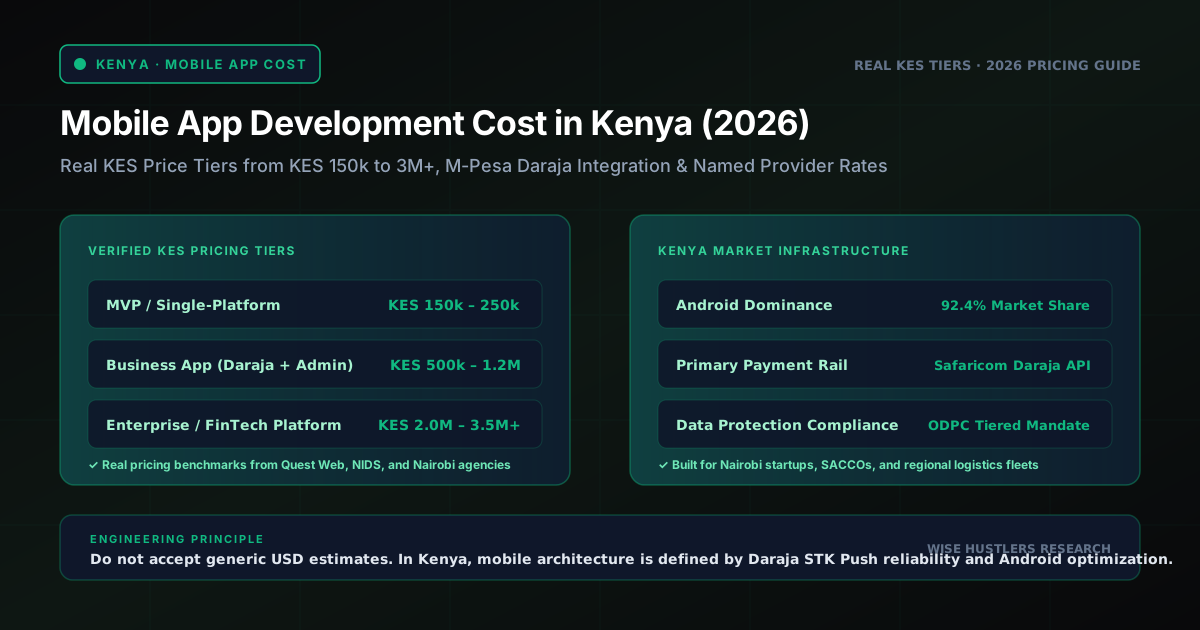
A basic MVP app in Kenya costs KES 150,000–400,000, a mid-tier business app with M-Pesa and a custom backend runs KES 500,000–1,500,000, and an enterprise-grade app starts around KES 2,000,000–3,000,000+ (roughly USD 15,000–23,000+ at current rates). These are real published prices as of late July 2026, at an exchange rate of approximately 1 USD = 129.4 KES.
Mobile App Pricing in Kenya by Tier (2026)
| Tier | Price (KES) | Approx. USD | Timeline | What you actually get |
|---|---|---|---|---|
| MVP / Basic | 150,000 – 400,000 | 1,160 – 3,090 | 6–10 weeks | Single platform (Android or iOS), 6–8 core screens, basic backend, simple login/profile, app store submission. The lower end is a bare-bones build; the upper end adds basic M-Pesa payment and push notifications. |
| Mid-tier / Business | 500,000 – 1,500,000 | 3,865 – 11,590 | 3–6 months | Cross-platform build (Android + iOS, usually Flutter or React Native), custom backend and API, M-Pesa and card payment integration, admin dashboard, analytics and crash reporting. |
| Enterprise / Advanced | 2,000,000 – 3,000,000+ | 15,460 – 23,190+ | 5–8 months+ | Multi-platform plus a companion web app, scalable cloud backend, advanced or fintech-grade security, real-time features, a dedicated project manager, ongoing SLA support. Local providers commonly quote this tier in USD rather than KES. |
These are app development prices specifically. If you're deciding between building an app at all versus a website or web portal for your business, that's a separate question with its own cost logic.
What Drives the Price Up or Down
The single biggest swing factor is payment integration, and in Kenya that almost always means M-Pesa. A simple app with no login and no payments sits at the bottom of its tier. The moment you add M-Pesa via Safaricom's Daraja API, you're adding real engineering work, not a plugin toggle — one CPaaS vendor that sells a managed alternative to building it yourself, HelloDuty, publishes that a raw, in-house Daraja integration typically takes 6–12 weeks of senior engineering time and runs KES 800,000–2,500,000 in build cost, plus 15–25% of that per year in ongoing maintenance . Whatever the exact number, expect payment integration to be one of the largest single line items in a mid-tier or enterprise quote.
Other factors that push price up:
- Platform choice. Android holds 92.44% of Kenya's mobile OS market versus iOS at 7.26% (Statcounter, June 2026), which is why most local providers price Android-only builds cheaper and treat iOS or dual-platform as an add-on rather than the default.
- Custom backend and admin tools. A staff-facing admin dashboard, inventory system, or driver/rider management panel is custom software, not a template setting.
- Real-time features. Live tracking, chat, or push-based notifications at scale need infrastructure a basic CRUD app doesn't.
- Third-party integrations beyond payments — SMS gateways, delivery/logistics APIs, accounting software.
To see what "enterprise-grade" actually looks like in practice: Twiga Foods, the Nairobi-based B2B food distribution company, built and runs its ordering app Soko Yetu (shop.twiga.ke) with outsourced senior engineering support rather than a one-off agency project. The initial engagement, arranged through the placement firm MADE (now Made by People), allocated one senior back-end engineer and one senior front-end engineer, each budgeted 80 hours a month, over an initial six-month term. No public figure for the total build cost is available, so we won't invent one — but the staffing shape (two senior engineers, part-time but sustained, over months rather than weeks) is a useful real-world reference point for what separates an enterprise-tier build from a basic app.
Things that bring the price down: choosing Android-only for launch and adding iOS later, using a cross-platform framework instead of two native codebases, launching with fewer screens and expanding post-launch, and doing your own QA/content entry instead of paying the developer to do it.
What's Included vs. What Gets Charged Extra
Most Kenyan developer quotes for MVP and mid-tier builds include the core build, basic testing, and app store submission. Check carefully what's bundled beyond that — quotes vary a lot on this point.
Almost always billed separately, even when it's easy to assume otherwise:
- App store fees — a one-time USD 25 Google Play developer registration (no renewal), and USD 99/year for the Apple Developer Program if you're shipping to iOS.
- Ongoing hosting/backend infrastructure for anything beyond a purely offline or static app.
- Post-launch maintenance and updates beyond whatever free window (commonly 3–6 months) the developer bundles into the initial quote.
- M-Pesa Paybill/Till setup and per-transaction fees — these are billed by Safaricom separately from the developer's build fee; confirm which side is paying them before you sign.
- Data protection compliance costs. If your app collects user data at meaningful scale, your business may need to register as a data controller/processor with Kenya's Office of the Data Protection Commissioner (ODPC) — published fee tiers run roughly KES 4,000–40,000 depending on organisation size, plus a KES 2,000 renewal . This is separate from, and in addition to, the developer's fee.
- Push notification and SMS gateway costs, if your app relies on either at volume.
If a quote doesn't itemise these, ask before signing — it's the most common source of a Kenyan app project running over budget after "launch."
Real Market Comparison: What Kenyan Developers Actually Charge
Rather than industry averages, here's what three real Kenya-based providers publish on their own pricing pages as of this writing:
| Provider | Type | Published price points |
|---|---|---|
| Quest Web (Quest Designers) | Nairobi-based agency | MVP/Starter from KES 150,000 (2–3 months); Business App from KES 500,000 (3–5 months, cross-platform + M-Pesa + admin panel + 6 months maintenance); Enterprise from KES 2,000,000+ (5–8 months) |
| NIDS (Software Solutions) | Kenyan software development company | Basic/simple apps KES 80,000–250,000; medium apps KES 250,000–800,000; advanced/complex apps KES 800,000–3,000,000+ |
| David Esabwa | Independent Kenyan Android developer | MVP from KES 250,000 one-time (up to 6 screens, basic payments, Play Store launch); Business app from KES 500,000 one-time (up to 15 screens, custom backend/API, M-Pesa + card payments, admin dashboard); custom quote for enterprise |
These are the providers' own published figures, not third-party estimates — worth checking their current pricing pages directly, since packages and inclusions change. Note the spread even at "MVP": an agency's advertised floor (KES 150,000) and an independent developer's MVP package (KES 250,000, but with more included — M-Pesa and push notifications from the start) aren't quite the same build. Compare scope, not just the headline number.
If you're weighing an independent developer against an agency more generally, the freelancer route is usually cheaper on paper — Kenyan freelancers on platforms like Upwork report charging anywhere from $5 to over $100 an hour depending on skill level, against a global Upwork median of $27/hour for app developers specifically. The trade-off is less structure: no project manager, no guaranteed backup if the developer becomes unavailable mid-project, and support after launch depends entirely on that one person's availability.
How to Avoid Being Overcharged
1. Ask for the price broken down by screen count and feature, not a single lump sum. "An app" means very different things at KES 150,000 and KES 1,500,000 — get the feature list in writing before paying a deposit.
2. Confirm who owns the source code and app store listing after final payment. Some cheaper providers keep control of the developer account or codebase and charge for every future change — settle this before you sign, not after.
3. Get M-Pesa integration scoped and priced as its own line item. Because it's the single biggest cost swing in this market, a vague "payments included" line is where budgets quietly blow out.
4. Compare like-for-like tiers. A KES 200,000 quote and a KES 1,000,000 quote for "a business app" are not competing for the same job — check what's actually being built, especially around backend complexity and admin tooling.
5. Ask what happens after the free maintenance window ends. Most mid-tier quotes bundle a few months of support; find out the ongoing monthly or hourly rate before you need it, not after something breaks.
6. Be wary of a "final price" that doesn't mention app store fees or ongoing hosting — these are small individually (USD 25 one-time, USD 99/year, plus hosting) but they're routinely left off the headline quote and then billed as a surprise.
FAQ
Is KES 150,000 enough to build a real app in Kenya?
It's enough for a genuine MVP — single platform, a handful of screens, basic backend, listed on the app store. It won't cover a cross-platform build, a custom admin dashboard, or full M-Pesa integration with card payments; those push you into the KES 500,000+ tier.
Why does M-Pesa integration cost so much more than a simple contact form?
Because it's real engineering work against Safaricom's Daraja API — OAuth tokens, STK Push requests, and asynchronous callback handling your server has to manage correctly — not a plugin you switch on. It's consistently one of the largest single cost drivers in Kenyan app quotes.
Should I build for Android only, or both Android and iOS?
Android holds over 92% of Kenya's mobile market, so many businesses launch Android-only and add iOS later once there's demand or budget to justify it. If your users are more likely to be enterprise, diaspora, or higher-income, iOS matters more and a cross-platform framework is usually more cost-efficient than two separate native builds.
Do Kenyan developers charge in KES or USD?
Most local agencies and freelancers quote in KES for MVP and mid-tier work. Enterprise-tier custom builds are often quoted in USD, and international/offshore providers typically quote in USD by default.
What ongoing costs should I budget for after the app is built?
At minimum: annual app store fees (USD 25 one-time for Google Play, USD 99/year for Apple), hosting/backend costs if your app needs a live server, and a maintenance arrangement once the developer's bundled support window ends. If your app handles meaningful user data, budget for ODPC data controller/processor registration as well.
What This Means for Your Project
Start by being honest about which tier your actual requirements fall into — most businesses scope an "enterprise app" when what they actually need, at least for launch, is a well-built MVP they can validate and grow from. If you're deciding between an app and other options for reaching customers, our mobile app development page breaks down what we build and how we scope a project before quoting. For the payments side specifically, see our e-commerce services page or our developer guide to M-Pesa Daraja integration; and if you're weighing a lighter web-based alternative first, our web portal guide covers that path too. Get in touch for a scoped quote against your actual feature list, not a ballpark figure.
---
Technical Architecture & Consultation with Wise Hustlers
For businesses in Kenya scaling digital platforms, Wise Hustlers designs custom software and web portals, high-availability cloud architecture, and automated lead systems. [Speak with our lead engineers today to review your technical scope](https://wise-hustlers.com/contact).