
# How Much Does It Cost to Build a Mobile App in South Africa in 2026? Real ZAR Prices
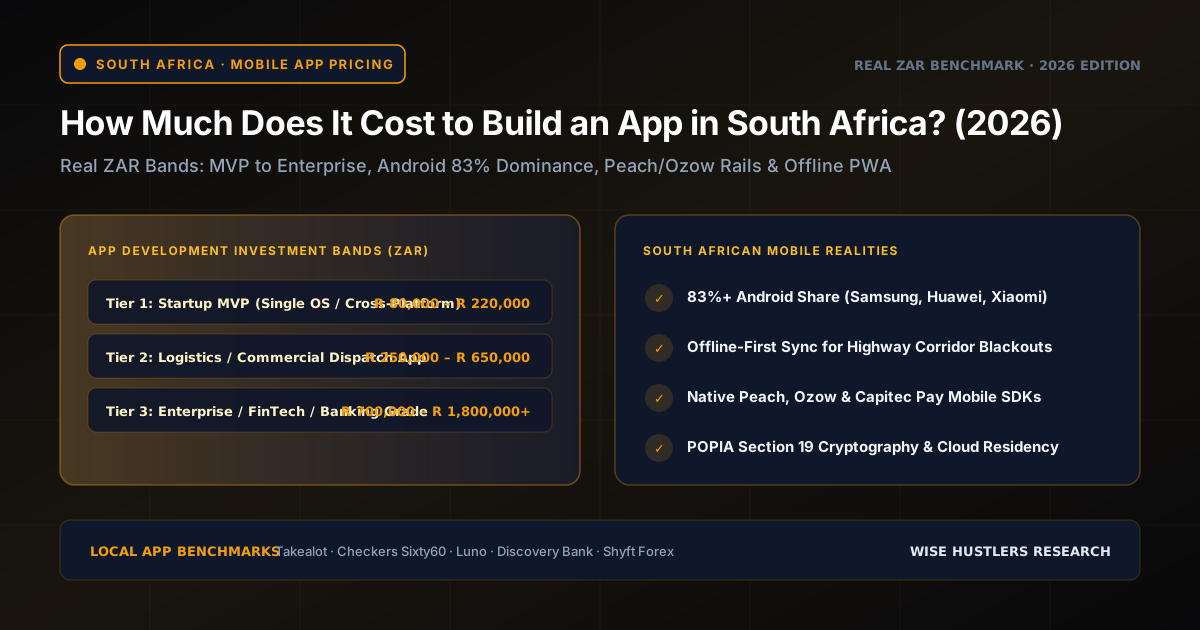
Direct answer: Building a mobile app in South Africa in 2026 costs between R 80,000 and R 220,000 for a single-platform or cross-platform Minimum Viable Product (MVP), R 250,000 and R 650,000 for a mid-market commercial or logistics application with custom backend APIs, and R 700,000 to R 1,800,000+ for an enterprise-grade fintech, banking, or multi-sided marketplace application (excl. 15% VAT). Blended agency rates across Johannesburg and Cape Town average R 750 to R 1,350 per hour.
---
2026 South Africa Mobile App Cost Benchmark (ZAR)
The table below breaks down real project bands for mobile applications engineered in South Africa or commissioned by South African enterprises, based on verified agency contracts, technology stacks, and local market scope:
| App Complexity Tier | Typical Cost Range (ZAR) | Timeline | Technology Architecture | Core Features Included | Real-World Benchmark Equivalent |
|---|---|---|---|---|---|
| Tier 1: Startup MVP App | R 80,000 – R 220,000 | 6–10 weeks | Flutter or React Native, Supabase / Firebase, Node.js | User authentication, basic profile management, push notifications, single payment gateway (PayFast / Ozow), basic search & filter | Simple booking app, niche community directory, basic loyalty card app |
| Tier 2: Commercial / Logistics / On-Demand | R 250,000 – R 650,000 | 12–18 weeks | React Native / Flutter, PostgreSQL, Redis, Google Maps / Mapbox, AWS Cape Town | Multi-role user flows (Customer vs Driver / Dispatcher), real-time GPS telemetry, offline-first photo e-POD, Peach Payments SDK, in-app chat | On-demand delivery (e.g. Courier service), field technician dispatch, B2B wholesale ordering |
| Tier 3: Enterprise / FinTech / Banking-Grade | R 700,000 – R 1,800,000+ | 18–32+ weeks | Native (Kotlin + Swift) or hardened React Native, Microservices, Dedicated HSM / KMS | Biometric authentication (FaceID/Fingerprint), FICA/KYC identity verification, automated reconciliation, bank host-to-host rails, POPIA audit vault | Mobile banking (Discovery Bank / TymeBank), crypto wallet (Luno), forex app (Shyft) |
---
South Africa Mobile Market Realities: Android Dominance & Data Costs
When architecting a mobile app for the South African commercial landscape, European or North American architectural blueprints fail if they ignore two local structural fundamentals:
1. Android Holds 83%+ Market Share
According to StatCounter and GSMA mobile data for South Africa:
- Android: ~83.2% market share (dominated by Samsung Galaxy A-series, Huawei HMS devices, Xiaomi, and Hisense).
- iOS (Apple): ~16.1% market share (concentrated predominantly in affluent suburban pockets of Johannesburg North, Pretoria East, and Cape Town's Atlantic Seaboard).
Strategic Directive: Unless your application exclusively targets high-net-worth wealth management clients, launching iOS-only is commercial suicide in South Africa. You must either build cross-platform using React Native or Flutter, or adopt an Android-first engineering roadmap.
2. High Mobile Data Costs & "Data-Free" Engineering
Mobile data remains relatively expensive in South Africa compared to average household income. South African smartphone users frequently manage prepaid data bundles carefully:
- Application Bundle Optimization: Your initial APK/AAB download size should remain strictly under 25MB to 35MB. Large 150MB+ apps experience massive drop-off at the Google Play Store installation step.
- Aggressive Caching: Assets, product catalogs, and instructional videos must be cached locally on the device via SQLite or WatermelonDB to prevent repeated data consumption.
- Zero-Rating Consideration: For high-volume mass-market or workforce apps, forward-thinking enterprises partner with Vodacom and MTN to zero-rate application data via reverse-billing APIs.
---
Architecture Breakdown: What Determines the Price Tag?
Building a mobile application involves two distinct engineering halves: the client application installed on the smartphone and the cloud backend infrastructure powering it.
┌──────────────────────────────────────────────────────────┐
│                   MOBILE CLIENT LAYER                     │
│  React Native / Flutter  │  Offline IndexedDB / SQLite   │
└────────────────────────────┬─────────────────────────────┘
                             │ REST / GraphQL / WebSockets
┌────────────────────────────▼─────────────────────────────┐
│                 BACKEND & CLOUD PLATFORM                 │
│  AWS Cape Town (af-south-1) │ Node.js / Go │ PostgreSQL │
└────────────────────────────┬─────────────────────────────┘
                             │ Webhooks & APIs
┌────────────────────────────▼─────────────────────────────┐
│             SOUTH AFRICAN INTEGRATION RAILS             │
│  Ozow Instant EFT │ Peach Payments │ Capitec Pay │ SMS   │
└──────────────────────────────────────────────────────────┘
Module 1: UI/UX Wireframing & Design (R 25,000 – R 65,000)
- Interactive Figma prototypes tested against native Android Material Design and iOS Human Interface guidelines.
- User journey mapping for multi-tier roles (e.g. End-customer, Delivery driver, Corporate administrator).
Module 2: Native Features & Hardware Access (R 35,000 – R 90,000)
- Biometric Security: Integration with Android BiometricPrompt and Apple LocalAuthentication for fingerprint and FaceID sign-in.
- Camera & Hardware Scanning: In-app barcode/QR scanning, photo compression, and OCR capture for driver delivery notes or identity documents.
- Background Geolocation: Continuous GPS tracking with battery-efficient geofencing algorithms (critical for fleet dispatch and food delivery).
Module 3: South African Mobile Payment Gateways (R 30,000 – R 75,000)
Integrating local payment rails inside mobile apps requires native SDK integration:
- Peach Payments Mobile SDK: Seamless embedded credit card processing with 3D Secure 2.0 without kicking users out to an external mobile browser.
- Capitec Pay & Ozow Push: Instant EFT prompts allowing users to approve payments directly inside their Capitec, Standard Bank, FNB, or Nedbank banking apps.
- In-App Digital Wallets: Storing card tokens securely using PCI-DSS Level 1 compliant tokenization vaults.
Module 4: Backend API & Database Infrastructure (R 60,000 – R 180,000)
- Microservices or modular monolith built in Node.js (NestJS) or Go.
- Relational database schema on PostgreSQL with automated migration scripts.
- Real-time event bus (RabbitMQ / Redis) for instant order notifications and live status updates.
Module 5: Admin Web Portal & Customer Support Console (R 45,000 – R 120,000)
No mobile app can operate in a vacuum. Your operations staff require a desktop-accessible web console to:
- Approve or suspend user accounts.
- Monitor active dispatch orders, drivers, and transaction volumes in real time.
- Issue refunds, adjust product catalog pricing, and send targeted push notifications.
---
Case Studies: Real South African App Architectures
To understand why costs scale, consider the architectural scope of household South African mobile apps:
1. Checkers Sixty60 (On-Demand Grocery Delivery)
- Estimated Build & Maturation Cost: R 15,000,000+ across multiple development phases.
- Engineering Complexity: Real-time grocery stock synchronization with hundreds of physical Shoprite/Checkers hypermarkets, automated store picker routing, GPS driver dispatch, machine learning route optimization, and live delivery countdowns.
2. Takealot Driver Mobile Workflow
- Estimated Module Build Cost: R 450,000 – R 900,000 (driver portal and mobile client).
- Engineering Complexity: Offline-first barcode scanning for package consolidation, automated driver manifest distribution, GPS geostamping on delivery, customer digital glass signature capture, and failover photo capture when customer signature fails.
3. Luno / Shyft (Fintech & FX Wallets)
- Estimated Build Cost: R 2,500,000 to R 6,000,000+.
- Engineering Complexity: Direct integration with South African Reserve Bank (SARB) reporting requirements, automated FICA identification document uploads, bank-grade encryption, two-way multi-currency forex conversions, and integration with local RTGS clearing systems.
---
Offline-First Architecture: Conquering South African Highway Blackouts
For commercial, transport, and industrial apps operating along key South African freight routes—such as the N3 Durban to Johannesburg corridor, the N1 Karoo crossing, or the Beitbridge border post—cellular connectivity is intermittent.
If an app crashes or refuses to record data when a driver enters a cellular dead zone, entire delivery chains freeze.
The Offline Engineering Standard:
1. Local Persistent Storage: All actions (e-POD photo captures, timestamp logs, parcel scans) are written instantly to an encrypted SQLite database on the handset.
2. Idempotent Sync Queue: When cellular connectivity (LTE/5G) is re-established, a background worker batches the queued events and dispatches them to the central server with idempotent transaction keys to prevent duplicate entries.
3. Optimistic UI Updates: The user interface reflects successful actions immediately without waiting for server network round-trips.
---
Mandatory Regulatory & App Store Recurring Expenses
Beyond agency development invoices, budget for mandatory platform and regulatory requirements:
1. Developer App Store Licenses
- Apple Developer Program: USD $99 / year (~R 1,800/yr). Requires a corporate D-U-N-S number for company registrations.
- Google Play Console: USD $25 one-time fee (~R 455). Note that Google mandates strict 20-tester closed beta testing for 14 days for personal developer accounts; enterprise accounts bypass this restriction.
2. Push Notification & SMS Infrastructure
- Push Notifications (Firebase Cloud Messaging / OneSignal): Free for basic tiers; scaling to R 500 – R 2,500/month for advanced automated segmentation.
- South African SMS Gateways (BulkSMS, WinSMS, SMSPortal): 18c to 32c per SMS for OTP registration codes.
- WhatsApp Business API (Meta): R 0.60 to R 1.15 per service/marketing conversation.
3. POPIA Section 19 Compliance
Under the Protection of Personal Information Act (POPIA Act 4 of 2013), mobile applications that harvest user GPS coordinates, identity numbers, or phone contacts must:
- Implement end-to-end TLS 1.3 encryption for all data in transit.
- Store sensitive tokens inside the operating system's secure enclave (iOS Keychain or Android Keystore).
- Maintain in-country data residency using South African cloud availability zones (AWS Cape Town `af-south-1` or Azure South Africa North in Johannesburg).
---
How to Get an Accurate Mobile App Quote in South Africa
When approaching software agencies in Johannesburg, Cape Town, or Durban for mobile app proposals:
1. Prepare a Feature Scope Document: Never ask "how much for an Uber-like app?" Instead, document exact screen counts, required user roles, payment methods, and third-party integrations.
2. Clarify Cross-Platform vs Native: Unless you require intense 3D graphics, low-level Bluetooth hardware access, or specialized AR, Flutter or React Native will save you 35% to 45% of total development and maintenance costs by maintaining a single unified codebase for both Android and iOS.
3. Verify Repository & IP Ownership: Demand full intellectual property ownership and unrestricted admin access to the Git repository from day one.
4. Insist on Staged Milestone Payments: Structure contracts with standard milestone gates (e.g. 25% Figma sign-off, 25% Alpha build, 25% Beta testing, 25% App Store approval).
---
Architectural Decision & Strategic Next Steps
Building a successful mobile app in South Africa requires deep engineering alignment with local device usage, network infrastructure, and payment gateways.
For further technical insights into our South African engineering capabilities:
- Review our full breakdown on Web Portal Development Cost in South Africa (2026) for fleet and logistics backends.
- Consult our guide on Website Cost in South Africa (2026) for marketing and commercial web platforms.
- Explore our dedicated Mobile App Development Services to schedule a scoping workshop with our technical architects.