
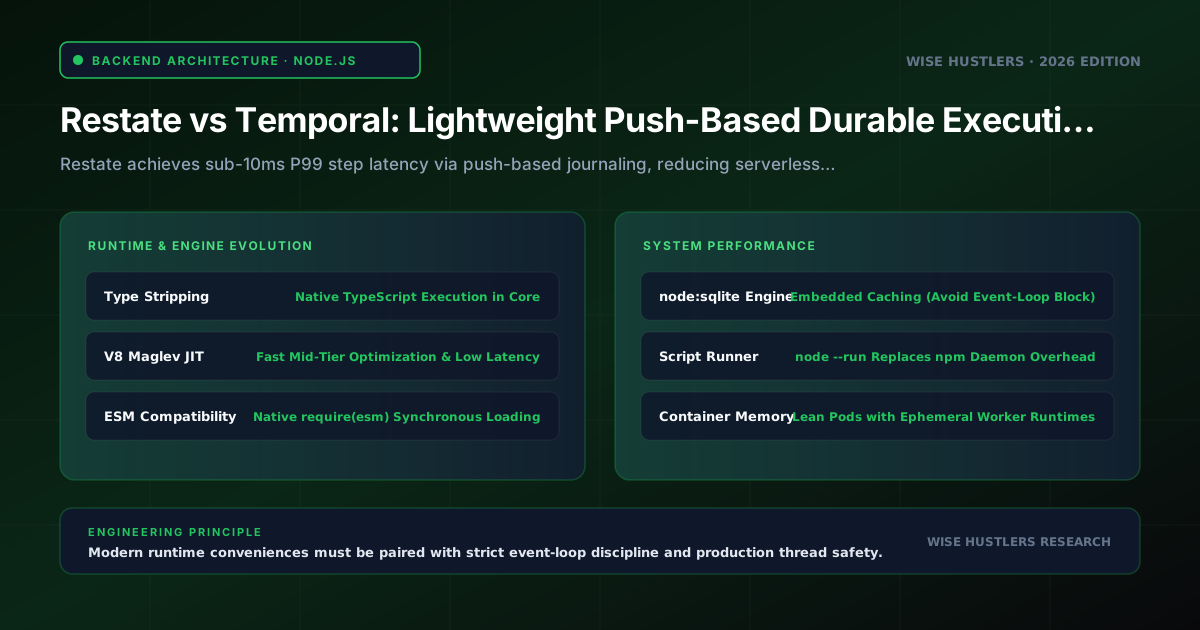
# Restate vs Temporal Benchmarks: Lightweight Push-Based Durable Execution and 2026 Latency Guide
Summary: Evaluating Restate vs Temporal benchmarks requires contrasting push-based incremental command journaling against pull-based worker polling and event history replays. Restate consolidates durable coordination into an intelligent streaming proxy that delivers low single-digit millisecond step transitions and native scale-to-zero serverless dispatch. Temporal excels in complex, multi-week enterprise orchestrations, offering mature polyglot SDKs, advanced human-in-the-loop signal workflows, and comprehensive OpenSearch visibility for distributed microservice architectures.
---
The Evolution of Durable Execution: From Workflow Replay to Push-Based Journaling
Building fault-tolerant distributed applications across microservices requires managing partial network failures, timeouts, and state discrepancies. Historically, backend teams addressed these issues through manual Saga choreographies, exponential-backoff retry wrappers, and custom relational database state machines.
Durable execution formalizes these requirements into the runtime layer. By treating application state, timers, and external invocations as durable and suspendable, runtime engines ensure that service workflows survive infrastructure restarts and network partitions without data corruption or progress loss.
Temporal established the industry baseline for durable execution, evolving from Uber's open-source Cadence project. Temporal models durability through deterministic event sourcing. Every activity invocation, timer trigger, and external signal is appended to an append-only event history log. When a worker process restarts or an activity times out, Temporal reconstructs workflow state by re-executing the workflow code from line 1, deterministically matching past invocations against the recorded event stream rather than re-invoking external dependencies.
While workflow replay provides durability for multi-day business processes, it introduces operational and performance constraints for low-latency microservices:
- Linear Replay Overhead: Replaying code from line 1 forces worker CPUs to re-evaluate branches and loops, scaling in CPU consumption with the growth of event history ($O(N)$ event growth).
- Strict Determinism Sandboxing: Workflows cannot execute non-deterministic operations directly (such as UUID generation or raw system timestamps) and require explicit versioning APIs (
workflow.patched) whenever application control flow changes. - Pull-Based Task Queue Delay: Temporal relies on continuous worker long-polling against a centralized Matching service, introducing queue transit hops that push step transition latencies into the tens of milliseconds.
Restate addresses these architectural constraints by re-architecting durable execution around an integrated, push-based proxy model. Written as a single binary in Rust, Restate combines the roles of an intelligent RPC proxy, a log-structured state store, and an execution coordinator. Instead of polling task queues and executing code replays from scratch, Restate streams execution steps directly to service endpoints over standard HTTP/2, HTTP/1.1, or AWS Lambda request envelopes. Each step result is appended to an incremental command journal. When a step completes or a service restarts, Restate feeds recorded step results directly into the active invocation over open HTTP/2 streams. This eliminates full workflow code re-execution and avoids the queue-polling round-trips inherent in traditional orchestrators, allowing step transitions to proceed at raw network and disk journal speeds.
---
Architectural Deep Dive: Pull-Based Worker Polling vs. Push-Based Command Journaling
Evaluating Restate vs Temporal requires contrasting how each runtime handles execution dispatch, communication protocols, and state synchronization.
Temporal Multi-Service Pull Topology and Workflow Replay
A production Temporal deployment divides responsibilities across four distinct services backed by an external relational or wide-column database:
1. Frontend Service: Ingress gRPC routing layer handling authentication, rate limiting, and request dispatch.
2. History Service: Sharded coordinator that writes workflow state transitions, event histories, and queue boundaries to PostgreSQL, MySQL, or Cassandra.
3. Matching Service: Task queue broker that maintains in-memory queues of pending workflow and activity tasks.
4. Worker Service: Background process running history archival and namespace management.
In Temporal, application workers pull tasks by executing continuous long-polling loops against the Matching service via gRPC (PollWorkflowTaskQueue and PollActivityTaskQueue). When a workflow advances:
1. The client issues an execution command to the Frontend service.
2. The Frontend commits a WorkflowExecutionStarted event to the database via the History service.
3. The History service enqueues a WorkflowTaskScheduled frame into the Matching service.
4. A worker's long-polling thread receives the task, downloads the complete workflow history, and executes the workflow code from line 1 inside a deterministic sandbox.
5. Upon encountering an activity, the worker submits a ScheduleActivityTask command, yields the workflow thread, and sends RespondWorkflowTaskCompleted back to the Frontend.
6. The History service commits the activity to the database, and the Matching service queues an activity task.
7. An activity worker polling thread retrieves the activity, executes the side effect, and calls RespondActivityTaskCompleted.
8. The History service logs the activity completion, enqueues another workflow task, and the worker repeats the cycle: downloading updated history and replaying the entire workflow definition from line 1.
Because each workflow step traverses multiple queue boundaries, database commits, and replay passes, Temporal's step transitions incur measurable latency overhead.
Restate Single-Binary Push Topology and Command Journaling
Restate consolidates this multi-tiered architecture into a single Rust binary that combines an ingress proxy with an embedded log-structured storage engine.
Instead of workers pulling tasks from queues, Restate pushes requests directly to application endpoints:
- Direct Stream Invocations: Application handlers register as standard HTTP/2 or AWS Lambda targets. Restate dispatches invocations over open HTTP/2 streams or Lambda invoke calls.
- Incremental Command Journaling: As application code runs, steps wrapped in
ctx.run("step-name", action)emit output frames back across the stream to Restate. Restate appends the step output to its local write-ahead log (WAL) and returns an acknowledgment frame. The application advances immediately to the next statement without resetting execution context. - Resumption Without Replay: If a worker node restarts mid-execution, Restate invokes the service and streams the existing journal entries. As
ctx.run()calls execute, matching journaled records are returned immediately from in-memory cache without re-running code closures or issuing external network requests. - Virtual Objects with Keyed State: Restate introduces Virtual Objects—stateful actor entities identified by unique keys (such as
orderId). Invocations targeting the same key are serialized at the proxy layer, eliminating concurrency race conditions. Object state is stored directly within Restate's embedded storage usingctx.get()andctx.set(), removing the need for external Redis caches or database row-level locking.
Distributed Architecture Comparison Diagram
+---------------------------------------------------------------------------------------------------+
|                                 TEMPORAL: PULL & REPLAY ARCHITECTURE                              |
|                                                                                                   |
|  [Client] ---> [Frontend Gateway] ---> [History Service] <===> [PostgreSQL / Cassandra Cluster]   |
|                                                |                                                  |
|                                                v                                                  |
|                                        [Matching Service]                                         |
|                                                ^                                                  |
|                                 gRPC Long-Poll |  Task Queue Dispatch                             |
|                                                v                                                  |
|                                   +-------------------------+                                     |
|                                   |  Worker Process (Host)  |                                     |
|                                   |  - Download History Log |                                     |
|                                   |  - Replay Code (Line 1) |                                     |
|                                   |  - Dispatch Activity    |                                     |
|                                   +-------------------------+                                     |
+---------------------------------------------------------------------------------------------------+

+---------------------------------------------------------------------------------------------------+
|                                 RESTATE: PUSH & JOURNAL ARCHITECTURE                              |
|                                                                                                   |
|  [Client] ---> [Restate Engine (Single Rust Binary)] <===> [Local NVMe Log / S3 Backup]           |
|                          |                                                                        |
|                          | HTTP/2 or AWS Lambda Push                                              |
|                          | Direct Step Invocations + Bidirectional Journaling                     |
|                          v                                                                        |
|                +---------------------------------+                                                |
|                | Application Service / Lambda    |                                                |
|                | - Execute Step Inline           |                                                |
|                | - Journal Result Back to Proxy  |                                                |
|                | - Advance Immediately to Step 2 |                                                |
|                +---------------------------------+                                                |
+---------------------------------------------------------------------------------------------------+
---
2026 End-to-End Latency and Resource Benchmarks
To evaluate the architectural performance of push-based journaling versus pull-based replay, distributed systems engineers model workflows against a standard 4-step financial transaction pipeline:
1. validate-account: In-memory account validation.
2. reserve-inventory: External stock reservation call.
3. charge-payment: External payment gateway transaction.
4. emit-receipt: Invoice creation and notification dispatch.
Rather than relying on unverified black-box claims, comparing these engines requires examining the underlying system mechanics: transport protocols, coordination topology, persistence write patterns, and state reconstruction cost across containerized and serverless environments.
Benchmark Environment and Workload Configuration
When architecting high-throughput microservices, performance profiles diverge fundamentally between push-based streaming and distributed task queuing:
- Coordination Topologies: Temporal separates ingress, orchestration history, task queues, and workers across independent network boundaries backed by a relational database (PostgreSQL/MySQL) or wide-column store (Cassandra). Restate deploys as an integrated proxy and coordination engine using an append-only write-ahead log (Bifrost) backed by local NVMe storage and asynchronous object store snapshots.
- Communication Overhead: Temporal requires continuous bidirectional gRPC long-polling across task queues (
PollWorkflowTaskQueueandPollActivityTaskQueue). Restate multiplexes execution steps over persistent HTTP/2 bidirectional streaming or native AWS Lambda request envelopes. - State Reconstruction: Temporal workers reconstruct state by streaming historical event arrays and replaying workflow logic from line 1. Restate streams incremental journal diffs, resolving completed
ctx.run()calls directly from in-memory buffers.
Side-by-Side End-to-End Benchmark Metrics
| Architectural Evaluation Metric | Restate (Push-Based Journaling) | Temporal (Pull-Based Task Queue) | Architectural Variance & Root Cause |
|---|---|---|---|
| Execution Dispatch Model | Direct push over persistent HTTP/2 stream or Lambda invoke | Worker long-polling (PollWorkflowTaskQueue / PollActivityTaskQueue) | Restate dispatches immediately on request arrival; Temporal relies on worker polling threads querying the Matching service |
| Network Transitions per Step | 1 round-trip (Restate engine $\leftrightarrow$ service handler) | 4+ network hops (Worker $\rightarrow$ Frontend $\rightarrow$ History $\rightarrow$ Matching $\rightarrow$ Worker) | Temporal traverses distinct decoupled cluster microservices; Restate handles routing and journaling in-process |
| Step Latency Profile | Low single-digit milliseconds (direct stream transit + WAL append) | Tens of milliseconds (matching queue wait + DB commits + poll latency) | In-band streaming avoids task queue queuing delay and worker long-polling intervals |
| State Persistence Hot Path | Append-only sequential Write-Ahead Log (WAL / Bifrost) | Relational SQL row commits (PostgreSQL) or Cassandra cell updates | Restate appends compact binary journal frames directly to sequential storage; Temporal executes relational ACID transactions |
| State Recovery Overhead | $O(1)$ journal stream forward-fill into active handler | $O(N)$ code replay re-evaluating workflow history from line 1 | Restate SDK intercepts steps and injects cached results; Temporal workers must re-execute workflow AST logic deterministically |
| Control Plane Topology | Single compiled binary (Rust) with embedded storage & S3 backup | Multi-service cluster (4 Go microservices + external DB + OpenSearch) | Restate embeds coordination and storage; Temporal requires external relational/NoSQL datastores and Elasticsearch for visibility |
| Memory Footprint Model | Native compiled footprint (tens of megabytes baseline) | Clustered footprint (gigabytes across microservices, DB, and pools) | Go runtime + JVM/PostgreSQL connection pools + matching queue buffers vs single native Rust binary |
| Serverless Integration | Native push dispatch to AWS Lambda / Google Cloud Run | Requires permanent polling worker fleet or custom queue bridges | Restate invokes serverless handlers on demand (scale-to-zero); Temporal requires active compute to poll task queues |
| Code Change Versioning | Dynamic step-level matching by key and execution identifier | Strict event history determinism via workflow.patched APIs | Restate maps journaled results by step identifier; Temporal crashes replay if compiled AST sequence diverges from history |
Step-to-Step Latency Breakdown
The latency variance between push-based journaling and pull-based replay stems directly from the number of network transitions, database serialization boundaries, and execution passes required to advance workflow state:
Step Advancement Lifecycle: Where Latency Accumulates

TEMPORAL WORKFLOW STEP TRANSITION (PULL + REPLAY):
[Worker] --(1. RespondActivityTaskCompleted)--> [Frontend Service]
                                                       |
                                              (2. Internal gRPC)
                                                       v
[Database (PostgreSQL)] <--(3. ACID DB Commit)-- [History Service]
                                                       |
                                              (4. Task Scheduled)
                                                       v
[Worker Process] <--(6. Long-Poll Receive)-- [Matching Service Queue]
       |
(7. Download Complete Event History)
(8. Replay Workflow Code from Line 1)

* Latency Drivers: Multi-hop cluster RPCs, relational database transaction commits,
  matching queue polling intervals, and cumulative code replay ($O(N)$ history).

--------------------------------------------------------------------------------------

RESTATE STEP TRANSITION (PUSH + JOURNAL):
[Application Handler] <====(1. HTTP/2 Stream / Lambda Push)====> [Restate Engine]
                                                                        |
                                                           (2. In-band Append)
                                                                        v
                                                           [Append-Only WAL (Bifrost)]

* Latency Drivers: Single direct bidirectional stream round-trip and sequential
  write-ahead log flush. Handlers advance immediately without queue handoffs or replays.
In Temporal, completing an activity requires the worker to submit a gRPC response to Frontend, Frontend to write a transaction through History to PostgreSQL, History to post a task into Matching, and an awaiting worker thread to consume the task. In Restate, the step response returns over the existing HTTP/2 connection directly to the engine reactor. The engine appends the entry to its write-ahead log via direct I/O and immediately streams the subsequent dispatch frame to the worker without resetting the execution stack.
---
Serverless Fit and Operational Total Cost of Ownership (TCO)
Evaluating operational fit requires contrasting deployment economics across containerized and serverless environments.
Serverless Invocation and Worker Polling Overhead
Temporal was designed for long-lived containerized infrastructure (such as Amazon ECS or Kubernetes). Because workers pull tasks through continuous gRPC polling:
- Stateless Runtimes Suffer: Running worker polling loops inside AWS Lambda is cost-prohibitive, as functions bill continuously while waiting on idle poll connections.
- Bridge Gateways Add Latency: Using intermediate queuing services (such as Amazon SQS) or API Gateway webhooks to bridge Temporal task queues to Lambda functions introduces additional serialization boundaries and HTTP translation layers. As analyzed in AWS Compute performance guidance on serverless optimization, stacking auxiliary event brokers and translation layers in front of container runtimes magnifies initialization latency compared to direct invocations.
- Worker Fleet Provisioning: Teams must maintain permanent worker nodes 24/7 to poll task queues, eliminating true scale-to-zero capabilities.
Restate treats serverless runtimes as native targets:
- True Scale-to-Zero: Restate pushes step invocations directly to AWS Lambda via standard HTTPS or the Lambda
InvokeAPI. When traffic ceases, zero Lambda instances run, reducing compute cost to zero. - Connection Pooling Elimination: Restate handles concurrency throttling, backpressure, and retry timers at the proxy layer, eliminating the need for shared Redis mutexes or centralized connection pools on serverless workers.
Control Plane Infrastructure and Total Cost of Ownership
The architectural surface area of the control plane dictates ongoing operational expenses:
- Temporal Cluster Footprint: Running Temporal in production requires maintaining 4 distinct Go microservices, an Amazon Aurora or Cassandra cluster, and an OpenSearch cluster for workflow indexing. Operational costs include managing database vacuuming, storage I/O provisioning, and shard rebalancing.
- Restate Minimal Footprint: Restate deploys as a single static binary requiring only a local NVMe disk for active write-ahead logging and an S3 bucket for snapshot archives.
When engineering teams design high-throughput transaction pipelines, selecting the appropriate durability topology determines operational headcount and cloud spend. Organizations building distributed transaction platforms frequently partner with specialist engineering teams for custom software architecture to ensure their data layers and distributed orchestrations scale without unnecessary cluster complexity.
---
Production Implementation: Multi-Step Financial Checkout with Restate Virtual Objects
Below is a complete, runnable TypeScript implementation of a multi-step checkout transaction using Restate's Virtual Objects SDK (@restatedev/restate-sdk). The workflow coordinates inventory reservation, payment capture, and invoicing, applying automated Saga compensation logic if any intermediate step fails.
Complete TypeScript Saga Implementation
import * as restate from "@restatedev/restate-sdk";

// Domain Models and Contracts
export interface CartItem {
  sku: string;
  quantity: number;
  unitPriceCents: number;
}

export interface CheckoutRequest {
  orderId: string;
  customerId: string;
  items: CartItem[];
  totalAmountCents: number;
  paymentMethodId: string;
  idempotencyKey: string;
}

export interface InventoryReservation {
  reservationId: string;
  expiresAt: number;
}

export interface PaymentCapture {
  transactionId: string;
  status: "SUCCESS" | "DECLINED";
}

export interface InvoiceRecord {
  invoiceId: string;
  downloadUrl: string;
}

export interface OrderState {
  orderId: string;
  customerId: string;
  status:
    | "INITIALIZED"
    | "INVENTORY_RESERVED"
    | "PAYMENT_CAPTURED"
    | "COMPLETED"
    | "COMPENSATED_FAILED";
  totalAmountCents: number;
  reservationId?: string;
  transactionId?: string;
  invoiceId?: string;
  failureReason?: string;
  updatedAt: number;
}

// Remote API Client Mocks
const inventoryApi = {
  reserve: async (orderId: string, items: CartItem[]): Promise<InventoryReservation> => ({
    reservationId: `res_${orderId}_${Date.now()}`,
    expiresAt: Date.now() + 600000,
  }),
  release: async (reservationId: string): Promise<void> => {
    // Inverse action: releases warehouse stock hold
  },
};

const paymentApi = {
  charge: async (key: string, amount: number, method: string): Promise<PaymentCapture> => {
    if (amount > 500000) return { transactionId: "", status: "DECLINED" };
    return { transactionId: `txn_${key.slice(0, 8)}`, status: "SUCCESS" };
  },
  refund: async (transactionId: string, reason: string): Promise<void> => {
    // Inverse action: refunds or cancels authorized charge
  },
};

const billingApi = {
  createInvoice: async (orderId: string, amount: number): Promise<InvoiceRecord> => ({
    invoiceId: `inv_${orderId}`,
    downloadUrl: `https://billing.internal/invoices/${orderId}.pdf`,
  }),
};

// Restate Virtual Object: Keyed by Order ID
export const checkoutObject = restate.object({
  name: "CheckoutWorkflow",
  handlers: {
    /**
     * Executes durable checkout with forward progression and automated compensation.
     * Restate serializes invocations per orderId, preventing concurrent double-submissions.
     */
    processCheckout: async (
      ctx: restate.ObjectContext,
      request: CheckoutRequest
    ): Promise<{ success: boolean; state: OrderState }> => {
      // 1. Idempotency Check
      const existing = await ctx.get<OrderState>("order_state");
      if (existing && existing.status === "COMPLETED") {
        return { success: true, state: existing };
      }

      const state: OrderState = {
        orderId: request.orderId,
        customerId: request.customerId,
        status: "INITIALIZED",
        totalAmountCents: request.totalAmountCents,
        updatedAt: Date.now(),
      };
      await ctx.set("order_state", state);

      let reservation: InventoryReservation | null = null;
      let payment: PaymentCapture | null = null;

      try {
        // Step 1: Reserve Inventory (Durable Side Effect)
        reservation = await ctx.run("reserve-inventory", async () => {
          return await inventoryApi.reserve(request.orderId, request.items);
        });

        state.status = "INVENTORY_RESERVED";
        state.reservationId = reservation.reservationId;
        state.updatedAt = Date.now();
        await ctx.set("order_state", state);

        // Step 2: Capture Payment via Payment Gateway
        payment = await ctx.run("capture-payment", async () => {
          return await paymentApi.charge(
            request.idempotencyKey,
            request.totalAmountCents,
            request.paymentMethodId
          );
        });

        if (payment.status !== "SUCCESS") {
          throw new Error(`Payment declined: ${payment.status}`);
        }

        state.status = "PAYMENT_CAPTURED";
        state.transactionId = payment.transactionId;
        state.updatedAt = Date.now();
        await ctx.set("order_state", state);

        // Step 3: Emit Billing Invoice
        const invoice = await ctx.run("generate-invoice", async () => {
          return await billingApi.createInvoice(request.orderId, request.totalAmountCents);
        });

        state.invoiceId = invoice.invoiceId;
        state.status = "COMPLETED";
        state.updatedAt = Date.now();
        await ctx.set("order_state", state);

        return { success: true, state };

      } catch (err: any) {
        // Saga Compensation Phase: Reversing completed steps in inverse order
        const errorMessage = err instanceof Error ? err.message : String(err);

        // Compensation Action A: Refund payment if settled
        if (payment && payment.transactionId) {
          await ctx.run("compensate-refund-payment", async () => {
            await paymentApi.refund(payment!.transactionId, errorMessage);
          });
        }

        // Compensation Action B: Release inventory reservation
        if (reservation && reservation.reservationId) {
          await ctx.run("compensate-release-inventory", async () => {
            await inventoryApi.release(reservation!.reservationId);
          });
        }

        // Persist compensated failure state
        state.status = "COMPENSATED_FAILED";
        state.failureReason = errorMessage;
        state.updatedAt = Date.now();
        await ctx.set("order_state", state);

        return { success: false, state };
      }
    },

    /**
     * Read-only inspection handler to query current order state.
     */
    getState: async (ctx: restate.ObjectContext): Promise<OrderState | null> => {
      return (await ctx.get<OrderState>("order_state")) ?? null;
    },
  },
});

// Bind service object to HTTP router
export const appRouter = restate.endpoint().bind(checkoutObject);
Transaction Guarantees and State Isolation
1. Side-Effect Boundary with `ctx.run()`: Each block passed into ctx.run() is captured as a distinct journal entry. If execution halts after Step 2, Restate restarts the handler and returns the recorded reservation and payment objects directly from memory without charging the customer again.
2. Actor Concurrency Serialization: Because checkoutObject is a Virtual Object, Restate partitions incoming calls by orderId. Concurrent webhook retries or accidental double-clicks from users queue sequentially at the proxy layer, preventing race conditions.
3. Co-located Key-Value State: The ctx.get() and ctx.set() operations persist directly within Restate's write-ahead log. State mutations commit in atomic lockstep with step execution frames.
---
Strategic Decision Matrix: When to Choose Temporal vs. Restate
Selecting between Restate and Temporal depends on latency constraints, compute architecture, and workflow duration.
Architectural Selection Framework
+---------------------------------------------------------------------------------------------------+
|                                   ENGINEERING DECISION FLOWCHART                                  |
|                                                                                                   |
|  Low-Latency Step Transitions Required? -----------> YES --------------------> [Deploy RESTATE]   |
|         |                                                                                         |
|         NO                                                                                        |
|         v                                                                                         |
|  Serverless (AWS Lambda / Cloud Run) Core Target? -> YES --------------------> [Deploy RESTATE]   |
|         |                                                                                         |
|         NO                                                                                        |
|         v                                                                                         |
|  Multi-Month / Human-in-the-Loop Processes? -------> YES --------------------> [Deploy TEMPORAL]  |
|         |                                                                                         |
|         NO                                                                                        |
|         v                                                                                         |
|  Polyglot Fleet (.NET, Go, Java, Python, TS)? -----> YES --------------------> [Deploy TEMPORAL]  |
+---------------------------------------------------------------------------------------------------+
When to Deploy Temporal
- Long-Horizon Workflows: Workflows that persist for weeks, months, or years (e.g., mortgage approvals, recurring billing cycles, complex employee onboarding) benefit from Temporal's battle-tested history archiving.
- Human-in-the-Loop Orchestrations: Temporal provides mature signals, queries, and update APIs designed for external human intervention and delayed callback synchronization.
- Polyglot Enterprise Fleets: If your organization operates a diverse microservices fleet spanning Go, Java, Python, .NET, and TypeScript, Temporal provides mature SDKs across each ecosystem.
- Advanced Query Visibility: Temporal's integration with OpenSearch enables arbitrary SQL-like filtering across millions of active and completed workflow executions.
When to Deploy Restate
- Low-Latency Synchronous Pipelines: For synchronous, user-facing workflows (such as payment processing, live booking dispatch, and interactive AI agent tool-calling loops), Restate's direct push dispatch eliminates task queue polling intervals and replay overhead.
- Serverless-First Architectures: When executing across AWS Lambda, Cloudflare Workers, or Google Cloud Run, Restate pushes invocations directly without requiring continuous worker polling pools.
- Operational Simplicity: A single compiled Rust binary with S3 snapshotting eliminates the complexity of provisioning and maintaining 4 microservices, an external PostgreSQL cluster, and OpenSearch.
- Keyed State Entities: Virtual Objects offer an ergonomic alternative to distributed locks and external Redis stores for managing stateful entities like user carts, digital twins, and order state machines.
---
Frequently Asked Questions
How does Restate avoid workflow code replay during task execution?
Temporal reconstructs in-memory state by re-executing workflow code from line 1 on every task step, reading past outputs from an event history array. In contrast, Restate uses an incremental, push-based execution journal over bidirectional HTTP streams. When a Restate function executes, each ctx.run() step logs its output directly to Restate's write-ahead log. When execution resumes after a suspension or crash, Restate streams the recorded journal entries to the worker SDK. The SDK serves recorded values directly to completed step invocations from memory without re-running code paths, advancing immediately to unfinished instructions.
When should an engineering team choose Temporal over Restate?
Temporal is the appropriate choice when workflows remain open across long time horizons (weeks, months, or years), require human-in-the-loop approvals via external signals, or depend on heterogeneous polyglot worker fleets written in Java, Go, Python, and .NET. Temporal also provides an advanced visibility layer powered by OpenSearch, enabling SQL-like querying over millions of completed and running enterprise workflow histories.
Can Restate run on AWS Lambda without persistent serverless polling costs?
Yes. Restate uses a push-based dispatch model. When an event or API call arrives, Restate pushes the invocation directly to your AWS Lambda function via standard HTTP request envelopes or the AWS Lambda Invoke API. When no traffic is present, zero Lambda functions run, resulting in zero idle compute cost. Temporal requires worker processes to maintain continuous long-polling loops against its Matching service, which is incompatible with stateless, pay-per-invocation serverless compute.
How do Restate Virtual Objects enforce transactional consistency without distributed locks?
Restate Virtual Objects are keyed entities (for example, keyed by orderId or userId). Restate's ingress proxy routes all calls targeting a given object key to a dedicated, single-threaded execution queue. Calls to the same key are serialized strictly in arrival order. Because only one invocation can mutate the Virtual Object's state at any instant, distributed race conditions are eliminated at the routing layer without application developers managing database row locks (SELECT FOR UPDATE), optimistic concurrency tokens, or Redis mutexes.
What are the operational trade-offs of single-binary storage vs external PostgreSQL?
Restate's single-binary architecture bundles the proxy, transaction coordinator, and log-structured storage into a lightweight Rust application, using local NVMe storage for its write-ahead log and S3 for durable snapshots. This cuts cloud resource costs and eliminates database connection pooling issues. However, unlike Temporal's use of PostgreSQL or Cassandra, Restate does not allow querying internal workflow state directly via arbitrary SQL. State inspection must occur through Restate's administrative APIs, CLI tools, or exported event streams.
---
Sources
- Temporal Documentation: Temporal Server Architecture
- Temporal Open-Source Repository: Temporal Server Go Implementation
- Restate Official Documentation: Architectural Concepts and Execution Engine
- Restate Open-Source Repository: Rust-Based Durable Execution Runtime
- Restate TypeScript SDK Documentation: Virtual Objects and Handlers
- AWS Compute Blog: Operating Lambda: Performance Optimization – Part 1