
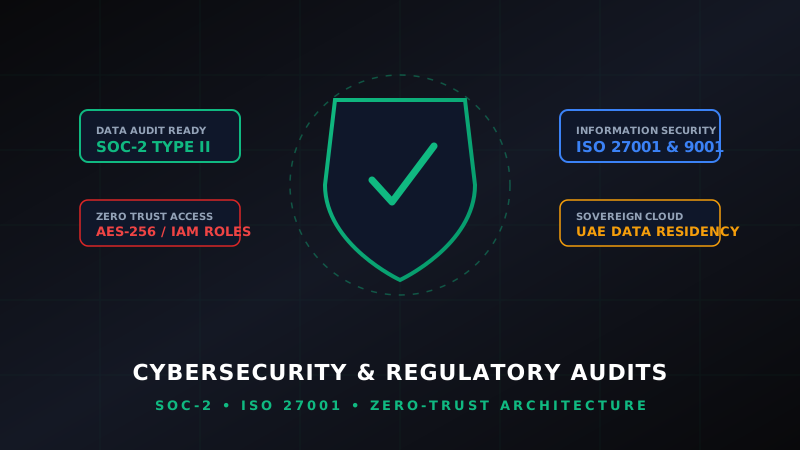
Security bolted on before a launch deadline is theater. Real application security is a set of decisions made in the architecture, the data model, and the code review checklist — not a scan run once before shipping.
Shift Security Left
The cheapest place to fix a vulnerability is in the design review, before a line of code exists; the most expensive is in production after a breach. Threat modeling a feature for a few minutes before building it — who could misuse this, what happens if this input is malicious, what does this endpoint expose to an unauthenticated user — catches entire vulnerability classes before they're written.
Broken Access Control (OWASP #1)
This has topped the OWASP list for good reason: it's the easiest mistake to make and the most damaging. The fix is structural, not a patch — every request handler must check both authentication (who is this) and authorization (are they allowed to touch this specific resource) at the data access layer, not just in a UI guard. A classic failure is an API that checks the user is logged in but not that the resource ID in the URL belongs to them — always scope queries to the authenticated user or tenant, never trust an ID from the client alone.
Cryptographic Failures
Passwords hashed with a slow, salted algorithm (bcrypt/argon2, never plain SHA-256), TLS enforced everywhere including internal service-to-service traffic, and secrets kept out of source control in a proper secrets manager — these are non-negotiable baseline, not advanced hardening. Encrypting sensitive fields at rest matters, but only if the key management around it is actually sound; encryption with the key sitting next to the ciphertext in the same database defeats the purpose.
Injection
Parameterized queries and an ORM (Prisma, in most modern stacks) eliminate SQL injection almost entirely if raw query string concatenation is banned outright and enforced in code review or linting. The same discipline applies beyond SQL — command injection from user input passed to a shell, and NoSQL injection from unsanitized query objects, follow the identical principle: never let user input become part of the query structure itself.
Insecure Design
Some vulnerabilities can't be patched because they're a property of the design, not a coding bug — a password reset flow that leaks whether an email exists, a rate limit that's missing entirely on an authentication endpoint. This is why a lightweight threat model belongs in the design phase for any feature touching authentication, payments, or user data, rather than being discovered by a pentest after launch.
Security Misconfiguration & Vulnerable Components
Default credentials, verbose error messages leaking stack traces to end users, and overly permissive CORS policies are still common in production systems years after being flagged as basic hygiene. Equally important: dependencies age, and a known CVE in a transitive package is a real attack surface — automated dependency scanning (npm audit, Dependabot, or an SBOM-based scanner) in CI catches this before it ships, not after a researcher finds it.
Wise Hustlers treats these mitigations as architectural defaults, not a pre-launch checklist — access control at the data layer, parameterized queries enforced by lint rules, and dependency scanning wired into CI from the first commit.