
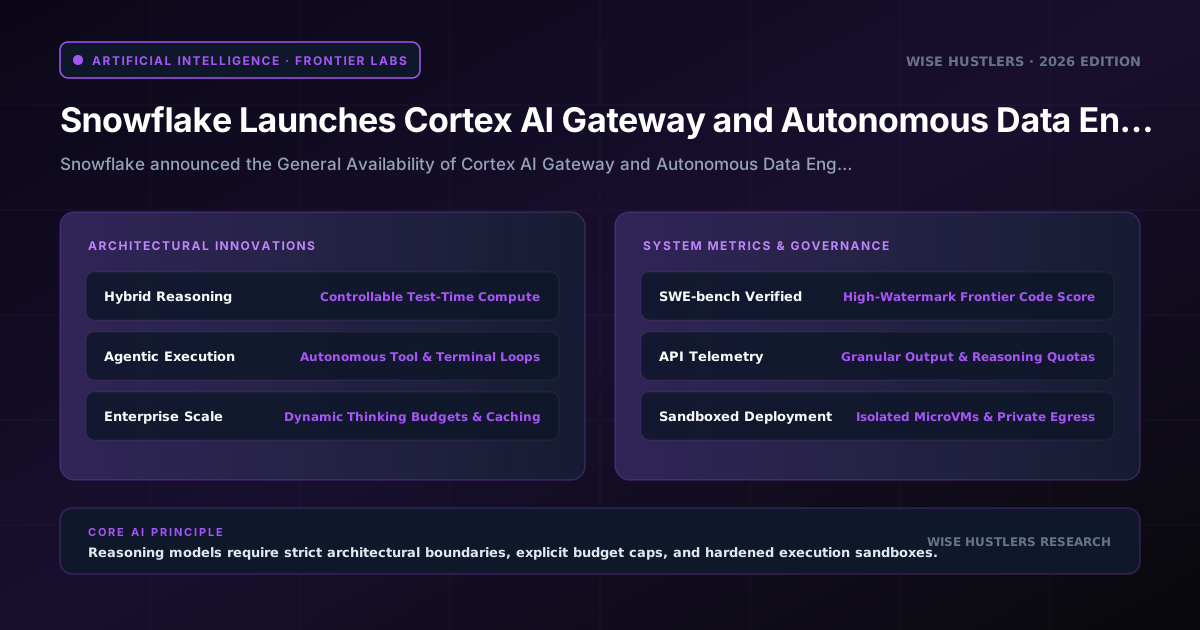
# Snowflake Launches Cortex AI Gateway and Autonomous Data Engineering to Secure Enterprise Agents
Summary: At Snowflake Expedition 2026 (November 3–6, 2026), Snowflake moved core Cortex AI Gateway capabilities—inference routing, OpenTelemetry observability, and usage telemetry—into General Availability, while advancing Model Context Protocol (MCP) governance in Public Preview and unveiling Autonomous Data Engineering with Snowflake CoCo. This shift equips enterprise AI with centralized cost controls, perimeter security, and automated code remediation within cloud data boundaries.
What Happened & Key Timeline
For two years, enterprise engineering teams have wrestled with the "agentic gap"—the divide separating experimental AI prototypes from secure production automation. While developer frameworks made it trivial for LLMs to invoke tools and generate code, technology leaders faced persistent operational blockers: runaway token expenses, opaque execution traces, prompt injection vulnerabilities, and autonomous scripts executing unvetted mutations on production data.
Snowflake addressed these systemic challenges at its Expedition 2026 conference, transforming its AI Data Cloud into a unified engine for governed autonomous operations:
- July 2026: Snowflake previewed model proxying and perimeter defenses around Black Hat, prioritizing safeguards against prompt injection and data exfiltration.
- September 15, 2026: Developer documentation introduced initial Cortex AI Gateway specifications, standardizing ingress for OpenAI and Anthropic SDK calls within customer accounts.
- October 2026: Model Context Protocol (MCP) tool governance entered Public Preview, establishing standardized schema verification and RBAC enforcement for agent tool invocation.
- November 3–6, 2026 (Snowflake Expedition): Snowflake officially transitioned core Cortex AI Gateway capabilities—including unified inference routing, OpenTelemetry tracing, and usage telemetry—into General Availability (GA). Concurrently, Snowflake unveiled Autonomous Data Engineering powered by Snowflake CoCo (CoCo Cloud Agents and Automations) in preview, supported by the Horizon Context Business Ontology in Private Preview.
The launch establishes a dual architecture: Cortex AI Gateway acts as the control plane for governance, security, and telemetry, while Snowflake CoCo provides an autonomous execution harness that monitors and repairs enterprise data pipelines.
Technical & Architectural Impact
The convergence of Cortex AI Gateway and Autonomous Data Engineering introduces four major architectural upgrades for enterprise stacks:
1. Centralized Ingress and Model Context Protocol (MCP) Brokering
Enterprise applications interacting with LLMs frequently suffer from API key sprawl. Microservices independently manage credentials and tool access, leaving security teams unable to enforce perimeter policies.
Cortex AI Gateway eliminates this fragmentation by provisioning a single account-level gateway object (SNOWFLAKE). All inference requests route through this ingress. In Public Preview, the gateway natively brokers tool execution over the Model Context Protocol (MCP), validating Role-Based Access Control (RBAC) privileges before an agent touches external business tools or tables. Privileges are strictly partitioned: a service role with USAGE triggers inference, while compliance auditors holding MONITOR privileges inspect trace payloads without execution rights.
-- Provision a governed Cortex AI Gateway object for enterprise agent workloads
CREATE OR REPLACE AI GATEWAY enterprise_agent_gateway
  COMMENT = 'Governed ingress, MCP tool brokering, and telemetry for enterprise agents';

-- Bind dynamic routing rules to prioritize small language models for routine triage
ALTER AI GATEWAY enterprise_agent_gateway SET
  DEFAULT_MODEL = 'mistral-large2'
  FALLBACK_MODEL = 'llama3.3-70b'
  MAX_DAILY_TOKEN_BUDGET = 5000000;

-- Enforce strict role-based execution and audit privileges
GRANT USAGE ON AI GATEWAY enterprise_agent_gateway TO ROLE agent_service_runner;
GRANT MONITOR ON AI GATEWAY enterprise_agent_gateway TO ROLE compliance_auditor;
2. Native OpenTelemetry Observability and Cost Guardrails
Debugging autonomous agent loops previously required instrumenting proprietary tracing frameworks. Cortex AI Gateway natively captures every execution step as standardized OpenTelemetry spans directly inside Snowflake.
Every model invocation, tool call, token count (distinguishing between cached and uncached prompts), latency metric, and error is streamed into AGENT_TRACE_TABLE. Platform engineers can query agent behavior via standard SQL, rapidly identifying recursive reasoning loops and payload errors. Simultaneously, the gateway tracks consumption across teams via AI_GATEWAY_USAGE_HISTORY. Teams can enforce hard token budgets and dynamic routing rules, diverting non-critical tasks from high-cost reasoning models to efficient small language models (SLMs).
-- Query agent execution spans, latency, and token consumption directly via SQL
SELECT
    trace_id,
    session_id,
    model_name,
    prompt_tokens,
    completion_tokens,
    cached_prompt_tokens,
    execution_time_ms,
    status,
    error_message
FROM SNOWFLAKE.TELEMETRY.AGENT_TRACE_TABLE
WHERE start_time >= DATEADD('hour', -24, CURRENT_TIMESTAMP())
  AND (status = 'ERROR' OR execution_time_ms > 4000)
ORDER BY start_time DESC
LIMIT 50;
3. Self-Healing Pipelines via Snowflake CoCo
Autonomous Data Engineering represents a fundamental leap in data reliability. Traditional data pipelines are fragile; an unexpected upstream schema change or malformed payload routinely crashes nocturnal ETL jobs, triggering pager alerts at 2:00 AM.
Snowflake CoCo shifts incident response from human triage to automated remediation. Operating as background cloud agents in preview, CoCo continuously monitors pipeline executions. When an orchestration job fails, CoCo Cloud Agents parse abstract syntax trees (ASTs), analyze query logs, and evaluate table lineage. Rather than applying unverified mutations to live warehouses, CoCo isolates the root cause, formulates an automated fix, executes tests in a sandbox, and generates a structured pull request for human review.
4. Semantic Grounding Through Horizon Business Ontology
Autonomous agents frequently hallucinate when interpreting domain metrics. One agent might compute "Monthly Recurring Revenue" (MRR) by excluding churn, while another includes trial discounts. Snowflake neutralizes this discrepancy via the Horizon Context Business Ontology (currently in Private Preview). By locking mathematical definitions within the metadata layer, multi-agent workflows evaluate metrics against a unified source of truth.
Architectural Comparison: Cortex AI Gateway vs. Traditional Ingress
| Architectural Dimension | Traditional API Gateway (e.g., Kong, AWS API GW) | Direct External LLM API Calls | Snowflake Cortex AI Gateway |
|---|---|---|---|
| Primary Ingress Unit | REST / GraphQL endpoints | Dispersed SDK endpoints | Governed Account Object (SNOWFLAKE) |
| Agent Tool Protocol | Generic webhook routing | Custom, unstandardized client glue | Native Model Context Protocol (MCP) Brokering (Public Preview) |
| Execution Observability | HTTP status codes & access logs | Proprietary tracing vendors (LangSmith, Arize) | Native OpenTelemetry spans in SQL (AGENT_TRACE_TABLE) |
| Security & Governance | API key headers & basic IP filters | Fragmented API keys per developer/service | Unified Snowflake RBAC, Horizon data masking & audit logs |
| Cost & FinOps Control | Request rate limits (RPS) | Reactive post-billing invoices | Token-level quotas, cache attribution & dynamic SLM routing |
| Data Perimeter | Payloads transit external proxies | Prompts cross public internet boundaries | Data boundary containment within enterprise cloud |
What This Means for Engineering Teams & Enterprises
This architectural evolution fundamentally reshapes operational workflows for engineers, data architects, and technology leaders:
Eradicating Maintenance Toil
Data engineering teams routinely allocate substantial sprint cycles to triaging failed dbt runs, broken Airflow DAGs, and unannounced upstream schema drift. Autonomous Data Engineering automates root-cause discovery and code remediation for these recurring operational bottlenecks. Engineers transition from reactive maintenance plumbers to system supervisors who define invariant guardrails, audit agent-generated pull requests, and build core data products.
FinOps Enforces an Agentic Circuit Breaker
Uncontrolled autonomous agents represent significant financial exposure; an infinite reasoning loop can consume thousands of dollars in API credits within hours. With Cortex AI Gateway, enterprise FinOps teams gain enforceable policy boundaries. Setting per-user and per-service consumption caps ensures enterprises can democratize internal agent development without risking unforecasted billing spikes.
Accelerating Production Agent Implementations
Moving from prototype notebooks to resilient production agents requires careful systems integration. Designing MCP tool brokers, semantic business models, and distributed agent telemetry demands specialized engineering rigor. Organizations aiming to accelerate this journey frequently engage expert partners; collaborating with Wise Hustlers custom engineering services helps enterprise teams design robust AI architectures, implement governed gateway routing, and deploy autonomous workflows tailored to specific business requirements.
Falsifiability: Verifying Architectural Success
Engineering leaders can validate this deployment using three falsifiable operational benchmarks:
1. Pipeline Mean Time to Remediation (MTTR): Engineering teams should observe measurable reductions in pipeline downtime, with automated pull requests successfully diagnosing and proposing verified code fixes for routine upstream schema changes and broken transformation logic before pager alerts trigger.
2. Shadow Inference Eradication: Trace tables should capture all internal enterprise AI model traffic across authorized service accounts, confirming that zero unsanctioned API calls bypass corporate security perimeters.
3. Spend Variance Predictability: Token expenditures across internal agent fleets should closely align with allocated FinOps budgets by enforcing dynamic model routing rules and hard consumption caps, eliminating unforecasted billing spikes.
Frequently Asked Questions
How does Cortex AI Gateway differ from traditional API gateways like Kong or AWS API Gateway?
Traditional API gateways handle HTTP routing, rate-limiting, and authentication for REST or GraphQL endpoints. Cortex AI Gateway is purpose-built for AI model semantics: it brokers Model Context Protocol (MCP) tool exchanges, dynamically routes prompts based on token context and model capability, streams OpenTelemetry execution traces into SQL-queryable tables (AGENT_TRACE_TABLE), and enforces token-level cost attribution per application.
Which Cortex AI Gateway and Autonomous Data Engineering capabilities are currently in General Availability?
Core inference routing, OpenTelemetry-compliant execution tracing via AGENT_TRACE_TABLE, and centralized token cost tracking via AI_GATEWAY_USAGE_HISTORY reached General Availability (GA) in November 2026. Complementary capabilities remain staged across preview tiers: Model Context Protocol (MCP) tool governance is in Public Preview, while Snowflake CoCo Cloud Agents and the Horizon Context Business Ontology are accessible via preview programs.
Can Snowflake CoCo push code changes directly to production databases?
No. Snowflake CoCo maintains a strict human-in-the-loop governance model. While CoCo Cloud Agents autonomously detect pipeline failures, diagnose root causes, and validate fixes in sandbox environments, the output is always a pull request containing diffs, test logs, and lineage impact. Production deployments remain subject to standard CI/CD approvals and code reviews.
Does Cortex AI Gateway restrict engineering teams to Snowflake-hosted models?
No. Cortex AI Gateway offers model-agnostic routing. While it natively supports Snowflake Cortex models, it accepts standard OpenAI and Anthropic SDK API calls, routing requests securely to external frontier models, proprietary fine-tuned endpoints, or self-hosted open-weights models while maintaining unified telemetry and access control.
Sources
- Snowflake Documentation: Cortex AI Gateway Overview
- Snowflake Engineering Blog: Expedition 2026 Announcements
- SiliconANGLE: Enterprise AI and Agent Governance at Snowflake Expedition
- Anthropic: Model Context Protocol (MCP) Open Specification
- OpenTelemetry: Standardized Tracing for Generative AI and Autonomous Agents