
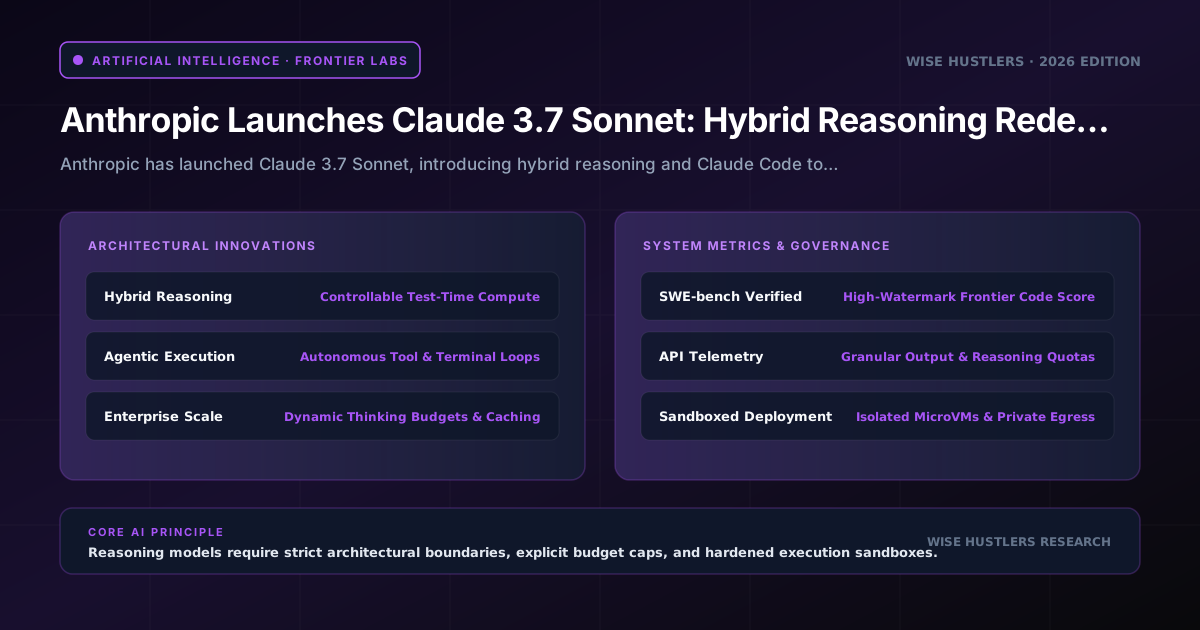
<h1>Anthropic Launches Claude 3.7 Sonnet: Hybrid Reasoning Redefines Enterprise AI</h1>
Summary: Anthropic has officially launched Claude 3.7 Sonnet, the industry's first hybrid reasoning foundation model, alongside Claude Code, an agentic command-line tool. By unifying instantaneous inference with developer-controlled extended thinking in a single parameter distribution, the model eliminates the architectural trade-off between reactive responses and multi-step reasoning. Delivering state-of-the-art software engineering benchmark performance, Claude 3.7 Sonnet establishes a new architectural standard for enterprise software automation, complex codebase refactoring, and deterministic agentic execution.
What Happened & Key Timeline
On February 24, 2025, Anthropic announced the general availability of Claude 3.7 Sonnet, marking a pivotal moment in enterprise AI engineering. Available across the Claude web interface, the Anthropic API, Amazon Bedrock, and Google Cloud Vertex AI, the model represents Anthropic's most capable foundation system to date. Crucially, it departs from industry convention by refusing to treat fast conversational LLMs and slow chain-of-thought reasoning models as distinct, isolated systems.
The rollout follows an intense escalation across frontier AI laboratories throughout late 2024 and early 2025. Following Anthropic's release of Claude 3.5 Sonnet in mid-2024—which became an industry staple for code synthesis—rival labs introduced dedicated post-training reasoning pipelines, notably OpenAI's o1 and o3-mini series and DeepSeek's open-weights R1. However, these specialized reasoning architectures forced engineering teams into an operational compromise: tolerate multi-second latency overheads for routine tasks, or maintain fragile routing heuristics across two distinct model families.
Anthropic's release timeline addressed this systemic friction directly:
- Mid-2024: Claude 3.5 Sonnet sets high industry benchmarks in code generation and tool utilization but relies strictly on immediate single-pass autoregressive decoding.
- Late 2024 - Early 2025: Dedicated reinforcement-learning reasoning models (OpenAI o1, DeepSeek-R1) demonstrate impressive logic synthesis but introduce rigid latency penalties and complex multi-model routing requirements.
- February 24, 2025: Anthropic launches Claude 3.7 Sonnet with native hybrid reasoning, alongside the research preview of Claude Code, a dedicated agentic command-line interface.
Technical & Architectural Impact
The core technical breakthrough of Claude 3.7 Sonnet is its unified hybrid architecture. Rather than routing queries upstream to separate models, Claude 3.7 Sonnet dynamically switches cognitive modes within a single parameter distribution.
Dynamic Thinking Budget and Token Telemetry
For engineering teams invoking the Anthropic Messages API, the hybrid model introduces a first-class configuration object: thinking. Developers can explicitly dictate whether the model executes zero-latency standard generation or allocates a bounded token budget for internal reasoning before producing user-visible text:
{
  "model": "claude-3-7-sonnet-20250219",
  "max_tokens": 8192,
  "thinking": {
    "type": "enabled",
    "budget_tokens": 4096
  },
  "messages": [{"role": "user", "content": "Refactor our distributed consensus state machine."}]
}
The budget_tokens parameter accepts values ranging from 1,024 tokens up to 128,000 tokens. When enabled, Claude generates an internal, auditable chain-of-thought block. Crucially, unlike black box reasoning systems, this stream provides granular visibility into intermediate architectural planning, algorithmic hypotheses, and validation steps while preserving API predictability.
Verified Benchmark Analysis & Evaluation Methodology
Claude 3.7 Sonnet's dual-mode translates into strong empirical performance across production-grade engineering challenges, though interpreting these results requires careful attention to evaluation methodology:
1. SWE-bench Verified: Evaluating automated issue resolution in real-world GitHub repositories, Claude 3.7 Sonnet scored 62.3% in standard extended thinking mode (single-pass reasoning). When augmented with Anthropic's high-compute test-time scaffolding—incorporating parallel candidate sampling, rejection filtering, and automated ranking—Anthropic reported a record resolution rate of 70.3%. By comparison, in DeepSeek's technical report (DeepSeek-R1: Incentivizing Reasoning Capability in LLMs via Reinforcement Learning, Jan 2025), unscaffolded base evaluations recorded 49.2% for DeepSeek-R1 and 48.9% for OpenAI o1 (high). Systems architects must distinguish between raw base-model pass@1 capabilities and high-compute scaffolded agentic frameworks when sizing performance gains.
2. TAU-bench Agentic Reliability: In multi-turn tool integration evaluations on Sierra's TAU-bench benchmark, Anthropic's self-reported internal numbers showed Claude 3.7 Sonnet achieving 81.2% in domain-specific retail workflows and 58.4% in complex airline operations. These results indicate substantial resilience against compounding multi-turn error drift when orchestrating stateful API tool calls compared to earlier foundation models.
3. Competitive Pricing Parity: Anthropic maintained exact cost parity with the previous Sonnet iteration: $3.00 per million input tokens and $15.00 per million output tokens. Thinking tokens are metered as standard output tokens, allowing systems architects to scale cognitive compute on demand without paying a frontier premium on base model throughput.
Comparative Benchmark Overview
To provide clear architectural visibility into how Claude 3.7 Sonnet compares with frontier reasoning models under verified evaluation conditions, the table below delineates execution modes, test-time scaffolding, and benchmark attributions:
| Model & Configuration | Benchmark Mode & Scaffolding | SWE-bench Verified | TAU-bench (Retail / Airline) | Evaluation Methodology & Attribution |
|---|---|---|---|---|
| Claude 3.7 Sonnet (Scaffolded) | Extended Thinking + High-Compute Scaffolding | 70.3% | — | Anthropic self-reported; parallel candidate generation, rejection filtering, and ranking |
| Claude 3.7 Sonnet (Standard Extended) | Extended Thinking (Single-Pass / Base Agent) | 62.3% | 81.2% / 58.4% | Anthropic self-reported; standard extended thinking; TAU-bench by Sierra |
| Claude 3.5 Sonnet (Base) | Standard Generation (Single-Pass) | 49.0% | 69.2% / 36.0% | Anthropic self-reported baseline |
| DeepSeek-R1 (Base) | Native Chain-of-Thought (pass@1) | 49.2% | — | DeepSeek Technical Report (Jan 2025); unscaffolded base model evaluation |
| OpenAI o1 (Base) | Native Chain-of-Thought (pass@1, High Compute) | 48.9% | — | Evaluated in DeepSeek Technical Report (Jan 2025); unscaffolded base model evaluation |
What This Means for Engineering Teams & Enterprises
Hybrid reasoning fundamentally alters enterprise software development lifecycles, migrating AI from passive inline code completion to autonomous terminal execution.
The Shift to Agentic Terminal Workflows
The debut of Claude Code signals where enterprise tooling is moving. Claude Code runs natively within developer terminal environments—distributed via standalone platform binaries and npm—with direct permissions to inspect git branches, grep codebases, invoke unit tests, resolve compilation errors, and submit structured pull requests. Instead of copying snippets between browser windows and IDE tabs, developers assign multi-file migration tasks to the agent, which plans, executes, verifies, and auto-corrects code iteratively.
Architectural Governance and Falsifiability Criteria
For engineering leadership, adopting Claude 3.7 Sonnet requires disciplined architectural governance. While extended reasoning delivers unprecedented problem-solving density, it introduces runtime trade-offs that must be monitored through measurable operational gates:
- Latency SLA Drift: Extended thinking consumes non-trivial wall-clock time. In synchronous user-facing API routes, unconstrained thinking budgets will breach strict 2-second p99 latency SLAs. Teams should establish architectural guardrails: run standard mode for user interactions, and restrict high-budget reasoning (
budget_tokens > 4096) to asynchronous batch jobs, CI/CD pipelines, and offline worker queues. - Token Budget Governance: Because internal reasoning tokens bill at output rates ($15/MTok), unbounded agentic loops running automated repairs can silently inflate monthly API expenditures. Monitored token caps and hard timeout policies must be enforced at the gateway layer.
- Falsifiability and Validation Criteria: How do engineering teams prove that hybrid reasoning delivers net-positive ROI rather than costly churn? Implement strict empirical metrics:
- PR Merge Acceptance Target: Engineering teams can establish an internal operational threshold—for example, targeting an 80% to 85% merge acceptance rate for routine automated pull requests without requiring substantial manual refactoring—to validate agent efficiency against baseline developer time.
- Test Coverage Delta: Code synthesized via extended thinking must include corresponding deterministic unit tests that execute in isolated staging containers with a 100% pass rate.
- Defect Escape Frequency: Track whether agent-generated diffs introduce regression escapes to production. If defect escapes exceed baseline thresholds, reduce the autonomy boundary of the toolchain.
Navigating these complex integration patterns, state persistence requirements, and autonomous guardrails requires seasoned systems architecture. For organizations modernizing legacy monorepos or constructing fault-tolerant multi-agent pipelines, partnering with Wise Hustlers custom engineering services provides the specialized architectural oversight needed to deploy production-grade enterprise AI solutions reliably.
Frequently Asked Questions
How does Claude 3.7 Sonnet's hybrid reasoning differ from OpenAI's o1 and o3-mini models?
OpenAI separates its offerings into distinct models: standard latency-optimized models (GPT-4o) and dedicated, mandatory reasoning models (o1, o3-mini). Claude 3.7 Sonnet unifies both capabilities into a single model architecture. Developers can invoke either instantaneous responses or fine-grained extended thinking by simply toggling the thinking parameter and defining a precise token budget in API requests, eliminating multi-model routing overhead.
How should engineering teams configure the thinking token budget in automated CI/CD pipelines?
In CI/CD environments where latency is secondary to deterministic correctness (such as automated linting remediation, unit test generation, and bug fixing), teams should configure higher token budgets between 8,192 and 16,384 tokens. For lightweight triage, commit summarization, and branch naming, standard mode or a minimal 1,024-token budget should be enforced to prevent unnecessary token consumption.
What security controls exist when running Claude Code in enterprise terminal environments?
Claude Code operates directly within the developer's local shell and inherits standard operating system permissions. To secure enterprise workflows, Anthropic incorporates explicit approval checkpoints before the agent executes destructive shell commands, modifies file systems outside the repository root, or pushes commits upstream. Organizations can further containerize execution environments within ephemeral Docker instances or virtual workspaces.
Why do benchmark scores differ between scaffolded agents and base model evaluations?
Base model benchmarks evaluate single-turn or single-pass performance (such as pass@1) with standard tool loops. In contrast, scaffolded benchmarks (such as the 70.3% SWE-bench Verified score reported for Claude 3.7 Sonnet) utilize test-time search strategies, parallel candidate sampling, automated test execution, and ranking filters. When comparing models, enterprise architects must account for compute budgets and scaffolding layers to avoid conflating agentic framework benefits with intrinsic model weights.
Sources
- Anthropic: Claude 3.7 Sonnet and Claude Code Announcement
- Anthropic Documentation: Building with Extended Thinking
- TechCrunch: Anthropic launches Claude 3.7 Sonnet with hybrid reasoning capabilities
- GitHub: Anthropic Official Claude Code Action Repository
- SWE-bench Verified: Software Engineering Benchmark Results
- Sierra: TAU-bench: A Benchmark for Tool-Agent-User Interaction in Real-World Domains
- DeepSeek: DeepSeek-R1: Incentivizing Reasoning Capability in LLMs via Reinforcement Learning