
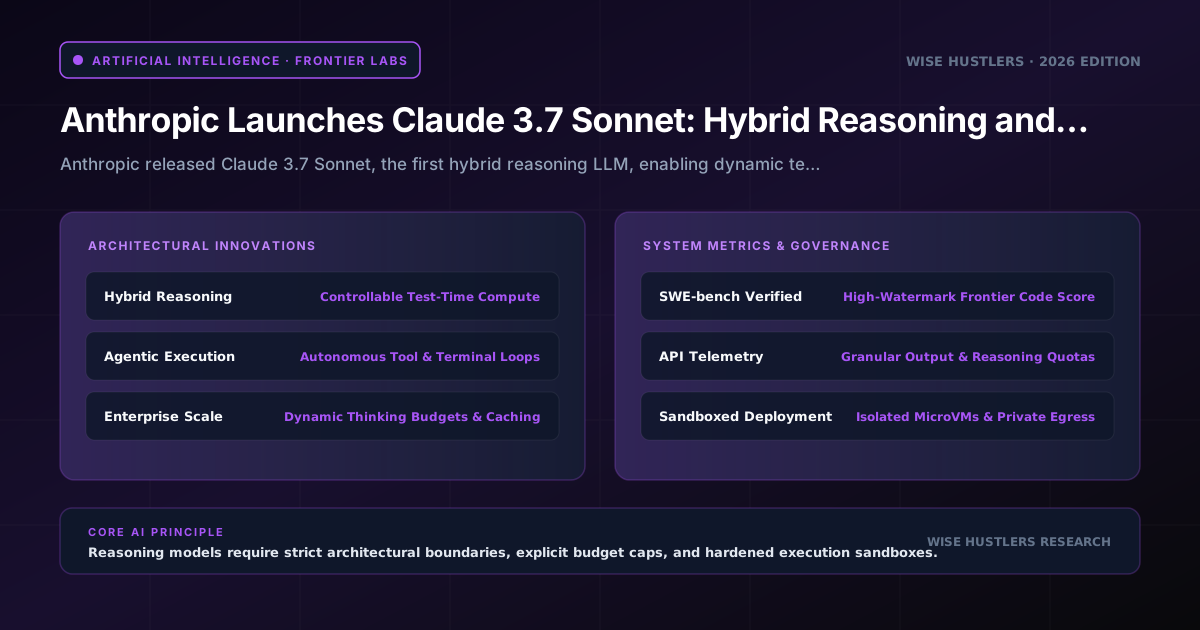
# Claude 3.7 Sonnet Arrives: Anthropic Debuts Hybrid Reasoning and Claude Code for Enterprise Engineering
Summary: Anthropic has officially unveiled Claude 3.7 Sonnet, the industry's first hybrid reasoning foundation model, pairing rapid token generation with adjustable extended-thinking compute. Alongside the launch of the Claude Code terminal agent, this release addresses the enterprise dichotomy between latency-sensitive workflows and complex architectural problem-solving. Achieving a 70.3% resolution rate on SWE-bench Verified, Claude 3.7 Sonnet establishes a unified paradigm for autonomous software development and enterprise agent orchestration.
What Happened & Key Timeline
On February 24, 2025, Anthropic officially released Claude 3.7 Sonnet (model identifier claude-3-7-sonnet-20250219), marking a pivotal structural evolution in the frontier artificial intelligence landscape. While previous foundation models forced engineering organizations to choose between low-latency generalist LLMs and high-latency, specialized chain-of-thought reasoners, Claude 3.7 Sonnet combines both capabilities into a singular, unified neural architecture.
Concurrently, Anthropic introduced Claude Code in a research preview. Distributed as an agentic command-line interface tool via npm (@anthropic-ai/claude-code), Claude Code shifts the focus of generative AI development away from passive code completions toward active, terminal-native autonomy. The tool can read codebases, execute shell commands, run test runners, edit multiple files in place, and orchestrate git commits with minimal developer friction.
Crucially for enterprise infrastructure leads, Anthropic avoided rolling out this frontier intelligence exclusively to closed consumer portals. From day one, Claude 3.7 Sonnet was deployed simultaneously across the Anthropic Messages API, Amazon Bedrock, and Google Cloud Vertex AI. The pricing structure remains pegged to that of its predecessor, Claude 3.5 Sonnet: $3.00 per million input tokens and $15.00 per million output tokens, with internal reasoning tokens billed at the standard output rate. The context window remains at 200,000 tokens. While the standard Messages API endpoint defaults to an 8,192-token output limit, developers can access an expanded maximum output ceiling of up to 128,000 tokens for extended-thinking workloads by passing the anthropic-beta: output-128k-2025-02-19 header.
Technical & Architectural Impact
The release of Claude 3.7 Sonnet introduces foundational shifts in how systems architects approach inference pipelines, token budgeting, and agentic autonomy.
1. Unified Hybrid Reasoning vs. Bifurcated Routing
Before Claude 3.7 Sonnet, production AI systems tackling complex reasoning were typically forced into bifurcated architectural patterns. Enterprise platforms maintained brittle routing layers: simple user requests were sent to fast models like Claude 3.5 Sonnet or GPT-4o, while multi-step logical operations were offloaded to models like OpenAI's o1 or DeepSeek-R1. This approach incurred considerable routing latency, duplicated prompt-caching costs, and complicated system observability.
Claude 3.7 Sonnet eliminates this routing friction by embedding both operating modes in the same foundation model. Through the Anthropic Messages API, developers control test-time compute via the thinking parameter:
curl https://api.anthropic.com/v1/messages \
  -H "content-type: application/json" \
  -H "x-api-key: $ANTHROPIC_API_KEY" \
  -H "anthropic-version: 2023-06-01" \
  -H "anthropic-beta: output-128k-2025-02-19" \
  -d '{
    "model": "claude-3-7-sonnet-20250219",
    "max_tokens": 16000,
    "thinking": {
      "type": "enabled",
      "budget_tokens": 4096
    },
    "messages": [
      {
        "role": "user",
        "content": "Analyze this distributed lock implementation for race conditions."
      }
    ]
  }'
When thinking is disabled, the model functions as a low-latency, upgraded Claude 3.5 Sonnet. When enabled, engineers specify a budget_tokens threshold (minimum 1,024 tokens). Under Anthropic's API specifications, budget_tokens must be configured strictly less than max_tokens (for example, max_tokens: 16000 with budget_tokens: 4096), reserving sufficient remaining tokens for the visible response text and preventing invalid_request_error exceptions. Unlike systems that obscure intermediate reasoning, Anthropic exposes the model's reasoning chain directly to API callers, providing engineering teams with transparent execution traces, prompt-debugging data, and architectural visibility.
| Architectural Dimension | Bifurcated Multi-Model Routing | Unified Hybrid Architecture (Claude 3.7 Sonnet) |
|---|---|---|
| Routing Overhead | High (requires semantic classifiers or intent heuristics) | None (single endpoint controls compute via budget_tokens) |
| Prompt Caching | Fragmented across separate model endpoints and caches | Shared prefix caching across standard and reasoning calls |
| Latency Profile | Variable (routing cold starts and unpredictable latency) | Configurable (engineers set explicit thinking token boundaries) |
| Operational Surface | High (multiple prompt formats, schemas, and fallback logic) | Streamlined (single client SDK, consistent tool definitions) |
2. State-of-the-Art Developer Benchmarks
The architectural validation of hybrid reasoning is reflected across industry-standard benchmarks:
- SWE-bench Verified: On this benchmark evaluating autonomous issue resolution on real-world GitHub repositories, Claude 3.7 Sonnet achieves 62.3% in standard mode. When paired with custom agentic scaffolding and test-time compute, the success rate reaches 70.3%, setting a verified benchmark for software development agents.
- [TAU-bench](https://github.com/sierra-research/tau-bench): Evaluating multi-turn tool use and conversational action execution across dynamic database environments, Anthropic reports that Claude 3.7 Sonnet with extended thinking achieved 81.2% in the retail domain (compared to OpenAI o1's reported 73.5%) and 58.4% in complex airline booking environments (compared to OpenAI o1's reported 54.2%), demonstrating improved state tracking across multi-turn agent interactions.
- MATH-500 & Formal Verification: On formal quantitative reasoning problem sets, Anthropic reports that Claude 3.7 Sonnet reaches 96.2% on MATH-500 when extended thinking is enabled, demonstrating how test-time compute directly improves multi-step logical deduction.
| Benchmark Suite | Evaluated Capability | Claude 3.7 Sonnet (Standard) | Claude 3.7 Sonnet (Extended Thinking) | Reported Baseline / Comparison |
|---|---|---|---|---|
| SWE-bench Verified | Real-world GitHub bug resolution | 62.3% | 70.3% (with scaffolding) | 48.9% (Claude 3.5 Sonnet) |
| TAU-bench (Retail) | Multi-turn agent tool execution | ~ | 81.2% | 73.5% (OpenAI o1) |
| TAU-bench (Airline) | Domain policy & state tracking | ~ | 58.4% | 54.2% (OpenAI o1) |
| MATH-500 | Formal mathematical reasoning | 78.4% | 96.2% | ~ |
What This Means for Engineering Teams & Enterprises
For VP of Engineering, Chief Technology Officers, and platform architects, the arrival of Claude 3.7 Sonnet reconfigures the enterprise AI roadmap in three strategic dimensions.
Eliminating the "Model Routing Tax"
In enterprise software engineering, maintaining separate model pipelines is a major source of hidden operational debt. Disparate models interpret prompts differently, expect different context formatting, and fail under distinct edge conditions. By adopting a unified hybrid reasoning model, platform engineering teams can replace custom semantic routers with a single configuration parameter: budget_tokens. Dynamic compute scaling can now be implemented directly at the gateway level—allocating 2,000 thinking tokens for unit test generation, 8,000 tokens for system refactoring, and zero thinking tokens for routine conversational retrieval.
The Rise of Terminal-Native Agentic Engineering
The pairing of Claude 3.7 Sonnet with Claude Code signals a major shift in developer tooling. Tab-autocomplete and chat sidebars in IDEs are shifting from primary drivers to peripheral aids. With Claude Code operating as an agentic CLI directly inside local repositories, AI agents execute the entire developer loop:
1. Grepping codebases and indexing file dependencies.
2. Formulating multi-file architectural refactoring plans.
3. Writing source files and executing test suites (npm test, pytest).
4. Parsing terminal errors, adjusting implementation code iteratively, and generating verified git commits.
This autonomy reduces cycle times for legacy migrations, technical debt remediation, and test coverage expansion. While early developer evaluations indicate qualitative gains in front-end synthesis—such as navigating component state lifecycles and complex layout assembly—production engineering teams should evaluate these agentic workflows through reproducible end-to-end integration test suites.
Governance, Cost Management, and Systems Integration
Extended thinking introduces new financial governance considerations. Because thinking tokens are billed at the full output rate ($15.00 per million tokens), unconstrained reasoning queries can rapidly inflate operational expenditures. Engineering leaders must enforce strict API-gateway budget ceilings, prompt caching, and granular access controls.
Successfully deploying these autonomous agentic workflows requires structured integration across legacy data stores, CI/CD pipelines, and secure cloud environments. Organizations looking to modernize their development stack can partner with Wise Hustlers custom engineering services to architect resilient AI agents, implement deterministic guardrails, and scale enterprise-grade hybrid reasoning solutions without sacrificing latency or security.
FAQ Section
How does Claude 3.7 Sonnet differ from OpenAI's o1 and o3 reasoning models?
Unlike dedicated chain-of-thought reasoners that enforce variable inference latency on every prompt, Claude 3.7 Sonnet is a hybrid model. Developers can dynamically toggle extended thinking on or off and set an exact budget_tokens cap per API request, allowing a single model to serve both instantaneous chat interactions and deep architectural tasks.
Are thinking tokens visible to enterprise developers in the API response?
Yes. Anthropic provides transparency by returning the model's internal thinking process as a structured thinking block within the API response. This allows enterprise engineering teams to inspect the model's intermediate logic, debug unexpected reasoning paths, and support internal architectural reviews.
Can enterprise teams deploy Claude 3.7 Sonnet within existing private cloud perimeters?
Yes. In addition to the Anthropic API, Claude 3.7 Sonnet is available natively through Amazon Bedrock and Google Cloud Vertex AI. Deploying through these managed platforms enables enterprise teams to apply existing cloud security controls, customer-managed Virtual Private Clouds (VPCs), and Identity and Access Management (IAM) policies according to standard cloud governance frameworks.
What API configuration is required to output more than 8,192 tokens?
By default, the Anthropic Messages API caps generation at 8,192 output tokens. To output up to 128,000 tokens during extended reasoning tasks, developers must include the anthropic-beta: output-128k-2025-02-19 header in their request. Additionally, the budget_tokens parameter inside the thinking block must be set strictly lower than max_tokens so that sufficient token capacity remains for the visible text response.