
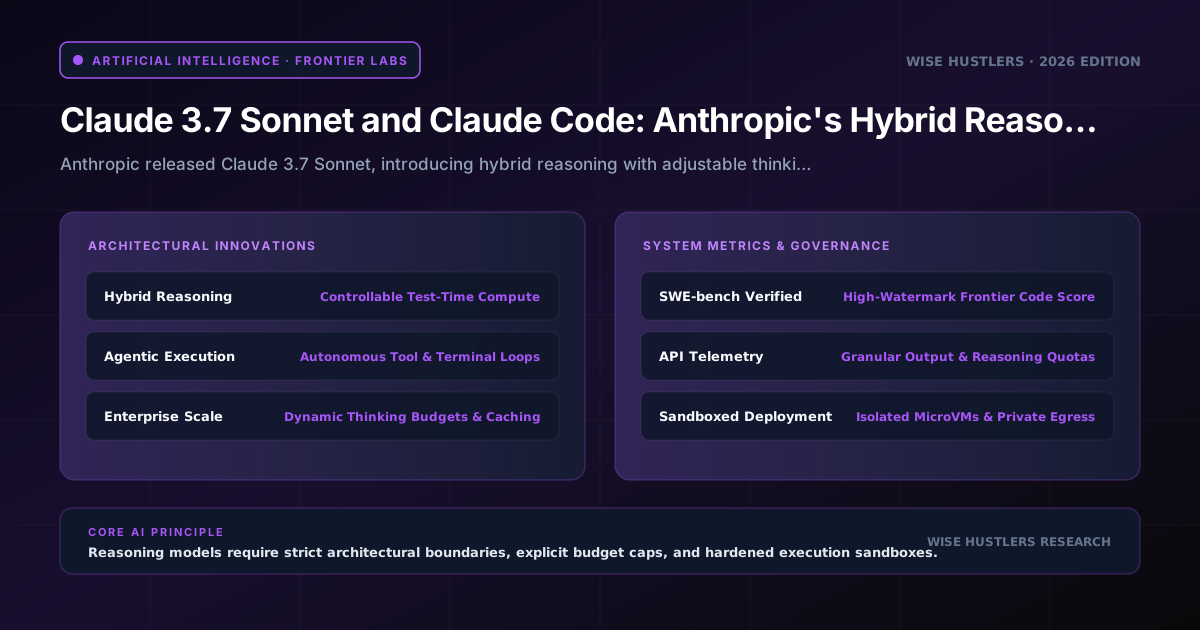
# Claude 3.7 Sonnet and Claude Code: Anthropic's Hybrid Reasoning Architecture Redefines Enterprise Engineering
Summary: Anthropic has unveiled Claude 3.7 Sonnet alongside Claude Code, introducing the industry's first production hybrid reasoning architecture. By unifying instantaneous code generation with dynamically allocated test-time compute in a single checkpoint, the model eliminates the tradeoff between sub-second latency and deep problem-solving. Scoring a record 70.3% on SWE-bench Verified with scaffolding, it sets a new standard for autonomous enterprise software engineering.
What Happened & Key Timeline
On February 24, 2025, Anthropic officially released Claude 3.7 Sonnet, marking a fundamental shift in frontier model design and developer tooling. Rather than maintaining separate checkpoints for low-latency chat versus slow, chain-of-thought reasoning, Anthropic unified both paradigms into a single engine.
Alongside the frontier model, Anthropic launched Claude Code, an agentic command-line interface (CLI) in research preview. Operating directly within developer terminals, Claude Code navigates local repositories, edits multi-file dependency trees, runs unit tests, resolves build errors, and manages Git branches autonomously.
The release rolled out immediately across primary enterprise channels:
- Anthropic API & Claude.ai: Standard mode is accessible across all Claude.ai tiers (including the Free tier), while extended thinking mode and granular token budget controls are available to paid plans (Pro, Team, Enterprise) and via the Anthropic API.
- Hyperscaler Platforms: Day-one deployment on Amazon Bedrock and Google Cloud Vertex AI, allowing enterprise teams to deploy within existing VPC boundaries and data governance frameworks.
- Model Context Protocol (MCP): Native interoperability with the open MCP standard for bi-directional access to databases, CI/CD telemetry, and internal microservice APIs.
Anthropic maintained its standard pricing tier: $3.00 per million input tokens and $15.00 per million output tokens (including generated thinking tokens). For prompt caching, cache write tokens cost $3.75 per million tokens (a 25% surcharge over base input), while cache read hits cost $0.30 per million tokens (a 90% discount), significantly reducing recurring inference overhead.
Technical & Architectural Impact
The core technical breakthrough in Claude 3.7 Sonnet is its hybrid reasoning engine. Previously, engineering architects faced a strict compromise: deploy fast models for responsive interactions or route complex prompts to reasoning-heavy models that incur 15-to-60 second latencies with unpredictable compute costs.
1. Dynamic Test-Time Compute Allocation
Claude 3.7 Sonnet resolves this friction by exposing test-time compute as an explicit API parameter: thinking.budget_tokens.
- Standard Mode (Budget = 0): Delivers immediate, high-throughput code synthesis matching or exceeding Claude 3.5 Sonnet's speed.
- Extended Thinking Mode: Allows engineers to specify an exact token ceiling (from 1,024 to 128,000 tokens). The model generates hidden chain-of-thought tokens—visible via the API for auditing—enabling it to evaluate edge cases, self-correct logic, and verify code paths before outputting final artifacts.
{
  "model": "claude-3-7-sonnet-20250219",
  "max_tokens": 4096,
  "thinking": {
    "type": "enabled",
    "budget_tokens": 2048
  },
  "messages": [
    {"role": "user", "content": "Refactor distributed lock manager to prevent deadlocks under split-brain network partitions."}
  ]
}
2. SOTA Benchmarks Across Real-World Engineering
The model establishes new performance milestones across software and reasoning benchmarks:
| Benchmark | Standard Mode | Extended Thinking / Scaffolding | Target Evaluation Domain |
|---|---|---|---|
| SWE-bench Verified | 62.3% | 70.3% | End-to-end GitHub software issue resolution |
| TAU-bench (Retail) | — | 81.2% | Multi-step agentic tool use & retail policy execution |
| TAU-bench (Airline) | — | 58.4% | Complex airline reservation & refund workflows |
| GPQA Diamond | 68.0% | 84.8% | Graduate-level STEM and scientific reasoning |
- SWE-bench Verified: Achieved 62.3% in standard mode and climbed to 70.3% using an agentic scaffolding harness, demonstrating unprecedented capability in resolving real-world GitHub issues.
- TAU-bench: Reached 81.2% in retail environments and 58.4% in airline workflows (using extended thinking with tool execution), demonstrating reliable multi-step tool orchestration.
- GPQA Diamond: Rose from 68.0% in standard mode to 84.8% with extended thinking, proving that elastic compute directly expands complex algorithmic problem-solving.
3. Claude Code: Terminal-Native Agentic Scaffolding
Claude Code moves beyond passive IDE completions. Functioning as a stateful terminal agent, it builds an in-memory dependency graph, utilizes ripgrep and AST analysis, plans multi-step diffs, executes test suites via local shells, and iteratively resolves runtime failures. Coupled with MCP servers, it links local codebases directly to issue trackers and cloud infrastructure.
What This Means for Engineering Teams & Enterprises
The arrival of hybrid reasoning shifts software development from basic code auto-completion to autonomous task execution.
Architectural Unification and Cost Governance
Instead of building complex prompt-classification layers to route queries between small and large models, platform teams can now standardize on a single endpoint. Developers adjust the budget_tokens parameter according to task requirements:
- CI/CD Flaky Test Analysis: Allocate 4,000 to 8,000 thinking tokens for deep trace diagnosis.
- Interactive Autocomplete: Set thinking tokens to zero for sub-second developer responsiveness.
- Large-Scale Refactoring: Apply maximum token ceilings for critical architectural migrations.
Building Scalable Agentic Workflows
With benchmark accuracy exceeding 70% on repository-level tasks, enterprises are moving from single-file generation to autonomous agents handling dependency updates, regression tests, and security remediation.
Implementing production-ready agentic pipelines requires specialized sandboxing, security governance, and custom context architectures. Organizations looking to accelerate their agentic transformation can partner with Wise Hustlers custom engineering services to design, integrate, and scale robust enterprise AI platforms.
Key Operational Considerations
Engineering organizations must address several key requirements during production rollout:
1. Latency Budgets: Extended thinking increases time-to-first-token. Latency-critical paths must keep thinking disabled or run asynchronously.
2. Context and Caching: Agent loops consume context rapidly; teams must configure prompt caching to prevent cost escalation.
3. Container Sandboxing: Terminal-native agents require secure containerization to prevent unintended system changes during automated test execution.
Frequently Asked Questions
How does Claude 3.7 Sonnet differ from dual-model setups like OpenAI o1 vs. GPT-4o?
Claude 3.7 Sonnet unifies quick conversational responses and deep reasoning into a single model checkpoint. Developers control thinking depth per request via the budget_tokens parameter, eliminating the overhead of maintaining distinct model routing pipelines.
What is Claude Code and how does it interface with existing repositories?
Claude Code is a research preview CLI tool operating inside developer terminals. It analyzes local codebases, edits multi-file architectures, runs test suites, and orchestrates Git workflows through natural language instructions with human verification.
How are thinking tokens billed under the Anthropic API?
Thinking tokens generated during extended reasoning are billed at standard output rates ($15.00 per million tokens). Setting explicit token budgets guarantees that inference costs remain strictly bounded per API call.
Which Claude tiers support extended thinking mode and budget controls?
Standard Claude 3.7 Sonnet responses are available across Claude.ai plans (including the Free tier). However, extended thinking mode and granular token budget controls are restricted to paid subscriptions (Claude Pro, Team, and Enterprise) and direct API access via Anthropic, AWS Bedrock, and Google Cloud Vertex AI.