
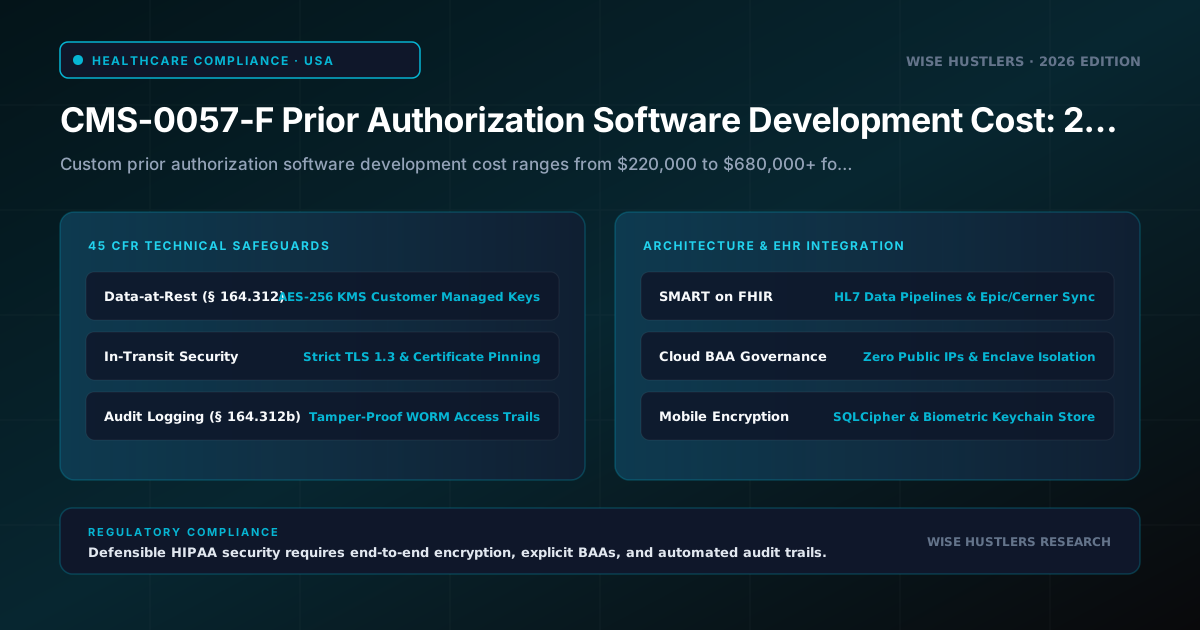
# CMS-0057-F Prior Authorization Software Development Cost: Compliance Timeline, Architecture & Enterprise Pricing Guide
Enterprise prior authorization software development cost ranges between $220,000 and $680,000+ for custom CMS-0057-F compliant builds. Based on 1,500 to 4,200 engineering hours at $120–$180/hr, capital spans architectural discovery ($35,000–$65,000), HL7 Da Vinci FHIR APIs ($95,000–$250,000), X12 278 EDI bridges ($45,000–$140,000), and claims/EHR connectors ($45,000–$225,000), requiring 6 to 14 months to deploy before CMS enforcement deadlines.
---
The Centers for Medicare & Medicaid Services (CMS) finalized the CMS-0057-F Interoperability and Prior Authorization Final Rule (89 FR 8758), establishing binding technical and operational requirements across US healthcare. Prior authorization has historically imposed substantial operational friction on the health system. According to the 2023 CAQH Index, administrative spending across healthcare transactions remains elevated, with prior authorization representing one of the costliest administrative workflows per instance ($14.01 per manual transaction versus $3.49 for an electronic transaction). The American Medical Association (AMA) 2023 Prior Authorization Physician Survey reports that physician practices complete an average of 43 prior authorizations per physician per week, with staff spending roughly 12 to 14 hours each week navigating disparate payer portals, phone calls, and faxes.
Under CMS-0057-F, manual processes must transition to automated Application Programming Interfaces (APIs). Impacted payers—including Medicare Advantage (MA) plans, State Medicaid agencies, Children's Health Insurance Program (CHIP) agencies, Medicaid managed care organizations (MCOs), and Qualified Health Plan (QHP) issuers on Federally-Facilitated Exchanges (FFEs)—must deploy standardized Fast Healthcare Interoperability Resources (FHIR) Release 4 endpoints integrated directly into Electronic Health Record (EHR) workflows.
For healthcare Chief Technology Officers (CTOs), Chief Information Officers (CIOs), and HealthTech engineering leaders, this guide delivers transparent engineering pricing benchmarks, architectural blueprints, risk frameworks, and vendor evaluation scorecards.
---
The Regulatory Catalyst: Unpacking CMS-0057-F Mandates for 2026 and 2027
To architect a compliant solution, engineering teams must recognize the phased structure of CMS-0057-F. The regulation enforces distinct operational and technical deadlines:
1. Phase 1: Operational & Adjudication Rules (Effective January 1, 2026): Payers must enforce shortened determination turnaround windows, issue granular clinical denial rationales regardless of request transmission channel, and publish annual prior authorization performance metrics on public websites.
2. Phase 2: Binding Technical API Mandates (Effective January 1, 2027): Payers must deploy, maintain, and support secure HL7 Da Vinci FHIR Release 4 APIs (Prior Authorization, Provider Access, Patient Access expansion, and Payer-to-Payer APIs) for automated clinical exchange.
| Mandated API Component | Required Standard / Implementation Guide | Compliance Deadline | Core Operational Function |
|---|---|---|---|
| Prior Authorization API | HL7 Da Vinci CRD, DTR, and PAS (STU2) | January 1, 2027 | Automates authorization discovery, clinical data gathering, and claim submission within EHRs. |
| Provider Access API | FHIR R4 US Core Profiles / PDex | January 1, 2027 | Enables in-network providers to query historical patient claims, encounters, and prior authorization records. |
| Patient Access API Expansion | FHIR R4 US Core Profiles | January 1, 2027 | Exposes pending, approved, and denied authorizations with specific clinical reasoning to patients. |
| Payer-to-Payer API | HL7 Da Vinci Payer Data Exchange (PDex) | January 1, 2027 | Transfers longitudinal clinical history and active prior authorizations when members switch plans. |
Statutory Adjudication Turnaround Deadlines (Effective January 1, 2026)
CMS-0057-F enforces strict determination windows:
- Expedited (Urgent) Requests: Payers must issue a binding decision within 72 hours of receipt.
- Standard (Non-Urgent) Requests: Payers must issue a binding decision within 7 calendar days (shortened from prior 14-day allowances for MA and Medicaid plans).
Granular Denial Reason Transparency & Public Metrics
Payers can no longer issue generic administrative denial codes. Every adverse determination must return a specific clinical rationale, exact coverage policy citations, missing clinical criteria, and formal appeal rights embedded directly into the FHIR payload or standard notification. Furthermore, payers must publish annual performance metrics (approval rates, denial rates, overturned appeals, and average turnaround times) on public websites by the statutory deadline.
---
Enterprise Pricing Matrix: Prior Authorization Software Development Cost Benchmarks
Custom engineering an enterprise CMS-0057-F compliant prior authorization engine typically requires an investment between $220,000 and $680,000+, depending on core claims infrastructure, legacy technical debt, and EHR integration depth.
Cost Estimation Methodology
The cost benchmarks presented in this guide are derived from an activity-based engineering estimation model reflecting prevailing US and blended nearshore healthcare software engineering rates ($120–$180/hour) across 1,500 to 4,200 total engineering hours. This model synthesizes data from mid-market health plan deployments, enterprise integration projects, and HL7 Da Vinci implementation specifications. The total budget variance is driven by four primary architectural components:
1. Architectural Discovery, Threat Modeling & Semantic EAV Design: 250–400 hours ($35,000–$65,000)
2. HL7 Da Vinci FHIR Endpoints (CRD, DTR, PAS): 700–1,600 hours ($95,000–$250,000)
3. Bidirectional FHIR-to-X12 278 EDI Translation Bridge: 350–900 hours ($45,000–$140,000)
4. Core Claims Adjudication & EHR Integration: 350–1,400 hours ($45,000–$225,000)
Phase-by-Phase Custom Engineering Investment
| Implementation Phase | Core Deliverables & Technical Architecture | Estimated Effort | Typical Timeline | Low-End Cost ($120/hr) | High-End Cost ($180/hr) |
|---|---|---|---|---|---|
| Phase 1: Discovery, Architecture & EAV Modeling | FHIR R4 profile gap analysis, Entity-Attribute-Value (EAV) data modeling, security threat modeling (SMART on FHIR v2, OAuth 2.0/mTLS), and payer policy rule scoping. | 250 – 400 Hours | 4 – 6 Weeks | $35,000 | $65,000 |
| Phase 2: HL7 Da Vinci FHIR Endpoints | Development of CRD (CDS Hooks service), DTR (SMART on FHIR app + CQL rule execution engine), and PAS ($submit Claim/ClaimResponse FHIR Bundle processors). | 700 – 1,600 Hours | 12 – 18 Weeks | $95,000 | $250,000 |
| Phase 3: FHIR-to-X12 278 EDI Translation Bridge | Bidirectional translation engine converting FHIR R4 Claim/ClaimResponse resources to ANSI ASC X12 278 (v5010) transactions; loop 2000E/2000F mapping, clearinghouse protocol routing, and 275 attachment handling. | 350 – 900 Hours | 8 – 12 Weeks | $45,000 | $140,000 |
| Phase 4: EHR Integration & Core Claims Connector | Bidirectional integration with Epic (App Market) and Oracle Health (Cerner), webhooks, and real-time middleware connectivity to core claims engines (TriZetto Facets, QNXT, HealthEdge). | 350 – 1,400 Hours | 8 – 14 Weeks | $45,000 | $225,000 |
| TOTAL INITIAL CUSTOM BUILD | Full End-to-End Enterprise Prior Authorization Suite | 1,650 – 4,300 Hours | 6 – 14 Months | $220,000 | $680,000+ |
Software Scope Tiers
| Scope Tier | Capital Budget | Engineering Hours | Delivery Horizon | Core Capability Set |
|---|---|---|---|---|
| Tier 1: Core Compliance Bridge | $220,000 – $340,000 | 1,500 – 2,200 Hours | 6 – 8 Months | CRD/DTR/PAS FHIR endpoints integrated with third-party EDI SaaS clearinghouse routing. Suitable for plans utilizing modern claims administration platforms with REST APIs. |
| Tier 2: Enterprise Automation Suite | $340,000 – $510,000 | 2,200 – 3,200 Hours | 8 – 11 Months | Full native FHIR stack, in-house X12 278 engine, automated CQL rules, and embedded EHR integration. Designed for mid-sized health plans seeking end-to-end automation. |
| Tier 3: Multi-Payer HealthTech Hub | $510,000 – $680,000+ | 3,200 – 4,200+ Hours | 11 – 14+ Months | Multi-tenant FHIR gateway, sub-second legacy caching, automated real-time adjudication, and custom rule authoring for complex legacy claims cores (e.g., Facets/COBOL). |
Core Engineering Cost Drivers
- Adjudication Infrastructure: Modern REST-native claims engines require significantly less integration effort than batch-oriented mainframe environments (legacy COBOL, DB2, or custom Facets installations).
- FHIR Server Foundation: Managed cloud infrastructure (Azure Health Data Services or AWS HealthLake) reduces baseline setup costs compared to orchestrating a custom HAPI FHIR cluster on Kubernetes.
- CQL Rule Execution Engine: Authoring and executing payer medical policies in Clinical Quality Language (CQL) within EHR environments represents a major informatics investment.
- Security Rigor: Implementing SMART on FHIR v2 with asymmetric client authentication (private key JWTs) and granular scopes demands specialized HealthTech security engineering.
Organizations evaluating their technical roadmap frequently partner with our custom healthcare software engineering services to architect scalable, compliant systems.
Ongoing Annual Total Cost of Ownership (TCO)
- Cloud Infrastructure & FHIR Ingestion: $18,000 – $54,000 / year (based on published HIPAA-compliant cloud hosting schedules for AWS HealthLake or Azure Health Data Services, managed databases, and API gateways).
- Third-Party Clearinghouse Fees: $0.15 – $0.45 per transaction (reflecting standard commercial EDI VAN and clearinghouse transaction fee schedules, such as Availity or Change Healthcare, when routing X12 278 EDI via external brokers).
- Da Vinci Implementation Guide Drift: $30,000 – $65,000 / year (reflecting 200–400 engineering hours annually to maintain FHIR StructureDefinitions, Clinical Quality Language rule libraries, and CMS regulatory updates).
---
Technical Architecture: HL7 Da Vinci FHIR & EDI Data Exchange Blueprint
Automating prior authorization requires a continuous, multi-protocol data exchange spanning provider EHRs, clinical decision support services, questionnaire engines, EDI translation layers, and payer claims adjudicators.
flowchart TD
    subgraph Provider_EHR["Provider Clinical Workflow (EHR: Epic / Oracle Health)"]
        direction TB
        ClinicianAction["Clinician Orders Service / Medication"]
        CDSHookTrigger["CDS Hook Triggered (order-select / order-sign)"]
        DTRAppLaunch["Launch DTR SMART on FHIR Application"]
        DataExtraction["Auto-Populate EHR Data via CQL Engine"]
        ClinicianReview["Clinician Reviews Pre-Filled Questionnaire"]
    end

    subgraph Payer_FHIR_Gateway["Payer FHIR Integration Gateway"]
        CRDService["CRD CDS Service (Evaluates Policy Rules)"]
        DTRService["DTR Questionnaire & CQL Rule Repository"]
        PASService["PAS Endpoint (Claim & Bundle Processor)"]
    end

    subgraph Translation_Adjudication["Core Adjudication & Clearinghouse Environment"]
        X12Bridge["Bidirectional FHIR-to-X12 278 Translation Bridge"]
        AdjudicationEngine["Payer UM Adjudication Engine (Facets / QNXT / Rules)"]
        DeterminationStore["Audit Logging & Metrics Store (CMS-0057-F Reporting)"]
    end

    ClinicianAction --> CDSHookTrigger
    CDSHookTrigger -->|"HTTP POST CDS Hook Request"| CRDService
    CRDService -->|"Return Cards (Auth Required? Templates?)"| CDSHookTrigger
    CDSHookTrigger --> DTRAppLaunch
    DTRAppLaunch -->|"Fetch Questionnaire & CQL"| DTRService
    DTRService --> DataExtraction
    DataExtraction --> ClinicianReview
    ClinicianReview -->|"Generate FHIR Claim $submit Bundle"| PASService
    PASService -->|"Forward Payload"| X12Bridge
    X12Bridge -->|"ANSI ASC X12 278 Request"| AdjudicationEngine
    AdjudicationEngine -->|"ANSI ASC X12 278 Response"| X12Bridge
    X12Bridge -->|"FHIR ClaimResponse Bundle"| PASService
    PASService -->|"Instant Adjudication / Status Card"| ClinicianReview
    AdjudicationEngine --> DeterminationStore
The 5-Step Automated Execution Protocol
1. Coverage Requirements Discovery (CRD): Triggered by an EHR workflow hook (order-select or order-sign). The provider EHR issues an HTTP POST to the payer's CRD endpoint. The payer rules engine evaluates coverage requirements and returns a CDS card indicating if prior authorization is required.
2. Documentation Templates and Rules (DTR): The clinician launches a SMART on FHIR application. DTR executes payer-provided Clinical Quality Language (CQL) rules against the local EHR FHIR server, automatically populating payer Questionnaire items with laboratory, medication, and diagnosis data.
3. Prior Authorization Support (PAS): The application bundles the validated QuestionnaireResponse and clinical attachments (DocumentReference/Binary) into an HL7 FHIR Claim resource and executes a $submit operation against the payer's PAS endpoint.
4. The HIPAA Compliance Bridge (FHIR-to-X12 278 EDI): While CMS requires FHIR, HIPAA regulations mandate ANSI ASC X12 278 transactions between covered entities. The translation bridge transforms inbound FHIR Claim bundles into X12 278 Request loops (2000E/2000F) and converts outbound X12 278 Responses back into compliant FHIR ClaimResponse bundles.
5. Utilization Management Adjudication: If automated clinical criteria are satisfied, the engine returns an immediate programmatic approval. If manual review is required, the request is routed to medical director worklists while initiating statutory countdown timers.
Executable Implementation: Da Vinci CRD CDS Hooks Handler
The following runnable Python script implements a production-pattern Da Vinci CRD CDS Hooks service handler. It processes an incoming order-select hook, evaluates draft clinical orders against payer prior authorization rules, and returns standard CDS cards:
import json
from typing import Any, Dict, List


def handle_crd_order_select(hook_request: Dict[str, Any]) -> Dict[str, Any]:
    """HL7 Da Vinci Coverage Requirements Discovery (CRD) CDS Hook Service Handler.

    Evaluates EHR draft orders against payer prior authorization policies
    and returns compliant CDS Hook decision cards.
    """
    hook = hook_request.get("hook")
    if hook != "order-select":
        return {"cards": []}

    context = hook_request.get("context", {})
    draft_orders = context.get("draftOrders", {})
    entries = draft_orders.get("entry", [])

    # Coverage policy lookup: Procedures requiring prior authorization
    PA_RULES = {
        "72148": {
            "policy": "PA-72148-SPINE",
            "name": "MRI Lumbar Spine without Contrast",
            "documentation_required": True,
        },
        "93306": {
            "policy": "PA-93306-ECHO",
            "name": "Transthoracic Echocardiography",
            "documentation_required": True,
        },
    }

    cards: List[Dict[str, Any]] = []

    for entry in entries:
        resource = entry.get("resource", {})
        coding_list = resource.get("code", {}).get("coding", [])
        for coding in coding_list:
            cpt_code = coding.get("code")
            if cpt_code in PA_RULES:
                rule = PA_RULES[cpt_code]
                card = {
                    "summary": f"Prior Authorization Required: CPT {cpt_code}",
                    "indicator": "warning",
                    "source": {
                        "label": "Payer UM Rules Engine (CMS-0057-F)",
                        "url": f"https://payer.example.org/coverage-policies/{rule['policy']}",
                    },
                    "detail": (
                        f"{rule['name']} requires prior authorization under policy "
                        f"{rule['policy']}. Documentation criteria must be satisfied prior to service."
                    ),
                    "links": [
                        {
                            "label": "Launch DTR Questionnaire",
                            "url": (
                                f"https://payer.example.org/smart/dtr?"
                                f"patient={context.get('patientId')}&order={resource.get('id')}"
                            ),
                            "type": "smart",
                        }
                    ],
                }
                cards.append(card)

    return {"cards": cards}


    # Synthetic test execution using simulated EHR order-select context
if __name__ == "__main__":
    synthetic_request = {
        "hook": "order-select",
        "hookInstance": "a823e4b1-8b09-4ce2-b2d2-8f198f39c122",
        "context": {
            "userId": "Practitioner/prov-4912",
            "patientId": "pat-82014",
            "draftOrders": {
                "resourceType": "Bundle",
                "entry": [
                    {
                        "resource": {
                            "resourceType": "ServiceRequest",
                            "id": "sr-lumbar-mri",
                            "status": "draft",
                            "intent": "order",
                            "code": {
                                "coding": [
                                    {
                                        "system": "http://www.ama-assn.org/go/cpt",
                                        "code": "72148",
                                        "display": "MRI Lumbar Spine without Contrast",
                                    }
                                ]
                            },
                        }
                    }
                ],
            },
        },
    }

    decision = handle_crd_order_select(synthetic_request)
    print("CRD Service Output:")
    print(json.dumps(decision, indent=2))
---
Entity-Attribute-Value (EAV) Modeling for Prior Authorization Interoperability
Building an automated prior authorization engine requires rigorous semantic normalization across disparate data models. Clinical concepts documented by providers must map programmatically and deterministically into payer coverage rules and adjudication tables.
Prior Authorization Semantic EAV Architecture
| Entity Domain | Attribute Name | Value Representation / Coding Standard | Target FHIR R4 Profile & Field | Target X12 278 Segment | ||
|---|---|---|---|---|---|---|
| Coverage Context | Member Identifier | Alphanumeric (Payer Subscriber ID) | Coverage.subscriberId | Loop 2010BA NM109 | ||
| Coverage Context | Plan Identification | Standard Payer Product Code | Coverage.class[group].value | Loop 2000C HL / REF | ||
| Service Request | Procedure Code | CPT / HCPCS Level II (e.g., 72148) | Claim.item.productOrService | Loop 2000F SV202-2 | ||
| Service Request | Diagnosis Code | ICD-10-CM (e.g., M54.50) | Claim.diagnosis.diagnosisCodeableConcept | Loop 2000F HI01-2 | ||
| Clinical Rule | Conservative Therapy Trial | Boolean + Duration Integer (Days) | QuestionnaireResponse.item.answer | Loop 2000F PWK / MSG | ||
| Clinical Rule | Diagnostic Lab Result | Numeric Value + UCUM Units | Observation.valueQuantity | Loop 2000F PWK01='CT' | ||
| Adjudication Outcome | Authorization Status | Enum: approved \ | denied \ | pended | ClaimResponse.outcome | Loop 2000F HCR01 |
| Adjudication Outcome | Denial Rationale | Textual Clinical Justification + URI | ClaimResponse.error.detail | Loop 2000F MSG01 | ||
| Adjudication Outcome | Approval Reference | Unique Payer Auth String | ClaimResponse.preAuthRef | Loop 2000F REF02 |
Structuring data with this EAV architecture allows payer rule engines to process inbound requests programmatically without hardcoded code dependencies. Inbound FHIR attributes normalize into discrete key-value tuples that feed directly into decision-table rules engines or CQL runtime evaluators.
---
Engineering Risk Mitigation: Technical Bottlenecks & CMS Safeguards
Healthcare IT projects frequently encounter architectural failures stemming from legacy latency, schema drift, and regulatory oversight.
| Engineering Vulnerability | Operational & Regulatory Impact | Architectural Mitigation Strategy |
|---|---|---|
| 1. US Core Semantic Drift | Payload rejection by EHR; broken questionnaire logic and validation failures. | Automated StructureDefinition validation pipelines, runtime JSON schema parsers, and terminology normalization microservices. |
| 2. Claims Latency Timeouts | CDS Hook connection drops; clinician workflow disruption in Epic/Cerner. | Two-tier asynchronous architecture with distributed Redis caching and Kafka-driven worker pools. |
| 3. CMS Non-Compliance CMPs | Civil penalties and intermediate administrative sanctions (enrollment/marketing freezes). | Real-time statutory SLA countdown monitors, automated escalation queues, and immutable audit logging. |
Technical Risk Solutions
1. US Core Profiles Validation: Implement runtime JSON Schema and StructureDefinition validation parsers at the ingress gateway. Normalization middleware dynamically converts divergent vendor extensions (US Core 3.1.1 vs. 6.1.0) into canonical Da Vinci profiles.
2. Overcoming Legacy Latency: Under HL7 CDS Hooks specifications and EHR vendor integration guidelines (including Epic and Oracle Health developer standards), client timeout thresholds are recommended or configured between 1,000 and 2,000 milliseconds to avoid blocking physician workflows during order placement. In contrast, complex policy queries against synchronous, legacy batch adjudication mainframes (e.g., older Facets or custom COBOL systems) frequently take 5 to 15 seconds to evaluate deep rule sets if unoptimized. To bridge this latency gap, engineering teams deploy a distributed in-memory cache (e.g., Redis) at the API gateway to return coverage cards in under 250 milliseconds, dispatching long-running claims adjudications asynchronously via Apache Kafka or Amazon SQS.
3. CMS Penalty Avoidance: Under 42 CFR § 422.752 and § 422.760 (and 42 CFR § 438.700 / § 438.704 for Medicaid managed care), CMS maintains statutory authority to levy Civil Money Penalties (CMPs) for adverse determinations and regulatory non-compliance. Under 42 CFR § 422.760(b)(1), standard CMPs can reach up to statutory maximums ($25,000 per determination or per adversely affected enrollee, adjusted annually for inflation under 45 CFR Part 102). In addition to direct monetary penalties, CMS may impose intermediate sanctions under 42 CFR § 422.750, including enrollment freezes, marketing suspensions, and mandatory Corrective Action Plans (CAPs). Real-time statutory SLA monitors flag requests approaching 60% of their adjudication deadlines, automatically routing them to expedited clinical review queues to prevent statutory breaches.
Falsifiability Verification Framework
Engineering teams must implement an automated verification harness to prove compliance prior to federal audits:
The Falsifiability Test: The system must successfully process 1,000 synthetic patient scenarios across diverse EHR vendor profiles using the official HL7 Da Vinci Touchstone / ONC Inferno testing suites. The test passes if and only if:
1. CRD hook execution achieves P99 latency < 800 milliseconds under 500 concurrent requests/sec.
2. DTR questionnaire auto-populates >= 85% of clinical criteria from structured FHIR records.
3. PAS Claim bundles generate valid ANSI ASC X12 278 EDI transactions with 0 syntax errors across validation loops.
4. Every adverse determination returns an explicit clinical rationale code and policy reference URL.
---
Strategic Delivery Model: Custom Build vs. SaaS Aggregator vs. Hybrid
Healthcare executives face a critical strategic decision: build an in-house proprietary platform, license a third-party turnkey SaaS aggregator, or engineer a hybrid accelerator solution.
| Evaluation Criteria | Custom In-House Build | Turnkey SaaS Aggregator | Hybrid Accelerator Build |
|---|---|---|---|
| Initial Capital Investment | High ($220k – $680k+) | Low to Moderate ($50k – $150k setup) | Balanced ($180k – $350k) |
| Recurring Annual Operating Cost | Minimal ($18k – $54k hosting) | High (PMPM fees or $0.50–$2.50/transaction + seats) | Moderate ($30k – $60k maintenance) |
| Intellectual Property Ownership | 100% Owned Enterprise Asset | 0% (Third-party proprietary lock-in) | 100% Owned Core Architecture |
| Workflow & EHR Customization | Completely customized to payer operations | Rigid, generic multi-tenant interface | Highly adaptable to internal claims core |
| Data Privacy & PHI Exposure | Zero third-party data egress | All clinical data transits third-party cloud | Hosted strictly within payer HIPAA tenant |
| 5-Year Total Cost of Ownership | Lowest for plans > 100k members | Highest (scales with member volume) | Optimal balance of speed and cost |
Commercial Pricing Dynamics: Custom vs. SaaS
Commercial SaaS aggregator platforms typically bill through a combination of per-member-per-month (PMPM) fees ($0.20–$0.85+ PMPM) or volume-tiered transaction fees ($0.50–$2.50 per authorization event) alongside seat licenses and setup fees. For health plans managing more than 100,000 covered lives, recurring volume costs can rapidly surpass initial custom development investments within 24 to 36 months.
For scaling health plans, avoiding ongoing per-transaction SaaS rents while maintaining complete data sovereignty and intellectual property rights consistently yields a superior return on investment.
Engineering leaders seeking to accelerate roadmap delivery frequently engage our HIPAA-compliant app development experts to deliver battle-tested FHIR infrastructure.
---
8-Point Vendor Evaluation Scorecard for Healthcare Payers & HealthTech CTOs
Selecting an engineering partner or software vendor to construct your CMS-0057-F prior authorization infrastructure requires rigorous vetting. Use this weighted 8-point technical scorecard during technical due diligence:
| # | Evaluation Dimension | Weight | Mandatory Technical Criteria |
|---|---|---|---|
| 1 | HL7 Da Vinci IG Conformance | 20% | Native support for CRD STU2, DTR STU2, and PAS STU2; verified via Inferno/Touchstone suites. |
| 2 | In-Memory X12 278 EDI Engine | 15% | Direct FHIR-to-X12 bidirectional engine without third-party clearinghouse intermediary hops. |
| 3 | Sub-Second CDS Hook Latency | 15% | Demonstrated P99 response times < 800ms via distributed caching architectures. |
| 4 | SMART on FHIR v2 & OAuth Rigor | 10% | Asymmetric mTLS, PKCE, private key JWTs, and granular FHIR resource scopes. |
| 5 | CQL Execution Engine | 10% | Integrated CQL authoring and runtime execution for automated clinical rule evaluation. |
| 6 | Direct EHR Marketplace Record | 10% | Verifiable production deployments on Epic App Market and Oracle Health Partner Network. |
| 7 | Large Binary & Attachment Engine | 10% | Robust handling of multi-megabyte C-CDA, PDF, and DICOM attachments via X12 275. |
| 8 | Commercial Terms & IP Ownership | 10% | Full transfer of source code, zero per-transaction licensing fees or recurring SaaS rents. |
---
Strategic Technology Partnership with Wise Hustlers
Modernizing prior authorization systems to comply with CMS-0057-F represents a complex operational and technical undertaking. Health plans and HealthTech enterprises cannot afford delayed rollouts, brittle EDI bridges, or sub-par EHR user experiences.
At Wise Hustlers, we operate as senior technology advisors and elite engineering partners for healthcare organizations across the United States. Our dedicated engineering teams combine deep clinical informatics expertise with advanced distributed systems architecture.
When you collaborate with our enterprise healthcare application development team, you gain:
- Modular Da Vinci Architectural Patterns: Accelerate engineering velocity by leveraging hardened reference microservices for CRD, DTR, and PAS foundations, minimizing greenfield boilerplate development and standardizing profile validations.
- High-Performance FHIR-to-EDI Translation Engines: Zero-latency in-memory mapping libraries bridging modern FHIR R4 resources to ANSI ASC X12 278/275 data loops.
- EHR Integration Mastery: Hands-on experience embedding SMART on FHIR applications into Epic, Oracle Health (Cerner), and Meditech workflows.
- Complete IP Ownership: We engineer your solution within your cloud environment (AWS, Azure, or GCP). You own 100% of the source code, infrastructure scripts, and clinical rules—free of recurring per-transaction royalties.
Whether your organization is building an end-to-end prior authorization platform from the ground up or upgrading existing claims middleware to satisfy CMS mandates, our senior consultants can evaluate your technical architecture and deliver a comprehensive implementation roadmap.
---
Executive FAQ: CMS-0057-F Prior Authorization Software Development
What is the realistic timeline to build a fully compliant CMS-0057-F Prior Authorization platform?
A ground-up enterprise custom build requires between 6 and 14 months, depending on your core claims adjudication architecture. Organizations using modern, API-first administration systems can deploy a minimal compliant bridge in 6 to 8 months. Payers with complex, legacy mainframe environments (such as older TriZetto Facets or custom COBOL systems) generally require 10 to 14 months to engineer, test, and validate asynchronous caching layers and bidirectional X12 278 EDI translation bridges ahead of the January 1, 2027 API compliance deadline.
Why does CMS-0057-F require FHIR when HIPAA mandates X12 278 transactions?
This duality reflects the evolution of US health data standards. HIPAA regulations legally mandate the ANSI ASC X12 278 standard for electronic prior authorization transactions between covered entities. However, CMS-0057-F requires HL7 Da Vinci FHIR APIs (CRD, DTR, and PAS) because modern EHR systems (Epic, Oracle Health) communicate natively via RESTful FHIR, not legacy EDI loops. To bridge this regulatory gap without violating HIPAA standard transaction rules, payers deploy an internal translation engine that accepts FHIR from providers, transforms it into X12 278 for adjudication, and transforms the response back into FHIR.
How do engineering teams prevent EHR CDS Hook timeouts when querying legacy adjudication engines?
Under EHR integration specifications, client timeout thresholds are typically configured between 1,000 and 2,000 milliseconds to prevent freezing clinician workflows during order entry. To prevent timeouts when querying legacy claims systems that take 5 to 15 seconds, engineering teams implement a two-tier decoupled architecture: high-frequency coverage requirement rules are cached in-memory (such as Redis) at the API gateway, returning CDS cards in under 250 milliseconds, while complex background adjudications execute asynchronously via distributed message queues (such as Apache Kafka).
What are the financial consequences and administrative sanctions of missing CMS-0057-F deadlines?
Under 42 CFR § 422.752 and § 422.760 (as well as 42 CFR § 438.700 for Medicaid), CMS maintains statutory authority to levy Civil Money Penalties (CMPs) up to statutory maximums ($25,000 per determination or per adversely affected enrollee, adjusted annually for inflation under 45 CFR Part 102). In addition to direct monetary fines, CMS can impose intermediate administrative sanctions under 42 CFR § 422.750, including freezes on new member enrollment, marketing suspensions, and mandatory Corrective Action Plans (CAPs).
---
Verified Regulatory & Technical Sources
- Centers for Medicare & Medicaid Services (CMS): Medicare and State Health Care Programs: CMS Interoperability and Prior Authorization Final Rule (CMS-0057-F), Federal Register, 89 FR 8758 (February 8, 2024). Federal Register CMS-0057-F
- Code of Federal Regulations: Title 42, Part 422, Subpart T—Civil Money Penalties and Intermediate Sanctions (§§ 422.750, 422.752, 422.760).
- Code of Federal Regulations: Title 42, Part 438, Subpart I—Sanctions for Medicaid Managed Care (§§ 438.700, 438.704).
- HL7 International: HL7 FHIR Implementation Guide: Da Vinci Coverage Requirements Discovery (CRD) Release 2 - US Realm (STU2). HL7 Da Vinci CRD
- HL7 International: HL7 FHIR Implementation Guide: Da Vinci Documentation Templates and Rules (DTR) Release 2 - US Realm (STU2). HL7 Da Vinci DTR
- HL7 International: HL7 FHIR Implementation Guide: Da Vinci Prior Authorization Support (PAS) Release 2 - US Realm (STU2). HL7 Da Vinci PAS
- Council for Affordable Quality Healthcare (CAQH): 2023 CAQH Index: Closing the Gap on Administrative Automation in Healthcare (January 2024). CAQH Index
- American Medical Association (AMA): 2023 AMA Prior Authorization (PA) Physician Survey (April 2024). AMA Survey Report
- HL7 International: CDS Hooks Specification, Version 1.0 / 2.0. CDS Hooks Specification