# Mobile Application Development #6 in Kinshasa: Android, iOS & Mobile Money
Summary: A mobile app built for Kinshasa needs to be Android-first (84.24% of the market versus 15.7% for iOS as of July 2026), light on data usage, and wired natively into M-Pesa, Airtel Money and Orange Money — otherwise it loses most of its users and its payments at the very first screen.
This sixth installment in our series on mobile development in the DRC tackles two questions every founder in Kinshasa eventually has to answer: which operating system to build for first, and how to actually let customers pay inside the app. Both answers come down to the same point — the Congolese market runs on its own rules, different from what generic guides written for Europe or the US assume.
The Congolese mobile market, by the numbers
By the end of 2025, the DRC had 64.7 million active mobile connections, roughly 56.9% of the total population, up 7.8% (+4.7 million) year on year, according to DataReportal's Digital 2026 report. What matters more for developers: 79.6% of those connections are now mobile broadband (3G, 4G or 5G), meaning most users in Kinshasa can run a modern app today — provided it stays reasonable on data consumption, since a data bundle is still a day-to-day budgeting decision for a large share of households.
Android first, iOS optional
According to Statcounter, as of July 2026 Android held 84.24% of the mobile market in the Democratic Republic of Congo, against 15.7% for iOS. That gap is wide enough to shape the build order and where testing budget goes.
In practice, for a project based in Kinshasa or Lubumbashi, this means:
- Build and test on Android first, including on entry- and mid-range devices (limited RAM, constrained storage, mixed screen resolutions), rather than targeting only the latest flagship models.
- Optimize APK size and data usage — a bigger retention factor here than in markets where fixed broadband is the norm.
- Treat the iOS build as a V2, unless the product specifically targets a premium, corporate, or expatriate audience, where iPhone usage is more common.
That's a meaningful departure from a "generic" spec: on this market, choosing Android first isn't a shortcut — it's the choice that matches actual usage.
Mobile money: the backbone of any Congolese app
No transactional app in the DRC can afford to ignore mobile money — it's the dominant digital payment method, far ahead of card payments. Three operators compete for the market, and the balance of power shifted noticeably in 2025:
| Operator | Subscriber share (mid-2025) | 2025 revenue | Trend |
|---|---|---|---|
| M-Pesa (Vodacom) | 36.78% | $207.1M (+23%) | Still the leader, but losing transactional share (46% → 43.4%) |
| Airtel Money | 28.79% | $194.8M (+42%) | Fastest-growing, closing the gap with the leader |
| Orange Money | 28.33% | — | Active base up 50.4% to 7.7 million users |
The mobile money sector as a whole generated $647.91 million in revenue in 2025, according to the ARPTC (the telecom regulator)'s Q4-2025 report, up 4.3%. In other words: skipping mobile money integration in an app built for the Congolese market means cutting yourself off from a payment method that nearly every active user already relies on daily.
A new entrant, Wave, is preparing to enter the Congolese market after its success in Côte d'Ivoire, Senegal and Cameroon — a signal that competition on transaction fees will keep intensifying, which is good news for merchants and app developers who will get to choose between several providers.
Integrating mobile money payments into an app
Technically, integration usually goes through each operator's dedicated API rather than a single universal gateway:
- Airtel Money API: OAuth 2.0 client-credentials authentication, a sandbox environment separate from production, with collection functions (accepting payments) and disbursement functions (refunds, payroll, commissions, transfers). Registration happens through the Airtel Africa developer portal, with mandatory KYC checks before production access.
- M-Pesa (Vodacom) and Orange Money offer equivalent APIs, each with its own authentication logic and webhooks — which in practice means the app's codebase needs an abstraction layer so business logic isn't duplicated every time a new operator is added.
- Regulatory interoperability is moving forward in parallel: Instruction No. 58/2024 from the Banque Centrale du Congo (BCC), dated September 4, 2024, mandates interoperability of electronic payment systems and participation in the national payment switch, named Mosolo, rolled out in 2025. Over time, this should simplify cross-operator payments for apps, but until adoption is complete, a solid app still needs to handle the three wallets separately at the integration level.
For a founder, the key point is to budget this integration into the scoping phase rather than treat it as a late add-on: it's often the longest part to test properly — handling failed transactions, network confirmation delays, accounting reconciliation — far more than the interface itself.
Regulatory framework to know
Two legal texts currently shape mobile app development that touches personal data or payments in the DRC:
- The Digital Code (Ordonnance-loi n° 23/010 of March 13, 2023), complemented by Law n° 20/017 of November 25, 2020 on telecommunications and ICT, which lays out the basics of personal data protection — collection, processing, retention, and a user's right to oversee their own data.
- The BCC's framework for electronic payments, requiring a minimum capital of $2.5 million for electronic money institutions (Instruction No. 24 of November 11, 2011) and, since 2024, the interoperability obligation described above.
Any app that collects personal data or touches payments should be designed around these constraints from the start, not patched in afterward.
What to take away for a Kinshasa app project
A realistic mobile app project for the Congolese market combines three priorities: a solid, data-light Android foundation, native mobile money integration from the first feature set, and baseline compliance with the Digital Code for handling user data. That's exactly the kind of spec we build with clients at Wise Hustlers, on our mobile app development page, starting from how the market actually behaves rather than a generic template dropped in as-is.
FAQ
Should Kinshasa apps be built natively for Android or as hybrid apps (React Native, Flutter)?
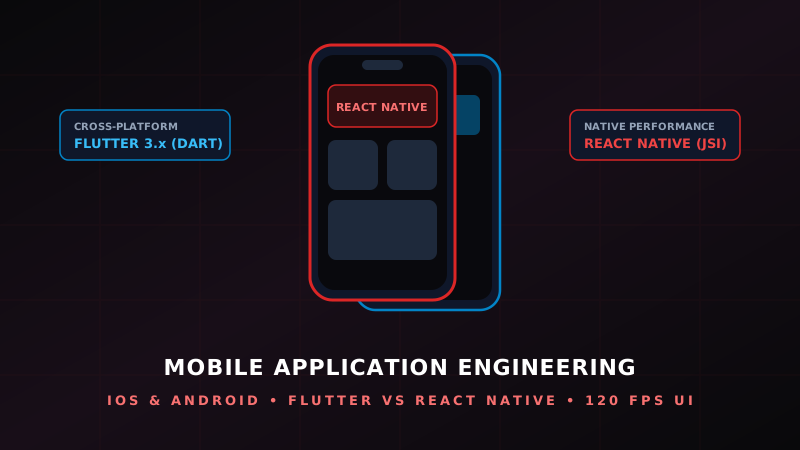
Both approaches work as long as Android stays the priority. The choice mostly comes down to budget and functional complexity: hybrid cuts initial development costs, while native gives more headroom to optimize data usage and performance on entry-level devices.
Can all three mobile money operators (M-Pesa, Airtel Money, Orange Money) be integrated into a single app?
Yes, and it's usually recommended so as not to exclude part of the customer base — but it requires a separate integration for each API, each with its own developer signup process and KYC validation timeline.
Will the Mosolo national switch eventually replace individual per-operator integrations?
The BCC's long-term goal with the national switch is to simplify cross-operator interoperability. In practice, as of 2026, adoption is still gradual, and most apps continue to integrate each operator's API directly to keep transactions reliable.
How long does mobile money integration take for an existing app?
It depends on how many operators need to be integrated and how complex the flows are (simple payment, refund, recurring subscription), but a dedicated testing budget is generally needed — validating failed-transaction handling and reconciliation usually takes longer than the technical integration itself.
Sources
- Digital 2026: The Democratic Republic Of The Congo — DataReportal
- Mobile Operating System Market Share The Democratic Republic Of The Congo — Statcounter Global Stats
- With $194.8 million in 2025 revenue, Airtel Money closes in on M-Pesa in DRC — BANKABLE
- DRC: Vodacom Had 6.4M M-Pesa Users in 2024, Up 28.4% YoY — BANKABLE
- Wave arrive en RDC, M-Pesa et Airtel Money ont peut-être plus à perdre qu'ils ne le pensent — Fintech Médias
- Transformation Numérique : La Banque Centrale du Congo accélère l'interopérabilité des paiements — Droit-Numérique.cd
- Democratic Republic of the Congo licensing — Licentium
- Airtel Money API — LobeHub Skills Marketplace
- Code du numérique — RD Congo — Droit-Numérique.cd