
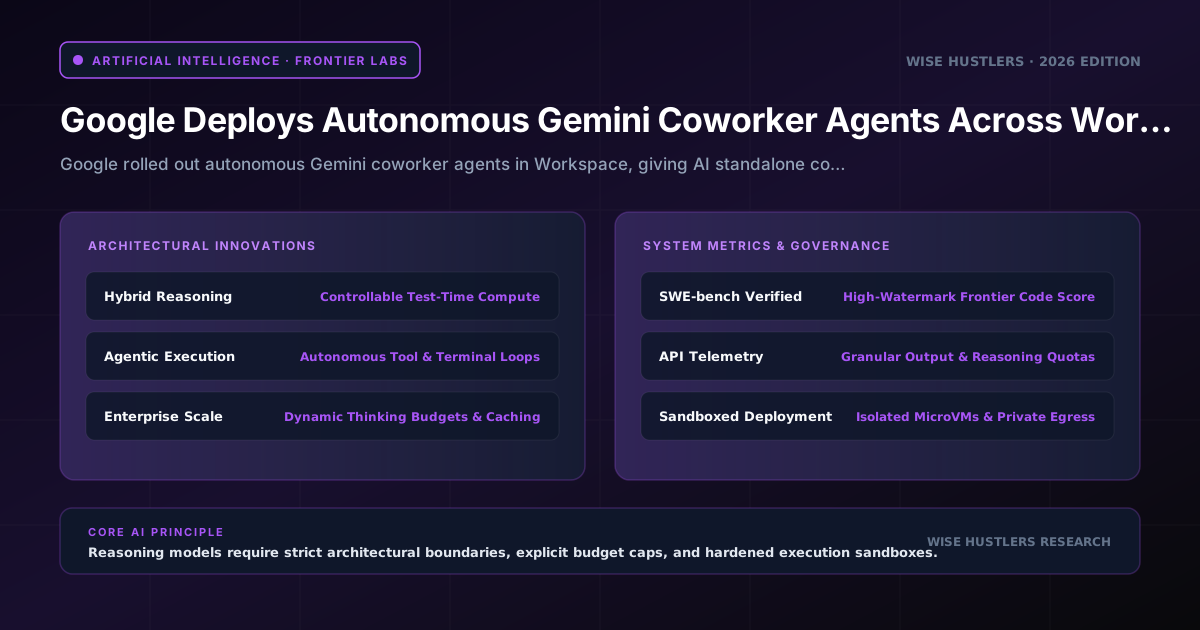
<h1>Google Deploys Autonomous Gemini Coworker Agents: Inside the Architecture of Corporate AI Colleagues</h1>
Summary: At the Gemini at Work summit on October 8, 2026, Google Cloud CEO Thomas Kurian introduced the universal Gemini agent and previewed autonomous Gemini coworker agents across Google Workspace. Moving beyond reactive chat copilots, these persistent systems operate with dedicated non-human identities, @agents.company.com email addresses, and independent audit logging. By running asynchronously in the cloud across Google Docs, Sheets, Slack, and Jira, coworker agents execute multi-step workflows over hours or days under least-privilege IAM controls.
What Happened & Key Timeline
During the Gemini at Work keynote on October 8, 2026, Google Cloud CEO Thomas Kurian unveiled the universal Gemini agent and previewed autonomous "coworker agents" within Google Workspace. Rather than issuing an immediate, universal general availability (GA) rollout, Google announced that initial industry-tailored editions—specifically targeting financial services and legal workflows—are available in developer and customer preview, with healthcare, retail, and public sector modules planned for subsequent phases. Broad general availability and finalized commercial pricing have not yet been announced.
The announcement marks a structural pivot from turn-by-turn conversational assistants toward persistent, asynchronous software colleagues. As Kurian highlighted during the keynote, modern enterprise automation is shifting toward delegating high-level objectives rather than managing micro-level prompts: "Work now starts in the prompt window."
The evolution toward enterprise coworker agents spans three distinct architectural milestones:
- Conversational Sidebars: Generative AI operated as passive assistants confined to application sidebars, requiring continuous manual prompts and losing context when browser tabs closed.
- Workspace Gems: Google launched customizable prompt personas to standardize recurring drafting and analysis templates.
- Autonomous Coworker Agents: Agents operate as persistent corporate actors provisioned with dedicated Workspace accounts, email addresses on an
@agentssubdomain (e.g.,analyst@agents.enterprise.com), Google Drive storage, calendar access, and active directory listings.
Unlike conventional chatbots, coworker agents accept asynchronous, objective-level directives. A team lead can assign an agent in Google Chat or Google Docs to audit competitive telemetry, reconcile quarterly financial sheets, and author an executive summary. The agent plans its execution graph, provisions temporary worker sub-agents, executes multi-step tool calls asynchronously in the cloud, and writes final artifacts directly to shared drives without requiring the user to maintain an active browser session.
Technical & Architectural Impact
Google's coworker framework introduces architectural patterns that solve persistent distributed systems, identity governance, and context management bottlenecks in enterprise AI deployments:
Decoupled Asynchronous Execution Graphs
Traditional copilot architectures rely on synchronous Server-Sent Events (SSE) tethered to an active client browser; closing the browser collapses the context window and terminates execution.
Google’s coworker architecture decouples execution state from client sessions via an asynchronous orchestration daemon hosted on Google Cloud. When an objective is submitted, an orchestrator decomposes the task into a Directed Acyclic Graph (DAG) of milestones. The runtime persists execution state, key-value (KV) caches, and scratchpad memory within encrypted stores, enabling long-running execution cycles and automated fault recovery without active client connections.
Standalone Corporate Identity and Audit Attribution
A core engineering advancement in the coworker model is eliminating credential masquerading. Historically, enterprise AI tools executed actions using an employee's session token or an unconstrained service account. If an automated script modified a database or sent an erroneous email, logs attributed the action to the human employee, complicating audit trails, identity governance, and enterprise compliance reviews under frameworks like SOC 2 and ISO 27001.
Under Google's coworker agent architecture:
- Every agent is provisioned with a dedicated non-human identity (NHI) registered in the Google Workspace directory.
- The agent operates using its own
@agents.company.comemail address, establishing clear provenance for all communications. - Document edits, comments, spreadsheet modifications, and external API requests are logged directly to the agent's account identity in Google Cloud Audit Logs.
- Security and audit teams can inspect structured records to review the exact prompt context, reasoning path, tool invocation payload, and response signature behind every state change.
Hierarchical Multi-Agent Orchestration & Smart Routing
Complex enterprise objectives often exceed the effective reasoning boundaries of a single context window. To prevent context dilution, the primary Gemini orchestrator dynamically spawns specialized sub-agents with isolated execution boundaries:
- Worker Dispatch: An orchestrator managing market research dispatches parallel sub-agents: one querying BigQuery telemetry, another executing data transformations in an isolated Python sandbox, and a third drafting narrative briefs in Google Docs.
- Smart Model Routing: The orchestration runtime routes tasks across models based on latency and reasoning requirements. High-speed data extraction and structured parsing route to lightweight, low-latency models such as Gemini 1.5 Flash, while multi-step logical synthesis and code generation route to high-capacity frontier models, including Gemini 1.5 Pro and Anthropic Claude models available via Vertex AI Model Garden.
Cross-Platform Connectors and Model Context Protocol
While embedded natively in Google Workspace applications, coworker agents incorporate bi-directional connectors to external enterprise backbones. Through OAuth handshakes and open connectivity standards like the Model Context Protocol (MCP), agents ingest webhooks from Slack, query records in Salesforce and ServiceNow, update Jira tickets, and inspect pull requests on GitHub.
Architectural Comparison: Chatbots vs. Autonomous Coworker Agents
The transition from synchronous assistance to asynchronous agency requires fundamental changes across all layers of the software stack:
| Architectural Dimension | Traditional Enterprise Copilots | Autonomous Gemini Coworker Agents |
|---|---|---|
| Identity & Authentication | Proxied employee session token or shared API key | Dedicated non-human identity (@agents.company.com) |
| Execution Lifecycle | Synchronous, browser-bound SSE streams | Asynchronous cloud daemon (multi-hour/multi-day) |
| State & Memory | Ephemeral per-session chat context window | Persistent scratchpad, KV cache, and Drive artifact storage |
| Audit & Attribution | Actions conflated with human user in audit logs | Isolated audit trail attributed directly to agent ID |
| Orchestration Model | Single-turn prompt-response interactions | Hierarchical DAG dispatch with specialized sub-agents |
| Integration Scope | In-app contextual suggestions and sidebars | Cross-platform APIs (Workspace, Slack, Jira, MCP servers) |
| Cost & Loop Governance | Static token limits per prompt | Token quota envelopes, step budgets, and circuit breakers |
What This Means for Engineering Teams & Enterprises
The arrival of identity-bearing autonomous agents alters how engineering teams structure workflows, enforce security boundaries, and manage compute budgets:
Modernizing DevOps and Sprint Workflows
Engineering organizations can integrate AI agents as formal participants within sprint cycles. Instead of treating AI merely as an IDE auto-complete tool, teams can assign backlog tickets, documentation reviews, and dependency audits directly to an agent’s Jira or GitHub identity. The agent runs diagnostics, authors pull request reviews under its own name, and requests human approval before deployments.
Guardrails, Budgeting, and Loop Circuit Breakers
Autonomous multi-agent execution introduces compute and token budget risks. An unconstrained recursive agent trapped in a reasoning loop can consume significant resources in minutes. To maintain control, enterprise architectures incorporate strict governance layers:
- Token Quota Envelopes: Administrators enforce maximum token and spend caps per agent, per project, and per 24-hour cycle.
- Loop Circuit Breakers: The orchestration runtime tracks execution steps and tool invocation signatures. If an agent repeats identical tool calls without state progression or exceeds its step budget, the runtime halts execution and escalates to a human supervisor.
- Agent Gateway Firewalls: Outbound tool calls pass through gateway proxies (such as Google's Agent Gateway) to inspect payloads, enforce data loss prevention (DLP) rules, and defend against SSRF vectors and prompt injection attempts.
The following Python implementation illustrates an enterprise circuit breaker pattern designed to monitor agent tool calls, prevent recursive stalls, and trigger human-in-the-loop escalations:
"""
Enterprise Agent Circuit Breaker & Loop Detector

Demonstrates deterministic step budgeting, tool-call repetition tracking,
and human-in-the-loop escalation gates for autonomous AI agents.
"""

import hashlib
import json
from typing import Any, Dict, List


class AgentCircuitBreaker:
    def __init__(self, max_steps: int = 25, repetition_threshold: int = 3):
        self.max_steps = max_steps
        self.repetition_threshold = repetition_threshold
        self.step_count = 0
        self.action_history: List[str] = []

    def _hash_action(self, tool_name: str, parameters: Dict[str, Any]) -> str:
        payload = json.dumps({"tool": tool_name, "params": parameters}, sort_keys=True)
        return hashlib.sha256(payload.encode("utf-8")).hexdigest()

    def validate_step(self, tool_name: str, parameters: Dict[str, Any]) -> Dict[str, Any]:
        self.step_count += 1

        if self.step_count > self.max_steps:
            return {
                "allow_execution": False,
                "reason": f"Step budget exceeded ({self.step_count}/{self.max_steps})",
                "action": "ESCALATE_TO_SUPERVISOR",
            }

        action_hash = self._hash_action(tool_name, parameters)
        recent_matches = sum(
            1 for h in self.action_history[-self.repetition_threshold:] if h == action_hash
        )

        if recent_matches >= (self.repetition_threshold - 1):
            return {
                "allow_execution": False,
                "reason": f"Repetitive tool call detected for '{tool_name}' without state progression",
                "action": "ESCALATE_TO_SUPERVISOR",
            }

        self.action_history.append(action_hash)
        return {
            "allow_execution": True,
            "step": self.step_count,
            "action": "CONTINUE",
        }


if __name__ == "__main__":
    breaker = AgentCircuitBreaker(max_steps=5, repetition_threshold=3)
    tool_call = {"sheet_id": "finance_q3_report", "range": "A1:D20"}

    # Simulate repetitive tool invocations
    for iteration in range(1, 4):
        result = breaker.validate_step("query_sheet", tool_call)
        print(f"Iteration {iteration}: {result['action']} -> {result.get('reason', 'OK')}")
Engineering teams can also enforce non-human identity boundaries and policy constraints using declarative specifications:
# Declarative Coworker Agent Governance Configuration
apiVersion: agents.enterprise/v1alpha1
kind: CoworkerAgent
metadata:
  name: financial-analyst-agent
  namespace: finance-operations
spec:
  identity:
    principal: "fin-analyst@agents.enterprise.com"
    workloadIdentityProvider: "projects/123456789/locations/global/workloadIdentityPools/agents-pool"
    directoryListing: true
  modelRouting:
    defaultModel: "gemini-1.5-flash"
    synthesisModel: "gemini-1.5-pro"
  governance:
    maxStepsPerTask: 30
    tokenSpendCapDailyUSD: 50.00
    circuitBreaker:
      repetitionThreshold: 3
      escalateOnFailure: true
  allowedIntegrations:
    - protocol: "mcp"
      endpoint: "https://mcp.internal.enterprise.com/sheets"
      scopes: ["read:spreadsheets", "write:reports"]
    - protocol: "oauth2"
      service: "jira"
      scopes: ["issues:read", "issues:write"]
Custom Pipelines vs. Turnkey Solutions
While Google Workspace delivers turnkey workplace automation, enterprise engineering teams often face integration friction when connecting agents to proprietary ERP backbones, on-premises data warehouses, and custom vector databases. Organizations seeking to build production multi-agent pipelines, configure sovereign model routing, or establish custom governance middleware can engage Wise Hustlers custom engineering services to architect, test, and scale enterprise AI systems aligned with strict compliance and security standards.
Falsifiability & Production Verification
How do enterprise systems analysts determine whether an autonomous agent deployment succeeds or degrades in production? Technical teams should evaluate four primary falsification metrics:
1. Context Drift Rate: The proportion of sub-agent outputs that deviate from parent constraints during workflows lasting longer than four hours.
2. Permission Boundary Inviolability: Zero instances of an agent executing tool invocations outside its assigned least-privilege IAM scopes during adversarial red-team evaluations.
3. Objective Completion Ratio: The percentage of asynchronous multi-step objectives successfully executed without requiring manual operational rollbacks.
4. Unit-Cost Efficiency: Verified data demonstrating that the total token, compute, and human review costs remain significantly lower than manual baseline engineering hours.
FAQ Section
How do Gemini coworker agents differ from traditional enterprise chatbots and Microsoft 365 Copilot?
Traditional chatbots and first-generation copilots operate primarily as synchronous, session-bound assistants answering single-turn queries while a user actively prompts them inside an open application window. Gemini coworker agents function as persistent, cloud-based entities with dedicated Google Workspace accounts, @agents email addresses, and the ability to execute long-running, multi-step tasks across hours or days without continuous user presence.
What is the current rollout status and pricing for Gemini coworker agents?
During the Gemini at Work 2026 keynote, Google Cloud introduced the Gemini agent and previewed coworker agent capabilities. Initial industry-tailored versions for financial services and legal teams were launched in developer and customer preview, with editions for healthcare, retail, and government slated for later phases. Universal general availability (GA) and final pricing schedules have not yet been announced.
How does provisioning dedicated email identities improve enterprise security and auditability?
When AI tools execute actions through user credentials or unmonitored service accounts, audit logs attribute changes to human employees, making forensic investigation difficult. Provisioning dedicated non-human identities with @agents.company.com addresses ensures that document edits, emails, and API calls are explicitly logged to the agent's unique ID. This enables granular role-based access control (RBAC) and clean audit provenance across enterprise compliance reviews.
Can Gemini coworker agents coordinate with software outside Google Workspace?
Yes. Beyond native Google Workspace applications (Docs, Sheets, Drive, Chat, Gmail), Google Cloud’s agent architecture connects to external enterprise platforms such as Slack, Jira, GitHub, Salesforce, ServiceNow, BigQuery, and Snowflake. The runtime also supports open connectivity standards such as the Model Context Protocol (MCP) to interact with proprietary internal microservices.