
# HIPAA Compliant App Development Checklist USA: Architecture, Encryption & BAA Guide
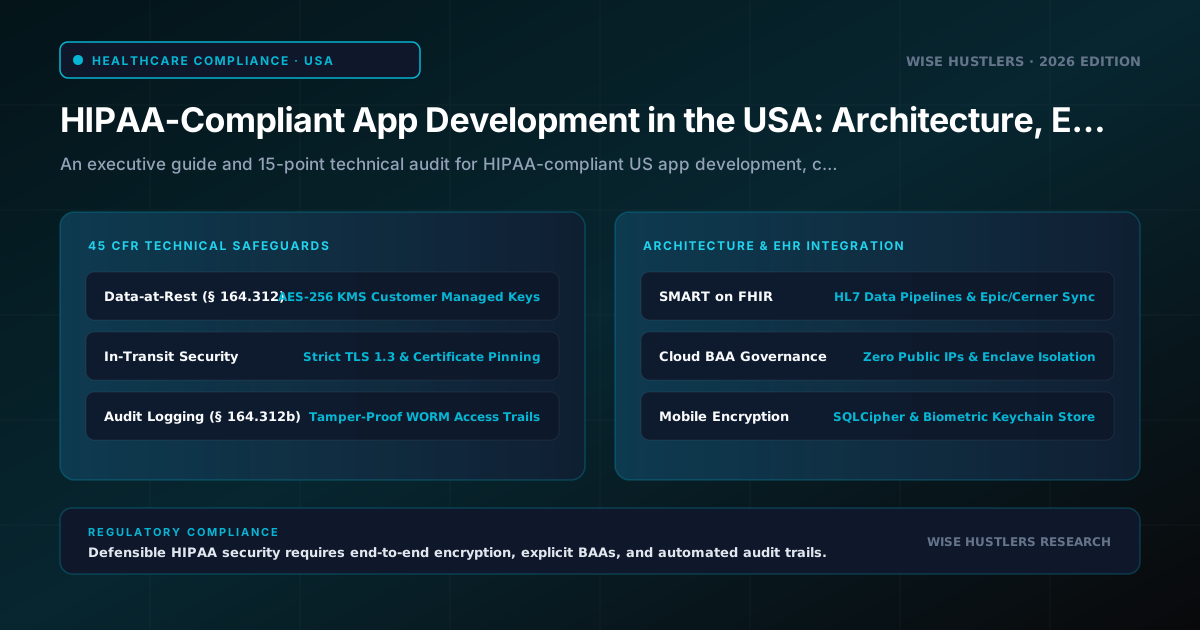
Summary: Building a HIPAA-compliant healthcare application in the United States typically requires an estimated investment of $65,000 for a baseline MVP to upwards of $240,000+ for enterprise clinical platforms across a 12 to 32-week engineering lifecycle, depending on architectural scope and EHR integration depth. Mitigating regulatory enforcement risk under the HHS Office for Civil Rights (OCR) demands rigorous technical controls: AES-256 encryption at rest, TLS 1.3 in transit, signed Business Associate Agreements (BAAs), HL7/FHIR interoperability, and immutable audit logging.
Deploying digital health software in the United States requires navigating strict federal oversight. Under the Health Insurance Portability and Accountability Act (HIPAA), the Health Information Technology for Economic and Clinical Health (HITECH) Act, and the ONC 21st Century Cures Act, technical non-compliance carries severe civil monetary penalties. Under annual inflation adjustments published in the Federal Register (45 CFR Part 102), statutory penalties for uncorrected willful neglect can exceed $2,000,000 per violation category annually, alongside mandatory corrective action plans and federal monitoring.
This operational hipaa compliant app development checklist usa provides CTOs, engineering leaders, and healthcare founders with an architectural roadmap to design, audit, and launch compliant digital health products.
---
1. Regulatory Scope: Defining ePHI and Legal Boundaries
Before engineering begins, technical leadership must define the regulatory perimeter under 45 CFR § 160.103.
Under HIPAA, health data becomes electronic Protected Health Information (ePHI) when clinical data (diagnoses, prescriptions, notes, lab results) links to any of the 18 statutory identifiers under 45 CFR § 164.514(b)(2)—including names, addresses, dates, phones, emails, SSNs, MRNs, device IDs, IP addresses, and biometrics. Under HHS OCR guidance on online tracking technologies, capturing IP addresses alongside user health inquiries brings an application's backend under HIPAA jurisdiction.
- Covered Entities (CEs): Healthcare providers, health plans, and clearinghouses rendering clinical or administrative services.
- Business Associates (BAs): Software agencies, cloud hosts, and SaaS vendors creating, receiving, maintaining, or transmitting ePHI for a CE.
- Business Associate Agreements (BAAs): Binding contracts under 45 CFR § 164.502(e) specifying permitted ePHI uses, security controls, and breach reporting protocols.
---
2. The 15-Point HIPAA Technical Audit Checklist
The HIPAA Security Rule (45 CFR Part 164, Subpart C) establishes administrative, physical, and technical safeguards. For engineering teams, the Technical Safeguards (§ 164.312) form the operational foundation of this hipaa compliance software checklist.
| Item | Control Domain | Regulatory Citation | Technical Architecture Requirement |
|---|---|---|---|
| 01 | Multi-Factor Auth | § 164.312(a)(2)(i) | Mandatory MFA (FIDO2/TOTP) for clinicians; biometric auth tied to keystores for patients per NIST SP 800-63B. |
| 02 | Role-Based Access | § 164.312(a)(1) | Enforce ABAC/RBAC restricting ePHI retrieval under statutory minimum necessary rules (§ 164.502(b)). |
| 03 | Inactivity Timeout | § 164.312(a)(2)(iii) | Enforce automatic session termination; NIST SP 800-66 Rev. 2 guidance recommends 15-min web and 5-min mobile timeouts. |
| 04 | Break-Glass Access | § 164.312(a)(2)(ii) | Audited emergency override workflow with instant compliance alerting during acute clinical crises. |
| 05 | Rest Encryption | § 164.312(a)(2)(iv) | AES-256 encryption on databases and buckets using dedicated KMS CMKs with annual key rotation. |
| 06 | Transit Encryption | § 164.312(e)(1) | Strict TLS 1.3 enforcement; deprecation of legacy TLS 1.0/1.1; mobile certificate pinning. |
| 07 | Local Sanitization | § 164.312(a)(1) | Zero plaintext caching; encrypted local stores (SQLCipher) tied to hardware Keystore/Keychain. |
| 08 | Immutable Logs | § 164.312(b) | Tamper-evident WORM audit logging capturing user ID, patient ID, timestamp, and action for all ePHI events. |
| 09 | Cloud BAAs | § 164.504(e) | Fully executed BAAs with AWS or GCP; workloads strictly restricted to verified BAA-eligible services. |
| 10 | Third-Party Vetting | § 164.502(e) | Purge consumer trackers (Meta Pixel/GA4) per OCR tracking guidance; execute BAAs for messaging SDKs (Twilio). |
| 11 | Interoperability | 45 CFR § 170.315 | SMART on FHIR Release 4.0.1 compliance with US Core profiles and OAuth 2.0 scopes under ONC Cures Act rules. |
| 12 | Disaster Recovery | § 164.308(a)(7) | Automated cross-region backups; target operational objectives (e.g., tested RPO < 15 min and RTO < 60 min). |
| 13 | Media Sanitization | § 164.310(d)(2) | NIST SP 800-88 Rev. 1 cryptographic erasure for retired storage volumes and non-production environments. |
| 14 | Vulnerability Scans | § 164.308(a)(8) | Continuous CI/CD SAST/DAST and dependency scans; periodic independent third-party penetration tests. |
| 15 | Incident Runbook | 45 CFR § 164.404 | Automated intrusion alerts; operational runbook ensuring 60-day OCR breach reporting for 500+ individuals. |
In healthcare app development usa, these 15 technical safeguards must be verified in automated CI/CD deployment pipelines.
---
3. HIPAA Cloud Architecture Blueprint
The following blueprint defines an enterprise cloud topology deployed within an isolated Virtual Private Cloud (VPC) on AWS or Google Cloud:
[Mobile / Web Client] -> HTTPS / TLS 1.3 (Certificate Pinning)
       |
       v
[Edge WAF & DDoS Shield] (AWS WAF / Cloudflare Enterprise, DNSSEC)
       |
       v
[Ingress Load Balancer] (TLS 1.3 Termination, Public Subnet)
       |
       v
[Identity Provider (BAA)] (Auth0 Enterprise / Cognito, OAuth 2.0 + MFA)
       |
       v  Private Subnet Routing (Zero Public IP Allocation)
[Application Container Cluster] (AWS ECS Fargate / EKS in Private VPC)
  |-- ABAC/RBAC Policy Engine & Break-Glass Controller
  |-- SMART on FHIR v4.0.1 Clinical API Proxy
  |-- Mutual TLS (mTLS) Inter-Service Communication
       |                                   |
       v                                   v
[EHR Gateway (Direct Connect)]    [Persistence Tier (Private Subnets)]
 - Epic / Cerner / Athena APIs     - AWS Aurora PostgreSQL (AES-256 KMS)
                                   - S3 Document Bucket (WORM Object Lock)
                                           |
                                           v
                                 [Audit & Compliance Tier]
                                  - CloudTrail Logs (Immutable S3 WORM)
                                  - Amazon GuardDuty & AWS Security Hub
Architectural Network Isolation Principles
- Zero Public IP Workloads: Containers reside in isolated private subnets, routing egress via NAT gateways and AWS PrivateLink interface endpoints.
- Service-to-Service Encryption: Microservices enforce mutual TLS (mTLS) with short-lived certificates to prevent internal network packet inspection.
- Segregated KMS Keys: Customer Managed Keys (CMKs) isolate dev, staging, and production datastores with automated annual rotation.
Implementation: Production-Grade HIPAA Audit Logging Middleware (TypeScript)
Under 45 CFR § 164.312(b), technical systems must record activity in datastores handling ePHI. The following Express/Node.js middleware captures required audit metadata while hashing payloads with SHA-256 to guarantee integrity without persisting raw ePHI in external log pipelines:
import { Request, Response, NextFunction } from 'express';
import crypto from 'crypto';

interface AuditRequest extends Request {
  user?: { id: string; role: string; orgId: string };
  patientContextId?: string;
}

function hashPayload(data: unknown): string {
  if (!data || Object.keys(data).length === 0) return 'NO_PAYLOAD';
  return crypto.createHash('sha256').update(JSON.stringify(data)).digest('hex');
}

export function hipaaAuditLogger(req: AuditRequest, res: Response, next: NextFunction): void {
  const payloadHash = hashPayload(req.body);

  res.on('finish', () => {
    const auditRecord = {
      eventId: crypto.randomUUID(),
      timestamp: new Date().toISOString(),
      actorId: req.user?.id || 'ANONYMOUS',
      actorRole: req.user?.role || 'UNKNOWN',
      patientId: (req.params.patientId || req.patientContextId || null) as string | null,
      method: req.method,
      uri: req.originalUrl || req.url,
      statusCode: res.statusCode,
      clientIp: req.ip || req.socket.remoteAddress || 'UNKNOWN',
      payloadSha256: payloadHash,
    };
    process.stdout.write(JSON.stringify(auditRecord) + '\n');
  });

  next();
}
This middleware demonstrates how engineering teams satisfy § 164.312(b): every clinical route produces an immutable audit record with cryptographic verification, shielding external logging pipelines from raw plaintext ePHI.
---
4. Telehealth & EHR Integration: FHIR vs. HL7 Standards
Bidirectional clinical data synchronization is a foundational capability in telehealth app development usa. Modern architectures must connect with hospital electronic health record systems without compromising data integrity.
| Architecture Dimension | HL7 Version 2 (Legacy Standard) | HL7 FHIR Release 4 (Modern Standard) |
|---|---|---|
| Transport Protocol | MLLP over TCP / VPN Tunnel | HTTPS / RESTful Web APIs |
| Payload Structure | Pipe-delimited ASCII segments | JSON / XML Resource Objects |
| Authentication | Static IP Whitelisting / IPSec VPN | OAuth 2.0 / OpenID Connect (SMART on FHIR) |
| Data Granularity | Monolithic message blocks (ADT, ORU) | Granular resources (Patient, Observation, Condition) |
| Regulatory Alignment | Legacy institutional systems | Mandated by ONC 21st Century Cures Act (45 CFR § 170.315) |
Navigating EHR Integration in the United States
When executing ehr integration app development, teams interface with three primary US platforms:
- Epic Systems: Connects via the Epic App Market using SMART on FHIR R4 APIs, requiring vendor review, technical verification, and endpoint approvals.
- Oracle Health (Cerner): Integrates via the Oracle Health Developer Program, supporting standardized FHIR resources for Patient, Observation, and DiagnosticReport.
- Athenahealth: Exposes REST and FHIR endpoints, common across ambulatory and specialty care networks.
---
5. Development Cost Breakdown & Timelines (2026 USA Benchmarks)
Budgeting for HIPAA-compliant software requires accounting for security engineering, penetration testing, and BAA governance alongside feature development. Unlike standard consumer applications, healthcare software requires mandatory regulatory controls—including encryption configurations, immutable audit trails, and access policy engines—that typically add 20% to 35% in engineering effort over baseline application development.
Healthcare App Development Cost Matrix (USA Market)
The following matrix outlines representative engineering estimates based on sprint capacity, developer hourly ranges, and compliance overhead across three typical product architectural tiers:
| Product Scope | Core Capabilities & Architecture | Timeline | Infrastructure & Audit | Total Estimated Investment |
|---|---|---|---|---|
| Tier 1: Telehealth MVP | Video consultations (Twilio BAA), encrypted chat, e-prescriptions, Stripe billing, baseline audit trail. (~600–900 engineering hours) | 12 – 16 Wks | $8,000 – $14,000 | $65,000 – $95,000 |
| Tier 2: EHR Clinical App | SMART on FHIR sync (Epic/Cerner), automated scheduling, lab result ingestion, role-based workflows, WORM logs. (~1,000–1,500 engineering hours) | 16 – 22 Wks | $15,000 – $25,000 | $110,000 – $165,000 |
| Tier 3: Enterprise RPM | BLE device telemetry, clinical alert engine, multi-region VPC, bidirectional hospital EHR integration. (~1,600–2,500+ engineering hours) | 22 – 32 Wks | $25,000 – $45,000+ | $165,000 – $240,000+ |
Note: Estimates reflect blended development models ($65–$120/hr for specialized offshore/hybrid teams up to $180–$250+/hr for onshore US specialists). Infrastructure and audit budgets cover enterprise cloud support tiers (e.g., AWS Business Support required for BAA execution), HIPAA-eligible cloud resource consumption, KMS requests, and third-party penetration testing assessments ($5,000–$15,000).
Agency Engagement Models: US Agency vs. Product Engineering Partner
US healthcare founders face an operational choice between traditional domestic consultancies and modern product engineering partners:
| Attribute | US Enterprise Healthcare Consultancy (Market Data) | Dedicated Product Engineering Partner (Wise Hustlers) |
|---|---|---|
| Hourly Rate | $175 – $275+ / hour (typical US onshore agency rates) | $55 – $85 / hour (capital-efficient distributed engineering model) |
| Staffing Model | Often utilizes blended tiering (mix of junior, mid-level, and senior staff) | Dedicated senior full-stack and healthcare compliance engineers |
| IP Ownership | Complex licensing agreements or delayed assignment milestones | Complete, unencumbered IP assignment from Day 1 |
| Release Velocity | Traditional monthly or milestone-based release cadences | Continuous bi-weekly production-ready CI/CD cycles |
| BAA Execution | Institutional paperwork with extended legal reviews | Direct BAA execution signed before kickoff |
For organizations evaluating technical execution, partnering with Wise Hustlers custom healthcare app development in the USA delivers institutional compliance, enterprise cloud architecture, and rapid product velocity at sensible capital efficiency.
---
6. Vendor Vetting Framework: Auditing Software Partners
When outsourcing healthcare engineering, executives must vet vendor qualifications to prevent costly compliance rewrites.
| Vetting Criteria | Evaluation Focus | Pass Standard |
|---|---|---|
| 1. Direct BAA Execution | Legal willingness to assume Business Associate liability. | Mutual BAA signed before reviewing proprietary code or repository access. |
| 2. Environment Segmentation | Prevention of real ePHI in non-production tiers. | Isolated AWS/GCP accounts with synthetic data fixtures; zero production data copies. |
| 3. Mobile Logging Sanitization | Prevention of ePHI leakage via crash logs or console outputs. | Automated lint rules blocking logging calls; zero ePHI payloads routed to Sentry or Datadog. |
| 4. Automated Security Gates | Continuous compliance verification in build pipelines. | Automated SAST, container image scanning, and secret detection gates in CI/CD. |
| 5. Interoperability Experience | Practical capability with US healthcare data exchange. | Verified architecture schematics and demonstrated SMART on FHIR deployments. |
| 6. IP & Code Ownership | Protection of proprietary software assets. | Complete, unencumbered code ownership transferred directly in client repositories. |
---
7. Technical Verification & Falsifiability Matrix
Engineering teams must validate HIPAA technical safeguards with repeatable verification procedures and clear falsifiability criteria.
| Security Control | Verification Procedure | Falsifiability Test (Failure Condition) |
|---|---|---|
| Rest Encryption (AES-256) | Inspect RDS/S3 configuration via AWS CLI or Terraform state to verify KMS key binding. | Unencrypted disk snapshot can be mounted or S3 object retrieved without KMS authorization. |
| Transport Security (TLS 1.3) | Run testssl.sh or automated SSL Labs scanner against public API endpoints. | Endpoint negotiates TLS 1.0/1.1 or accepts deprecated cipher suites. |
| Inactivity Timeout | Initiate user session, idle client beyond timeout threshold (e.g., 15 min web, 5 min mobile), execute follow-up API call. | API accepts expired access token without forcing user re-authentication. |
| Immutable Audit Logging | Execute database update, then query immutable audit storage for event record. | No event record appears within 60s, or administrator credentials can delete or modify the log. |
| Mobile Storage Sanitization | Extract application sandbox directory via ADB or Xcode debugger on test devices. | Plaintext patient names, tokens, or clinical notes appear in SQLite databases or local caches. |
| Zero ePHI in Push Alerts | Intercept APNs / FCM packet payload during notification dispatch. | Push notification payload contains patient health data, clinical details, or full patient names. |
---
Frequently Asked Questions
What are the financial and legal penalties if our healthcare application experiences an ePHI data breach?
Civil monetary penalties under HIPAA are enforced by HHS OCR under 45 CFR Part 160, Subpart D, with statutory amounts adjusted annually for inflation pursuant to the Federal Civil Penalties Inflation Adjustment Act (codified at 45 CFR Part 102, e.g., 89 FR 4744). Penalties span four culpability tiers:
- Tier 1 (No Knowledge): $137 to $68,928 per violation.
- Tier 2 (Reasonable Cause): $1,379 to $68,928 per violation.
- Tier 3 (Willful Neglect, Corrected): $13,785 to $68,928 per violation.
- Tier 4 (Willful Neglect, Uncorrected): Statutory minimum of $68,928 per violation, reaching statutory annual caps exceeding $2,000,000 per violation category under 45 CFR § 102.3.
Enforcement also entails mandatory Resolution Agreements, independent compliance monitoring, and corrective action plans.
Can our mobile app use third-party analytics (Google Analytics, Mixpanel) and push notifications?
Under HHS OCR guidance on online tracking technologies, consumer analytics (e.g., Google Analytics 4, Meta Pixel) cannot be used on authenticated healthcare portals if they capture IP addresses or device identifiers without an executed BAA. Push notification services (Apple APNs, Google FCM) operate outside BAAs; therefore, notification payloads must never contain ePHI. Alerts must use generic notices prompting secure user authentication.
Does signing a Business Associate Agreement (BAA) with AWS or Google Cloud make our application automatically compliant?
No. Cloud providers operate under a Shared Responsibility Model. The BAA covers physical infrastructure and hypervisors. Application teams remain responsible for configuring IAM policies, AES-256 database encryption, TLS 1.3, VPC network isolation, and immutable audit logs under 45 CFR § 164.312.
How long does bidirectional EHR integration with Epic or Cerner take, and what are the primary engineering hurdles?
In typical digital health implementations, bidirectional EHR integration using SMART on FHIR generally spans an estimated 8 to 16 weeks of engineering and governance. Primary hurdles involve institutional approvals rather than code: vendor app marketplace registration, mapping data to US Core FHIR profiles, security reviews, and hospital endpoint configuration.
---
Sources & Regulatory Authorities
- U.S. Department of Health & Human Services (HHS) OCR: HIPAA Security Rule Regulations (45 CFR Part 160 & Part 164, Subparts A and C).
- HHS Office for Civil Rights: Use of Online Tracking Technologies by HIPAA Covered Entities and Business Associates Bulletin.
- Federal Register / HHS: Annual Civil Monetary Penalties Inflation Adjustment (45 CFR Part 102).
- National Institute of Standards and Technology (NIST): Special Publication 800-66 Revision 2: Implementing the HIPAA Security Rule.
- National Institute of Standards and Technology (NIST): Special Publication 800-88 Revision 1: Guidelines for Media Sanitization.
- Office of the National Coordinator for Health IT (ONC): 21st Century Cures Act Interoperability & Information Blocking Rules (45 CFR Part 170).
- HL7 International: HL7 FHIR Release 4 (v4.0.1) Specification.