
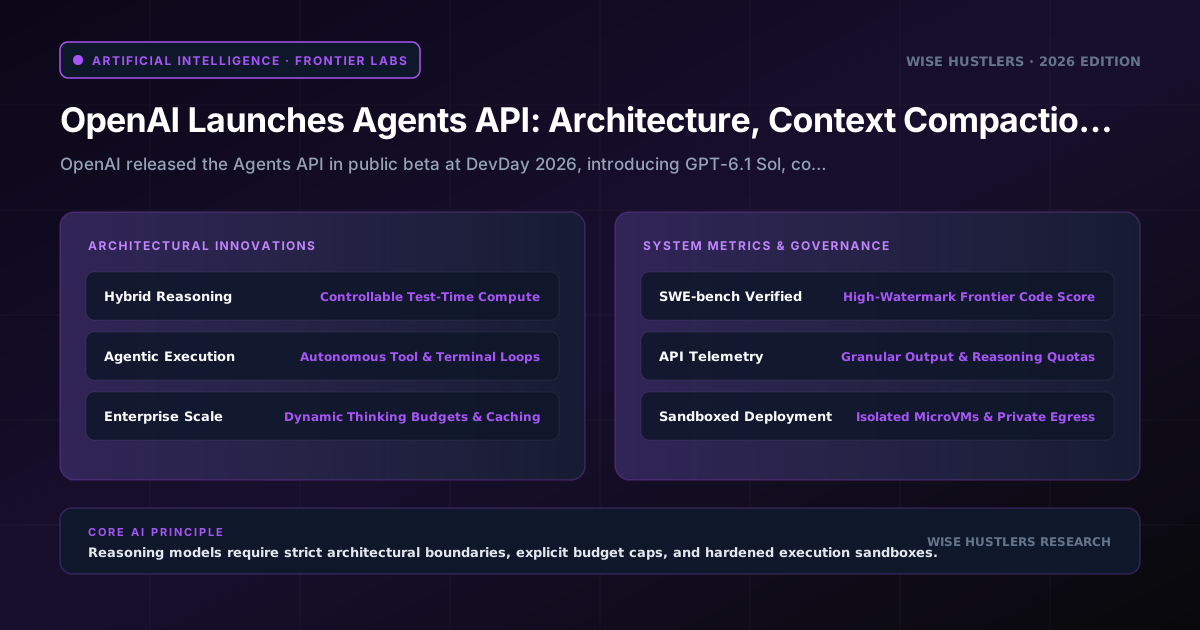
# OpenAI Launches Agents API in Public Beta: Architecture, Context Compaction, and Enterprise Impact
Summary: At DevDay 2026 on September 29, OpenAI released its Agents API into public beta alongside GPT-6.1 Sol, shifting agent orchestration from custom client-side loops to managed cloud infrastructure. The platform features native computer use, dynamic tool search, and automated context compaction to resolve context window bloat and latency degradation across long-running enterprise workflows.
What Happened & Key Timeline
On September 29, 2026, OpenAI hosted DevDay 2026 at Fort Mason in San Francisco, focusing the developer keynote on autonomous systems and "active intelligence." The flagship announcement was the public beta release of the OpenAI Agents API, coupled with the launch of GPT-6.1 Sol—a frontier model optimized for multi-turn execution, terminal environments, and graphical computer use.
Prior to this release, engineering teams constructing autonomous agents relied on client-side state engines to manage multi-step interactions. Developers manually parsed tool outputs, handled retry logic, managed context capacity, and persisted state across ephemeral connections. The launch of the Agents API marks an architectural transition: OpenAI now manages stateful execution loops directly within its cloud platform.
The release timeline highlights immediate broad availability:
- September 29, 2026: Public beta release of the Agents API across OpenAI endpoints, integrated across developer tooling and enterprise plans including ChatGPT Enterprise and ChatGPT Team.
- September 29, 2026: Launch of GPT-6.1 Sol, priced at $2.00 per million input tokens, $0.10 per million cached input tokens ($2.50 per 1M cache writes), and $10.00 per million output tokens—roughly 20% of the token cost of the flagship Astra model (referenced on the official OpenAI API Pricing page).
- September 29, 2026: Announcement of GPT-6.1 Sol Ultrafast, an optimized inference tier delivering accelerated token generation (up to 6x on the API and 8x in Codex) to eliminate latency bottlenecks during tight multi-turn tool loops.
Along with the Agents API, OpenAI previewed the Decisions API, an intelligent routing primitive running on its lightweight Luna model designed to classify incoming events and direct them toward specialized agents.
Technical & Architectural Impact
The Agents API introduces three architectural primitives that reshape how distributed systems integrate with frontier AI models: hosted execution sessions, context compaction, and dynamic tool discovery.
+-------------------------------------------------------------------+
|                     Enterprise Client Service                     |
+---------------------------------+---------------------------------+
                                  | POST /v1/agents/sessions
                                  | (Header: OpenAI-Beta: agents=v1)
                                  v
+-------------------------------------------------------------------+
|                 OpenAI Agents API Session Runtime                 |
|                                                                   |
|  +------------------------+             +----------------------+  |
|  | Context Compaction     | <---------> | Dynamic Tool Search  |  |
|  | (Automated Pruning)    |             | (Vectorized Schemas) |  |
|  +------------------------+             +----------------------+  |
|                                                                   |
|  +-------------------------------------------------------------+  |
|  | Stateful Execution Engine (GPT-6.1 Sol Reasoning Loop)      |  |
|  +-------------------------------------------------------------+  |
+-------------------+-----------------------------+-----------------+
                    |                             |
                    v                             v
+-----------------------------+     +-------------------------------+
| Registered API Tools & DBs  |     | Sandboxed GUI Computer Use    |
+-----------------------------+     +-------------------------------+
1. Server-Side Execution Loop vs. Client-Side Orchestration
In conventional agent pipelines, applications parse model outputs, execute local functions, append results to a conversation array, and transmit payloads back over HTTP. This ping-pong exchange introduces serialization overhead, network latency, and state synchronization vulnerabilities.
The Agents API replaces this pattern by hosting the execution loop on OpenAI infrastructure. When an application initiates a session via POST /v1/agents/sessions, the server-side runtime manages the multi-turn loop until the agent completes or requests human input. Clients simply subscribe to streaming events or poll turn status.
| Architectural Dimension | Client-Side Orchestration (Custom / Frameworks) | OpenAI Agents API (Managed Sessions) |
|---|---|---|
| Session State | Stored in external client databases (PostgreSQL, Redis) | Managed durably via /v1/agents/sessions |
| Loop Execution | Polling round-trips over public network per tool call | Server-side execution loop with streaming events |
| Context Management | Manual FIFO message slicing or ad-hoc summarizers | Automatic semantic context compaction |
| Tool Discovery | Static injection of all schemas into prompt context | Dynamic vector indexing via Tool Search |
| UI / Desktop Action | Self-hosted headless browsers and external VMs | Sandboxed container runtime for native Computer Use |
| Cost Model | Model token rates plus self-hosted infrastructure servers | Model tokens plus standard tool and container sandbox rates |
The following illustrative TypeScript example demonstrates initializing a durable agent session using the official OpenAI SDK:
import OpenAI from "openai";

const openai = new OpenAI();

// Illustrative session initialization on the Agents API beta
const session = await openai.beta.agents.sessions.create({
  agent: {
    name: "data-pipeline-agent",
    model: "gpt-6.1-sol",
    instructions: "Audit PostgreSQL tables, identify orphaned foreign keys, and generate migration scripts.",
    tools: [
      { type: "tool_search" },
      { type: "computer_use", environment: { type: "openai_hosted" } }
    ]
  }
});
2. Context Compaction Mechanics
Context consumption drives latency and failure in agentic software. In complex workflows—such as analyzing database schemas, paginating API responses, or inspecting application logs—raw history accumulates rapidly. In iterative pipelines returning thousands of tokens per step, unmanaged context growth degrades model steering and inflates inference costs.
Context compaction resolves this via automated semantic state consolidation. Rather than naively discarding early turns with a FIFO sliding window, the runtime condenses historical iterations, intermediate JSON, and terminal output into concise structured summaries. The agent preserves critical constraints, variable bindings, and task progress without carrying prior raw payloads into downstream reasoning steps, stabilizing per-turn latency.
3. Tool Search and Computer Use
Injecting dozens of OpenAPI schemas directly into model prompts degrades instruction following, increases prompt processing costs, and triggers tool hallucinations. With tool search, developers register extensive API catalogs that the runtime indexes and dynamically injects via vector search based on immediate task context.
Native computer use extends agent autonomy into graphical interfaces within sandboxed environments. The model interprets screenshots, calculates coordinates, and issues mouse and keyboard inputs to navigate software lacking programmatic APIs.
What This Means for Engineering Teams & Enterprises
The public beta of the Agents API alters the operational economics and system design of generative AI in production software.
1. Radically Improved Cost Economics
Pairing the Agents API with GPT-6.1 Sol reduces financial friction. At $2.00 per million input tokens, $0.10 per million cached input tokens, and $10.00 per million output tokens, high-volume multi-step agent loops become viable in production. OpenAI bills standard token rates for intelligence, standard tool rates for built-in capabilities, and standard container compute rates for hosted sandbox execution (such as computer use environments). Without platform subscription markups on the API protocol itself, expenses scale directly with consumed compute and token throughput.
2. Reduction of Infrastructure Sprawl
Teams can decommission custom orchestration layers previously maintained for state machines, token bookkeeping, and retry logic. Engineering resources can shift toward data validation, domain business logic, and security guardrails rather than orchestration plumbing.
3. Enterprise Integration and Security
While hosted loops accelerate delivery, enterprise production demands strict architectural boundaries: zero-trust credential segregation, network isolation for computer use sandboxes, and audit logging across all execution paths.
For organizations evaluating how to design, secure, and integrate production-grade agent pipelines into legacy data warehouses or internal ERPs, partnering with Wise Hustlers custom engineering services provides specialized architecture consulting, custom tool bridge implementations, and tailored enterprise agent blueprints.
Frequently Asked Questions
How does context compaction in the Agents API differ from standard rolling window truncation?
Standard rolling window truncation discards earliest conversation messages once the token limit is approached, frequently losing initial system instructions, global constraints, or crucial early outputs. Context compaction acts as an automated memory consolidation engine: it summarizes past interaction cycles into a compressed semantic state object. This ensures all critical variables, established rules, and progress markers are preserved while eliminating verbose intermediate payloads.
What are the operational differences between GPT-6.1 Sol and the Astra model?
GPT-6.1 Sol is an efficiency-focused frontier model optimized specifically for multi-turn tool calling, code generation, terminal commands, and computer use at 20% of the token cost of Astra ($2.00 / 1M input and $10.00 / 1M output vs. Astra's $10.00 / 1M input and $50.00 / 1M output). Astra remains suited for wide-aperture creative reasoning and open-ended research synthesis, whereas Sol provides low-latency execution and high structural compliance required for production agent control loops.
Does using the OpenAI Agents API create vendor lock-in for enterprise systems?
While the execution runtime runs within OpenAI infrastructure, the underlying tool definitions adhere to standard JSON schemas and REST specifications. By decoupling domain business logic from the agent execution layer, engineering teams can transition between the hosted Agents API and self-hosted open-source runtimes without rewriting core enterprise microservices.
Sources
- OpenAI Platform Documentation: Agents API Architecture & Sessions Guide
- OpenAI API Pricing & Token Rates
- InfoQ: OpenAI DevDay 2026 Unveils Agents API, GPT-6.1 Sol, and Codex Cloud
- The Decoder: OpenAI Announces Agents API, GPT-6.1 Sol, and Always-On Dots
- Axios: OpenAI DevDay 2026 Debuts Persistent Agents, GPT-6.1 Sol, and Developer Platform