
# Custom Insurance Software Development Cost USA
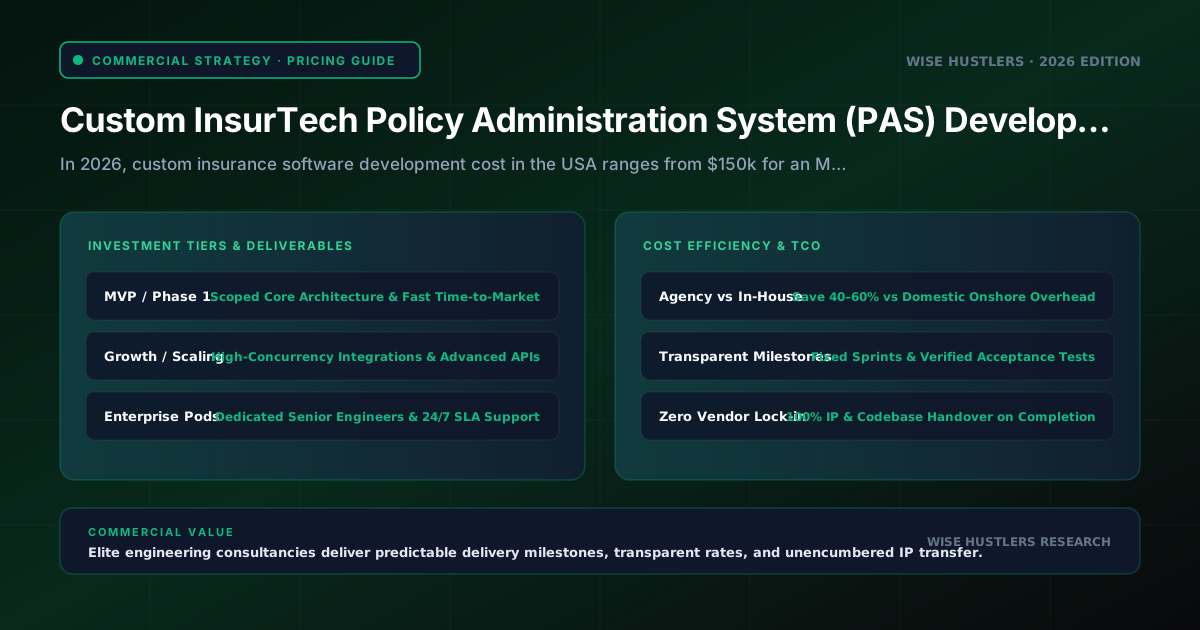
Summary: In 2026, the custom insurance software development cost in the USA typically ranges from $150,000 to $350,000 for a single-line Managing General Agent (MGA) MVP, $400,000 to $900,000 for a multi-state commercial Property & Casualty (P&C) platform, and $1,000,000 to $3,000,000+ for enterprise carrier core systems. Annual maintenance historically requires 15% to 20% of initial build capital (~$25,000 to $600,000/year) based on IEEE and Gartner software lifecycle standards.
---
Developing a custom Policy Administration System (PAS) in the United States requires engineering teams to balance multi-jurisdictional regulatory frameworks, dynamic actuarial rating logic, straight-through underwriting, and multi-tier broker distribution channels. For high-growth Managing General Agents (MGAs), program administrators, and specialty carriers, off-the-shelf legacy platforms frequently introduce prohibitive recurring licensing fees, restrictive change cycles, and gross written premium (GWP) basis-point take rates that compress operating margins.
Engineering a proprietary, event-driven PAS establishes an appreciating software asset on the enterprise balance sheet. This technical advisory guide analyzes 2026 capital expenditure benchmarks, 5-year Total Cost of Ownership (TCO) models, event-driven underwriting architectures, ACORD data standards, and state Department of Insurance (DOI) audit compliance requirements.
---
1. 2026 Pricing Matrix: Capital Outlay by Architectural Scope
In the US market, custom insurance core engineering investments depend on line of business (LOB) complexity, multi-state rate filing variations, automated straight-through processing (STP) thresholds, and third-party risk enrichment integrations.
Senior InsurTech engineering teams in the United States typically bill between $140 and $220 per hour for specialized pods that combine enterprise software architects, actuarial rules developers, cloud infrastructure engineers, and regulatory security analysts. Based on analysis from insurance technology research firms such as Celent and Aite-Novarica, custom PAS builds align into three primary capital expenditure profiles.
| Deployment Tier | Target Insurance Entity | Estimated Capital Outlay (USD) | Estimated Delivery Timeline | Engineering Effort & Team Composition | Core Capabilities & Architecture Scope |
|---|---|---|---|---|---|
| Tier 1: Niche MGA Single-Line MVP | Monoline MGAs, Program Administrators, Warranty InsurTechs | $150,000 – $350,000 | 3 – 5 Months (12–20 Weeks) | 1,000 – 2,000 Hours<br/>(1 Lead Architect, 2 Full-Stack Engineers, 1 QA/DevOps) | Direct-to-consumer and broker portal, deterministic rules rating, STP quote/bind flow, dynamic PDF policy jacket assembly, tokenized credit card/ACH billing, monthly bordereau export. |
| Tier 2: Multi-State Commercial P&C Platform | Regional Carriers, Multi-State Commercial MGAs, Specialty Wholesalers | $400,000 – $900,000 | 6 – 9 Months (24–36 Weeks) | 2,500 – 5,000 Hours<br/>(1 Principal Architect, 4 Senior Engineers, 1 Domain Actuarial Dev, 1 DevOps) | Multi-tier broker workbench, dynamic state-specific rating engine (ISO/AAIS base loss costs with state deviations), Mid-Term Adjustments (MTAs), out-of-sequence endorsement state machines, quota-share reinsurance allocation, fiduciary trust ledger. |
| Tier 3: Enterprise Carrier Core PAS | National P&C Carriers, Mutual Insurers, Digital Subsidiaries | $1,000,000 – $3,000,000+ | 10 – 18+ Months | 6,000 – 18,000+ Hours<br/>(Multi-pod engineering team, systems integrators, enterprise data leads) | Multi-line underwriting engine, visual actuarial rule management, complex treaty/facultative reinsurance ledgers, ACORD XML/JSON transformation gateways, claims core orchestration, statutory general ledger sync, SERFF audit logging. |
---
Tier 1: Niche MGA Single-Line MVP ($150,000 – $350,000)
A Tier 1 deployment addresses monoline specialty insurance programs—such as commercial cyber liability, parametric weather, embedded cargo, or pet health insurance. The functional objective is delivering an automated quote-to-bind experience with minimal administrative overhead.
Under agile sprint delivery with an insurance-literate engineering pod, an initial production MVP can launch within approximately 12 to 20 weeks. Core architectural components include:
- Distribution & Broker Portal: A responsive portal built with Next.js and TypeScript, supporting broker self-registration, license verification, and submission ingestion.
- Deterministic Rules Engine: Algorithmic translation of filed actuarial rating matrices into executable code pipelines with zero floating-point calculation errors.
- Linear Lifecycle State Machine: Programmatic transitions across clear states:
Application Submitted$\rightarrow$Quoted$\rightarrow$Payment Authorized$\rightarrow$Bound$\rightarrow$In-Force. - Fiscal Operations: Integration with tokenized payment gateways (such as Stripe Billing) for automated premium collection and scheduled monthly bordereau generation matching fronting carrier reporting specifications.
---
Tier 2: Multi-State Commercial P&C Platform ($400,000 – $900,000)
Tier 2 platforms support multi-state commercial programs across complex lines such as Commercial Property, General Liability, Inland Marine, and Excess Casualty. These systems must process state-specific Department of Insurance (DOI) loss cost multipliers, territory definitions, and mandatory endorsement forms.
Key architectural capabilities include:
- Multi-Tier Broker Workbench: Granular Role-Based Access Control (RBAC) accommodating agency hierarchies, tiered commission splits, and automated Agency Management System (AMS) data ingestion.
- Temporal Endorsement Logic: Mathematical handling of pro-rata and short-rate cancellations, retroactive coverage endorsements, and out-of-sequence policy variations that dynamically adjust unearned premium reserves (UPR).
- Third-Party Risk Enrichment: Automated API lookups via Verisk, LexisNexis, HazardHub, or state business registries to populate commercial building construction classes, fire protection grades, and loss run histories.
- Fiduciary Ledger Segregation: Code-level separation of premium trust escrow balances, operating commission revenues, and statutory surplus lines tax liabilities.
---
Tier 3: Enterprise-Grade Carrier Core PAS ($1,000,000 – $3,000,000+)
Tier 3 systems serve enterprise carriers requiring full core modernization or established insurers launching digital greenfield subsidiaries. According to Celent's North American policy administration market studies, enterprise core transformations at this level involve multi-pod systems integration and extensive data migration.
Key architectural standards include:
- Event-Sourced Ledger Architecture: Every policy lifecycle event is recorded in an immutable event store, ensuring point-in-time calculation reproducibility for any historical date of record.
- Reinsurance Allocation Core: Automatic allocation of gross written premium (GWP) and subject exposures across complex treaty structures—including quota share arrangements, surplus lines structures, and excess-of-loss attachments.
- Enterprise Interoperability: Bidirectional data synchronization with statutory general ledgers (SAP Financials, Oracle NetSuite), external claims management suites (Guidewire ClaimCenter, Snapsheet), and regulatory reporting clearinghouses.
---
2. 5-Year Total Cost of Ownership (TCO) Lifecycle Projection
Long-term software economics extend beyond initial build capital. According to empirical software maintenance standards established by the IEEE (IEEE Standard 1219) and IT operational budgeting frameworks from Gartner, annual post-deployment operations and maintenance (O&M) for custom enterprise software typically averages 15% to 20% of initial build capital.
For an insurance platform, this translates to annual operational maintenance budgets ranging from $25,000/year for a targeted MVP to $600,000/year for an enterprise carrier deployment.
                      ANNUAL OPERATING BUDGET ALLOCATION
                      (15% to 20% of Build Capex Baseline)

  +-----------------------------------------------------------------------+
  |  Actuarial Updates & Circulars (~5% - 7%)                             |
  |  ISO / AAIS rate revisions, territory factor adjustments, SERFF sync  |
  +-----------------------------------------------------------------------+
  |  Cloud Hosting & High-Availability Infrastructure (~3% - 5%)          |
  |  Multi-AZ compute, DB clustering, point-in-time recovery, APM         |
  +-----------------------------------------------------------------------+
  |  Compliance, Auditing & Security Patching (~4% - 5%)                  |
  |  SOC 2 Type II audit support, pen testing, CVE patching, key rotation |
  +-----------------------------------------------------------------------+
  |  Variable Usage Opex (Consumption-Based)                              |
  |  Address normalization, property data telemetry, credit scoring APIs  |
  +-----------------------------------------------------------------------+
---
Annual Operational Maintenance Allocations (15%–20% Baseline)
Within the 15% to 20% annual operational baseline, engineering and actuarial resources typically distribute across four primary cost categories:
1. Actuarial Logic & Circular Updates (~5%–7% of Build Capex): Advisory organizations such as Verisk (ISO) and the American Association of Insurance Services (AAIS), alongside state DOIs, issue periodic circulars containing revised advisory loss costs, territory alignments, and mandatory coverage forms. Engineering and actuarial teams must back-test and deploy these rate rules without disrupting in-force policies.
2. Cloud Infrastructure & High-Availability Hosting (~3%–5% of Build Capex): Hosting within SOC 2 Type II and ISO 27001 certified cloud environments (AWS or Microsoft Azure) configured for multi-availability zone failover, automated point-in-time database replication, and enterprise recovery point objectives (RPO < 1 minute) and recovery time objectives (RTO < 15 minutes).
3. Regulatory Audit Maintenance & Security Patching (~4%–5% of Build Capex): Ongoing vulnerability assessments, automated penetration testing, third-party library patching, and technical preparation for state market conduct reviews and SOC 2 Type II recertifications.
4. Variable Third-Party API Ingestion Fees (Usage-Based OpEx): Consumption-based fees for address verification (Google Places, Smarty), property risk attributes (HazardHub, Verisk A-PLUS), and entity legal standing validation.
---
5-Year TCO Comparison: Custom Greenfield vs. Monolithic Legacy vs. Composable Headless Core
To illustrate software economics, the financial model below compares three architectural deployment paths for a commercial insurance program writing a cumulative $25,000,000 in Gross Written Premium (GWP) over five years.
+----------------------------------------------------------------------------------------------------+
| 5-YEAR TCO EXPOSURE: CUSTOM GREENFIELD vs. MONOLITHIC SUITE vs. COMPOSABLE HEADLESS CORE            |
| Program Profile: US Multi-State Commercial Lines | Cumulative 5-Year GWP: $25,000,000              |
+---------------------------------+----------------------------+-------------------------+--------------------+
| Financial & Operational Metric  | 1. Custom Greenfield PAS   | 2. Monolithic Suite     | 3. Composable Core |
|                                 | (Proprietary Asset Model)  | (Enterprise Packaged)   | (Headless SaaS)    |
+---------------------------------+----------------------------+-------------------------+--------------------+
| Year 1: Initial Build & License | $650,000                   | $2,200,000              | $320,000           |
| Year 2: Maintenance & License   | $110,000                   | $550,000                | $180,000           |
| Year 3: Maintenance & License   | $115,000                   | $580,000                | $210,000           |
| Year 4: Maintenance & License   | $120,000                   | $610,000                | $240,000           |
| Year 5: Maintenance & License   | $125,000                   | $640,000                | $270,000           |
| GWP Basis-Point Take Fee (5-Yr) | $0 (0 bps)                 | $0 (Fixed Contract)     | $75,000 (30 bps)*  |
| Third-Party APIs & Cloud Host   | $180,000                   | $320,000                | $125,000           |
+---------------------------------+----------------------------+-------------------------+--------------------+
| Total 5-Year Financial Outlay   | $1,300,000                 | $4,900,000              | $1,420,000         |
| Software IP Balance-Sheet Asset | 100% Owned Institutional   | $0 (Licensed Software;  | $0 (Multi-Tenant   |
|                                 | Enterprise Equity          | Third-Party Property)   | Rented Tenancy)    |
+---------------------------------+----------------------------+-------------------------+--------------------+
* Note: Basis-point calculation reflects exactly 30 bps (0.30%) applied to $25,000,000 cumulative GWP: 0.0030 * $25,000,000 = $75,000.
While composable headless SaaS platforms reduce initial upfront capital outlays, basis-point take rates and rising tier subscription fees create an escalating operational expense as written premium expands. By Year 4, a custom greenfield system delivers a lower cumulative run-rate while capitalizing the software as proprietary intellectual property on the company's balance sheet.
---
3. Production Event-Driven PAS Architecture Blueprint
Modern insurance core software cannot function as a standard relational CRUD application. Because an insurance policy is a regulated legal contract subject to temporal mutations (such as endorsements, cancellations, rewrites, and audits), the system must process lifecycle state changes through an asynchronous, event-driven architecture.
The following blueprint illustrates how enterprise PAS components interface across ingestion, rating, policy servicing, and financial settlement layers.
flowchart TD
    subgraph Ingestion["1. Distribution & Ingestion Layer"]
        PP["Policyholder Portal<br/>(Self-Service Digital App)"]
        BW["Broker Workbench<br/>(Multi-Tier Agent Portal)"]
        API["Distribution API<br/>(B2B Embedded / Partner Feeds)"]
    end

    subgraph Gateway["2. Edge & Security Orchestration"]
        APIGW["API Gateway & Identity Provider<br/>(OAuth2 / OIDC / Mutual TLS)"]
    end

    subgraph Underwriting["3. Dynamic Rating & Underwriting Core"]
        RE["Dynamic Rating & Underwriting Rules Engine<br/>(Versioned Actuarial Rules Engine)"]
        DE["External Enrichment Adapters<br/>(Verisk / LexisNexis / HazardHub)"]
        UW["Underwriter Exception & Referral Queue<br/>(Manual Inspection & Authority Limits)"]
    end

    subgraph Core["4. Policy Lifecycle & Document Engine"]
        SM["Policy Lifecycle State Machine<br/>(Quote -> Bind -> Endorse -> Cancel -> Renew)"]
        DG["Document Assembly & e-Signature<br/>(Dynamic PDF Engine & DocuSign API)"]
    end

    subgraph Finance["5. Fiscal Ledger & Reinsurance"]
        BL["Bordereaux Reporting Engine<br/>(Monthly Production & Premium Schedules)"]
        RL["Reinsurance Allocation Ledger<br/>(Quota Share / Excess of Loss Treaty Engine)"]
        PG["Payment & Disbursement Gateway<br/>(Stripe Billing / Automated ACH)"]
    end

    subgraph Storage["6. Persistence & Compliance"]
        DB[("Event Store & Immutable Audit Trail<br/>(PostgreSQL Event-Sourced Ledger)")]
    end

    PP --> APIGW
    BW --> APIGW
    API --> APIGW

    APIGW --> RE
    RE <--> DE
    RE --> UW
    RE --> SM

    SM --> DG
    SM --> DB
    SM --> BL
    SM --> RL
    SM --> PG
---
Core Subsystems and Engineering Specifications
1. Distribution & Ingestion Layer:
- Broker Workbench: Implemented using Next.js, React, and TypeScript, this interface allows independent brokers to submit applications, track bind statuses, manage agency rosters, and download commission statements. Dynamic schema validation guarantees that submissions meet mandatory state underwriting prerequisites before invoking rating services.
- Policyholder Self-Service Portal: A mobile-responsive web application enabling policyholders to review active coverage, retrieve Certificates of Insurance (COIs), download policy jackets, and file First Notices of Loss (FNOL).
- Partner Distribution API: OpenAPI-compliant REST and GraphQL endpoints enabling insurtech distributors and embedded platforms (e.g., commercial lending software, freight logistics systems) to obtain programmatic quotes in real time.
2. Dynamic Rating & Underwriting Rules Core:
- Separation of Rule Logic from Application Code: Embedding actuarial calculation formulas directly into application business logic generates technical debt and hinders regulatory agility. The rating service executes declarative calculation models via sandboxed execution engines (such as JSONLogic, Drools, or compiled WebAssembly modules).
- Versioned Actuarial Matrices: Actuarial teams maintain base rates, minimum premiums, and territorial factors as version-tagged tabular datasets. When new state filings take effect, the engine loads the new matrix version keyed to the policy's effective date without requiring application redeployment.
- Underwriting Referral Queues: Submissions exceeding straight-through processing limits (e.g., Total Insured Value exceeding $5,000,000 or elevated hazard classifications) automatically transition to an underwriter review queue with role-based authority limits.
3. Policy Lifecycle Finite State Machine:
The core policy lifecycle must execute as a deterministic Finite State Machine (FSM). Programmatic guards validate that lifecycle transitions occur strictly in statutory sequence.
                                  +-------------------+
                                  |    Application    |
                                  +---------+---------+
                                            |
                                            v
                                  +-------------------+
                       +--------> |      Quoted       | <--------+
                       |          +---------+---------+          |
                       |                    |                    |
                       |                    v                    |
                       |          +-------------------+          |
                       |          |       Bound       |          |
                       |          +---------+---------+          |
                       |                    |                    |
                       |                    v                    |
                       |          +-------------------+          |
    Endorsement Incurred|          |      Active       |          | Reinstated
                       +--------- +----+---------+----+ ---------+
                                       |         |
                          Cancellation |         | Natural Expiration
                                       v         v
                             +-----------+     +-----------+
                             | Cancelled |     |  Expired  |
                             +-----------+     +-----------+
Every state transition generates an immutable event payload documenting the acting user ID, effective timestamp, transaction type, and serialized data delta.
---
Implementation: Deterministic Rating Engine and Pro-Rata UPR Ledger
The runnable TypeScript implementation below demonstrates three essential architectural patterns: integer-based deterministic premium rating (preventing IEEE 754 floating-point drift), cryptographic calculation hashing for SERFF auditability, and pro-rata Unearned Premium Reserve (UPR) computation.
import { createHash } from "crypto";

/**
 * Actuarial Rate Table Definition (ISO / State-Specific Relativity Matrix)
 */
interface ActuarialMatrix {
  matrixVersion: string;
  serffFilingId: string;
  baseRatePerThousandCents: number; // Stored in integer cents to prevent floating-point errors
  territoryMultipliers: Record<string, number>;
  constructionClassFactors: Record<string, number>;
  deductibleCredits: Record<number, number>; // Deductible amount -> credit factor
}

interface UnderwritingSubmission {
  quoteId: string;
  effectiveDate: string; // ISO 8601 Date
  expirationDate: string;
  totalInsuredValue: number; // In dollars
  territoryCode: string;
  constructionClass: string;
  deductible: number;
}

interface RatingResult {
  quoteId: string;
  serffFilingId: string;
  matrixVersion: string;
  grossWrittenPremiumCents: number;
  calculationAuditHash: string;
  calculatedAt: string;
}

/**
 * Deterministic Commercial Property Rating Service
 */
export class DeterministicRatingEngine {
  constructor(private readonly rateMatrix: ActuarialMatrix) {}

  public calculatePremium(submission: UnderwritingSubmission): RatingResult {
    const territoryFactor = this.rateMatrix.territoryMultipliers[submission.territoryCode];
    if (!territoryFactor) {
      throw new Error(`Invalid territory code: ${submission.territoryCode}`);
    }

    const constructionFactor = this.rateMatrix.constructionClassFactors[submission.constructionClass];
    if (!constructionFactor) {
      throw new Error(`Invalid construction class: ${submission.constructionClass}`);
    }

    const deductibleCredit = this.rateMatrix.deductibleCredits[submission.deductible] ?? 0.0;

    // Premium Calculation Pipeline
    const coverageUnits = submission.totalInsuredValue / 1000;
    const basePremiumCents = Math.round(coverageUnits * this.rateMatrix.baseRatePerThousandCents);

    const adjustedPremiumCents = Math.round(
      basePremiumCents * territoryFactor * constructionFactor * (1 - deductibleCredit)
    );

    // Cryptographic calculation audit hash for DOI / SERFF market conduct verification
    const auditPayload = JSON.stringify({
      quoteId: submission.quoteId,
      serffFilingId: this.rateMatrix.serffFilingId,
      matrixVersion: this.rateMatrix.matrixVersion,
      submission,
      calculatedPremiumCents: adjustedPremiumCents,
    });

    const auditHash = createHash("sha256").update(auditPayload).digest("hex");

    return {
      quoteId: submission.quoteId,
      serffFilingId: this.rateMatrix.serffFilingId,
      matrixVersion: this.rateMatrix.matrixVersion,
      grossWrittenPremiumCents: adjustedPremiumCents,
      calculationAuditHash: auditHash,
      calculatedAt: new Date().toISOString(),
    };
  }

  /**
   * Calculates Pro-Rata Unearned Premium Reserve (UPR) and Return Premium upon cancellation
   */
  public calculateProRataCancellation(
    grossWrittenPremiumCents: number,
    effectiveDateStr: string,
    expirationDateStr: string,
    cancellationDateStr: string
  ): { earnedPremiumCents: number; returnPremiumCents: number; unearnedFactor: number } {
    const effective = new Date(effectiveDateStr).getTime();
    const expiration = new Date(expirationDateStr).getTime();
    const cancellation = new Date(cancellationDateStr).getTime();

    if (cancellation < effective || cancellation > expiration) {
      throw new Error("Cancellation date must fall between effective and expiration dates.");
    }

    const totalTermMs = expiration - effective;
    const elapsedMs = cancellation - effective;

    const earnedFactor = elapsedMs / totalTermMs;
    const unearnedFactor = 1 - earnedFactor;

    const earnedPremiumCents = Math.round(grossWrittenPremiumCents * earnedFactor);
    const returnPremiumCents = grossWrittenPremiumCents - earnedPremiumCents;

    return {
      earnedPremiumCents,
      returnPremiumCents,
      unearnedFactor: parseFloat(unearnedFactor.toFixed(6)),
    };
  }
}

// ---------------------------------------------------------------------------
// Runnable Demonstration Trace
// ---------------------------------------------------------------------------
const sampleActuarialMatrix: ActuarialMatrix = {
  matrixVersion: "2026.04-COMM-PROP",
  serffFilingId: "WHUS-2026-994821",
  baseRatePerThousandCents: 450, // $4.50 per $1,000 of Total Insured Value
  territoryMultipliers: { "FL-MIA": 1.45, "TX-DAL": 1.15, "NY-NYC": 1.25 },
  constructionClassFactors: { "ISO-01-FRAME": 1.2, "ISO-04-MASONRY": 0.85 },
  deductibleCredits: { 5000: 0.05, 10000: 0.12, 25000: 0.2 },
};

const engine = new DeterministicRatingEngine(sampleActuarialMatrix);

const quoteResult = engine.calculatePremium({
  quoteId: "QTE-2026-00481",
  effectiveDate: "2026-01-01T00:00:00Z",
  expirationDate: "2027-01-01T00:00:00Z",
  totalInsuredValue: 1_500_000, // $1.5M Commercial Property
  territoryCode: "TX-DAL",
  constructionClass: "ISO-04-MASONRY",
  deductible: 10000,
});

console.log("Rated Premium (USD):", (quoteResult.grossWrittenPremiumCents / 100).toFixed(2));
console.log("Audit Hash (SERFF Trace):", quoteResult.calculationAuditHash);

const uprResult = engine.calculateProRataCancellation(
  quoteResult.grossWrittenPremiumCents,
  "2026-01-01T00:00:00Z",
  "2027-01-01T00:00:00Z",
  "2026-07-02T12:00:00Z" // Mid-term cancellation (approx 50% elapsed)
);

console.log("Earned Premium (USD):", (uprResult.earnedPremiumCents / 100).toFixed(2));
console.log("Return Premium to Insured (USD):", (uprResult.returnPremiumCents / 100).toFixed(2));
This rating and UPR engine guarantees mathematical determinism across all policy mutations, avoiding rounding discrepancies during state examinations and accounting closes.
---
4. State Regulatory Standards, SERFF Auditability, and ACORD Data Flows
Unlike federally chartered financial institutions, insurance companies and MGAs in the United States operate under state-level regulatory frameworks across 50 state Departments of Insurance (plus DC and US territories), coordinated by the National Association of Insurance Commissioners (NAIC).
ACORD Standard Data Ingestion and Transformation
The Association for Cooperative Operations Research and Development (ACORD) defines standard insurance messaging standards. While legacy carrier backbones often exchange heavy ACORD XML schemas, modern frontend distribution platforms communicate via JSON REST APIs.
A production-grade PAS implements bidirectional translation adapters for standard ACORD forms:
- ACORD 125: Commercial Insurance Application (Applicant, Prior Carrier, Loss History)
- ACORD 126: Commercial General Liability Section (Exposures, Hazards, Endorsements)
- ACORD 130: Workers' Compensation Application (Class Codes, Payroll, States)
- ACORD 140: Commercial Property Section (Premises, Construction, Fire Protection)
[Modern REST / JSON Frontend Submissions]
                    │
                    ▼
[Translation Layer: Bidirectional JSON <-> ACORD XML Engine]
                    │
                    ├── Validate Schema against ACORD XSD Data Dictionaries
                    ├── Extract Line-of-Business (LOB) Sub-Objects
                    └── Serialize into Carrier Form Schemas
                    │
                    ▼
[Carrier Gateway / External Clearinghouse Ingestion]
---
State Regulatory Audit Readiness Checklist
Regulators review insurance software during statutory market conduct examinations and solvency audits. Incorporating these technical controls ensures audit readiness across state jurisdictions:
- Deterministic Rate Reproducibility & SERFF Auditability: During state examinations, regulators audit rate calculations against rate and rule filings submitted through the System for Electronic Rates & Forms Filing (SERFF). Software architectures must deterministically reproduce the exact premium calculated for any historical quote by preserving version-locked rate tables, territory factors, and rule sets keyed to the coverage effective date.
- Immutable State Change Logging: Mid-term endorsements, cancellation notices, and address changes must preserve the preceding record state, recording an append-only audit trail with actor IDs, timestamps, and justification metadata.
- NAIC Insurance Data Security Model Law (#668) Alignment: Enacted by more than 20 states to establish information security standards for insurance licensees, Model #668 requires comprehensive administrative, technical, and physical safeguards. Engineering teams implement AES-256 encryption at rest, TLS 1.3 in transit, multi-factor authentication (MFA) on broker/administrative endpoints, and continuous audit logging to support licensee compliance.
- Fiduciary Premium Trust Accounting: State insurance regulations mandate strict fiduciary accountability for collected insurance premiums. Software financial ledgers must programmatically separate fiduciary premium escrow balances from operating agency revenues and statutory surplus lines tax settlement accounts.
- Configurable Cancellation & Notice Period Enforcement: Statutory notice periods for cancellation and non-renewal vary across state jurisdictions and insurance lines (for example, notice mandates commonly range from 10 days for non-payment of premium to 30, 45, or 60 days for non-renewal or mid-term cancellation). Policy lifecycle state machines must enforce programmatic gates that prevent premature policy terminations.
- Double-Entry Statutory Accounting (SAP & GAAP): Every policy binding event creates balanced debit and credit entries across gross written premiums, unearned premium reserves (UPR), broker commissions payable, and premium tax liabilities, ensuring continuous reconciliation with carrier general ledgers.
- Tokenized Payment Infrastructure (PCI-DSS Scope Minimization): Utilizing tokenized payment infrastructure (such as Stripe Billing) handles recurring ACH debits and credit card payments. Because payment data is tokenized directly at the edge, internal PAS servers store only customer tokens and transaction references, significantly reducing the application's PCI-DSS compliance scope.
---
5. Strategic Evaluation: Custom Build vs. Composable Buy Matrix
Executive leadership teams must decide whether to engineer a proprietary core platform or license third-party software. The matrix below analyzes the three prevailing deployment paths for US insurance operators.
| Evaluation Dimension | 1. Custom Greenfield PAS | 2. Monolithic Enterprise Suite | 3. Composable Headless Core |
|---|---|---|---|
| Architectural Archetypes | Proprietary event-driven core built with an elite partner like Wise Hustlers | Packaged carrier core suites (e.g., Guidewire PolicyCenter, Duck Creek, Majesco) | Cloud-native headless policy engines (e.g., Socotra, InsureMO, EIS Group) |
| Initial Time to Market | 3 to 9 Months | 14 to 24+ Months | 4 to 8 Months |
| Upfront Capital Outlay | $150k – $900k (MGA MVP to Multi-State) | $1.5M – $5M+ (Licensing + System Integrator) | $100k – $350k (Integration & Onboarding) |
| Ongoing Operating Cost | 15%–20% of build cost/year (Hosting + Maintenance) | $450k–$1M+ annual license maintenance & SI retainers | Base subscription + GWP basis-point cut (15–40 bps) |
| Actuarial Logic Flexibility | Complete control. Unlimited custom rating formulas, external API hooks, and instant version updates. | Constrained by vendor product update cycles and proprietary configuration languages. | High API configurability, but constrained by the vendor's underlying data model. |
| Balance Sheet Equity Impact | Highest Asset Multiplier: 100% proprietary software IP owned on the balance sheet. | Zero Asset Creation: High recurring licensing overhead; platform owned entirely by vendor. | Moderate: Flexible modern stack, but recurring basis-point drag compresses net margins. |
| Vendor Lock-in Exposure | Zero: The company owns 100% of the source code, repositories, and cloud tenancy. | Severe: High switching friction; carrier legacy core migrations frequently require 2 to 4 years. | Moderate to High: Dependent on vendor API stability, roadmap priorities, and pricing revisions. |
---
6. Engineering Vendor Selection & Risk Mitigation Framework
Core system modernization initiatives carry substantial operational risk. Long-term software engineering research conducted by The Standish Group (the CHAOS Report) indicates that approximately 69% to 71% of enterprise software projects are categorized as "challenged" (experiencing budget overruns, delivery delays, or scope reduction) or fail outright. Furthermore, a joint landmark study by McKinsey & Company and the University of Oxford evaluating over 5,400 large-scale IT projects found that software implementations run an average of 45% over budget while delivering 56% less value than initially projected.
In the insurance sector, project failures typically stem from partnering with generalist development consultancies that lack domain-specific insurance literacy. Generalist agencies often underestimate actuarial rating complexity, mid-term endorsement variations, and statutory trust accounting rules.
                      +---------------------------------------+
                      |    1. Actuarial Literacy & Rating     |
                      |   Translates loss cost tables and     |
                      |   state filings into scalable code.   |
                      +-------------------+-------------------+
                                          |
                                          v
                      +---------------------------------------+
                      |   2. Event-Driven System Design       |
                      |   Builds immutable, event-sourced     |
                      |   state machines for policy lifecycles|
                      +-------------------+-------------------+
                                          |
                                          v
                      +---------------------------------------+
                      |    3. Accounting & Ledger Precision   |
                      |   Implements double-entry ledgering,  |
                      |   UPR, and multi-party trust splits.  |
                      +-------------------+-------------------+
                                          |
                                          v
                      +---------------------------------------+
                      |   4. Statutory Regulatory Compliance  |
                      |   Engineers for NAIC 668, SERFF,      |
                      |   SOC 2, and state DOI audit reviews. |
                      +-------------------+-------------------+
                                          |
                                          v
                      +---------------------------------------+
                      |    5. Complete IP & Asset Transfer    |
                      |   100% code ownership with no         |
                      |   per-policy royalties or lock-in.    |
                      +---------------------------------------+
---
Five Technical Vetting Benchmarks for Insurance Engineering Partners
When evaluating engineering firms for a custom PAS initiative, technical leadership should require prospective partners to demonstrate capabilities across five core benchmarks:
1. Actuarial Literacy & Dynamic Rating Mechanics: The engineering team must demonstrate experience parsing actuarial circulars, translating multi-factor rate equations into code, and isolating rating parameters from application logic to support dynamic rate filings.
2. Event-Driven Architecture & Temporal State Machines: The team must possess production experience with event streaming platforms (Kafka, RabbitMQ, or AWS EventBridge) to guarantee data integrity across complex policy mutations (endorsements, audits, cancellations).
3. Double-Entry Financial Accounting Standards: Insurance transactions require balance-sheet precision. The vendor must understand the mechanics of unearned premium calculations (pro-rata vs. short-rate), commission split schedules, and ceded reinsurance ledgers.
4. Regulatory & Compliance Architecture: The partner must have practical experience implementing cloud security architectures aligned with SOC 2 Type II, NAIC Model Law #668, and state DOI market conduct audit standards.
5. Complete Code Ownership & Asset Transfer: Ensure that all developed intellectual property, infrastructure-as-code scripts, and custom frameworks transfer entirely to your organization's balance sheet without recurring royalty fees.
Organizations seeking institutional-grade engineering capability partner with the Wise Hustlers custom software engineering team to architect and deploy high-performance insurance core systems. Wise Hustlers combines financial engineering rigor with modern cloud craftsmanship, delivering production-grade systems that eliminate vendor lock-in.
---
7. Executive Frequently Asked Questions
How do custom rating engines handle frequent ISO/AAIS circular updates without code redeployment?
Production insurance architectures decouple calculation formulas from actuarial rate tables. Base rates, territory multipliers, class code factors, and expense loads are structured as versioned, declarative configuration sets stored in database tables or managed through an administrative rules interface. When ISO or AAIS distributes a circular with updated loss costs, actuaries upload the revised matrix with an assigned future effective date. The rating engine dynamically evaluates the appropriate rate table based on the policy's effective coverage date, eliminating the need to modify application source code or trigger production redeployments.
What is the realistic engineering timeline from initial architecture to first bound policy?
Under agile sprint delivery with an experienced, insurance-literate engineering pod, a focused Tier 1 monoline MGA MVP can launch in approximately 12 to 20 weeks (3 to 5 months). This timeframe assumes a defined functional scope: deterministic rating for a single line of business, automated quote-to-bind workflows, standard bordereau export generation, and third-party payment/e-signature integrations. Multi-state commercial platforms (Tier 2) typically require 24 to 36 weeks (6 to 9 months) to accommodate multi-jurisdictional rate filings, dynamic endorsement state machines, and legacy carrier clearinghouse integrations.
Can a custom PAS integrate with legacy carrier mainframes and enterprise accounting systems?
Yes. Modern custom PAS platforms interface with legacy carrier environments through specialized integration layers. Using asynchronous microservices and secure SFTP or REST gateways, the platform transforms real-time event streams into batch outputs formatted for enterprise ERPs and accounting systems (including SAP Financials, Oracle NetSuite, and legacy AS400 mainframes). This enables modern digital distribution while maintaining standard carrier financial reporting routines.
How does owning proprietary software IP impact MGA valuation multiples?
In insurance M&A transactions and capital raises, technology-enabled MGAs with proprietary software receive premium valuation multiples compared to traditional retail brokerages. According to transaction surveys by insurance investment banking and advisory firms such as MarshBerry, firms operating with delegated underwriting authority command average valuations of 19.4x pro forma EBITDA, significantly outperforming traditional retail brokerages which average base multiples of 11.5x to 11.8x EBITDA. When an MGA owns its proprietary underwriting, rating, and distribution technology, acquirers and private equity investors treat the business as a scalable tech-enabled platform, rewarding the absence of third-party software licensing drag and defensible operational efficiency with higher valuation multiples.
---
8. Structuring Your InsurTech Roadmap with Wise Hustlers
Modernizing insurance core infrastructure requires an engineering approach that accounts for rigorous compliance standards, distributed systems performance, and financial precision. Whether launching a greenfield MGA program or modernizing legacy carrier operations, your software architecture directly drives underwriting profitability and enterprise valuation.
To review architectural plans, discuss technical requirements, and develop a fixed-scope delivery model, schedule an executive advisory session with the Wise Hustlers technology consulting team. We collaborate with executive teams to deliver mission-critical software systems on schedule and within budget.
---
Sources
1. Celent — North American Policy Administration Systems: P&C Insurance Edition (In-depth analysis of core system replacement costs, vendor evaluation criteria, and modern cloud deployment architectures).
2. The Standish Group — CHAOS Study & Project Performance Database (Long-term empirical research on enterprise IT project success rates, cost overruns, and scope challenges).
3. McKinsey & Company & University of Oxford (BT Centre for Major Programme Management) — Delivering Large-Scale IT Projects on Time, on Budget, and on Value (Empirical analysis of 5,400+ large capital IT projects evaluating budget overruns and schedule slippages).
4. MarshBerry — Specialty Practice M&A Market Updates: Delegated Authority (MGA/MGU) Valuation Multiples vs. Retail Brokerages (M&A transaction database tracking EBITDA multiples for delegated underwriting authority platforms).
5. IEEE Computer Society — IEEE Standard 1219: Standard for Software Maintenance & Gartner — IT Budgeting and Enterprise Software Lifecycle Benchmarks (Standard cost models establishing the 15% to 20% annual O&M baseline).
6. National Association of Insurance Commissioners (NAIC) — Insurance Data Security Model Law (#668) and System for Electronic Rates & Forms Filing (SERFF) Guidelines (State model standards for data protection, market conduct auditability, and electronic rate filings).
7. ACORD (Association for Cooperative Operations Research and Development) — ACORD Standards Framework: P&C XML and JSON Data Dictionaries (Standardized data interchange schemas for commercial lines applications, binders, and bordereaux).