
<h1>Microsoft Unveils Microsoft Foundry and Entra Agent ID: The Enterprise Architecture for Non-Human Identity and Zero-Copy Federation</h1>
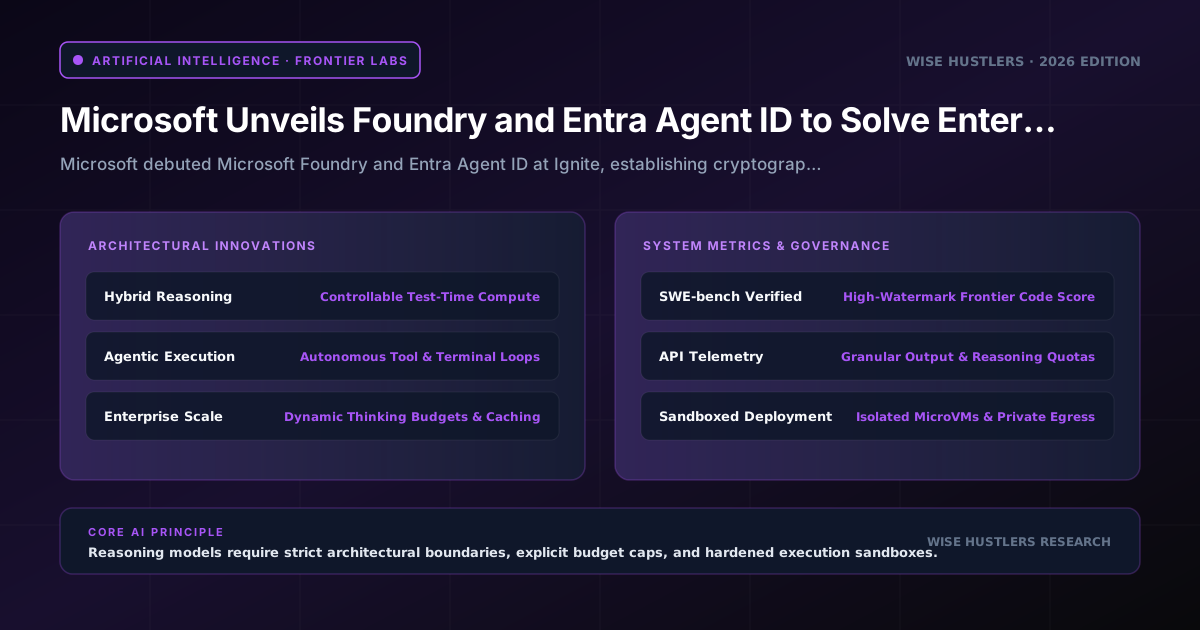
Summary: Microsoft has officially unveiled Microsoft Foundry and announced the General Availability of Microsoft Entra Agent ID at Microsoft Ignite. The dual release tackles enterprise AI's two most critical architectural roadblocks: unmanaged non-human identity credentials and brittle, duplicative ETL data pipelines. By introducing cryptographic agent blueprints, platform-managed token exchanges, and bidirectional Zero Copy federation with Salesforce and Microsoft Fabric, Microsoft establishes a secure, governable foundation for production-grade agentic systems.
What Happened & Key Timeline
At Microsoft Ignite, Microsoft announced a strategic shift in how enterprises build, govern, and deploy autonomous artificial intelligence. Moving past consumer-facing chat assistants and prompt wrappers, Microsoft introduced an integrated production framework centered on rebranding and architecturally expanding Azure AI Studio and Azure AI Foundry into Microsoft Foundry.
Parallel to this platform consolidation, Microsoft announced the General Availability of Microsoft Entra Agent ID, an enterprise identity standard engineered specifically for non-human autonomous agents. Rather than forcing engineering teams to manage agents using generic application registrations, shared service principals, or static API keys, Entra Agent ID introduces first-class cryptographic identity lifecycles for autonomous workloads.
The announcement highlighted two foundational milestones:
1. Foundry Agent Service & Foundry IQ: A containerized execution tier supporting deployment on enterprise Azure Kubernetes Service (AKS) clusters, paired with permission-aware data retrieval running over the Model Context Protocol (MCP).
2. The "Copilotforce" Alliance with Salesforce: A bidirectional Zero Copy data integration linking Salesforce Data 360 directly with Microsoft Fabric's OneLake, eliminating raw data movement across cloud ecosystems.
Together, these releases address two persistent bottlenecks that have stalled enterprise agent pilots in 2026: expanding blast radiuses from unmanaged credentials and the operational fragility of multi-terabyte data synchronization pipelines.
Technical & Architectural Impact
The architectural significance of Microsoft Foundry and Entra Agent ID lies in how they systematically address the security and data bottlenecks of agentic systems.
Cryptographic Non-Human Identity (NHI) Architecture
Prior to Entra Agent ID, autonomous agents typically operated under an untenable compromise: inheriting broad human credentials via shared bearer tokens or running through administrative service principals with wide read-write permissions. If an agent experienced hallucinated tool invocation, goal misalignment, or indirect prompt injection, its potential blast radius threatened the entire enterprise tenant.
Entra Agent ID structures agent identity into a hierarchical, two-tier model:
- The Agent Blueprint: Registered at the Microsoft Foundry project boundary, the blueprint functions as an immutable parent template. It establishes the administrative baseline for agent capabilities, defining permitted API scopes, execution constraints, and authorized downstream tools.
- Ephemeral Instance Identities: When an agent initiates an execution loop, Entra mints a distinct child identity cryptographically tied to that specific session.
- Platform-Managed Token Exchange (RFC 8693): Autonomous agents avoid storing, rotating, or transmitting client secrets. Microsoft Foundry negotiates short-lived, down-scoped tokens using OAuth 2.0 On-Behalf-Of (OBO) workflows. Downstream services receive tokens restricted exclusively to that individual transaction.
This architecture enforces deterministic blast-radius containment. If an agent instance misbehaves, security operations centers (SOCs) can instantly revoke its child token without disrupting parent blueprints, companion agents, or production APIs.
Comparison: Entra Agent ID vs. Traditional Machine Identities
To illustrate this architectural shift, consider how Entra Agent ID compares directly to legacy machine identities:
| Architecture Dimension | Traditional Service Principals | Microsoft Entra Agent ID |
|---|---|---|
| Lifecycle Model | Static, long-lived application registration | Dynamic, ephemeral session instances derived from parent blueprints |
| Credential Storage | Static client secrets or certificates in vaults | Secretless, platform-managed token exchanges (RFC 8693) |
| Blast Radius Containment | Broad subscription-level or database-wide scopes | Scoped strictly to individual reasoning steps and target APIs |
| Delegation Lineage | Direct service account access; loses user context | Preserved On-Behalf-Of (OBO) chain linking user and agent |
| Runtime Revocation | Revoking credentials interrupts shared workloads | Instant child token invalidation without disrupting blueprints |
| Observability & SIEM | Generic machine identity logs in Microsoft Sentinel | Cryptographic instance IDs correlated to specific agentic loops |
Bidirectional Zero-Copy Data Federation
Simultaneously, Microsoft tackled retrieval-augmented generation (RAG) and tool-calling friction through bidirectional Zero Copy federation connecting Salesforce Data 360 and Microsoft Fabric OneLake.
Traditional enterprise architectures rely on scheduled batch ETL jobs to replicate CRM data into analytic stores, introducing synchronization lag, inflating storage expenses, and stripping out source role-based access control (RBAC) metadata.
Under the Zero Copy model:
- OneLake Shortcuts: Salesforce Data 360 exposes curated CRM objects into Microsoft Fabric via native OneLake Shortcuts. Data teams query live CRM entities in Delta Lake and Apache Parquet formats without moving bytes across cloud boundaries.
- Fabric Federation into Data 360: Salesforce agents execute federated queries against enterprise datasets in Microsoft OneLake, allowing cross-cloud queries to execute against data resident within Azure boundaries without requiring duplicative raw data replication.
- Permission-Aware Retrieval (Foundry IQ): When agents search structured records and unstructured documents through standardized Model Context Protocol (MCP) servers, Foundry IQ evaluates user and agent permissions at query runtime, supporting unified security policy coordination across Microsoft Entra access controls and Salesforce Shield event monitoring at the service integration boundary.
Implementation Blueprint: Ephemeral Token Exchange via RFC 8693
Engineering teams operationalize Entra Agent ID using platform-managed token exchange endpoints. Rather than bundling API keys with autonomous workloads, the execution harness exchanges user-delegated context for ephemeral instance tokens:
import httpx
import os

async def request_ephemeral_agent_token(
    blueprint_id: str,
    user_assertion_jwt: str,
    target_api_scope: str,
) -> str:
    """
    Exchanges caller assertion for a short-lived, down-scoped agent token
    via Microsoft Entra token exchange (RFC 8693) without static secrets.
    """
    tenant_id = os.environ["AZURE_TENANT_ID"]
    token_url = f"https://login.microsoftonline.com/{tenant_id}/oauth2/v2.0/token"

    payload = {
        "grant_type": "urn:ietf:params:oauth:grant-type:token-exchange",
        "client_id": blueprint_id,
        "subject_token": user_assertion_jwt,
        "subject_token_type": "urn:ietf:params:oauth:token-type:access_token",
        "requested_token_use": "on_behalf_of",
        "scope": target_api_scope,
    }

    async with httpx.AsyncClient(timeout=5.0) as client:
        response = await client.post(token_url, data=payload)
        response.raise_for_status()
        return response.json()["access_token"]
What This Means for Engineering Teams & Enterprises
For engineering leads, cloud architects, and enterprise systems analysts, Microsoft's announcements mark the transition of autonomous AI from experimental scripts to disciplined systems engineering.
Eliminating Infrastructure Overhead
Developers no longer need to maintain custom identity wrappers, token caching layers, and manual secret rotation scripts for each micro-agent. By abstracting identity into native cloud infrastructure, engineering teams can focus on orchestration graphs, domain logic, and deterministic evaluation benchmarks.
Falsifiability and Observability Metrics
Engineering leadership can objectively validate this architectural transition across three key operational metrics:
1. Token Exchange Overhead: Profiling token-exchange latency during high-velocity multi-hop tool execution. Engineering teams establish internal latency budgets and token-caching tiers for OAuth 2.0 On-Behalf-Of (OBO) exchanges to prevent compounding sequential delays across reasoning loops.
2. Zero-Copy Network Egress: Validating cross-cloud query execution between Salesforce Hyperforce and Azure Fabric instances to confirm federated partition pruning avoids full-table scans.
3. Audit Trail Completeness: Validating telemetry and identity propagation by ensuring non-human agent execution loops emit distinct cryptographic instance IDs into centralized monitoring platforms like Microsoft Sentinel and Defender for Cloud, supporting verifiable execution lineage between human user intent, agent planning steps, and backend mutations.
Navigating this architectural shift requires deep expertise across cloud security boundaries, distributed data fabrics, and production-grade model orchestration. Organizations seeking to modernize legacy data lakes and operationalize resilient multi-agent systems often collaborate with Wise Hustlers custom AI solutions to implement zero-trust architectures without taking on compounding technical debt.
Frequently Asked Questions
How does Microsoft Entra Agent ID differ from traditional Service Principals?
Traditional service principals are static machine identities built for predictable background jobs, requiring manual credential rotation and broad access scopes. Entra Agent ID introduces dynamic, short-lived child identities derived from an Agent Blueprint. It automates platform-managed token exchanges without secrets in application code, enforcing strict session-level isolation for non-deterministic AI tool invocations.
What is the operational benefit of the Zero Copy integration between Microsoft and Salesforce?
Zero Copy eliminates brittle ETL batch pipelines between Salesforce Data 360 and Microsoft Fabric. By virtualizing data access through OneLake Shortcuts and federated queries, AI agents in both environments query synchronized customer and enterprise context in place. This reduces storage redundancy, avoids cross-cloud data transfer fees, and preserves source access control lists.
Can Microsoft Foundry Agent Service run within enterprise Kubernetes clusters?
Yes. In addition to Microsoft-managed serverless hosting, Microsoft Foundry Agent Service supports deployment directly onto enterprise Azure Kubernetes Service (AKS) clusters. This architectural model allows organizations deploying within regulated, sovereign cloud, or custom network environments to execute autonomous agents inside private subnets, integrating with private Certificate Authority (CA) trust hierarchies and restricted egress gateways.
Sources
- Microsoft Azure Blog: Introducing Microsoft Foundry and Next-Generation Agent Infrastructure
- Microsoft Entra Tech Community: Securing AI Agents with Microsoft Entra Agent ID
- Microsoft Fabric Documentation: OneLake Shortcuts and Cross-Cloud Architecture
- Salesforce Newsroom: Salesforce and Microsoft Announce Bidirectional Zero-Copy Integration
- IETF RFC 8693: OAuth 2.0 Token Exchange Specification