
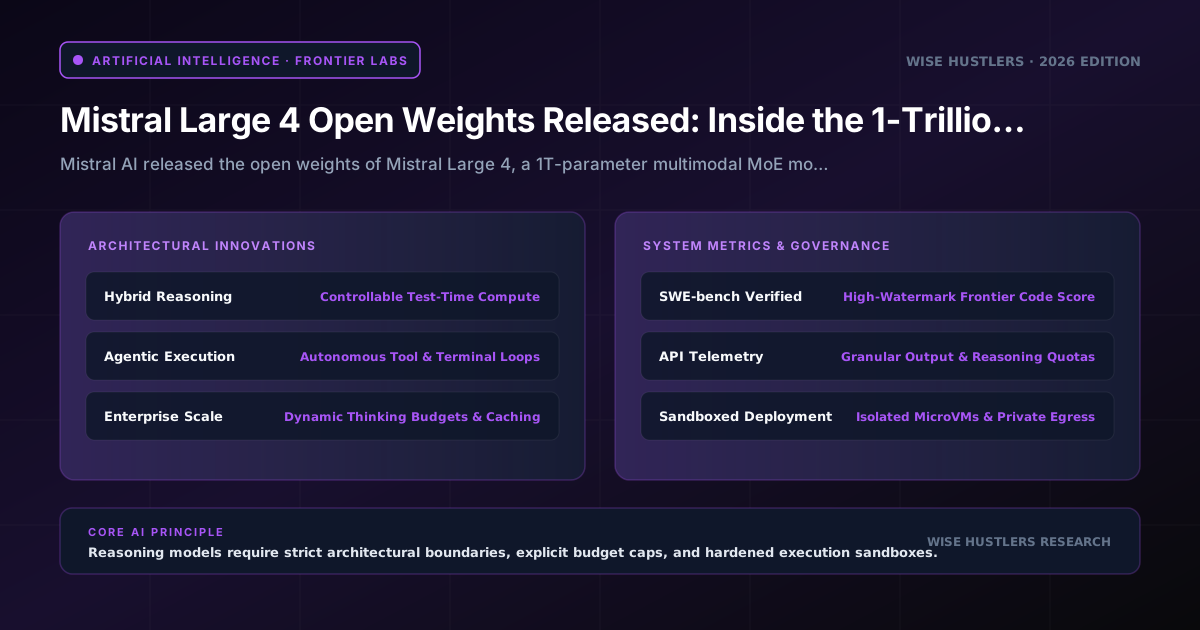
<h1>Mistral Large 4 Open Weights Released: Inside the 1-Trillion Parameter Enterprise MoE Model</h1>
Summary: On October 29, 2026, Mistral AI released the open weights for Mistral Large 4 ("Le Chonk"), a 1-trillion parameter natively multimodal Mixture-of-Experts foundation model. Built on European sovereign infrastructure, the release introduces a tri-modal reasoning engine, FP8 quantization support, and high token efficiency for enterprise agentic coding and security audits. Engineering teams can download the weights directly or deploy via containerized runtimes for air-gapped, zero-egress production workloads.
What Happened & Key Timeline
Mistral AI introduced Mistral Large 4 in early October 2026 as a restricted API preview. Over the subsequent three weeks, the Paris-based team applied continuous reinforcement learning (RL) focused on autonomous coding, terminal automation, and vulnerability remediation. According to Mistral's technical disclosures, these post-preview iterations yielded double-digit benchmark gains across engineering workflows without signs of performance saturation.
On October 29, 2026, Mistral transitioned the improved model from preview to a public open-weight release. The complete weights are available for download on Hugging Face, supported by community serving engines including vLLM and SGLang. For managed enterprise deployments, the model is simultaneously available via the Mistral API, OpenRouter, NVIDIA NIM microservice containers, and Microsoft Foundry for private Azure environments.
The release operates under the Mistral Ecosystem Open-Weight license. This licensing framework permits internal enterprise deployment, academic research, custom fine-tuning, and commercial SaaS product embedding. It requires a dedicated commercial agreement only for vendors offering standalone Model-as-a-Service hosting. As standard practice for enterprise governance, legal teams should review the complete license terms against their internal compliance guidelines.
On Mistral's managed platform, announced API pricing is listed at $0.70 per million input tokens, $0.07 per million cached input tokens (reflecting a 90% prompt caching discount), and $2.10 per million output tokens. Actual costs across multi-provider aggregators and cloud marketplaces vary depending on compute regions, dedicated throughput reservations, and enterprise volume agreements.
Technical & Architectural Impact
Mistral Large 4 uses a sparse Mixture-of-Experts (MoE) architecture with 1 trillion total parameters and approximately 49 billion active parameters per forward pass. This routing design delivers frontier-grade dense reasoning while keeping memory throughput manageable on modern accelerator clusters. The model natively processes text, high-resolution imagery, and technical documentation across a 1-million-token context window.
Tri-Modal Reasoning Engine
Rather than forcing a binary choice between raw completion and extended thinking, Mistral Large 4 introduces three distinct runtime reasoning modes:
- Low Reasoning: Tailored for low-latency tasks such as tool routing, structured data extraction, and syntax conversion.
- Medium Reasoning: Balanced for everyday code refactoring, test generation, and pull-request reviews.
- High Reasoning (Default): Allocated for intricate architectural synthesis, multi-step debugging, and theorem proving.
This design directly affects agentic cost structures. Dynamically adjusting internal reasoning depth prevents unnecessary token generation during straightforward execution loops, preserving compute for complex verification stages.
Quantization and Inference Efficiency
Deploying dense foundation models often demands massive distributed GPU clusters. Mistral Large 4 addresses memory constraints through native FP8 quantization support for both weights and KV cache. With an active parameter footprint of ~49 billion parameters, inference engines can execute full tensor-parallel forward passes on a single node equipped with high-memory accelerators, minimizing the interconnect latency typical of multi-node configurations.
Benchmark Results and Model Comparison
Standardized evaluations demonstrate Mistral Large 4's capabilities across software engineering and system security benchmarks:
- FrontierCode 2.0 (Cognition): Mistral Large 4 achieved a 19.7% pull-request acceptance rate on real-world repository maintenance tasks, outperforming DeepSeek V4.1 Flash (19.3%), GLM-5.3 (17.8%), and Kimi K3 (17.3%).
- Artificial Analysis Coding Agent Index: The model recorded a 48% task completion score, matching GLM-5.3 while consuming approximately 47% fewer tokens per task on average due to routing efficiency.
- Artificial Analysis Cyber Index: Mistral Large 4 reached 51%, evaluating autonomous vulnerability identification and non-breaking patch generation.
- Defensive Security Alignment: Rather than applying broad refusals to legitimate technical prompts, Mistral tuned safety classifiers to permit source audits, reverse-engineering inspection, and vulnerability verification while blocking exploit payload weaponization.
Model Architecture and Performance Comparison
| Model | Architecture | Active / Total Params | Context Window | Coding Agent Index (AA) | Primary License / Availability |
|---|---|---|---|---|---|
| Mistral Large 4 | Sparse MoE | ~49B / 1,000B | 1,000,000 tokens | 48% | Mistral Ecosystem Open-Weight |
| GLM-5.3 | Dense / MoE | ~52B / 700B | 128,000 tokens | 48% | Open Weights / Commercial Tier |
| DeepSeek V4.1 Flash | Sparse MoE | ~37B / 680B | 128,000 tokens | 45% | DeepSeek Open Model License |
| Kimi K3 | Sparse MoE | ~48B / 800B | 200,000 tokens | 44% | Hosted API |
| Claude Sonnet 3.7 | Frontier Hybrid | Proprietary | 200,000 tokens | 52% | Proprietary API |
Production Deployment & Cluster Configuration
Deploying Mistral Large 4 in production requires balancing memory footprint against latency targets. The table below outlines standard cluster profiles:
Hardware Sizing Matrix
| Deployment Profile | Precision | Recommended Hardware | Total VRAM | Primary Use Case |
|---|---|---|---|---|
| Single-Node Serving | FP8 | 8x NVIDIA H200 (141GB) or B200 | ~1,128 GB | High-throughput agent serving, air-gapped VPC |
| Multi-Node Serving | BF16 / FP16 | 16x–24x NVIDIA H100 (80GB) | ~1,280–1,920 GB | Unquantized reference inference, full fine-tuning |
| Canary Evaluation | AWQ / INT4 | 4x–8x NVIDIA A100 (80GB) | ~320–640 GB | Staging environments, offline regression testing |
Serving with vLLM
Production teams can serve Mistral Large 4 with tensor parallelism and FP8 quantization using vLLM:
# Launch Mistral Large 4 on an 8x NVIDIA H200 node using vLLM
vllm serve mistralai/Mistral-Large-4 \
  --tensor-parallel-size 8 \
  --max-model-len 32768 \
  --gpu-memory-utilization 0.92 \
  --quantization fp8 \
  --kv-cache-dtype fp8 \
  --trust-remote-code \
  --port 8000
Python Client Integration
The following client snippet queries the local endpoint, configuring reasoning depth for an automated code audit:
import os
from openai import OpenAI

# Initialize client pointing to local air-gapped vLLM endpoint
client = OpenAI(
    base_url="http://localhost:8000/v1",
    api_key=os.environ.get("LOCAL_API_KEY", "EMPTY")
)

# Execute an automated code audit query with high reasoning effort
response = client.chat.completions.create(
    model="mistralai/Mistral-Large-4",
    messages=[
        {
            "role": "system",
            "content": "You are a senior systems architect conducting an AST security review."
        },
        {
            "role": "user",
            "content": "Analyze this authentication middleware for race conditions and propose a non-breaking patch."
        }
    ],
    temperature=0.2,
    extra_body={"reasoning_effort": "high"}
)

print(response.choices[0].message.content)
What This Means for Engineering Teams & Enterprises
The availability of a 1-trillion parameter open-weight model influences enterprise AI strategy across three key operational areas:
1. Sovereign AI and Zero-Egress Deployments
Regulated organizations in financial services, healthcare, and critical infrastructure frequently encounter compliance constraints when transmitting proprietary source code or customer data to external APIs. European financial institutions, including La Banque Postale and ABN AMRO, previously established enterprise AI partnerships with Mistral AI to evaluate localized infrastructure models.
With the release of Mistral Large 4 open weights, engineering teams in compliance-sensitive sectors can operate frontier-class models entirely within private, air-gapped Virtual Private Clouds (VPCs). By keeping prompt data, embeddings, and telemetry within the organization's perimeter, enterprises satisfy regional data governance frameworks such as the EU AI Act and GDPR without relying on third-party cloud data processing agreements.
2. High-Throughput Economics and Cluster Sizing
Deploying continuous coding agents across large engineering teams via proprietary APIs creates variable operational expenses that scale with token volume. Mistral Large 4's token efficiency reduces raw token burn, while self-hosting provides predictable hardware amortization across sustained workloads. Utilizing FP8 quantization on an 8x NVIDIA H200 (141GB) or B200 system keeps inference within a single chassis, avoiding the multi-node network penalties typical of trillion-parameter deployments.
For organizations evaluating private on-premise clusters or containerized inference on cloud GPUs, partnering with experienced systems engineers—such as the team delivering Wise Hustlers custom AI engineering solutions—accelerates cluster sizing, tensor parallel tuning, and retrieval integration.
3. Engineering Verification and Falsifiability Protocol
Engineering teams migrating production workflows from closed frontier models to self-hosted Mistral Large 4 should implement an empirical 14-day canary validation against strict falsifiability criteria:
- Latency Baseline: P95 time-to-first-token (TTFT) must remain under 1,200 milliseconds across 32 concurrent agent sessions on an 8x H200 node. If TTFT exceeds 1,500 milliseconds, local serving fails operational feasibility compared to managed endpoints.
- PR Acceptance Rate: Across an internal test suite of 100 historical repository bugs, generated patches must achieve a CI pass rate within 4% of commercial frontier models. If regression tests fail on more than 8% of tasks, teams must apply domain-specific LoRA adapters before deprecating commercial APIs.
- Token Efficiency Check: Average token consumption per resolved task must remain at least 30% below equivalent dense model baselines; otherwise, the economic justification for self-hosted high-reasoning tiers collapses.
Frequently Asked Questions
Can enterprises legally deploy and fine-tune Mistral Large 4 for commercial SaaS products?
Yes. Under the Mistral Ecosystem Open-Weight license, organizations can deploy the weights internally, fine-tune models on domain data, and embed the outputs into commercial SaaS applications. A dedicated commercial license is required only if the business resells access to the underlying model as a standalone Model-as-a-Service offering. Enterprise teams should have legal counsel review the license terms against their product architecture.
What hardware configuration is required to self-host Mistral Large 4 in production?
Serving unquantized 16-bit weights requires a multi-node cluster with at least 16 to 24 NVIDIA H100 (80GB) GPUs. In contrast, using FP8 quantization in vLLM, SGLang, or NVIDIA NIM enables production hosting on a single 8x NVIDIA H200 (141GB) or NVIDIA B200 system, fitting active parameters into unified node memory.
How do the three reasoning modes affect production API costs?
The Low, Medium, and High reasoning modes modulate internal token exploration depth. Low mode reduces token generation for deterministic API workflows, Medium handles day-to-day coding tasks, and High executes deep verification for complex logic. Selecting the appropriate tier prevents excessive token consumption on routine requests.
How does Mistral Large 4 handle prompt caching and long-context workflows?
Mistral Large 4 supports a 1-million-token context window with prefix caching. On managed API endpoints, cached tokens receive a 90% discount, lowering operational expenses for agentic systems that repeatedly evaluate large codebases or repository dependency graphs.
Sources
- Mistral AI: Mistral Large 4 Release Announcement
- Mistral AI Documentation: Model Catalog and Inference API
- Hugging Face Model Hub: mistralai/Mistral-Large-4 Repository
- Artificial Analysis: Mistral Large 4 Benchmark Leaderboard
- Microsoft Learn: Deploy Mistral Foundation Models on Azure Foundry
- Cognition AI: FrontierCode Evaluation Methodology