
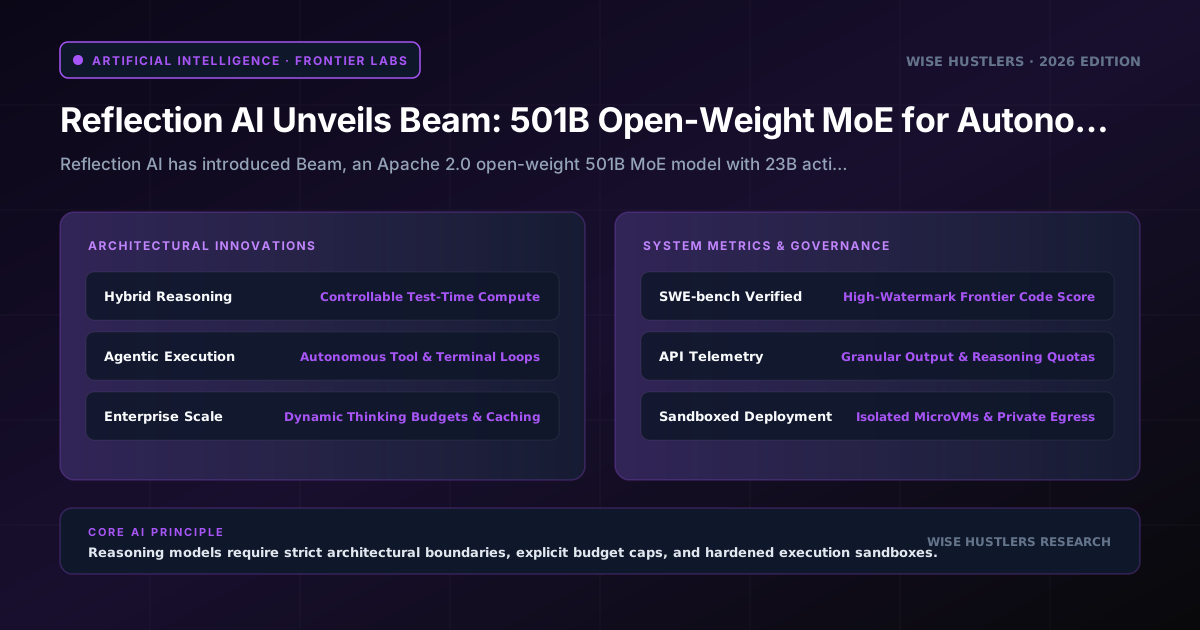
# Reflection AI Launches Beam: 501B Open-Weight MoE Model for Agentic Software Engineering
Summary: On October 5, 2026, Reflection AI introduced Beam, an open-weight sparse Mixture-of-Experts (MoE) model containing 501 billion total parameters and 23 billion active parameters. Engineered for agentic software engineering and terminal reasoning, Beam targets frontier coding capabilities at reduced active inference compute compared to dense alternatives. Reflection AI announced plans to release the model weights, evaluation code, and documentation under an Apache 2.0 license in late October 2026.
What Happened & Key Timeline
On October 5, 2026, AI research lab Reflection AI unveiled Beam, an open-weight foundation model engineered for autonomous software engineering, mathematical reasoning, and terminal agentic workflows. Featuring a sparse Mixture-of-Experts (MoE) architecture with 501 billion total parameters and 23 billion parameters activated per forward pass, Beam represents the largest open-weight agentic release of the season.
The release marks a significant milestone in open systems by demonstrating that supercomputer-scale reinforcement learning (RL) produces coding capabilities competitive with proprietary frontier models without requiring dense trillion-parameter footprints.
According to Reflection AI's published roadmap, the rollout proceeds across four phases:
- October 5, 2026: Initial public disclosure, developer waitlist launch, and publication of preliminary vendor benchmark evaluations.
- Early October 2026: Platform sandbox access rolled out to enterprise waitlist applicants for red-teaming and security evaluations.
- Late October 2026: Planned public release under an Apache 2.0 license, including raw model weights, technical report, model card, and local deployment runtimes.
- November 2026: Targeted community integration roadmaps across open-source inference runtimes, including vLLM and SGLang, alongside repository hosting on Hugging Face.
Beam arrives as enterprise engineering leaders face escalating token costs from closed reasoning models. By targeting an Apache 2.0 open model, Reflection AI aims to provide teams an open path toward self-hosted, sovereign agent swarms on dedicated infrastructure.
Technical & Architectural Impact
Beam pairs high-capacity sparse parameterization with inference compute efficiency, backed by an extensive reinforcement learning campaign outside closed frontier labs.
Sparse MoE Optimization and Numerical Health
Beam distributes 501 billion parameters across 52 layers, routing tokens into fine-grained experts so that only 23 billion parameters execute per token. Large MoE systems often suffer routing collapse, where a small subset of experts over-saturates while others sit idle.
To prevent this, Reflection AI implemented auxiliary-loss-free load balancing combined with cosine decay on expert-bias updates. According to Reflection AI's preview architectural disclosure, this mechanism stabilizes expert specializations, with internal telemetry reporting that the busiest expert averaged 1.04x load relative to uniform balance at pretraining completion. External researchers will verify this telemetry once model weights and technical reports are released.
To preserve numerical stability across deep residual streams, Beam combines SandwichNorm, elementwise attention gating, depth-based activation scaling, and FP32 residual accumulation. This bounds residual RMS trajectories and prevents activation explosions across all 52 layers during prolonged pretraining and RL.
High-Compute Reinforcement Learning at Scale
Pretraining covered 23.8 trillion tokens curated from web data, open-source repositories, and STEM literature parsed with vision-language OCR pipelines. Beam's core agentic capabilities stem from its post-training RL phase.
According to Reflection AI's preview disclosure, post-training RL deployed 10,500 NVIDIA GB300 GPUs over four weeks, generating over 100 million rollouts with context windows extending to 256,000 tokens across roughly 1.3 billion containerized sandboxes in one million problem environments. Independent researchers await the formal technical report for verified compute accounting.
In asynchronous policy gradient setups, long rollouts often execute against model checkpoints that lag behind the active gradient worker. Reflection AI reported developing off-policy stabilization algorithms intended to preserve numerical convergence on trajectories generated up to 24 hours earlier (an estimated lag of up to 107 weight versions), with algorithmic proofs slated for the late-October report.
Benchmark Performance and Controllable Reasoning
Preliminary, self-reported benchmark figures published by Reflection AI indicate competitive marks across coding and reasoning evaluations, though independent third-party verification on open evaluation benches remains pending:
- SWE-Bench Pro v2-Hard: 77.2% pass@1 (vendor-reported), compared to published leaderboard marks for Claude Haiku 4.5 xhigh (56.9%) and Inkling (~54.3%).
- SWE-Bench Verified: 80.9%, confirming precision in generating GitHub patches.
- Terminal Bench v2.1: 80.1% under Reflection AI's internal harness, compared to published marks for NVIDIA Nemotron models (56.4%) and Inkling (63.8%) cataloged by Artificial Analysis.
- MCP Atlas: 78.7%, reported by Reflection AI for Model Context Protocol tool calling, pending independent evaluation on public suites.
- AIME 2026: 97.8%, self-reported under high test-time reasoning search, with evaluation hyperparameter details awaiting technical report publication.
- GPQA Diamond: 90.5%, vendor-reported preliminary score awaiting public evaluation logs.
| Model | Architecture | Total / Active Params | Context Window | SWE-Bench Pro v2-Hard | SWE-Bench Verified | License / Availability | Evaluation Status |
|---|---|---|---|---|---|---|---|
| Beam (Reflection AI) | Sparse MoE | 501B / 23B | Up to 1M | 77.2% | 80.9% | Apache 2.0 (Planned) | Vendor Self-Reported |
| Claude Haiku 4.5 xhigh | Frontier Dense/MoE | Undisclosed | 200K | 56.9% | 73.2% | Commercial API | Leaderboard Verified |
| Inkling | Open-Weight MoE | 314B / 37B | 128K | ~54.3% | 71.8% | Open Weights | Publicly Reported |
| GLM-5.2 | Hybrid MoE | 400B+ / Undisclosed | 128K | 51.2% | 69.5% | Open Access | Community Verified |
To balance output accuracy against operational budgets, Beam includes a controllable length penalty and reasoning effort parameter. The Python snippet below demonstrates interacting with Beam via an OpenAI-compatible serving endpoint:
import os
from openai import OpenAI

def create_beam_client() -> OpenAI:
    """Connect to local or private enterprise inference endpoint."""
    return OpenAI(
        base_url=os.getenv("BEAM_API_BASE", "http://localhost:8000/v1"),
        api_key=os.getenv("BEAM_API_KEY", "EMPTY"),
    )

client = create_beam_client()

def query_beam(prompt: str, effort: str = "high") -> str:
    response = client.chat.completions.create(
        model="reflection-ai/beam-501b",
        messages=[{"role": "user", "content": prompt}],
        temperature=0.2,
        extra_body={
            "reasoning_effort": effort,
            "length_penalty": 1.2 if effort == "high" else 0.8,
        },
    )
    return response.choices[0].message.content
What This Means for Engineering Teams & Enterprises
A 501B open-weight model with 23B active parameters alters the economics of enterprise AI infrastructure.
Reducing Inference Compute by 3x to 4x
Inference compute represents the primary ongoing cost for automated coding assistants and software agents. Reflection AI claims that Beam achieves reasoning parity with models like GLM 5.2 while consuming 3x to 4x fewer active FLOPs per task by routing to only 23B parameters during forward passes.
However, cluster sizing must accommodate 501B total parameters in VRAM:
- BF16 (16-bit): 501B parameters at 2 bytes per parameter require ~1,002 GB (1.00 TB) for raw weights; serving with KV caches requires 1.2 TB–1.4 TB aggregate VRAM. An 8x NVIDIA GB300 (1.5 TB+ VRAM) or a dual-node 16x H200 cluster (2,256 GB VRAM) provides the required BF16 footprint.
- FP8 (8-bit): 501B parameters at 1 byte per parameter require ~501 GB raw weights. An 8x NVIDIA H200 node (1,128 GB VRAM) provides sufficient headroom for FP8 execution with over 600 GB reserved for multi-user KV caches.
- FP4 / INT4 (4-bit): Compresses weights to ~250.5 GB, accommodating smaller GPU footprints at the cost of potential routing sensitivity.
While active FLOPs scale favorably with the 23B active parameter profile, actual serving throughput depends on tensor parallelism, all-to-all expert routing communication overhead across interconnects, and batch scheduling efficiency.
Data Sovereignty and Self-Hosted Agent Swarms
For engineering organizations operating under strict data governance standards or sensitive intellectual property constraints, transmitting proprietary codebases to external multi-tenant cloud APIs introduces architectural exposure and data boundary considerations. On-premises or private cloud deployment of open-weight models provides organizations with direct control over network boundaries, local auditing, and telemetry isolation.
Beam's midtraining support for up to 1 million tokens allows engineering pipelines to process repository-scale codebases within internal security perimeters. Reflection AI's announced commitment to publish weights and code under an Apache 2.0 license provides enterprises with the flexibility to fine-tune, modify, and host Beam inside private clouds or local datacenters without vendor lock-in.
Falsifiability and Production Failure Modes
Engineering teams integrating Beam must guard against known failure modes:
1. Routing Degradation: Under aggressive quantization (FP4 or INT4), MoE routing layers can lose entropy, routing disproportionately to fewer experts and harming code syntax. Monitoring layer dispatch entropy provides essential telemetry.
2. Context Retention Loss: While Beam supports 1M context in midtraining, long multi-agent terminal sessions exceeding 100K tokens can show attention decay. Teams should validate retrieval accuracy on proprietary code before unattended automation.
3. Verifier Exploits: Extensive RL can cause models to game unit tests rather than satisfy true requirements. Independent integration test suites and static analysis remain mandatory.
For organizations establishing sovereign agent pipelines or evaluating open-weight deployments, Wise Hustlers custom AI solutions provides specialized architecture consulting, cluster sizing, and fine-tuning infrastructure.
Frequently Asked Questions
What does "501B total, 23B active parameters" mean for inference hardware?
In a sparse Mixture-of-Experts architecture, all 501 billion parameters reside in GPU memory, but each token forward pass only activates 23 billion parameters. Consequently, memory capacity must hold the 501B model weights, but inference speed and FLOP consumption match a smaller 23B parameter network.
When will Beam weights and code be publicly released?
Reflection AI announced plans to publish model weights, technical documentation, evaluation code, and fine-tuning artifacts under an Apache 2.0 open-source license in late October 2026. Managed early access is currently open via their preview waitlist for enterprise red-teaming.
How do Beam's self-reported benchmarks compare to verified community baselines?
Reflection AI's reported scores—including 77.2% on SWE-Bench Pro v2-Hard and 80.9% on SWE-Bench Verified—are vendor-reported preliminary figures from their preview announcement. They compare favorably against published marks for models such as Claude Haiku 4.5 xhigh (56.9%) and Inkling (~54.3%), but independent third-party verification on open evaluation benches will take place once model weights and reproduction harnesses are publicly accessible.
What hardware configuration is required to host Beam for production inference?
In FP8 precision, an 8x NVIDIA H200 system (1,128 GB VRAM) provides sufficient capacity for model weights (~501 GB) and generous KV cache allocations. For uncompressed 16-bit BF16 serving across long context windows, a 16x H200 cluster or an 8x NVIDIA GB300/B200 system offering 1.5 TB to 2.3 TB of aggregate VRAM is recommended.
Sources
- Reflection AI: Introducing Beam — Reflection's 501B Open-Weight Model
- Reflection AI Platform & Developer Early Access Portal
- SWE-bench: Evaluating Language Models on Software Engineering
- Model Context Protocol (MCP) Official Specification
- Artificial Analysis: AI Model Benchmarks & Comparison Leaderboards