
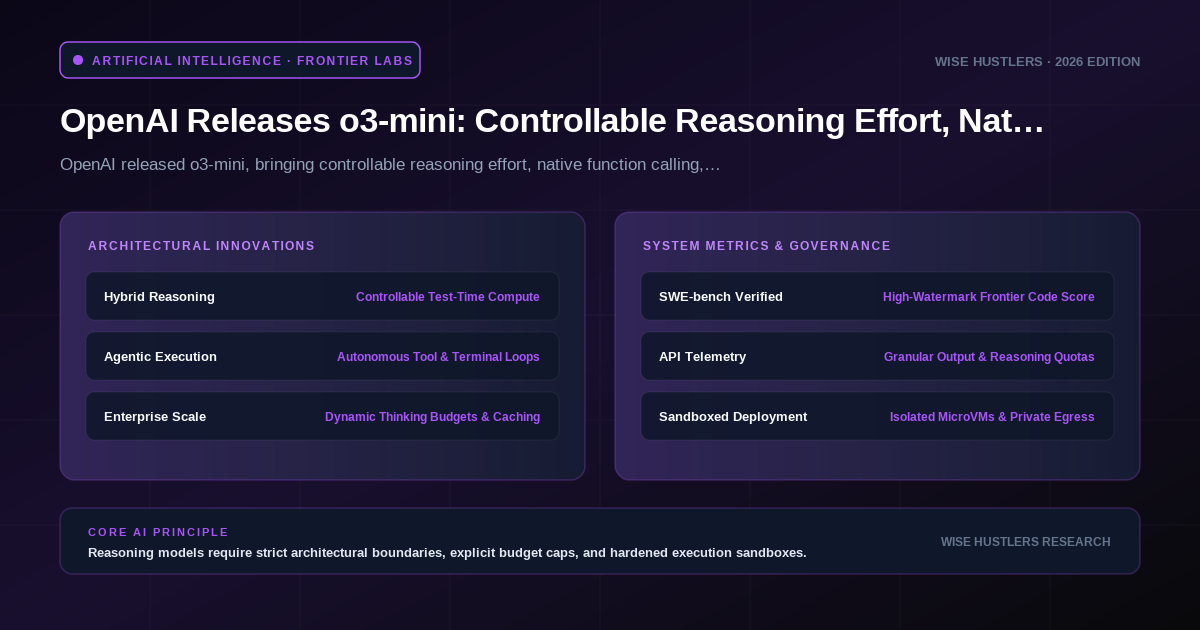
<h1>OpenAI Releases o3-mini: Controllable Reasoning Effort, Native Function Calling, and Enterprise API Impact</h1>
Summary: OpenAI has officially launched o3-mini, a cost-efficient reasoning model engineered for STEM problem-solving, algorithmic coding, and multi-step reasoning. Featuring adjustable reasoning effort, native function calling, and structured outputs at roughly 63% lower cost than o1-mini, o3-mini fundamentally alters the unit economics of enterprise AI agents and establishes a new performance baseline for production engineering pipelines.
What Happened & Key Timeline
On January 31, 2025, OpenAI released o3-mini, the direct successor to o1-mini designed for software engineering, mathematics, and science. The release removes the latency and cost barriers that historically limited reasoning models to offline audits.
The launch unfolded across key channels:
- January 31, 2025: OpenAI launched o3-mini across API tiers 1–5, ChatGPT Plus, Team, Pro, and free tiers.
- January 31, 2025: GitHub rolled out o3-mini in public preview for GitHub Copilot in Visual Studio Code, enabling deep reasoning directly in editor workflows.
- February 2025: OpenAI expanded o3-mini to ChatGPT Enterprise and Edu workspaces, providing organizational administrative controls and workspace data isolation.
Earlier o1 models scored high on benchmarks but lacked tool calling, rejected JSON schemas, and cost up to $60.00 per million tokens. Consequently, teams routed interactive pipelines to GPT-4o, reserving reasoning models for offline evaluation. The release of o3-mini unifies these operational requirements.
Technical & Architectural Impact
The release introduces key architectural capabilities that transform reasoning models into production infrastructure.
Controllable Test-Time Compute via reasoning_effort
In reasoning models, response accuracy scales directly with test-time compute—the volume of internal thinking tokens generated before producing an answer. Previously, models produced reasoning tokens until internal heuristics triggered, offering developers no control over latency or spend.
OpenAI introduced the reasoning_effort parameter with three distinct modes:
low: Minimizes reasoning token production for low latency. Optimal for classification, syntax remediation, and rapid routing.medium: The default configuration, balancing chain-of-thought verification with fast token generation for interactive workflows.high: Allocates maximum test-time compute to exploratory search, designed for complex algorithmic refactoring and theorem proving.
Exposing reasoning_effort allows architects to dynamically tune compute budgets based on query difficulty, enforcing service-level agreements (SLAs) and controlling inference expenses.
from openai import OpenAI

client = OpenAI()

# Initialize o3-mini with controllable test-time compute
response = client.chat.completions.create(
    model="o3-mini",
    reasoning_effort="high",  # "low" | "medium" | "high"
    messages=[
        {"role": "developer", "content": "You are a software architect analyzing distributed systems."},
        {"role": "user", "content": "Compare raft log replication vs Paxos in high-throughput architectures."},
    ],
)

print(response.choices[0].message.content)
Native Tool Use: Function Calling in the Reasoning Loop
Previous reasoning models operated as closed text generators. Integrating external tools required fragile parsing and complex multi-turn coordination.
The o3-mini architecture embeds function calling directly into its reinforcement learning loop. During execution, o3-mini emits a structured tool call, pauses while the runtime executes the function, ingests the JSON payload, and resumes its reasoning chain. This allows the model to test code against compiler feedback, query database schemas, and validate API responses before finalizing implementations.
Guaranteed Schema Compliance with Structured Outputs
In production systems, non-deterministic model outputs break downstream services. Earlier reasoning models lacked schema constraints, forcing developers to rely on regex parsing and retry loops to catch malformed JSON.
With o3-mini, OpenAI enabled native Structured Outputs with schema enforcement (strict: true). The inference engine restricts token sampling strictly to valid schema transitions, guaranteeing schema adherence for automated triage engines and typed API gateways.
Pricing Architecture and Expanded Context Window
The unit economics of o3-mini shift the pricing profile of reasoning infrastructure. OpenAI reduced token rates by roughly 63% compared to o1-mini, expanding the context window to 200,000 tokens with a 100,000-token completion ceiling:
| Feature / Metric | OpenAI o1-mini | OpenAI o3-mini | Architectural Delta |
|---|---|---|---|
| Input Price (per 1M tokens) | $3.00 | $1.10 | 63.3% reduction |
| Output Price (per 1M tokens) | $12.00 | $4.40 | 63.3% reduction |
| Batch Output (per 1M tokens) | $6.00 | $2.20 | 63.3% reduction |
| Context Window | 128,000 tokens | 200,000 tokens | +56.3% context capacity |
| Max Output Tokens | 65,536 tokens | 100,000 tokens | +52.6% generation limit |
| reasoning_effort Control | Unsupported | low, medium, high | Dynamic compute budgeting |
| Function Calling | Unsupported | Supported | In-loop tool execution |
| Structured Outputs | Unsupported | Supported (strict: true) | Deterministic JSON compliance |
Benchmark Performance Across Coding and STEM
OpenAI reported notable benchmark evaluations demonstrating gains over earlier models:
- SWE-bench Verified: Scored 49.3% in high reasoning effort on real-world GitHub issues.
- GPQA Diamond: Scored 79.7% on PhD-level scientific questions.
- AIME 2024: Achieved an 87.3% pass@1 score under high reasoning effort, demonstrating advanced mathematical capability without requiring consensus sampling.
- Codeforces: Achieved an Elo rating of 2073 in competitive programming evaluations, placing it among elite competitive programmers.
Independent evaluations from Artificial Analysis confirmed that o3-mini delivers frontier coding performance while maintaining significantly lower latency than flagship reasoning models.
What This Means for Engineering Teams & Enterprises
The rollout of o3-mini changes how engineering teams design and operate AI systems.
Collapsing Multi-Model Routing Layers
Enterprise architectures frequently required dual-model pipelines: a lightweight model handled tool execution, while a reasoning model handled complex logic. This topology introduced latency overhead, cache invalidation hurdles, and fragile fallback logic.
By integrating function calling, structured outputs, and adjustable compute, o3-mini consolidates these pipelines into a single model. One endpoint handles schema validation under low effort and escalates to high effort when complex exceptions emerge.
Unit Economics in CI/CD and Automated Review
Automated code review agents process hundreds of pull requests daily. At $12.00 to $60.00 per million output tokens, continuous reasoning across large monorepos was cost-prohibitive.
At $4.40 per million output tokens—and $2.20 on the Batch API—o3-mini makes continuous reasoning economically viable. Engineering teams can run automated security reviews, dependency conflict detection, and architectural linting on every commit within standard infrastructure budgets.
Transitioning from Prototypes to Production Agentic Systems
While consumer tools demonstrate basic prompt automation, production enterprise agents require deterministic execution, least-privilege tool access, and VPC-level security. For engineering leaders modernizing internal workflows, Wise Hustlers custom AI engineering services build production-ready agent architectures, deterministic orchestration pipelines, and secure enterprise integrations.
FAQ Section
How does o3-mini differ from OpenAI o1 and o1-mini?
The o3-mini model costs roughly 63% less than o1-mini ($1.10/$4.40 vs $3.00/$12.00 per million tokens), expands the context window to 200,000 tokens, and introduces the reasoning_effort parameter (low, medium, high). Crucially, o3-mini natively supports function calling and Structured Outputs (strict: true), capabilities absent from earlier reasoning models.
How are reasoning tokens billed in the o3-mini API?
Reasoning tokens are generated during the model's internal thinking process and billed at the standard output rate of $4.40 per million tokens ($2.20 on the Batch API). While counted in total usage metrics for billing and rate limits, raw reasoning text remains hidden to protect proprietary alignment techniques.
Can o3-mini be deployed within enterprise compliance boundaries?
Yes. Like earlier foundation models in the OpenAI API, o3-mini operates under standard enterprise data privacy commitments: OpenAI does not use API inputs, outputs, or reasoning tokens to train future models by default. For regulated environments, qualifying enterprise organizations can establish custom agreements, including Zero Data Retention (ZDR), subject to organizational approval. Additionally, ChatGPT Enterprise and Edu deployments enforce workspace-level data isolation and administrative controls aligned with SOC 2 compliance standards.