
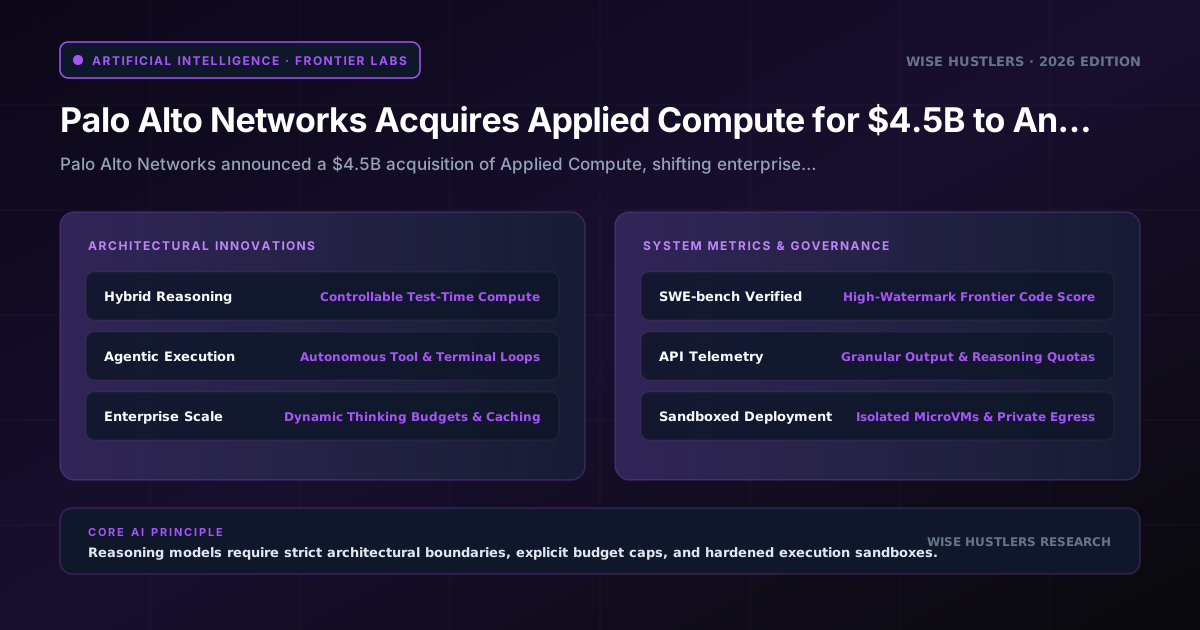
# Palo Alto Networks Acquires Applied Compute for $4.5B: The Enterprise Shift to Open-Weight Post-Training
Summary: Palo Alto Networks entered a definitive $4.5 billion all-stock agreement to acquire Applied Compute, an AI startup founded by former OpenAI researchers that reached $100 million in annualized revenue in 18 months. The acquisition moves enterprise AI from closed third-party model APIs to private post-training and secure inference of open-weight models. By integrating reinforcement learning pipelines with perimeter security, enterprises gain deterministic control over proprietary weights, customer data, and agent execution.
What Happened & Key Timeline
On November 18, 2026, cybersecurity firm Palo Alto Networks (NASDAQ: PANW) announced a definitive agreement to acquire Applied Compute, an 18-month-old AI infrastructure platform, in an all-stock transaction valued at $4.5 billion. The transaction represents one of the largest infrastructure acquisitions in enterprise AI history, cementing a broader strategic repositioning for Palo Alto Networks beyond perimeter security and into model compute governance.
Applied Compute was founded in mid-2025 by a team of former OpenAI researchers led by 23-year-old CEO Yash Patil. The startup achieved steep commercial velocity, crossing $100 million in annualized run-rate (ARR) prior to the transaction by serving enterprise customers including DoorDash and legal-tech platform Harvey. Under the terms of the agreement, which is scheduled to close during Palo Alto Networks' fiscal third quarter of 2027 subject to customary regulatory approvals, Yash Patil will join the executive leadership team as Co-Chief AI Officer.
During the company’s fiscal first-quarter 2027 earnings presentation, Palo Alto Networks Chairman and CEO Nikesh Arora framed the purchase as a fundamental response to how Global 2000 enterprises deploy machine learning. Arora stated that while the first wave of enterprise generative AI relied almost entirely on closed frontier APIs, production deployments are rapidly migrating toward hybrid architectures where specialized, private open-weight models run inside corporate perimeters. Arora projected that Applied Compute’s addressable compute and post-training footprint could eventually match or exceed Palo Alto Networks' traditional perimeter security revenue.
The deal caps an accelerating sequence of consolidations across AI infrastructure throughout late 2026, demonstrating that enterprise security vendors must operate at the inference and training layer rather than acting merely as passive API gateways.
Technical & Architectural Impact
The core technical asset of Applied Compute is its AC2 platform (Applied Compute Agent Cloud), an integrated post-training and high-performance inference engine built specifically for open-weight foundation models like DeepSeek, Qwen, and GLM. To understand the architectural importance of this acquisition, systems engineers must evaluate the operational bottleneck in modern enterprise AI: the gap between generic pre-trained weights and reliable task execution.
Pre-trained foundation models possess broad conversational reasoning but consistently fail in production environments due to schema hallucinations, non-deterministic tool calling, and brittle compliance alignment. While many software teams initially attempted to fix these shortcomings through complex prompt engineering and Retrieval-Augmented Generation (RAG) context stuffing, these approaches introduce latency overhead, expand token costs, and degrade as reasoning depth increases.
Applied Compute solved this constraint by industrializing the post-training loop through two core methodologies:
1. Automated Reinforcement Learning with Verifiable Rewards (RLVR): Rather than relying solely on manual Supervised Fine-Tuning (SFT) using static human-annotated datasets, AC2 uses algorithmic reward models and automated evaluation sandboxes. An internal orchestrator, known as ARI (Automated Research Instance), systematically generates targeted synthetic reasoning traces, tests candidate weights against strict customer eval suites, and executes iterative policy gradient updates. This process bakes domain-specific business logic, API validation schemas, and deterministic control directly into model parameter weights.
2. Kernel-Optimized Unified Inference & Training Runtime: Traditional machine learning pipelines maintain an expensive separation between training clusters (built on frameworks like Megatron-LM or DeepSpeed) and production serving infrastructure (such as vLLM or TensorRT-LLM). AC2 unifies this lifecycle. Models are adapted using optimized flash-attention kernels, custom quantization formats (FP8 and INT4 weight-only), and continuous online telemetry updates. When an agent experiences an edge-case failure in production, that trace is converted into a regression unit test and fed back into the next RLVR adaptation cycle.
By acquiring this stack, Palo Alto Networks integrates security directly into the model adaptation loop. Rather than inspecting prompts at an external proxy layer after malicious data has entered the context window, enterprise security policies can now be enforced as mathematical reward penalties during post-training. This prevents prompt injection breakouts, unauthorized data extraction, and tool privilege escalations at the weight layer.
What This Means for Engineering Teams & Enterprises
For engineering leaders and platform architects, the acquisition validates a decisive architectural shift: enterprise AI is moving from rented intelligence to owned intelligence.
Relying exclusively on commercial closed APIs presents serious long-term liabilities for enterprise software systems:
- Data Sovereignty and Confidentiality: Regulated sectors—including banking, healthcare, and telecommunications—cannot transmit sensitive intellectual property or personally identifiable information (PII) to shared multi-tenant cloud APIs.
- Inference Cost Predictability: High-throughput workflows running millions of tokens per day become economically unsustainable under closed API per-token billing models.
- Model Drift and Deprecation Risks: Upstream model updates by third-party providers frequently break fragile prompt formulations and functional tool-calling contracts without notice.
By bringing Applied Compute into an enterprise-grade distribution network, software engineering teams obtain the tools to take state-of-the-art open-weight models, adapt them on proprietary corporate codebases, and host them inside private Virtual Private Clouds (VPCs) or sovereign data centers.
Engineering teams must now treat model post-training as a standard phase of their Continuous Integration and Continuous Deployment (CI/CD) pipelines. In this operational model, model weights are versioned alongside source code, pull requests trigger automated verification suites, and reward functions enforce compliance rules. Collaborating with seasoned infrastructure partners—such as Wise Hustlers custom engineering services—allows enterprise engineering organizations to design scalable post-training pipelines, select cost-effective GPU compute clusters, and deploy hardened private agent architectures without technical friction.
Frequently Asked Questions
Why are enterprises shifting from closed API models to open-weight post-training?
Closed model APIs provide rapid initial prototyping, but they introduce compounding risks around data privacy, unpredictable token pricing at scale, and sudden model deprecations. Post-training open-weight models (such as Qwen, DeepSeek, or Llama variants) using private company telemetry allows organizations to own their model weights, run inferences entirely within private clouds, and tailor model behaviors to precise internal schemas.
What is the difference between prompt engineering, RAG, and RLVR post-training?
Prompt engineering guides model outputs through natural language instructions in the input context, while RAG injects external documents dynamically at query time. In contrast, Reinforcement Learning with Verifiable Rewards (RLVR) updates the actual parameter weights of the neural network using mathematical reward functions and automated validation tests. RLVR bakes domain constraints directly into the model, eliminating token bloat and dramatically reducing hallucination rates.
When will Palo Alto Networks integrate Applied Compute into its product line?
The transaction is expected to close in Palo Alto Networks' fiscal third quarter of 2027, subject to customary regulatory approvals. Following the close, Applied Compute's AC2 technology will form the foundation of Palo Alto Networks' private AI compute and security governance offerings, led by co-founder Yash Patil as Co-Chief AI Officer.
Sources
- Palo Alto Networks Official Announcement: Agreement to Acquire Applied Compute
- SDxCentral: Palo Alto Networks Bets $4.5B on Applied Compute for Enterprise AI Infrastructure
- TechZine: Palo Alto Networks Acquires Applied Compute in $4.5B All-Stock Deal
- PYMNTS: Palo Alto Networks to Acquire Applied Compute for $4.5 Billion to Accelerate Enterprise AI