
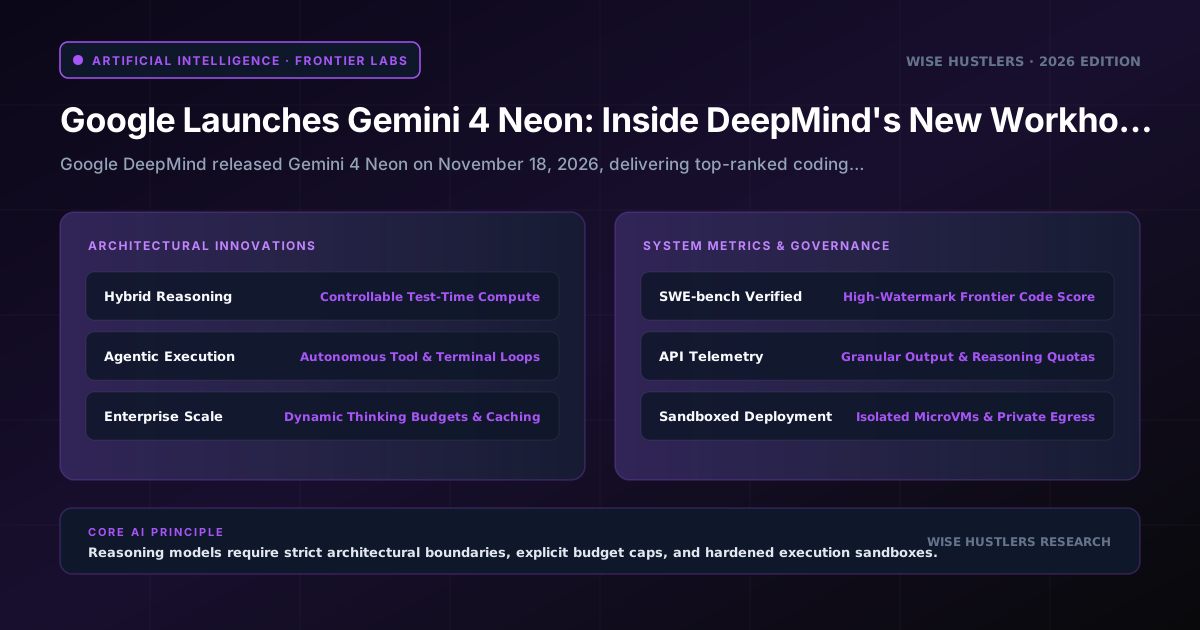
<h1>Google Launches Gemini 4 Neon: Inside DeepMind's New Workhorse for Autonomous Software Engineering</h1>
Summary: On November 18, 2026, Google DeepMind unveiled Gemini 4 Neon, a specialized model engineered for autonomous software development and multi-agent systems. Taking the top spot on the independent Artificial Analysis Coding Agent Index with a 58.6 score, Neon operates alongside Google-reported cost savings of 32 percent compared to Gemini 4 Carbon. The release establishes an efficient operational baseline for enterprise software engineering pipelines.
The enterprise artificial intelligence landscape shifted this week with the arrival of Google DeepMind's Gemini 4 Neon. Engineered specifically to tackle high-frequency, complex software engineering tasks and multi-agent orchestration, Neon addresses the primary operational bottleneck facing enterprise AI adoption: the steep cost and latency penalty of running top-tier reasoning models across continuous deployment loops.
As reported by TechCrunch, enterprise software organizations have faced unsustainable cloud bills when routing high-frequency agentic feedback loops through heavy frontier models. By adapting the core reasoning architecture of Gemini 4 Carbon into a streamlined inference envelope, DeepMind has produced an engine optimized for sustained agentic execution. Rather than treating coding tasks as one-off completions, Neon is structured to handle iterative debugging, automated test generation, and repository-scale refactoring while maintaining strict budget boundaries.
What Happened & Key Timeline
The debut of Gemini 4 Neon completes an aggressive fourth-generation model rollout from Google throughout autumn 2026. The phased strategy reflects an enterprise shift away from generalist frontier models toward workload-specialized agent engines:
- Mid-October 2026: Following its September 30 announcement, Google Cloud reached General Availability on October 13 for Gemini 4 Argon, a specialized model for automated cybersecurity operations, vulnerability remediation, and enterprise threat intelligence.
- Late October 2026: Google DeepMind unveiled Gemini 4 Carbon on October 28 as its flagship deep-reasoning model for high-complexity architecture and scientific discovery.
- Mid-November 2026: On November 12, Google DeepMind launched Gemini 4 Hydrogen, an ultra-fast execution model tailored for routine tool calling, conversational routing, and rapid triage across Google Workspace and CI/CD pipelines.
- November 18, 2026: Google DeepMind officially announced Gemini 4 Neon (
gemini-4-neon), opening access immediately across Google AI Studio, Google Cloud Vertex AI, Android Studio, and the Google Antigravity developer environment. - November 19–21, 2026: Independent evaluation platforms, led by the Artificial Analysis Coding Agent Index, published comprehensive benchmark verifications. Neon scored 58.6 on the Coding Agent Index, claiming the first-place ranking over competing models. Concurrently, at its highest computational setting, Neon recorded an overall intelligence score of 61, placing third globally and outperforming baseline runs of Gemini 4 Carbon.
This rapid sequence of releases demonstrates a deliberate architectural playbook: establish high-throughput foundations with Hydrogen, isolate security governance with Argon, and anchor the core engineering workflow in Neon.
Technical & Architectural Impact
The architecture of Gemini 4 Neon is derived directly from Gemini 4 Carbon, but it incorporates an optimized sparse attention mechanism and a re-engineered parameter routing profile. This design yields significant improvements in token generation velocity and inference-time efficiency.
Configurable Thinking Budgets
At the heart of Neon is a dynamic reasoning scheduler. Rather than locking engineers into a fixed chain-of-thought overhead, the model exposes four discrete reasoning settings:
1. Low: Direct inference with minimal intermediate scratchpad tokens, designed for fast unit testing, boilerplate code generation, and single-file syntax corrections.
2. Medium: Standard multi-step reasoning that checks internal logic branches before emitting code patches, ideal for API integration and refactoring functions under 500 lines.
3. High: Deep analytical verification, where the model performs extensive code tracing, dependency analysis, and edge-case simulation prior to code synthesis.
4. Extra High (`xhigh`): An expansive reasoning mode designed for complex architectural re-platforming and formal verification. In this mode, Neon generated up to 283 million evaluation tokens during Artificial Analysis stress testing, achieving frontier-level reasoning depth.
Context Buffer and Output Throughput
Gemini 4 Neon features a native 1-million-token input context window capable of ingesting full monorepos, database schemas, API specifications, and architectural diagrams in a single prompt. Because the model is natively multimodal, it accepts raw architectural whiteboards, network packet captures, and PDF engineering briefs alongside standard source code.
According to the official Google Cloud Vertex AI Model Reference, Neon supports up to 64,000 synchronous output tokens per request for interactive generation. For large-scale batch tasks, such as complete repository modernizations or automated documentation overhauls, the developer API specifications detail an asynchronous long-decode mode that scales batch output generation to 1 million tokens.
Token Economics and Prompt Caching
The operational cost model is tailored for continuous automated pipelines. According to the official Google Cloud Vertex AI Pricing Schedule, standard API consumption is structured as follows:
- Input Tokens: Priced at $3.00 per million tokens for standard dynamic prompt payloads.
- Cached Input Tokens: Priced at $0.15 per million tokens, representing a 95 percent discount for persisted repository contexts, static dependencies, and recurring system instructions.
- Output Tokens: Priced at $15.00 per million tokens, encompassing all generated scratchpad reasoning and final code artifacts.
In its first-party launch disclosures, Google reported that at its default High thinking configuration, Neon executes coding agent benchmarks at approximately a 32 percent lower cost per completed task compared to Gemini 4 Carbon. While independent verification from Artificial Analysis confirmed Neon's throughput advantages and benchmark dominance, teams should evaluate their own repository sizes and cache hit rates to project actual cost reductions.
Gemini 4 Architecture & Benchmark Comparison
The fourth-generation Gemini lineup establishes distinct operational parameters across each model tier:
| Model Variant | Primary Workload | Context Window | Max Output (Sync) | Coding Agent Index | Published API Rate (Input / Output per 1M) |
|---|---|---|---|---|---|
| Gemini 4 Hydrogen | Triage, routing, fast tool calling | 128,000 tokens | 8,192 tokens | 42.1 | $0.20 / $0.80 |
| Gemini 4 Neon | Autonomous coding, refactoring, agent loops | 1,000,000 tokens | 64,000 tokens | 58.6 | $3.00 / $15.00 ($0.15 cached) |
| Gemini 4 Carbon | High-horizon architecture, theorem proving | 2,000,000 tokens | 64,000 tokens | 57.2 | $5.00 / $25.00 ($0.50 cached) |
| Gemini 4 Argon | Automated vulnerability remediation & SecOps | 1,000,000 tokens | 32,000 tokens | 54.8 (SecOps) | $4.50 / $20.00 ($0.30 cached) |
Implementing Gemini 4 Neon with Vertex AI Python SDK
Developers integrating Gemini 4 Neon into automated CI/CD runners or local agents can configure reasoning budgets and token bounds via the standard Google Cloud SDK:
import os
from google import genai
from google.genai import types

# Initialize client targeting Google Cloud Vertex AI
client = genai.Client(
    vertexai=True,
    project=os.environ.get("GOOGLE_CLOUD_PROJECT", "production-infra"),
    location="us-central1",
)

# Configure Gemini 4 Neon with explicit thinking budget and output limits
response = client.models.generate_content(
    model="gemini-4-neon",
    contents="Refactor the authentication middleware to enforce zero-trust session validation.",
    config=types.GenerateContentConfig(
        thinking_config=types.ThinkingConfig(
            thinking_budget=16384  # Configurable: 2048 (low), 8192 (medium), 16384 (high)
        ),
        temperature=0.2,
        max_output_tokens=64000,
    ),
)

print(f"Refactored Implementation:\n{response.text}")
What This Means for Engineering Teams & Enterprises
The arrival of Neon alters the engineering economics of autonomous software development. In earlier iterations of AI-assisted development, organizations were forced to choose between inexpensive models with poor multi-step reasoning or high-capability models whose token consumption made automated swarms cost-prohibitive. Neon resolves this friction by establishing a balanced performance tier.
Shift to Stratified Model Routing
Engineering platforms are increasingly moving away from monolithic agent architectures. Instead, systems run multi-tiered agent teams:
1. Strategic Planning Tier: Deep-horizon models like Gemini 4 Carbon map high-level system requirements, break down dependencies, and create task tickets.
2. Implementation Tier: Gemini 4 Neon receives structured tasks, writes code, creates git commits, and executes localized refactoring.
3. Validation & Triage Tier: Lightweight engines like Gemini 4 Hydrogen run linters, parse unit test logs, and ping developer communications channels.
This hierarchical approach preserves developer productivity while keeping cloud inference expenses predictable.
Hardware Isolation and Tool Boundaries
Because Neon excels at autonomous execution, enterprise security teams must enforce strict sandboxing around agent runtimes. Automated agents writing code, pulling third-party packages, and issuing terminal commands require hardware-level microVM isolation and granular access boundaries rather than open host access.
For organizations looking to deploy autonomous multi-model agent architectures, Wise Hustlers custom engineering services helps enterprises design, benchmark, and integrate hardened agentic pipelines with enterprise governance and spend controls. By pairing advanced routing logic with dedicated runtime isolation, engineering teams can deploy coding agents that produce verified production software safely.
FAQ Section
How does Gemini 4 Neon differ from Gemini 4 Hydrogen and Carbon?
Gemini 4 Hydrogen is an ultra-fast, low-cost execution model designed for routine triage, lightweight tool usage, and basic classification. Gemini 4 Carbon is Google's flagship reasoning model built for high-complexity scientific analysis and long-horizon architecture planning. Gemini 4 Neon bridges these models, offering top-tier coding performance and deep analytical reasoning while reducing operational cost per completed task compared to Carbon.
Can Gemini 4 Neon run fully offline or self-hosted?
No. Gemini 4 Neon is a cloud-hosted proprietary model offered through Google Cloud Vertex AI and Google AI Studio. Enterprise engineering teams can configure deployment boundaries using Google Cloud VPC Service Controls, integrate Customer-Managed Encryption Keys (CMEK), and apply enterprise data-governance settings under their existing Google Cloud organizational policies and service agreements.
What is the advantage of Gemini 4 Neon's context caching?
Neon supports context caching at $0.15 per million input tokens, compared to $3.00 per million uncached input tokens on the Vertex AI rate schedule. In continuous development environments where large codebases, schema definitions, and system guidelines remain stable across multiple agent iterations, caching reduces overall input token overhead by up to 95 percent.
Which thinking budget is optimal for continuous integration agents?
For standard CI/CD linting, formatting, and single-function unit test generation, the Medium reasoning budget provides an optimal trade-off between latency and accuracy. For complex multi-file refactoring, dependency migrations, or state-machine redesigns, configuring Neon to High (16,384 thinking tokens) ensures comprehensive edge-case analysis before code emission.
Sources
- Google DeepMind: Gemini 4 Neon Announcement
- Google DeepMind: Gemini 4 Hydrogen Architecture & Release
- Google DeepMind: Gemini 4 Carbon Frontier Reasoning
- Google Cloud Security: Gemini 4 Argon Deployment
- Google Cloud Vertex AI Pricing Schedule
- Google Cloud Vertex AI Model Reference: Gemini 4 Neon
- Artificial Analysis: Gemini 4 Neon Coding Agent Index & Benchmark Report
- TechCrunch: Google DeepMind Unveils Gemini 4 Neon for Agentic Coding Workloads