
<h1>Microsoft Unveils MAI Code 2 and Licensed Weights at Ignite 2026: An Enterprise Systems Deep Dive</h1>
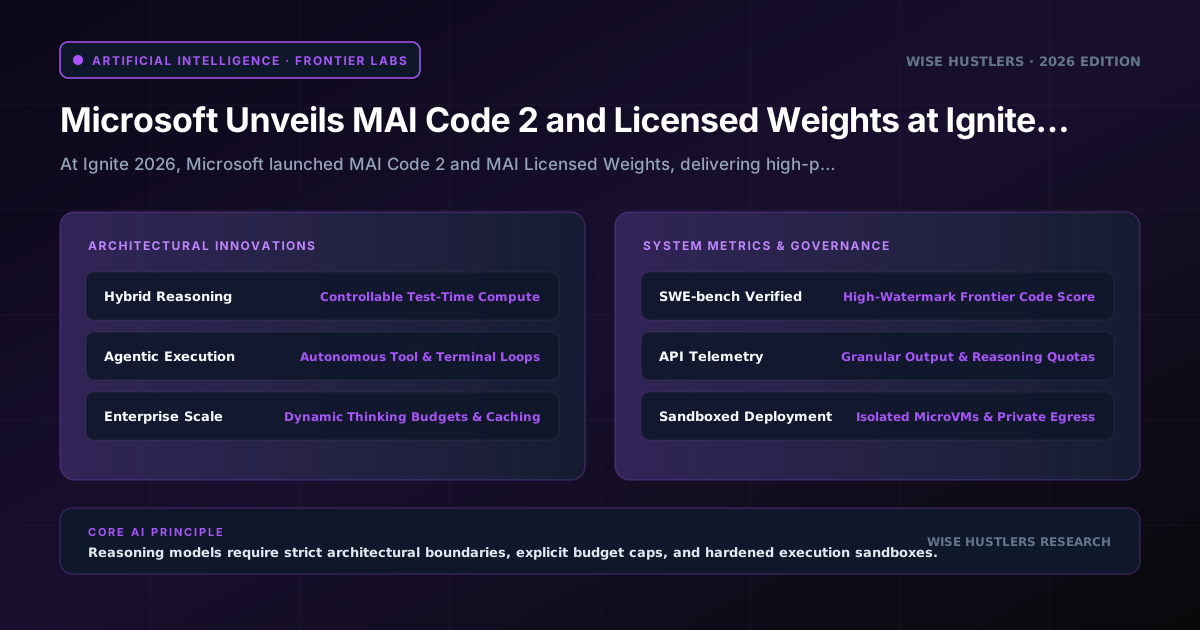
Summary: On November 17, 2026, Microsoft Chairman and CEO Satya Nadella and Microsoft AI CEO Mustafa Suleyman unveiled MAI Code 2 and MAI Licensed Weights at Ignite 2026. The release integrates Microsoft's proprietary frontier coding models directly into GitHub Copilot while introducing a private weight licensing model in Azure. This architectural pivot provides cost-efficient multi-file agentic coding and enhanced data sovereignty for enterprise engineering teams evaluating private cloud deployments.
What Happened & Key Timeline
On November 17, 2026, at the Microsoft Ignite conference in San Francisco, Microsoft announced a strategic expansion of its in-house artificial intelligence portfolio. Chairman and CEO Satya Nadella and Microsoft AI CEO Mustafa Suleyman unveiled the second-generation Microsoft AI (MAI) model family, signaling Microsoft's transition from an infrastructure host reliant on external foundational model providers toward a vertically integrated developer of proprietary frontier AI.
The announcement introduces two core offerings for software engineering organizations:
1. MAI Code 2 & MAI Code 2 Flash: Proprietary models engineered specifically for autonomous agentic workflows, repository-wide reasoning, deep debugging, and multi-file refactoring, deployed immediately across GitHub Copilot and Azure AI Foundry.
2. MAI Licensed Weights: An enterprise licensing initiative through Microsoft's Frontier Company program that allows organizations to license model weights directly for private fine-tuning and isolated execution inside dedicated Azure virtual networks (VNets).
Established under Suleyman in early 2024, Microsoft AI has progressed from early internal checkpoints to full general availability of production-grade models at Ignite 2026.
Supporting ecosystem announcements include:
- MAI Cyber 2 Flash: A domain-specialized model designed for automated vulnerability triage, security patch generation, and policy enforcement.
- Microsoft-Decision-1.1: A low-latency routing engine directing developer tasks between fast completion models and deeper reasoning tiers.
- Azure Maia 200 AI Accelerators: Second-generation custom datacenter silicon optimized for high-throughput model inference.
- Copilot Workspaces & Autopilot: Native environments in which autonomous coding agents execute multi-turn, asynchronous developer workflows.
During the keynote presentation, Suleyman highlighted internal vendor benchmarks claiming MAI Code 2 achieves approximately 98% of OpenAI GPT-6.1 Sol coding performance at roughly 40% of the cost, and 96% of Anthropic Claude Opus 5.5 capability at approximately 5% of the token price. While independent evaluation frameworks (such as SWE-bench Verified or HumanEval audits) have not yet verified these comparative cost-efficiency metrics, the pricing posture demonstrates Microsoft's commitment to lowering the cost of automated software engineering.
Technical & Architectural Impact
MAI Code 2 and the Licensed Weights framework address three persistent architectural bottlenecks in enterprise software engineering: inference latency, token burn across iterative agentic loops, and source code boundary isolation.
Agentic Execution Loops and Token Economics
Traditional IDE code completion depends on single-turn inference generating a dozen tokens at a time. In contrast, modern agentic software engineering operates as an iterative feedback loop: an autonomous agent parses an issue description, builds an Abstract Syntax Tree (AST), traces dependency graphs across modules, drafts multi-file diffs, executes test runners, and refactors code based on compiler diagnostics.
In complex repository environments, these multi-turn loops accumulate tens of thousands of tokens per completed pull request. When relying on flagship frontier models whose output tokens have historically been priced at $15 to $30 per million tokens on managed cloud APIs, running continuous background developer agents across large enterprise teams created substantial operational expenditures.
MAI Code 2 mitigates this through a tiered architectural design:
- MAI Code 2 Flash: A lightweight, low-latency model optimized for rapid iteration, inline completions, routine bug fixes, and single-function edits with minimal computational overhead.
- MAI Code 2: A larger model equipped with extended reasoning buffers and broad context retention, designed for multi-file diff generation, complex dependency analysis, and architectural refactoring across large codebases.
Separating routine inline tasks from complex repository reasoning reduces the average token cost profile of continuous CI/CD agents.
Model Architecture & Enterprise Deployment Comparison
The table below contrasts the technical and deployment profiles of MAI Code 2 variants against representative frontier models:
| Architecture Metric | MAI Code 2 | MAI Code 2 Flash | Claude Opus 5.5 (Baseline) | GPT-6.1 Sol (Baseline) |
|---|---|---|---|---|
| Primary Workload | Multi-file refactoring, deep debugging, repo reasoning | Inline code completion, routine fixes, code explanation | Complex multi-domain reasoning, frontier code synthesis | Frontier code generation, agentic architecture planning |
| Vendor Cost Profile | Internal claim: ~40% cost of GPT-6.1 Sol | Ultra-low cost tier for high-frequency completion | Flagship frontier API pricing tier | High-tier frontier API pricing tier |
| Deployment Mode | Managed API & Licensed Weights (Azure) | Managed API via GitHub Copilot & Foundry | Multi-tenant Managed Cloud API | Multi-tenant Managed Cloud API |
| Execution Silicon | Azure Maia 200 & Azure AI Infrastructure | Azure Maia 200 & Enterprise Compute | Cloud Provider Datacenter Clusters | Cloud Provider Datacenter Clusters |
| Network Boundary | Dedicated Azure VNet / Private Endpoints | GitHub Copilot Multi-Tenant Service | Public / VPC Managed Endpoints | Public / Enterprise API Endpoints |
| Customization | Private LoRA / Parameter Tuning in Tenant | Context window routing / System prompts | Model fine-tuning via provider platform | Model fine-tuning via provider platform |
The Licensed Weights Paradigm
Prior to the Ignite 2026 announcement, enterprise systems architects faced a structural compromise:
- Closed API Endpoints: Delivered state-of-the-art reasoning quality, but source code snippets leave corporate boundaries to reach external multi-tenant infrastructure, introducing latency variance and external rate limits.
- Open-Source Weights: Provided complete data boundary control, but required internal engineering teams to absorb the operational overhead of cluster provisioning, quantization, security patching, and manual fine-tuning.
MAI Licensed Weights introduces an intermediate architecture. Enterprises acquire contractual access to Microsoft's trained model checkpoints, deploying them inside dedicated Azure subscription boundaries. Organizations can apply Low-Rank Adaptation (LoRA) or parameter tuning directly to proprietary codebases without transmitting intellectual property to external endpoints.
To enforce network isolation, engineering teams configure Azure Private Endpoints, disabling public internet ingress so that inference traffic never leaves corporate virtual networks:
# Provision private network isolation for Azure AI Foundry and MAI Licensed Weights
# Ensures model endpoints resolve strictly to private IP space within the enterprise VNet

# 1. Create a dedicated subnet for AI model inference endpoints
az network vnet subnet create \
  --resource-group rg-enterprise-ai \
  --vnet-name vnet-core-production \
  --name snet-ai-private-endpoints \
  --address-prefixes 10.240.4.0/24 \
  --disable-private-endpoint-network-policies true

# 2. Deploy the Private Endpoint linking Azure AI Foundry to the enterprise subnet
az network private-endpoint create \
  --resource-group rg-enterprise-ai \
  --name pe-mai-licensed-weights \
  --vnet-name vnet-core-production \
  --subnet snet-ai-private-endpoints \
  --private-connection-resource-id "/subscriptions/${AZURE_SUBSCRIPTION_ID}/resourceGroups/rg-enterprise-ai/providers/Microsoft.CognitiveServices/accounts/foundry-mai-cluster" \
  --group-id account \
  --connection-name conn-mai-isolated-endpoint

# 3. Restrict inbound traffic to eliminate public internet exposure
az cognitiveservices account update \
  --resource-group rg-enterprise-ai \
  --name foundry-mai-cluster \
  --public-network-access Disabled
Production Falsifiability: Validating Vendor Claims
Systems architects should evaluate vendor benchmarks with methodological skepticism. To verify whether MAI Code 2 meets enterprise production standards, teams must establish an empirical validation framework:
- Syntax and AST Validation: Track the proportion of agent-generated multi-file diffs that compile cleanly without syntax errors or hallucinated internal library imports.
- Automated Test Pass Ratio: Measure the rate at which agentic pull requests satisfy existing unit, integration, and type-checking suites without human patch intervention.
- Effective Cost per Accepted PR: Measure total dollar expenditure per merged pull request against baseline models like Claude Sonnet or GPT-4o. If real-world multi-file refactoring requires additional iterative turns to resolve subtle logic defects, theoretical savings on raw token prices diminish rapidly.
What This Means for Engineering Teams & Enterprises
The rollout of MAI Code 2 and Licensed Weights introduces concrete operational changes for engineering organizations.
Scaling Autonomous CI/CD Agents
By lowering token expenses and offering dedicated model tiers, background coding agents become practical components of standard development pipelines. Teams can deploy autonomous agents that triage incoming GitHub issues, generate reproduction suites, and submit draft pull requests overnight. Native integration into GitHub Copilot and Azure AI Foundry eliminates the custom API routing middleware previously required to coordinate third-party models.
Managing Enterprise IP and Compliance Posture
In regulated industries—including financial services, legal technology, and healthcare—sending proprietary source code to shared public endpoints frequently complicates compliance validation. Operating licensed weights within isolated Azure VNets enables security officers to enforce perimeter controls, apply customer-managed encryption keys (CMK), and monitor data boundaries. Under the cloud shared responsibility model, this private deployment architecture provides the foundational technical controls required to support SOC 2, HIPAA, and GDPR compliance audits.
Navigating Ecosystem Lock-In
While MAI Licensed Weights offers direct access to frontier model checkpoints, it reinforces architectural dependency on Microsoft Azure. Unlike open-source models that can be exported across multiple clouds or on-premise hardware, MAI weights are contractually and technically coupled to Azure AI Foundry and Microsoft infrastructure. Engineering leaders must weigh the operational convenience of unified GitHub and Azure tooling against the flexibility of multi-cloud architectures.
For organizations evaluating sovereign LLM pipelines or integrating autonomous developer agents into existing CI/CD environments, Wise Hustlers custom AI solutions provides enterprise teams with specialized infrastructure engineering, deterministic agent benchmarking, and private cloud deployment frameworks.
Frequently Asked Questions
What is the difference between MAI Licensed Weights and open-source models?
Open-source models, such as Meta's Llama series, permit deployment across any computing infrastructure, including local developer workstations, bare-metal clusters, or competing cloud providers. In contrast, MAI Licensed Weights are proprietary Microsoft models licensed specifically for execution, fine-tuning, and deployment within an enterprise customer's dedicated Azure environment. This model grants organizations private weight adaptation and network isolation while Microsoft manages foundational model security and hardware optimization.
Can engineering teams run MAI Code 2 outside of Microsoft Azure?
No. Under the licensing terms announced at Ignite 2026, MAI Code 2 and its licensed checkpoints are restricted to Microsoft Azure environments through Azure AI Foundry and GitHub Copilot. Teams cannot export raw weights for execution on third-party cloud platforms or unmanaged bare-metal clusters. Organizations requiring cross-cloud portability must continue deploying open-source foundational models.
How does MAI Code 2 integrate with existing GitHub Copilot enterprise subscriptions?
MAI Code 2 and MAI Code 2 Flash are directly integrated into GitHub Copilot's multi-model picker across supported environments, including Visual Studio Code, Visual Studio, JetBrains, Xcode, and GitHub interfaces. Enterprise administrators can designate MAI Code 2 as the organization-wide default or allow developers to switch dynamically between MAI Code 2, Anthropic Claude, and OpenAI models. Copilot routes high-volume inline autocompletions to MAI Code 2 Flash while delegating complex workspace tasks to MAI Code 2.
How does MAI Licensed Weights deployment support enterprise compliance obligations?
Running licensed weights inside customer-controlled Azure virtual networks (VNets) with private endpoints prevents source code and inference payloads from traversing public internet backbones. While this private infrastructure satisfies technical data-isolation requirements, organizations remain responsible under the cloud shared responsibility model for configuring proper audit logging, role-based access control (RBAC), and encryption to satisfy SOC 2, HIPAA, and GDPR standards.
Sources
- Microsoft News: Microsoft Ignite 2026 Keynote & AI Platform Announcements
- GitHub Blog: Introducing MAI Code 2 and MAI Code 2 Flash in GitHub Copilot
- Azure AI Platform: MAI Models and Dedicated Deployments on Azure AI Foundry
- GeekWire: Microsoft Jabs at OpenAI and Anthropic, Touting Cheaper, Customizable In-House AI Models
- Axios: Microsoft AI CEO Mustafa Suleyman on In-House Models and Enterprise Strategy